Part 1: What Did Trump Actually Say?
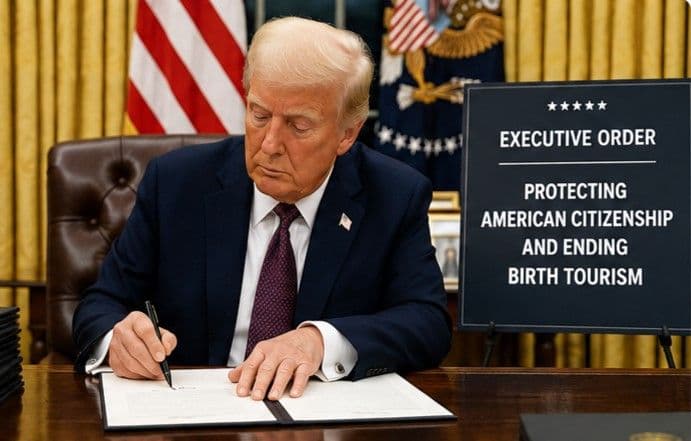
President Donald Trump has opened a new debate over Chinese automakers and the U.S. automobile market.
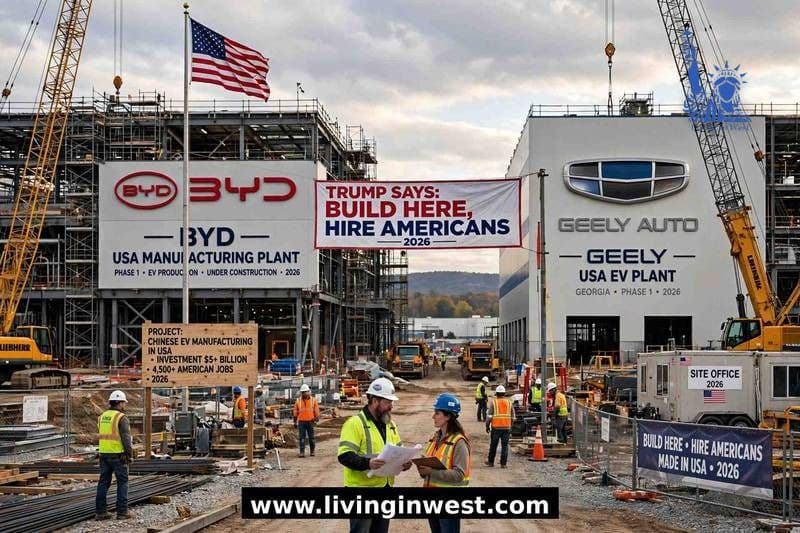
In an interview reported on September 12, 2026, Trump said he would be comfortable with Chinese companies coming to the United States, opening automobile factories and hiring American workers.
He compared the idea with Japanese automakers, which built large manufacturing operations in the United States and created American jobs.
Trump also made an important distinction.
He said he would not be comfortable with Chinese companies manufacturing vehicles in Mexico and then sending those vehicles into the United States.
In simple terms, Trump's position can be understood as:
Build in China → export to U.S. = major obstacle
Build in Mexico → export to U.S. = Trump opposes this model
Build in America → employ American workers = Trump says he is open to it
Reuters reported that Trump's comments come as U.S. lawmakers and the American auto industry are pushing for tougher restrictions on Chinese vehicles.
However, there is an important distinction.
Trump's comments are not themselves a new law allowing Chinese automakers to sell cars in America.
Existing tariffs and technology restrictions remain relevant.
Why Chinese Cars Face So Many U.S. Restrictions
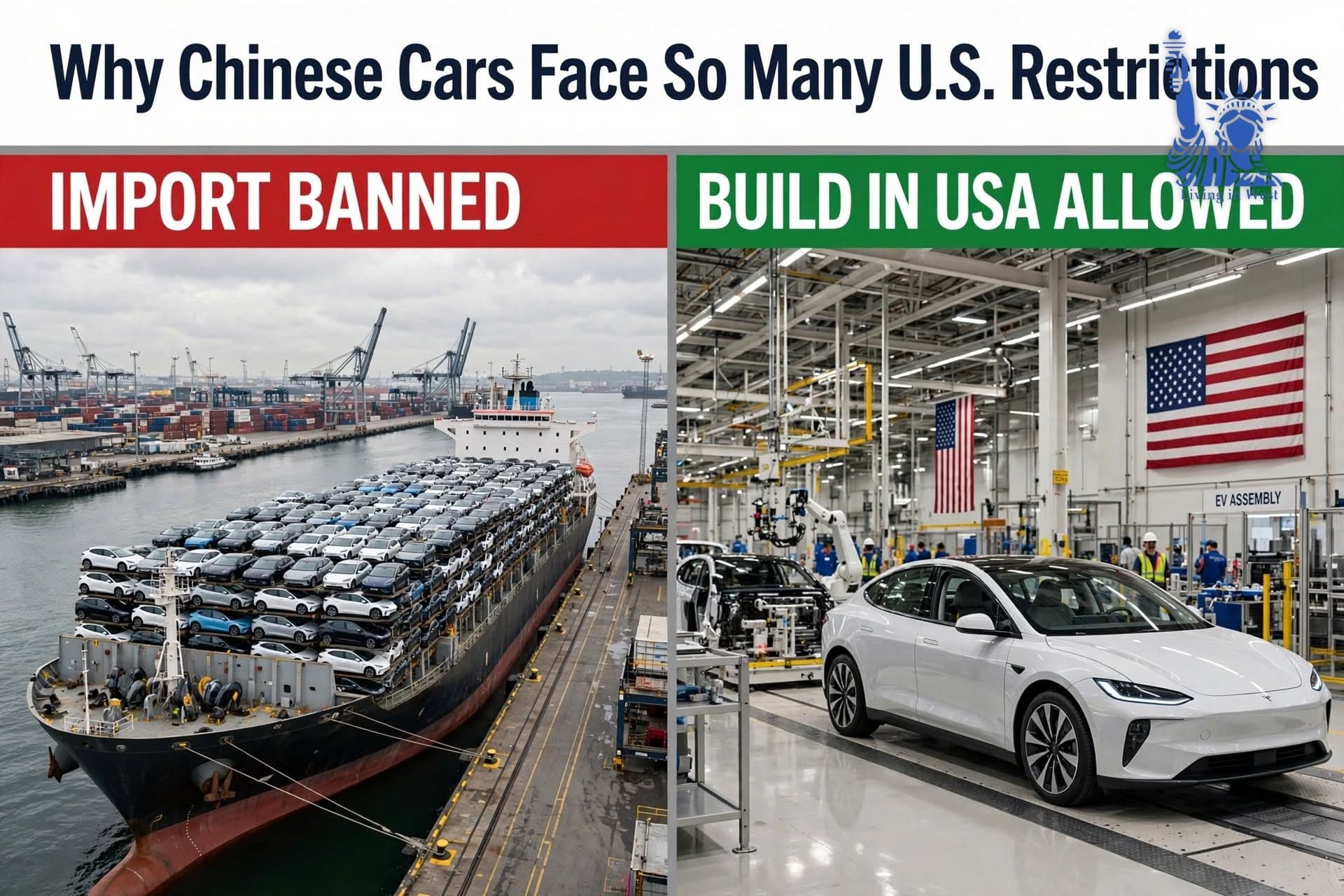
The United States has taken a much tougher position toward Chinese automobiles than many other major markets.
There are two major pieces of the story:
Trade tariffs
and
National-security and connected-vehicle restrictions.
The 100% Chinese EV Tariff
In 2024, the Biden administration increased the Section 301 tariff on Chinese electric vehicles to 100%.
The purpose was to make it much harder for China-made EVs to compete directly with American vehicles on price.
But this is only one layer of the U.S. trade system.
Trump's 25% Auto Tariff
Trump's own administration added another major barrier in 2025.
On March 26, 2025, Trump signed a proclamation imposing a 25% Section 232 tariff on imported automobiles, effective April 3, 2025.
The measure covers passenger vehicles such as:
- Sedans
- SUVs
- Crossovers
- Minivans
- Cargo vans
- Light trucks
It also covers certain automobile parts, including engines, transmissions, powertrain components and electrical components.
That tariff is important because it applies to imported automobiles generally, not just Chinese vehicles.
This makes Trump's "build in America" argument much clearer.
If an automaker manufactures the vehicle in the United States, it can avoid the 25% tariff that would otherwise apply to an imported vehicle.
However, American-built vehicles can still contain imported components, and separate rules can affect those parts.
The White House also created a temporary import-adjustment offset for certain U.S.-assembled vehicles to help manufacturers with parts-related Section 232 costs.
So Trump's auto strategy is not simply about China.
It is part of a broader policy designed to encourage automobile production inside the United States.
The Connected-Car Problem Is Even Bigger
Tariffs are not the only reason Chinese automakers have difficulty entering the U.S. market.
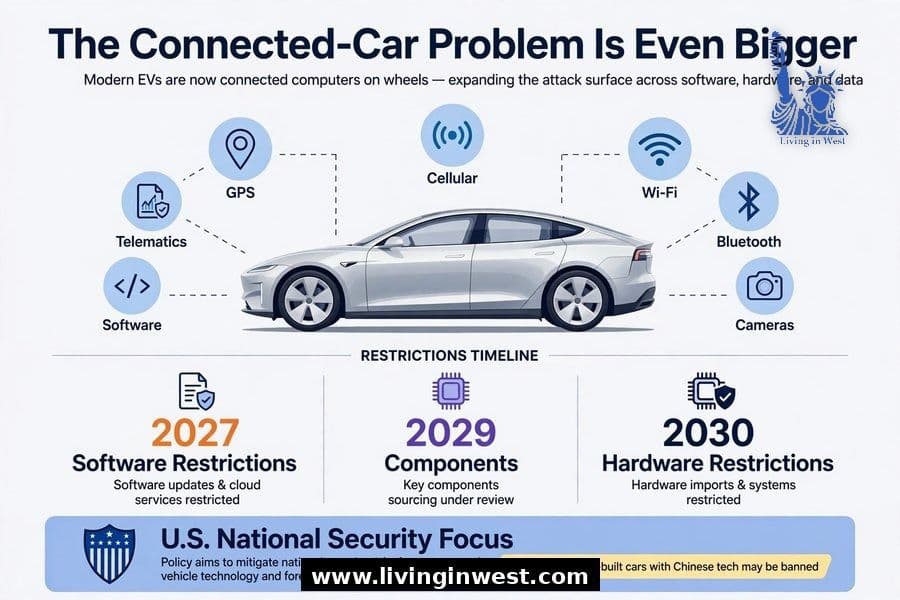
Modern vehicles are increasingly connected computers on wheels.
They can contain:
- GPS
- Cellular connections
- Wi-Fi
- Bluetooth
- Cameras
- Telematics
- Automated-driving systems
- Vehicle software
- Data collection systems
The U.S. government has therefore treated some foreign connected-vehicle technology as a national-security issue.
The Commerce Department's Bureau of Industry and Security finalized its connected-vehicle rule on January 14, 2025.
The rule restricts certain transactions involving connected-vehicle hardware and software with a sufficient connection to China or Russia.
What happens in Model Year 2027?
Starting with Model Year 2027, certain connected-vehicle software restrictions apply.
The rules also prohibit certain connected-vehicle manufacturers with a sufficient China or Russia nexus from selling covered new connected vehicles in the United States.
Importantly, this restriction can apply even when the vehicle itself is manufactured in the United States.
What happens in Model Year 2030?
Restrictions on covered Vehicle Connectivity System hardware take effect for Model Year 2030.
For components without a model year, the hardware restriction begins January 1, 2029.
This creates a major complication for any future Chinese automobile factory in America.
A Chinese company cannot simply say:
"We built the car in Michigan, so everything is now allowed."
The vehicle's technology, software, hardware and corporate structure could still determine whether it can legally be sold.
Which Chinese Automakers Could Be Interested?
Trump did not announce a specific Chinese company that will build cars in America.
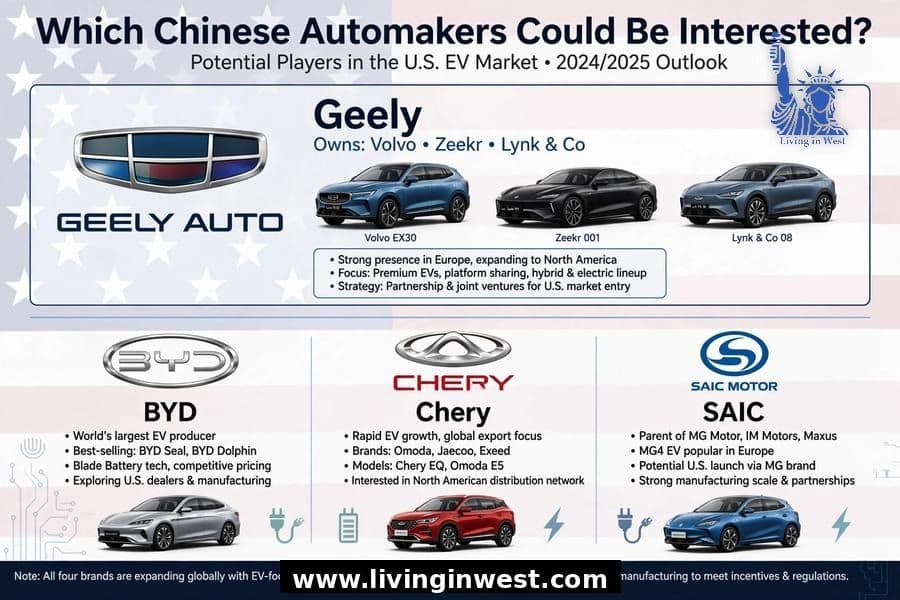
But several major companies are important to watch.
Geely
Geely is probably one of the most interesting names.
Geely Holding owns Volvo and controls brands including Zeekr and Lynk & Co.
The company already has a significant connection to the American market through its Volvo operations.
In January 2026, Geely's global communications chief Ash Sutcliffe said the company could announce a U.S. expansion within 24 to 36 months.
However, Volvo has not confirmed that its South Carolina factory will become a Geely-brand production site.
That distinction is important.
Geely is exploring the U.S. opportunity, but there is no confirmed Geely-branded passenger-car factory announcement in America yet.
BYD
BYD is another major Chinese automaker to watch.
The company has become one of the world's largest EV manufacturers and has expanded rapidly across international markets.
But there is currently no confirmed announcement that BYD is opening a U.S. passenger-vehicle factory as a result of Trump's latest comments.
BYD is also facing strong political resistance in Washington.
Major U.S. automakers and industry groups have urged Congress to create stronger restrictions against Chinese vehicle manufacturers.
Chery and SAIC
Chery and SAIC are also major Chinese automobile manufacturers with significant international ambitions.
Both companies demonstrate how aggressively China's automobile industry has expanded outside its home market.
But neither should currently be described as having a confirmed Trump-backed U.S. factory plan.
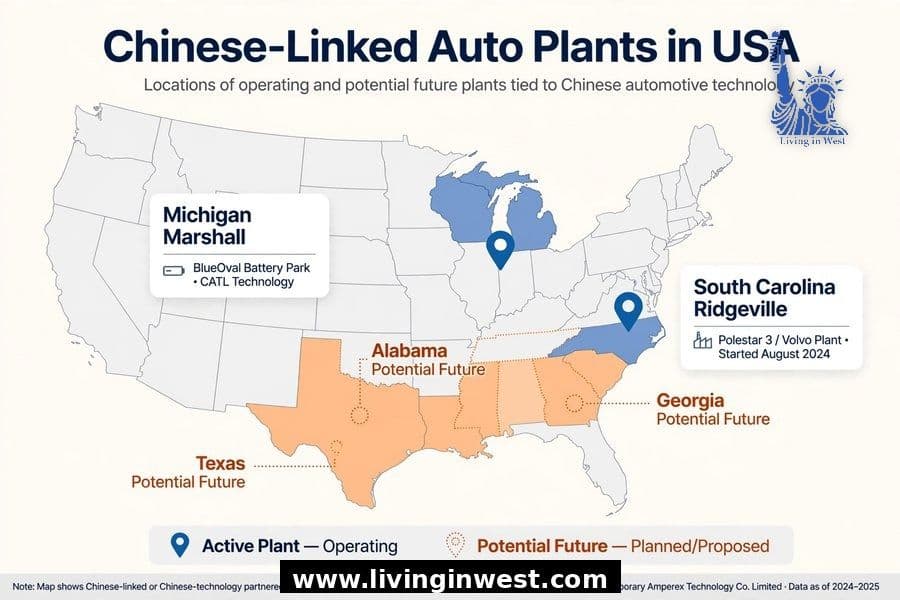
Chinese Cars Are Already Connected to U.S. Production in an Important Way
One of the strongest examples is Polestar 3.
Polestar is a Swedish-origin electric performance brand with strong ownership and corporate links to the Geely/Volvo ecosystem.
Production of the Polestar 3 began at the company's facility in Ridgeville, South Carolina, in August 2024.
Polestar itself announced that the South Carolina factory would produce vehicles for U.S. and European customers.
This is important because it shows that the broader China-linked automotive ecosystem is not completely separate from American manufacturing.
But Polestar 3 should not be described simply as a Chinese car.
Polestar is a Swedish-origin brand, and the South Carolina-built Polestar 3 is an American-produced vehicle.
The example is useful because it shows how complicated the modern automotive ownership and manufacturing structure has become.
A vehicle can involve:
A European-origin brand + Chinese ownership links + American manufacturing.
That is exactly the kind of model that could become more important if Chinese automakers expand further into the United States.
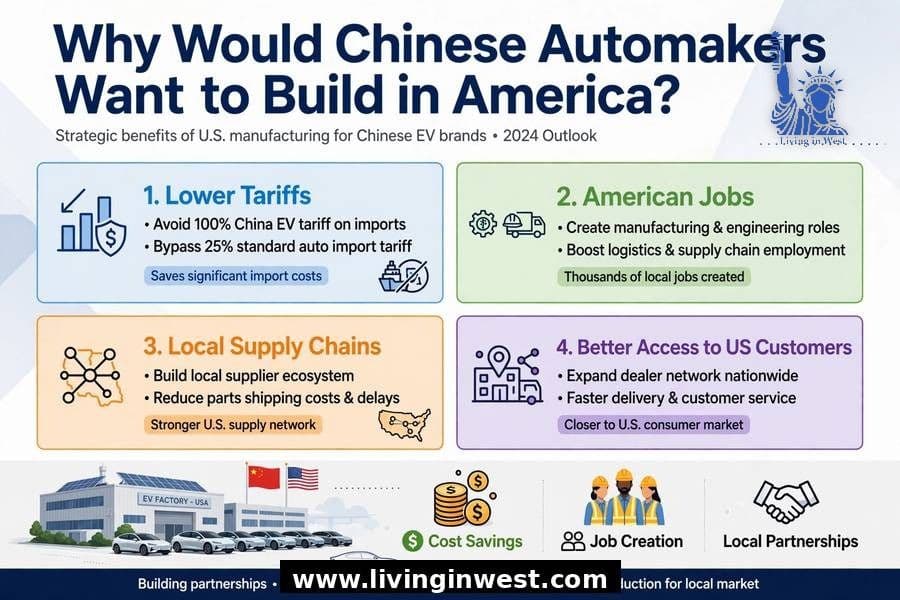
Why Would Chinese Automakers Want to Build in America?
For Chinese automakers, the U.S. market would be extremely valuable.
The United States is one of the world's largest automobile markets.
But directly exporting China-made vehicles into America is difficult because of tariffs and technology restrictions.
A U.S. manufacturing operation could potentially provide several advantages.
1. Lower Dependence on Vehicle Import Tariffs
A vehicle produced in America would not be treated in the same way as a China-made vehicle imported into the United States.
That could significantly change the economics of selling the car.
2. American Jobs
This is the part Trump has emphasized.
A large automobile factory can create jobs in:
- Manufacturing
- Engineering
- Logistics
- Maintenance
- Parts production
- Supplier companies
3. Local Supply Chains
A factory can encourage suppliers to establish operations nearby.
That can create an entire automotive ecosystem rather than just a single assembly plant.
4. Better Access to U.S. Customers
Manufacturing inside America also puts an automaker physically closer to its customers and dealers.
But there is another reason Chinese companies may eventually look harder at overseas markets.
China's domestic automobile market is extremely competitive, and Chinese manufacturers have been expanding internationally.
That makes major markets outside China increasingly important for long-term growth.
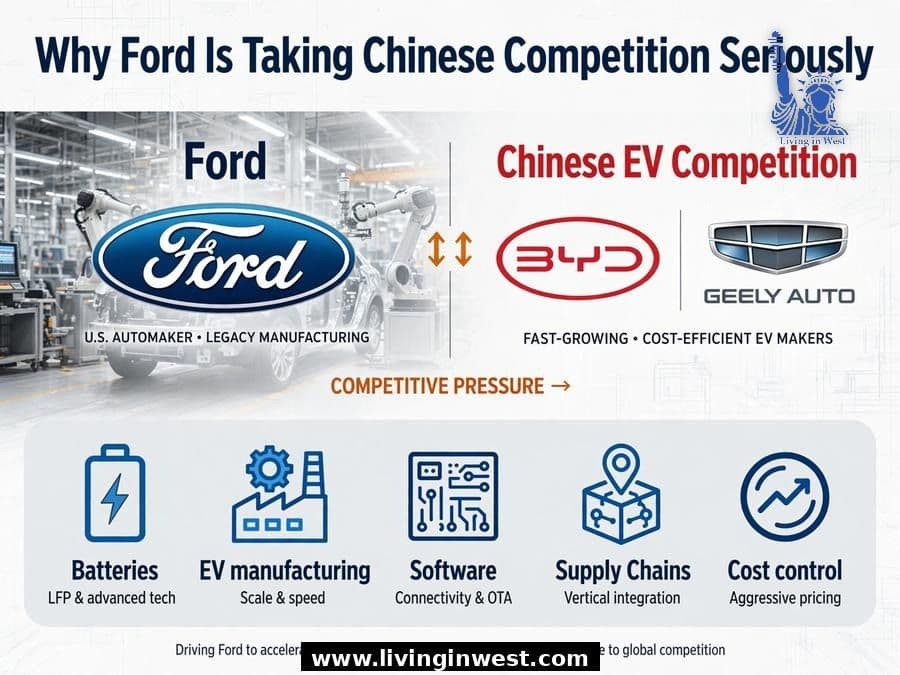
Part 7: Why Ford Is Taking the Chinese Competition Seriously
Ford CEO Jim Farley has repeatedly warned that Chinese automakers represent one of the biggest competitive challenges facing traditional Western automakers.
The concern goes beyond cheap EVs.
Chinese manufacturers have developed strong capabilities in:
- Batteries
- EV manufacturing
- Software
- Supply chains
- Vehicle development
- Production scale
- Cost control
That can create a powerful combination.
A Chinese company could potentially build a vehicle with competitive technology and lower manufacturing costs.
If that company then built the vehicle inside America, the traditional protection created by tariffs would become less effective.
Ford therefore faces a complicated situation.
It wants to protect American manufacturing from Chinese competition while also using technology and partnerships that can help it compete globally.
That contradiction became very visible in September 2026.
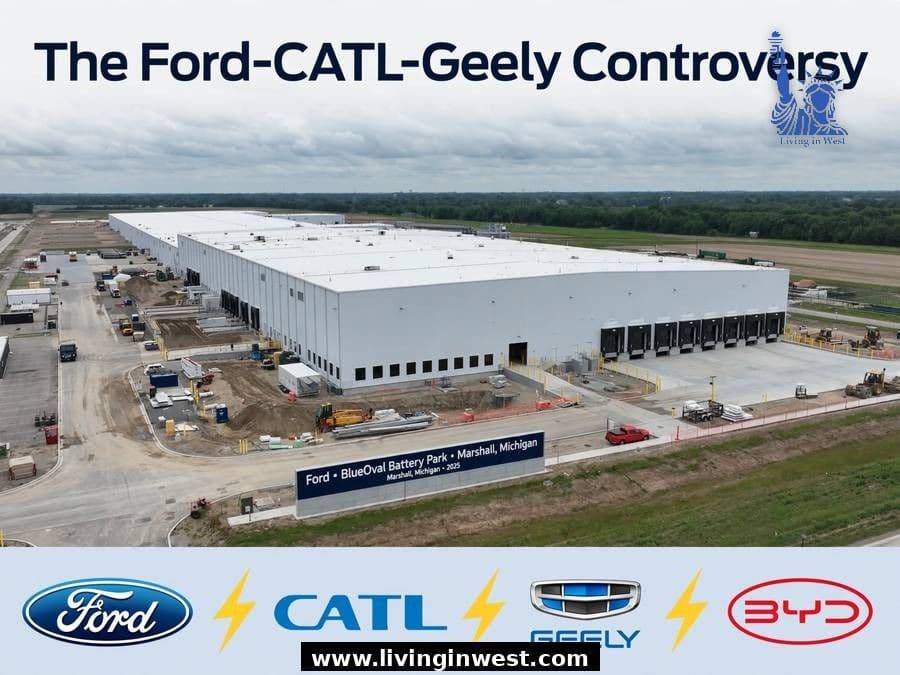
Part 8: The Ford-CATL-Geely Controversy
On September 8, 2026, Transportation Secretary Sean Duffy sharply criticized Ford's relationships with Chinese companies.
Duffy specifically raised concerns about Ford's use of licensed technology from Chinese battery manufacturer CATL at Ford's battery facility in Marshall, Michigan.
He also criticized Ford's relationships with Chinese automakers including Geely and BYD.
Ford pushed back.
The company said it owns its Michigan battery facility, controls the operation and employs the workforce.
Ford also argued that it is investing in U.S. manufacturing rather than simply importing Chinese batteries.
This controversy is highly relevant to Trump's latest comments.
Why?
Because it shows that the debate is not simply:
Chinese cars vs American cars.
It is increasingly:
How much Chinese technology and Chinese automotive cooperation should be allowed inside American manufacturing?
That question could become even more important if Chinese automakers begin proposing American factories.
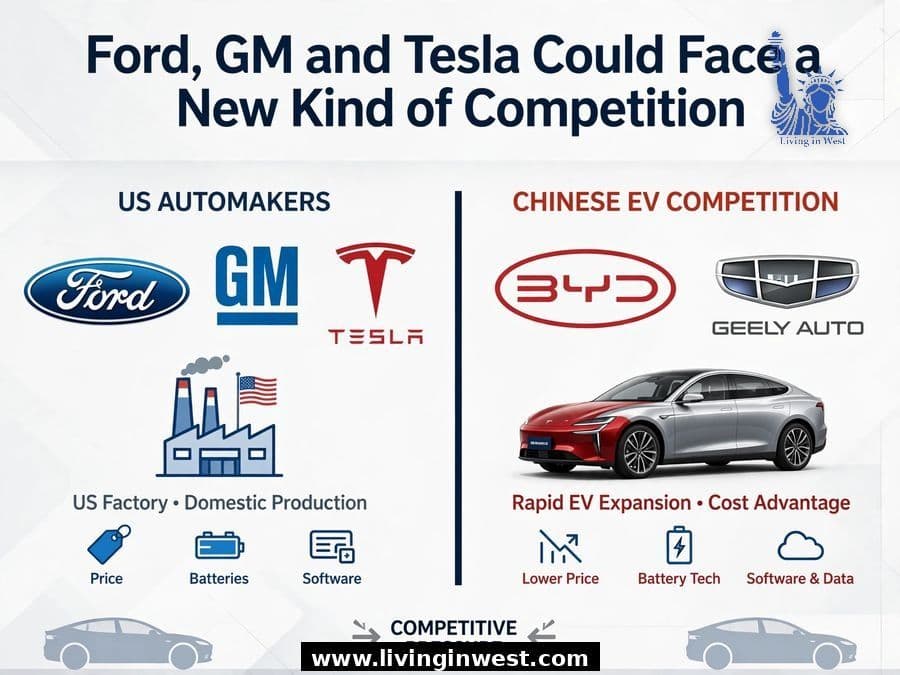
Part 9: Ford, GM and Tesla Could Face a New Kind of Competition
If Chinese automakers eventually build vehicles inside America, the competitive landscape could change significantly.
Ford
Ford would face pressure from Chinese manufacturers on price, batteries, software and production efficiency.
Jim Farley has already described China's automotive manufacturing capabilities as a major strategic threat.
The company would have to compete against Chinese technology while maintaining an American manufacturing base.
General Motors
GM could face similar pressure.
The company competes heavily in mainstream cars, SUVs, trucks and electric vehicles.
If a Chinese manufacturer could produce a competitively priced EV inside the United States, GM would have less protection from import tariffs.
The competition would move directly into the American manufacturing market.
Tesla
Tesla has an especially complicated relationship with China.
China is an important Tesla market and is also home to Tesla's Shanghai manufacturing operation.
At the same time, Chinese EV manufacturers have become some of Tesla's strongest competitors.
That means Tesla could face competition from Chinese technology both outside and inside the United States.
The issue is therefore bigger than one particular Chinese brand.
It is about how quickly Chinese companies can turn manufacturing scale and technology into global market share.
Part 10: South Carolina vs. Michigan — Which State Makes More Sense?
There is currently no confirmed decision that a future Chinese automaker factory will be located in either South Carolina or Michigan.
But both states have strong arguments.
South Carolina
South Carolina has an important advantage:
It already has Chinese-linked automotive manufacturing connections.
Volvo operates a major manufacturing facility in the state, and Volvo is owned by Geely Holding.
Polestar 3 is also produced in Ridgeville, South Carolina.
That gives the state an established automotive ecosystem and experience producing vehicles connected to the wider Geely/Volvo group.
South Carolina also offers:
- Port access
- Automotive suppliers
- Established manufacturing infrastructure
- A growing Southeast auto industry
- Existing Volvo production
For Geely-related expansion, that makes South Carolina particularly interesting.
But there is no confirmed announcement that Geely will use the Volvo facility to produce Geely-branded vehicles.
Michigan
Michigan has a completely different advantage.
It is the historic center of the American automobile industry.
The state has:
- Ford
- General Motors
- Stellantis
- Major automotive suppliers
- Engineering talent
- Skilled manufacturing workers
- Battery investments
- UAW workforce infrastructure
Ford's battery operation in Marshall also puts Michigan directly into the current China-technology debate.
That makes Michigan strategically important.
However, the same political concerns surrounding Chinese technology could make a Chinese automaker partnership in Michigan more difficult.
Part 11: Could a Chinese-American Joint Venture Happen?
A joint venture is one possible future business model, but there is currently no general Trump policy saying that Chinese automakers can simply create U.S. joint ventures.
Several structures are possible.
Model 1: Chinese Company Builds Its Own U.S. Factory
The Chinese company could invest directly in an American plant and hire U.S. workers.
Model 2: Chinese Technology + American Manufacturing
An American company could potentially use licensed Chinese technology while producing vehicles or components in America.
But Ford's CATL controversy shows how politically sensitive this model has become.
Model 3: Joint Venture
An American and Chinese company could potentially create a partnership if the structure satisfies U.S. law and national-security requirements.
Ford already has international experience working with Chinese companies.
However, that does not mean such a partnership would automatically be permitted for U.S. passenger vehicles.
Model 4: Existing U.S. Manufacturing Capacity
A Chinese-linked brand could potentially use an existing American automotive manufacturing ecosystem instead of starting completely from zero.
The Polestar 3 example shows that manufacturing arrangements involving internationally owned automotive groups can already operate in America.
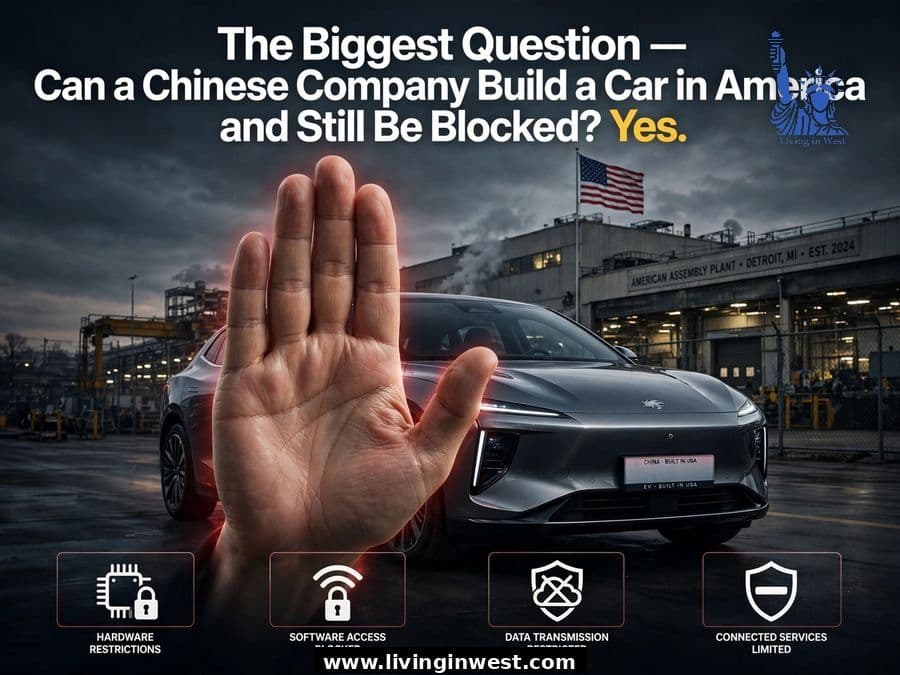
Part 12: The Biggest Question — Can a Chinese Company Build a Car in America and Still Be Blocked?
Yes.
This is one of the most important points in understanding the issue.
Building a vehicle in America does not automatically eliminate all U.S. restrictions.
The Commerce Department's connected-vehicle rule specifically states that certain Chinese- or Russian-linked manufacturers can face restrictions on selling covered connected vehicles in the United States even when those vehicles are manufactured in the United States.
That means a future Chinese automaker would need to satisfy much more than factory-location requirements.
The company could face scrutiny over:
- Ownership
- Control
- Software
- Connectivity hardware
- Automated-driving systems
- Data
- Supply chains
- National-security concerns
This is why Trump's statement should be understood as an opening of the political debate, rather than an automatic green light.
Part 13: What Would Chinese-Made-in-America Cars Mean for Consumers?
If Chinese automakers eventually receive permission to manufacture and sell vehicles in America, U.S. consumers could potentially benefit from greater competition.
Possible effects could include:
- More affordable EVs
- More vehicle choices
- Greater battery competition
- Faster EV innovation
- More pressure on American automakers to lower costs
- More competition in vehicle software
But there are also concerns.
Critics worry about:
- Vehicle data
- Cybersecurity
- Chinese government influence
- Dependence on Chinese technology
- Subsidized competition
- Supply-chain dependence
- National-security risks
So this is not simply a debate about whether Chinese cars are cheaper.
It is a debate over price, jobs, technology, national security and America's industrial strategy.
Part 14: What Happens Next?
Trump's latest comments could lead to more discussion between U.S. policymakers, automakers and foreign manufacturers.
But several things would need to happen before a Chinese-branded car could become a normal sight on American roads.
First, a company would need to decide that the U.S. market is worth the enormous investment required.
Second, the company would need a manufacturing and supply-chain strategy.
Third, its vehicles and technology would need to comply with U.S. rules.
Fourth, the company would face political scrutiny.
And finally, Congress could still change the rules.
This last point is important because U.S. lawmakers and the auto industry are currently pushing for stronger restrictions on Chinese vehicles. Reuters reported that major automakers are supporting legislation aimed at permanently restricting Chinese vehicle manufacturers from the U.S. market.
So there is a genuine policy tension:
Trump says Chinese companies could potentially build in America and create American jobs.
At the same time:
Other members of the administration, lawmakers and major U.S. automakers are pushing for stronger restrictions on Chinese automotive technology and companies.
Final Verdict: Will Chinese Cars Be Built in America?
Possibly — but it is far too early to say that a Chinese automaker is about to open a major U.S. passenger-car factory.
Trump has clearly signaled that he is more comfortable with Chinese companies building vehicles in America and employing American workers than with Chinese companies simply exporting vehicles into the United States.
But that position does not remove the existing tariffs, connected-vehicle rules or national-security restrictions.
The U.S. already has examples showing how complicated the situation can become.
Geely owns Volvo, Volvo produces vehicles in South Carolina, and Polestar 3 is manufactured in South Carolina. At the same time, Washington is increasing scrutiny of Chinese automotive technology and partnerships.
For now, South Carolina looks interesting because of its existing Volvo/Geely and Polestar manufacturing connections, while Michigan remains strategically important because it is the heart of the U.S. automotive industry.
But neither state has been officially selected for a new Chinese passenger-car factory.
The real story is bigger than one factory.
America is moving toward a new automotive question:
Should Chinese automakers be kept completely outside the U.S. market, or should they be allowed to compete — as long as they build in America and employ Americans?
Trump's latest comments suggest he is open to the second approach.
Whether U.S. regulators, Congress and the American auto industry ultimately accept it is the much bigger question.
FAQ
Can I buy a BYD car in the USA?
Chinese automaker BYD does not currently have a normal nationwide passenger-car sales operation in the United States. U.S. restrictions, tariffs and political opposition remain major barriers to a BYD passenger-vehicle launch.
What is the 100% tariff on Chinese EVs?
The U.S. increased the Section 301 tariff on Chinese electric vehicles to 100% in 2024. The tariff was designed to protect U.S. manufacturers from heavily subsidized Chinese EV competition.
What is Trump's 25% car tariff?
In March 2025, President Trump imposed a 25% Section 232 tariff on imported automobiles and certain automobile parts. The automobile tariff took effect on April 3, 2025.
Can a Chinese company build cars in America?
Trump has said he would be open to Chinese automakers building vehicles in the United States if they employ American workers. However, existing U.S. regulations and national-security restrictions would still apply.
Is Geely opening a factory in the USA?
There is no confirmed Geely-branded passenger-car factory announcement yet. In January 2026, Geely's global communications chief said the company could announce a U.S. expansion within 24 to 36 months.
Is Polestar 3 made in America?
Yes. Production of the Polestar 3 began at Polestar's facility in Ridgeville, South Carolina, in 2024. The vehicle is also produced in China.
What are the U.S. connected-car restrictions?
The Commerce Department's 2025 rule restricts certain connected-vehicle software and hardware with a sufficient connection to China or Russia. Software-related restrictions begin with Model Year 2027, while covered VCS hardware restrictions begin with Model Year 2030.
Could a Chinese company build a car in Michigan?
Potentially, but there is no confirmed Chinese passenger-car factory announcement for Michigan. Michigan has a major automotive workforce and supplier ecosystem, but Chinese technology and ownership are facing increasing scrutiny from U.S. officials.
Why is Ford worried about Chinese automakers?
Ford executives have warned that Chinese automakers have major advantages in areas such as batteries, manufacturing costs, supply chains and EV technology. Ford is also facing political scrutiny over its own relationships with Chinese companies.

Editorial Team