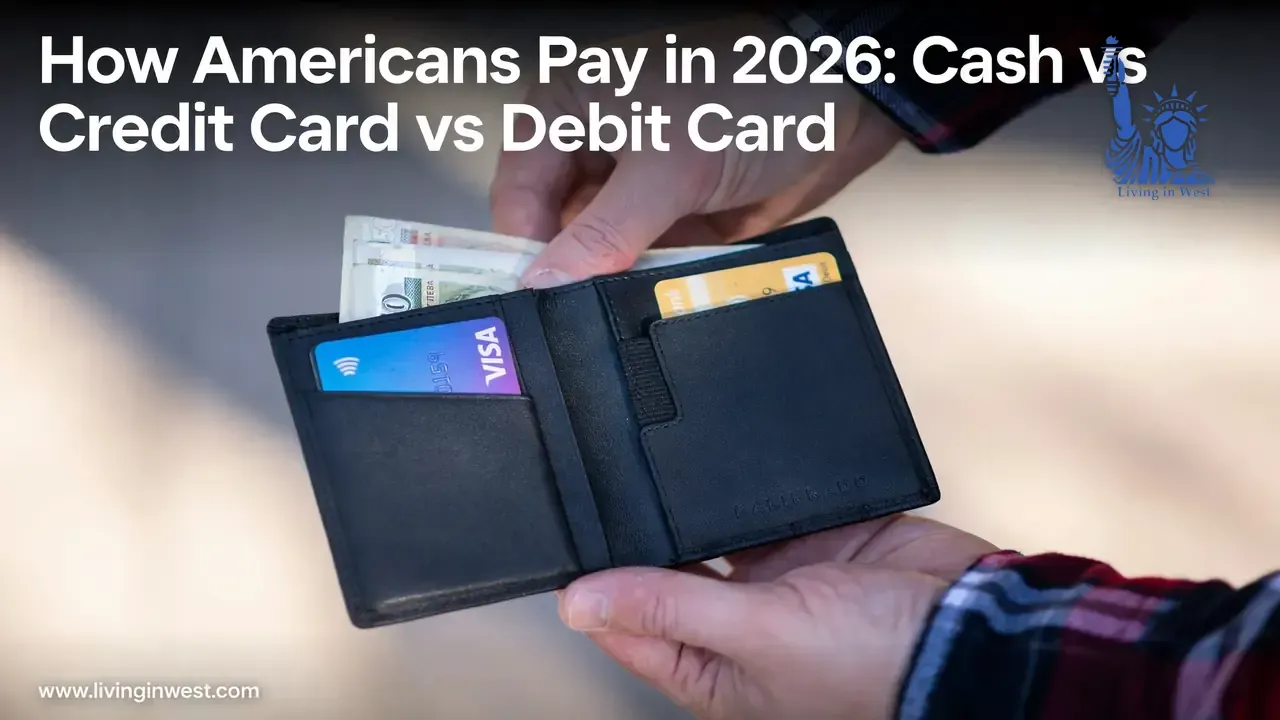
What Is the Most Used Payment Method in the USA?
For everyday consumer payments, cards are clearly the dominant payment category.
According to Federal Reserve consumer-payment research, in the latest Diary data:
- Credit cards: about 32% of consumer payments
- Debit cards: about 30%
- Cash: about 16%
Together, credit and debit cards account for roughly 62% of consumer payments in this measure.
That makes cards the leading way Americans pay for everyday purchases.
Payment MethodApprox. Share
Credit Card
32%
Debit Card
30%
Cash
16%
Other Methods
Remaining share
Credit Cards Are Gaining Ground
Credit cards are becoming increasingly important in the U.S. payment system.
The Federal Reserve's latest Payments Study found that credit card payments reached 67.1 billion transactions in 2024.
Credit card payments increased by 16.2 billion transactions between 2021 and 2024. During that period, credit card payments grew faster than debit card payments for the first time in a three-year period measured by the Federal Reserve since 2000.
That is an important change in America's payment habits.
Debit Cards Are Still a Major Payment Tool
Debit cards remain one of the most common ways Americans pay.
Unlike credit cards, debit cards generally take money directly from a customer's bank account. They are widely used for groceries, fuel, restaurants, shopping and everyday expenses.
For many consumers, debit cards provide the convenience of electronic payment without borrowing money.
Is Cash Disappearing?
No.
Cash use has fallen substantially, but Americans still use physical money.
Federal Reserve research shows that cash represented around 31% of consumer payments in 2016, compared with about 16% in 2023.
The decline has been significant, but the Federal Reserve says cash use appears to have reached a floor rather than continuing toward zero.
Cash also remains more important for certain groups, including some older and lower-income consumers.
What About Apple Pay and Other Digital Wallets?
Digital wallets are becoming increasingly common in America.
Consumers can use smartphones and other devices to make contactless payments or use payment accounts online.
Examples include services such as Apple Pay, Google Pay and PayPal.
However, digital wallets should not simply be added to credit-card and debit-card percentages.
For example, someone can use Apple Pay while the underlying payment is still made with a credit or debit card.
This means "digital wallet" and "card" are not always separate payment categories.
The 2026 Payment Picture
The U.S. payment system in 2026 can be summarized in three simple trends:
Cards remain dominant.
Credit and debit cards continue to account for a large share of everyday consumer payments.
Digital payments continue expanding.
Smartphones, contactless terminals and online payment systems have made electronic payments easier.
Cash remains relevant.
Cash has declined significantly but has not disappeared.
FAQ
What is the most popular payment method in the USA in 2026?
Cards are the dominant payment category for everyday consumer payments, with credit and debit cards together accounting for about 62% in the latest Federal Reserve Diary data.
Do Americans still use cash in 2026?
Yes. Cash remains an important payment method, although its share has declined substantially compared with 2016.
Are credit cards more popular than debit cards?
In the latest Federal Reserve Diary data, credit cards represented about 32% of consumer payments compared with about 30% for debit cards.
Is the USA becoming cashless?
The U.S. is becoming more digital, but the available Federal Reserve evidence does not suggest that cash is disappearing completely.
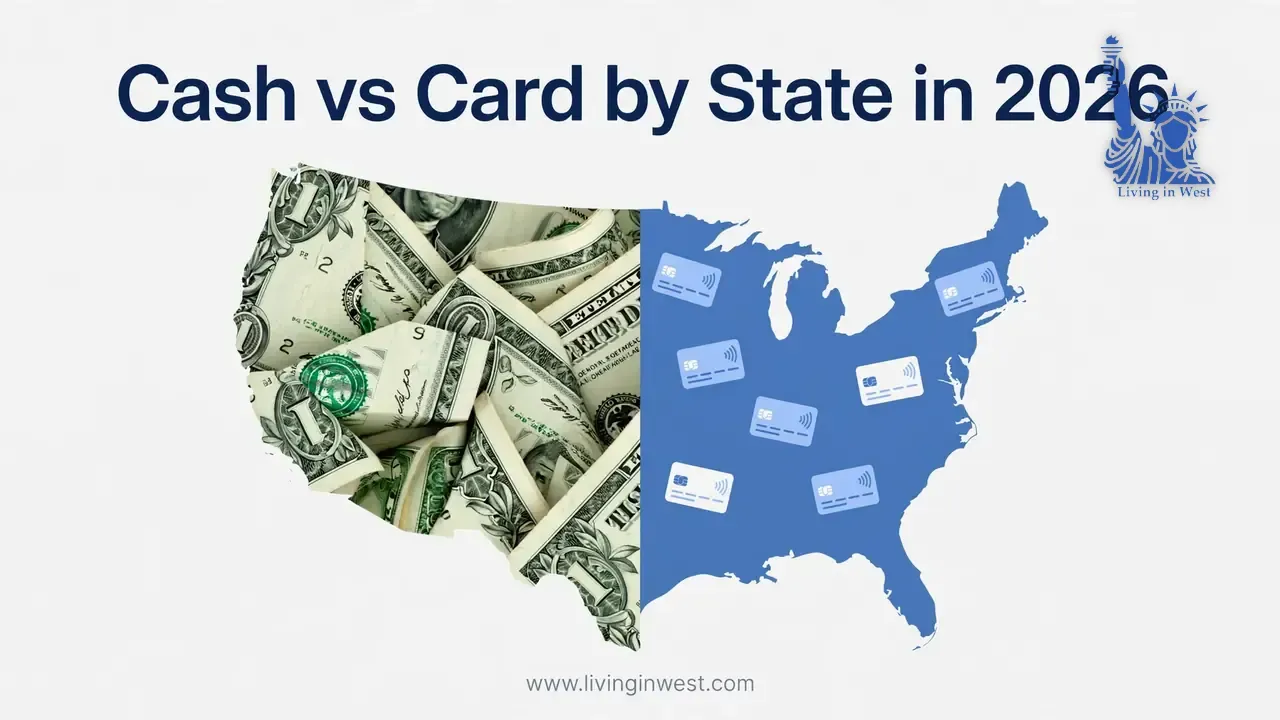
Cash vs Card by State in 2026: How Americans Pay Across the USA
Does someone in California pay differently from someone in Mississippi?
Payment habits can vary across America, but there is one important problem with many online payment maps: they present exact state-by-state percentages without a reliable nationwide source.
The Federal Reserve provides detailed national payment statistics, but it does not publish an official table showing that every state uses a specific percentage of cash, cards and digital wallets.
So rather than inventing exact numbers, it is more useful to look at the factors that influence payment behavior across the country.
Where Is Cash More Important?
Cash tends to be used more frequently by certain consumer groups.
Federal Reserve research shows that cash use is generally higher among older consumers and lower-income households.
This means cash can remain particularly important in communities where consumers have different income levels, age profiles or access to financial services.
Rural communities and small businesses may also continue to use cash for some transactions.
However, it would be incorrect to say that an entire state is a "cash state."
For example, not every person in Mississippi, Alabama, Arkansas or West Virginia uses cash more than people in California or New York.
Where Are Cards Dominant?
Cards are widely used throughout the United States.
Credit and debit cards are convenient for almost every major type of purchase, including:
- Grocery shopping
- Gas stations
- Restaurants
- Retail stores
- Travel
- Online shopping
- Subscription services
This means card payments are not limited to large cities or wealthy states.
They are part of everyday American commerce across the country.
What About California and New York?
Major technology and business centers have widespread access to smartphones, contactless payment terminals and online services.
Cities such as New York, San Francisco, Seattle and Boston have large numbers of consumers who regularly encounter digital and contactless payment options.
But that does not mean we can accurately claim that California has exactly 30% digital-wallet usage or that New York has a specific cash percentage without a state-specific study.
Those figures should not be presented as Federal Reserve statistics.
Why Payment Habits Differ
Several factors can influence how Americans pay.
FactorPossible Effect
Age
Older consumers may use cash more often
Income
Lower-income households may rely more on cash
Smartphone access
Can encourage digital payments
Contactless terminals
Make tap-to-pay easier
Online shopping
Increases electronic payments
Rural vs. urban location
Payment options and habits can differ
Business type
Some businesses may prefer particular payment methods
The Bigger Trend Is National
Even though payment habits can differ from one community to another, the overall national direction is clear.
Electronic payments continue to expand.
The Federal Reserve's latest Payments Study found that U.S. consumers, businesses and governments made 236.6 billion noncash payments in 2024.
Cards accounted for more than three-quarters of noncash payments by number.
That tells us something important about the American economy: electronic payments are now deeply integrated into everyday life.
Will Every State Become Cashless?
Probably not.
Some communities and consumers will continue to prefer cash.
Others will increasingly use cards, smartphones and electronic payment systems.
So the future is unlikely to be a simple choice between "cash states" and "digital states."
Instead, Americans will increasingly have multiple payment options available at the same time.
FAQ
Which U.S. state uses the most cash?
There is no current Federal Reserve nationwide ranking that provides an exact cash-use percentage for every state.
Which state uses the most digital payments?
There is no single official Federal Reserve state ranking for digital-wallet usage that can reliably answer this question.
Do people in rural America use more cash?
Cash can remain important in rural communities, but payment behavior depends on factors such as age, income, banking access and the types of businesses people use.
Is California mostly cashless?
No. California has extensive digital-payment infrastructure, but cash remains a valid and widely used payment method.
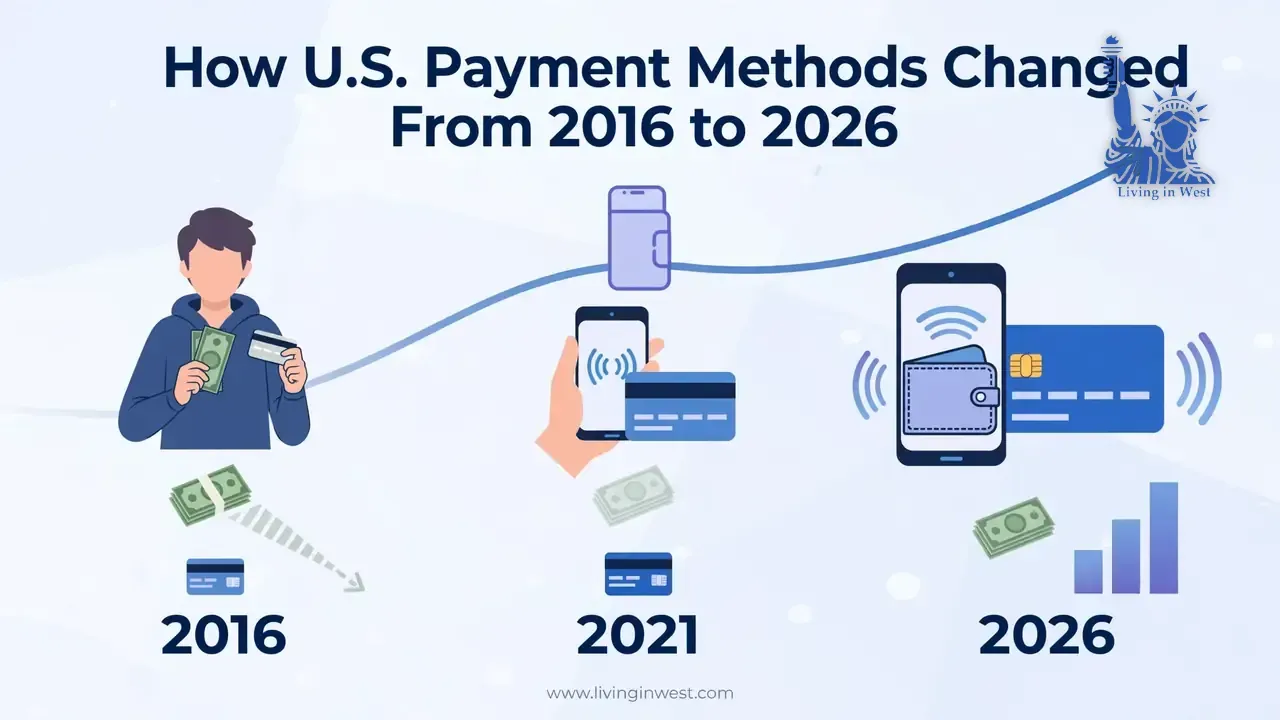
How U.S. Payment Methods Changed From 2016 to 2026
America's payment system has gone through a major transformation over the last decade.
In 2016, cash represented almost one-third of consumer payments.
Today, cards and electronic payments dominate everyday transactions, while cash has fallen to a much smaller share.
The change did not happen overnight. It accelerated as online shopping, smartphones, contactless payments and digital financial services became part of everyday life.
2016 vs. Today
One of the clearest examples is cash.
Federal Reserve research shows:
2016: Cash represented about 31% of consumer payments.
2023: Cash represented about 16%.
That is a decline of 15 percentage points, or roughly 48% relative to its 2016 share.
It is better to describe the change this way rather than saying cash declined "55%."
America's Payment Timeline
2016 — Cash Still Had a Major Role
Cash represented around 31% of consumer payments.
Cards were already widely used, but cash was still a much larger part of everyday spending than it is today.
2020 — COVID Changes Payment Habits
The COVID-19 pandemic accelerated online shopping and contactless payment adoption.
Consumers increasingly needed ways to pay without physically handling cash or interacting closely with checkout systems.
2021–2022 — Electronic Payments Keep Growing
Digital commerce and electronic payment services continued expanding.
Smartphones also made contactless payments easier for consumers.
2023 — Cash Falls to About 16%
Federal Reserve Diary data showed cash at approximately 16% of consumer payments.
The decline from 2016 was substantial, but cash did not disappear.
2024 — Noncash Payments Reach 236.6 Billion
The Federal Reserve's latest Payments Study found 236.6 billion noncash payments in the United States in 2024.
Card payments represented more than three-quarters of those noncash payments by number.
Credit card payments also showed particularly strong growth between 2021 and 2024.
What Does This Mean for the U.S. Government?
A more electronic payment system can provide advantages to the economy and government, but some claims about these benefits are often exaggerated.
1. Electronic Records Can Improve Transparency
Electronic transactions generally create financial records.
That can make some financial activity easier to document than transactions conducted entirely in cash.
The IRS also requires businesses to report certain large cash transactions.
For example, businesses generally must file Form 8300 when they receive more than $10,000 in cash in a single transaction or related transactions.
2. Digital Records Can Support Tax Compliance
Electronic records can help tax authorities identify certain forms of underreporting.
However, digital payments do not eliminate tax evasion.
The IRS estimated the U.S. gross tax gap at $696 billion for tax year 2022.
It is important to understand that this is the overall tax gap, not a "cash-only tax gap."
3. Less Physical Cash Handling
Electronic payments can reduce the need for businesses and consumers to physically handle, store and transport cash.
But that does not mean the Federal Reserve has eliminated the costs of maintaining America's currency system.
The U.S. still needs to produce, distribute and process physical currency because cash remains part of the economy.
4. Faster Commerce
Digital payments make it easier to:
- Buy products online
- Pay bills automatically
- Send money electronically
- Make contactless purchases
- Track transactions
- Run subscription services
This has helped electronic payments become a normal part of everyday American life.
Is There a Downside?
Yes.
A society that relies more heavily on electronic payments also creates concerns.
Privacy
Cash can provide a level of transaction privacy that electronic payments generally do not.
Access
Not every consumer has the same access to banking services, smartphones or digital payment technology.
Technology Dependence
Electronic payments can depend on networks, electricity, devices and financial institutions.
If systems go down, consumers may have difficulty paying.
That is one reason cash remains useful.
Will America Become Completely Cashless by 2026?
No evidence supports the idea that America will suddenly become a completely cashless country in 2026.
The long-term trend is clearly toward more electronic payments.
But cash has not disappeared.
The Federal Reserve's research indicates that cash use has fallen significantly and appears to have reached a relative floor.
The more realistic future is therefore not "cash disappears."
It is:
More cards + more digital payments + less cash, while cash remains available.
FAQ
How much has cash use declined in the USA?
Cash fell from about 31% of consumer payments in 2016 to about 16% in 2023, according to Federal Reserve research.
Are credit cards growing faster than debit cards?
Yes. Between 2021 and 2024, credit card payments grew faster than debit card payments in the Federal Reserve's Payments Study.
How many noncash payments were made in the U.S. in 2024?
The Federal Reserve estimated 236.6 billion noncash payments in 2024.
Does digital payment mean cash will disappear?
Not necessarily. Cash use has declined, but Federal Reserve research indicates that it has reached a relative floor rather than moving toward zero.
What is the future of payments in America?
The U.S. payment system is likely to become increasingly digital, with cards, mobile payments and electronic transfers continuing to grow while cash remains an important alternative.

Editorial Team