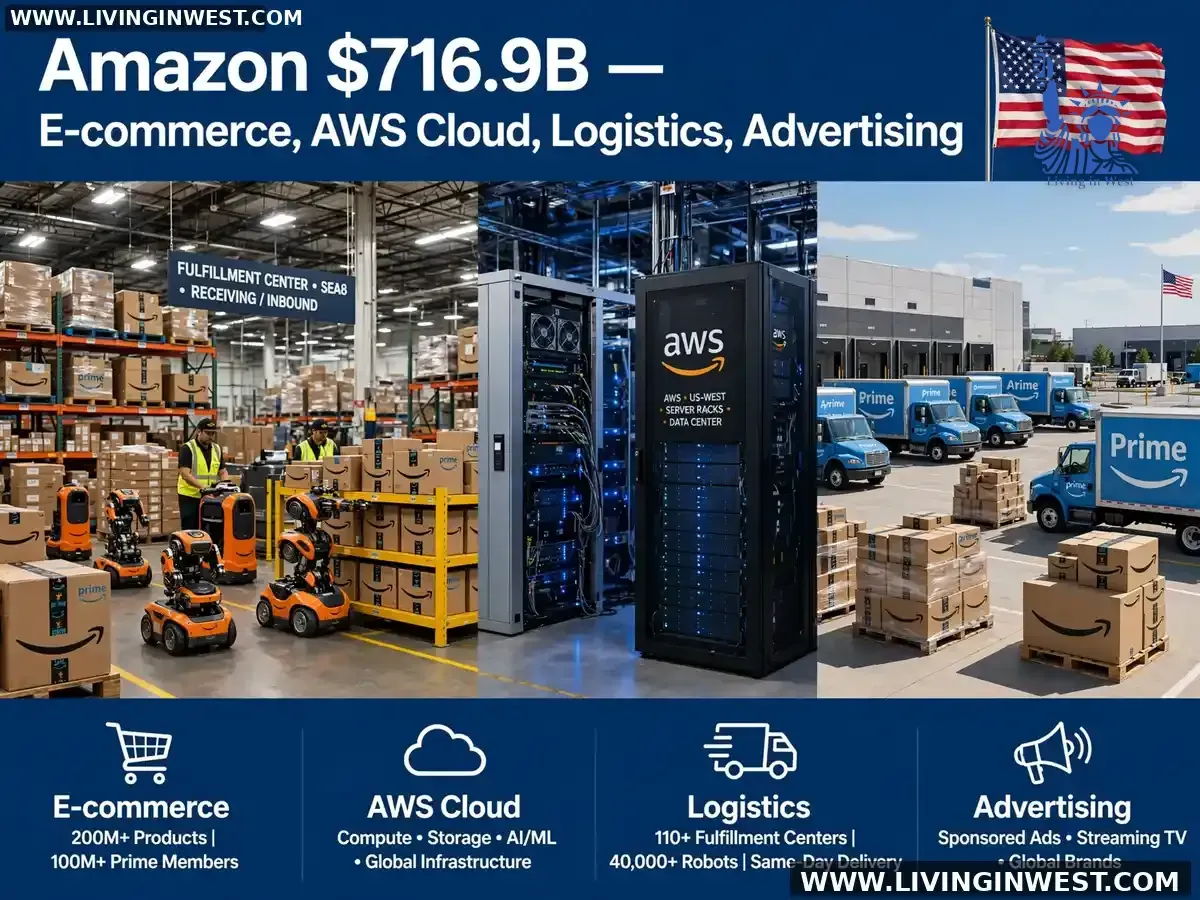
1. Amazon (AMZN) — $716.9 Billion Revenue
Stock: NASDAQ: AMZN
2025 Revenue: $716.9 billion
Market Cap: Approximately $2.8 trillion in early September 2026
Trailing P/E: About 20.5
Amazon's 2025 revenue reached $716.9 billion, up 12% from 2024. Its business is much bigger than online shopping.
Amazon now combines e-commerce, cloud computing, advertising, subscriptions, logistics and physical retail.
Why Is Amazon's Business So Large?
AWS Cloud Computing
Amazon Web Services is one of the company's most important profit engines.
In the second quarter of 2026, AWS revenue increased 37% year over year to $42.2 billion, its fastest growth in 18 quarters according to Amazon.
Amazon also said AWS had reached a $169 billion annualized revenue run rate.
AI is one of the major forces behind the increasing demand for cloud computing and infrastructure.
E-Commerce
Amazon remains one of America's largest online shopping platforms.
Its enormous fulfillment and delivery network allows customers to order everything from groceries and household products to electronics, clothing and business supplies.
Advertising
Amazon has also become a major digital advertising company.
Brands can pay to appear in Amazon search results and across its advertising ecosystem.
This creates another high-margin business alongside retail.
Logistics
Amazon has built a massive logistics network rather than depending entirely on traditional delivery companies.
In 2026, Amazon also expanded its logistics business by offering parts of its supply-chain network to other businesses through Amazon Supply Chain Services.
How Many States Does Amazon Operate In?
Amazon has a nationwide U.S. footprint.
Its operations include fulfillment centers, delivery stations, corporate offices, AWS infrastructure and other facilities across many states.
Amazon's current U.S. investment information lists investments and operations across all 50 states.
The company says its U.S. investments have supported approximately 2 million jobs, including about 1 million direct employees and another 1 million indirectly supported jobs.
These economic-impact figures are estimates prepared by Keystone Strategy using a methodology based on U.S. Bureau of Economic Analysis input-output methods, so they should be treated as company-reported economic estimates rather than government employment counts.
How Americans Benefit From Amazon
1. Jobs
Amazon provides jobs in logistics, warehouses, transportation, technology, cloud computing, customer service, engineering and corporate operations.
2. Small Business Opportunities
Amazon is also important for independent sellers.
Small businesses can use Amazon's marketplace and fulfillment infrastructure to reach customers across the United States.
Amazon says approximately 2 million people in the U.S. are employed by independent sellers to support their Amazon-related businesses.
3. Faster Delivery
Amazon's logistics network has changed consumer expectations around delivery speed.
Same-day and next-day delivery are now available for many products in many U.S. markets.
4. Cloud Technology
AWS provides computing infrastructure to startups, businesses, government organizations and technology companies.
That means Amazon's impact extends far beyond shopping.
2. Walmart (WMT) — $713.2 Billion Revenue
Stock: NASDAQ: WMT
Fiscal 2026 Revenue: $713.2 billion
Market Cap: Approximately $860 billion in September 2026
Trailing P/E: About 39×
Walmart generated $713.2 billion in total revenue during fiscal 2026.
The company operates Walmart U.S., Walmart International and Sam's Club U.S.
Walmart U.S. alone generated approximately $483 billion in net sales during fiscal 2026 and operated 4,611 stores across all 50 states, Washington, D.C., and Puerto Rico.
Why Is Walmart's Business So Large?
Grocery Is a Major Advantage
Food and household necessities are products people continue to purchase even when economic conditions become difficult.
This gives Walmart a defensive element that many discretionary retailers do not have.
Low-Price Strategy
Walmart's core strategy is built around everyday low prices.
Its enormous purchasing scale allows the company to negotiate with suppliers and operate one of the world's largest retail supply chains.
E-Commerce Is Growing
Walmart is no longer just a physical-store company.
During Q2 fiscal 2027, global e-commerce sales increased 23%, while Walmart U.S. e-commerce increased 24%.
Advertising Is Becoming Important
Walmart's advertising business is growing rapidly.
In Q2 fiscal 2027, Walmart reported global advertising growth of 38%, while Walmart Connect in the U.S. increased 43% excluding VIZIO.
This gives Walmart another important source of revenue beyond retail sales.
How Many States Does Walmart Operate In?
Walmart U.S. operates in all 50 states, Washington, D.C., and Puerto Rico.
It had 4,611 U.S. stores at the end of fiscal 2026.
Walmart also says it has approximately 1.6 million U.S. associates, making it the country's largest private employer.
Some private-employer rankings estimate Walmart is the largest private employer in roughly 22 states.
However, that should not be confused with being the largest employer overall in 22 states because state governments, public universities and other public institutions can employ more people.
How Americans Benefit From Walmart
1. Lower-Cost Shopping
Walmart's scale gives consumers access to groceries, household goods, clothing, electronics and other products through its low-price strategy.
2. Jobs
Walmart employs approximately 1.6 million people in the United States.
Those jobs range from store associates and truck drivers to pharmacists, managers, technology workers and corporate employees.
3. Small Business Opportunities
Walmart Marketplace allows third-party sellers to reach customers through Walmart's online platform.
That gives small businesses another major channel for selling products online.
4. Convenient Online Shopping
Walmart combines physical stores with pickup, delivery and online shopping.
Its store network also acts as part of its e-commerce infrastructure.

3. UnitedHealth Group (UNH) — $447.6 Billion Revenue
Stock: NYSE: UNH
2025 Revenue: $447.6 billion
Q2 2026 Revenue: $112.0 billion
Market Cap: Approximately $360 billion in September 2026
Trailing P/E: About 25.7
UnitedHealth Group is different from Amazon, Walmart and Apple because its business is primarily connected to healthcare and health services.
Its 2025 revenue reached $447.6 billion, up 12% year over year.
In Q2 2026, revenue reached $112.0 billion.
Why Is UnitedHealth's Business So Large?
Health Insurance
UnitedHealthcare provides health benefit programs for individuals, employers and people covered through Medicare and Medicaid.
Healthcare spending in the United States is enormous, which creates a huge market for insurance and healthcare services.
Optum
UnitedHealth Group also owns Optum, which operates across healthcare services, pharmacy services, technology and care delivery.
This gives the company exposure to multiple parts of the healthcare system instead of relying only on insurance premiums.
Large Healthcare Network
UnitedHealthcare says it contracts directly with more than 1.7 million physicians and care professionals and 7,000 hospitals and other care facilities nationwide.
Does UnitedHealthcare Operate Across the United States?
UnitedHealthcare has a nationwide healthcare presence, but the exact insurance products available to consumers vary by state and plan.
For example, individual and family Marketplace offerings are not necessarily identical in every state.
Therefore, it is more accurate to say that UnitedHealthcare has a nationwide provider and healthcare network, rather than claiming that every UnitedHealthcare insurance product is available in all 50 states.
How Americans Benefit From UnitedHealth Group
1. Health Coverage
UnitedHealthcare provides health insurance and benefit programs to individuals, employers and government-program beneficiaries.
2. Healthcare Access
Its large provider network gives members access to doctors, hospitals and other healthcare professionals.
3. Healthcare Jobs
The broader UnitedHealth ecosystem supports jobs across insurance, healthcare services, technology, pharmacy, administration and clinical operations.
4. Digital Healthcare
Technology is increasingly being used to help patients manage benefits, find providers, understand costs and navigate healthcare services.
UnitedHealth said in 2026 that it was applying modern technology to improve affordability and the healthcare experience.

4. Apple (AAPL) — About $416 Billion Fiscal 2025 Revenue
Stock: NASDAQ: AAPL
Fiscal 2025 Revenue: About $416 billion
Market Cap: Approximately $4.8 trillion in September 2026
Trailing P/E: About 37.7
Apple is one of the world's most valuable publicly traded companies.
Its fiscal 2025 revenue reached approximately $416 billion.
But Apple's latest results show that the company continued growing in 2026.
In fiscal Q3 2026, Apple reported $109.4 billion in quarterly revenue, up 16% year over year.
iPhone revenue reached $54.3 billion, Mac revenue reached $10.4 billion and Services revenue reached $30.7 billion during the quarter.
Why Is Apple's Business So Large?
iPhone
The iPhone remains Apple's most important hardware business.
The latest 2026 results showed iPhone revenue rising 22% year over year to $54.3 billion in the June quarter.
The growth was driven by the iPhone 17 family.
Services
Apple is no longer dependent only on selling devices.
Its Services business includes:
- App Store
- iCloud
- Apple Music
- Apple TV
- Apple Pay
- AppleCare
- Other digital services
Services revenue reached a record $30.7 billion in fiscal Q3 2026, up 12% year over year.
AI and Apple Intelligence
Artificial intelligence is becoming an increasingly important part of Apple's product strategy.
At WWDC26, Apple introduced its next-generation Siri AI and additional Apple Intelligence features.
The company is increasingly integrating AI into the iPhone, Mac and wider Apple ecosystem.
How Many States Does Apple Operate In?
Apple has a nationwide U.S. business through its retail stores, online store, services ecosystem, corporate operations and developer ecosystem.
It is headquartered in Cupertino, California.
Unlike Walmart, it is not useful to measure Apple's U.S. presence simply by counting physical stores.
A major part of Apple's economic footprint comes through:
- Software developers
- App Store businesses
- Retail
- Manufacturing and supply chains
- Corporate employment
- Technology services
- Independent app developers
Apple says its App Store ecosystem has supported developers earning more than $550 billion globally since 2008.
How Americans Benefit From Apple
1. Technology
Americans use Apple's devices for communication, education, entertainment, business and productivity.
2. Jobs
Apple directly employs workers in engineering, retail, software, customer support, operations and corporate functions.
3. App Economy
Millions of developers and businesses use Apple's platforms to distribute applications and digital products.
4. U.S. Innovation
Apple's hardware and software ecosystem supports demand for engineers, developers, designers, semiconductor technology, cloud infrastructure and other parts of the technology economy.

What Do These Four Companies Mean for the U.S. Economy?
These companies affect the American economy in very different ways.
Amazon
Amazon connects consumers, small businesses, logistics companies, cloud customers and advertisers.
Its U.S. investments and employment have a major economic footprint. Amazon estimates that its investments since 2010 have contributed more than $1.8 trillion to the U.S. economy and supported approximately 2 million U.S. jobs. These are company-reported estimates prepared by Keystone Strategy.
Walmart
Walmart has one of the largest retail employment footprints in America.
Its stores, distribution network and suppliers move enormous quantities of goods through the U.S. economy.
Its low-price model also affects how consumers spend their household budgets.
UnitedHealth Group
UnitedHealth operates inside one of America's largest economic sectors: healthcare.
Its insurance and healthcare-services businesses connect employers, patients, doctors, hospitals, pharmacies and government healthcare programs.
Apple
Apple contributes through technology, consumer spending, software development, retail, services and its global supply chain.
Its ecosystem also creates opportunities for independent developers and businesses.
How Can an American Citizen Benefit From These Companies?
1. Get a Job
Americans can find opportunities ranging from entry-level positions to highly specialized careers.
Amazon offers roles in logistics, technology, cloud computing and corporate operations.
Walmart employs workers in stores, distribution, pharmacy, technology and management.
UnitedHealth offers opportunities across healthcare, insurance, technology and administration.
Apple hires across retail, engineering, software, operations and corporate functions.
2. Start a Small Business
Amazon and Walmart both provide marketplaces where businesses can sell products online.
This can allow a small business to reach customers far beyond its local city.
Technology companies can also build applications and services around Apple's ecosystem.
3. Invest Through the Stock Market
Americans can buy shares of publicly traded companies such as:
AMZN — Amazon
WMT — Walmart
UNH — UnitedHealth Group
AAPL — Apple
Investors may also have exposure to these companies through broad-market index funds, 401(k) plans or IRAs.
However, owning an individual stock carries risk.
A low P/E ratio does not automatically mean a stock is cheap or guaranteed to rise.
Amazon's current trailing P/E is around 20.5, while Walmart is around 39 and Apple around 37.7, but these companies have very different business models, growth rates, margins and risks.
This article is for general information and is not individual investment advice.
4. Get Better Products and Services
Consumers benefit from competition between these companies.
Amazon competes on selection, convenience and delivery.
Walmart competes heavily on price and convenience.
UnitedHealth provides insurance and healthcare services.
Apple competes through hardware, software and services.
The result is a huge range of products and services available to American consumers.
Which Company Has the Biggest Economic Impact?
There is no single answer because the companies operate in completely different industries.
Amazon: strongest combination of e-commerce, cloud computing, logistics and small-business infrastructure.
Walmart: enormous retail footprint and one of the largest private-sector workforces in America.
UnitedHealth Group: major presence in insurance and healthcare services.
Apple: massive consumer technology ecosystem with hardware, software and services.
Their revenue numbers should also not be interpreted as profit.
A company can generate hundreds of billions of dollars in revenue while having a much smaller amount of actual profit.
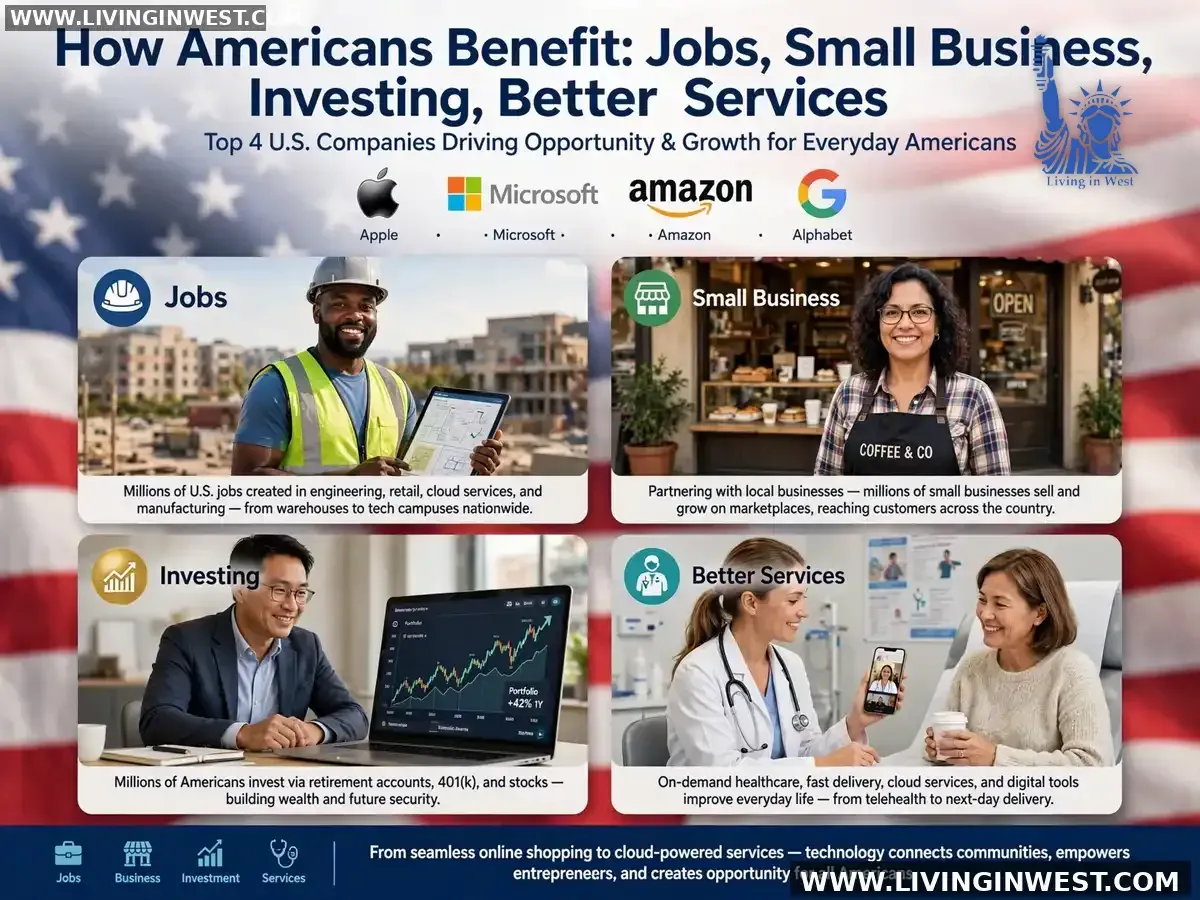
Final Verdict
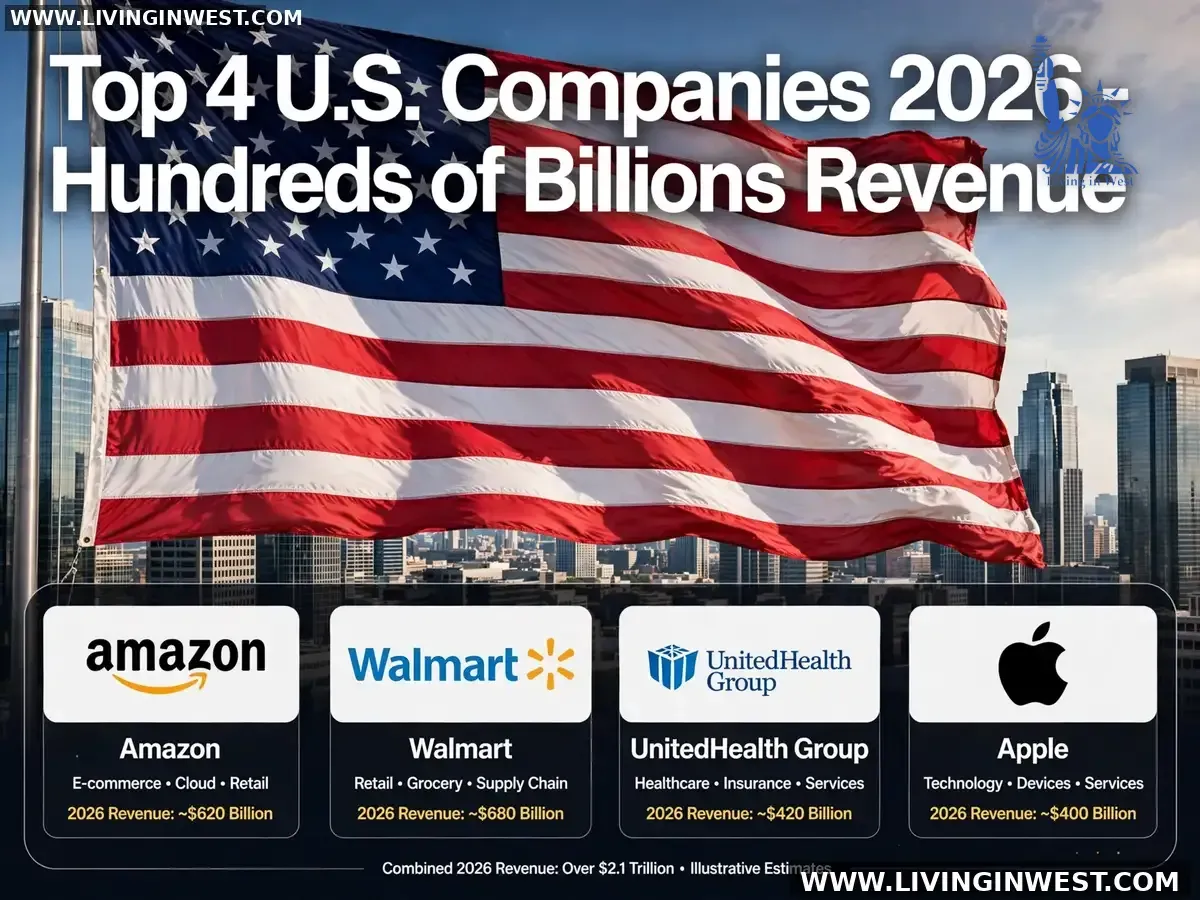
Amazon, Walmart, UnitedHealth Group and Apple show four different sides of the American economy.
Amazon represents the combination of e-commerce, cloud computing, AI infrastructure, logistics and digital advertising.
Walmart represents low-cost retail, groceries, physical stores, e-commerce and one of America's largest private workforces.
UnitedHealth represents health insurance, healthcare services and the enormous U.S. healthcare economy.
Apple represents consumer technology, smartphones, software, digital services and the growing AI-powered device ecosystem.
For Americans, these companies are not just Wall Street tickers.
They can influence where people work, what they buy, how businesses sell products, how healthcare is delivered and how technology is used every day.
And that is why their hundreds of billions of dollars in annual revenue matter far beyond the stock market.

Editorial Team