1: How Much Does It Cost to Live in Boston in 2026?
Boston is known for its universities, hospitals, professional opportunities, and historic neighborhoods. However, living in the city comes with a significant financial commitment, particularly for people who want to rent their own apartment.
In 2026, Boston's rental market is showing some signs of change. Apartment prices remain high, but renters have started seeing more competitive listings, slower monthly rent growth, and promotional offers from some property managers.
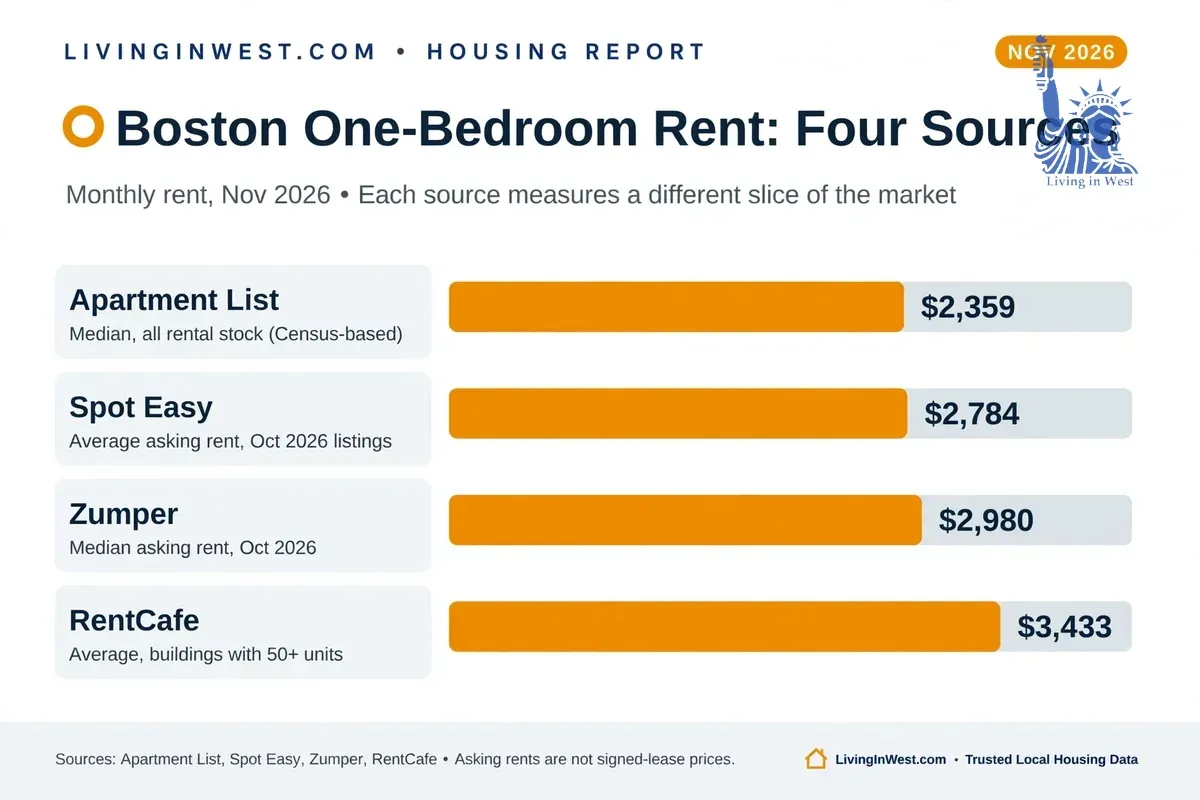
According to Apartment List's November 2026 Rent Report, Boston's median rent across all apartment sizes is $2,453 per month. The one-bedroom median is $2,359, while the two-bedroom median is $2,484.
However, these figures should not be confused with the prices a new renter will necessarily encounter when searching for an apartment.
Apartment List starts with Census Bureau rental statistics and updates them using its own rental listing growth data. This methodology is designed to represent the broader rental stock, rather than only apartments currently advertised to new tenants.
Active rental listings provide another perspective.
Spot Easy's October 2026 Rent Index reports an average asking rent of $2,784 for a one-bedroom apartment within Boston city limits. Its Greater Boston average, which includes surrounding cities, is $2,724.
RentCafe reports an average one-bedroom rent of $3,433, using data from larger apartment communities.
These figures measure different parts of the rental market, so prospective tenants should consider all three when planning their housing budget.
Boston monthly budget for one person
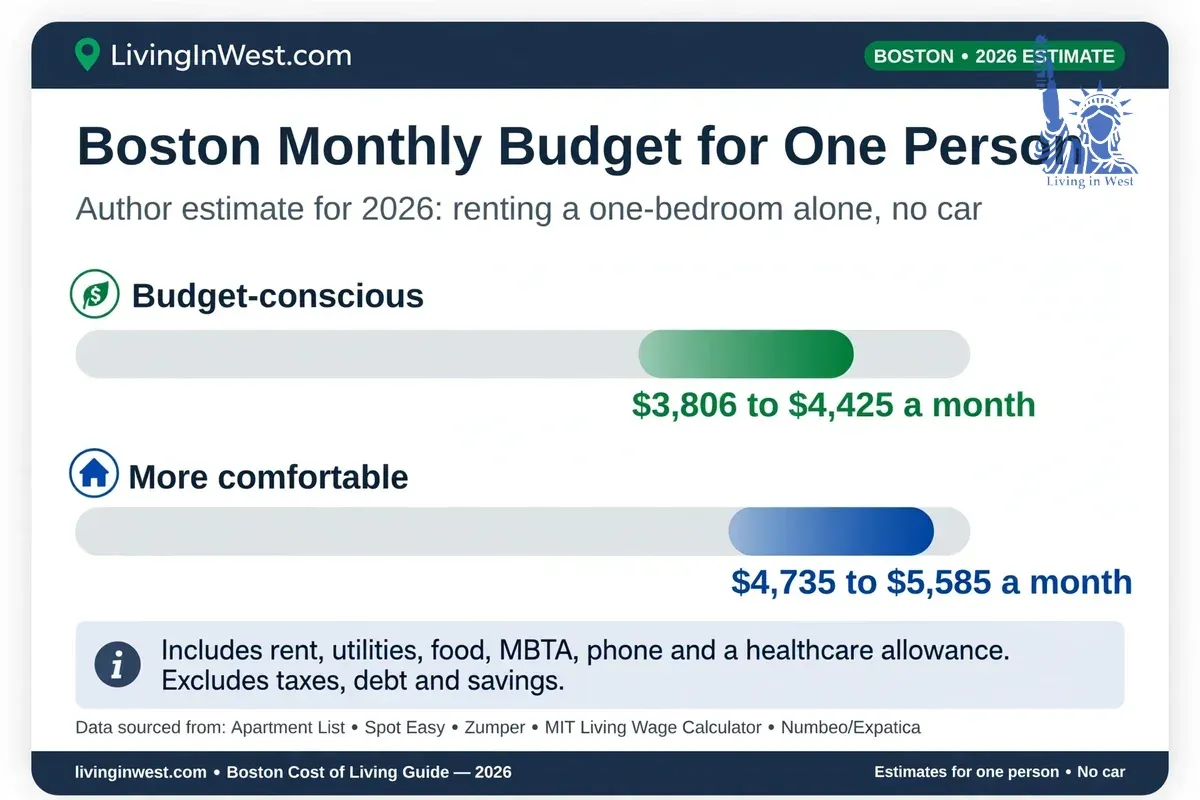
Here is a practical monthly budget for someone living alone without owning a car.
| Monthly Expense | Budget-Conscious | More Comfortable |
|---|---|---|
| One-bedroom rent | $2,550-$2,784 | $3,200-$3,433 |
| Utilities and internet | $350-$420 | $350-$420 |
| Groceries and food | $400-$550 | $650-$850 |
| Transportation | $90-$120 | $120-$180 |
| Mobile phone | $50-$70 | $60-$80 |
| Healthcare allowance | $355 | $355 |
| **Estimated monthly total** | **$3,795-$4,299** | **$4,735-$5,318** |
These are author-created planning estimates, not official average household expenditure figures. The healthcare allowance uses MIT's estimated medical expenses for one adult in Suffolk County, divided by 12. It is not a quoted insurance premium.
The estimates exclude income taxes, debt payments, childcare, major emergencies, and savings goals.
For someone renting alone, housing will generally be the largest monthly expense. Sharing an apartment, choosing a less expensive neighborhood, or finding a rental concession can make a meaningful difference.
Is Boston's rental market becoming more renter-friendly?
There are signs that renters have gained some negotiating power in 2026.
A local Boston rental-market analysis published by BMN Boston on August 17, 2026, reported that approximately 30% of Boston-area listings offered concessions during spring 2026.
The analysis cited two separate figures:
- Zillow: 29.5% of listings offering concessions.
- Banker & Tradesman: 31.1%.
Concessions can include a free month of rent, waived fees, or other promotional offers.
This is not a November citywide concession rate, and it should not be confused with Apartment List's separate concession dataset.
Nevertheless, it indicates that some renters had more opportunities to negotiate during spring 2026.
A renter should always calculate the effective rent after promotional discounts and check whether the offer applies throughout the lease or only during selected months.
Sources:
2: Boston Rent Prices and the Most Affordable Neighborhoods
Rent is usually the biggest financial challenge for people moving to Boston.
A single renter looking for a private apartment needs to understand that rental prices differ significantly between neighborhoods, building types, and apartment sizes.
What does a one-bedroom apartment cost?
The following figures come from three different rental-market sources.
| Source | One-Bedroom Rent | Measurement |
|---|---|---|
| Apartment List | $2,359 | Median rental-stock estimate |
| Spot Easy | $2,784 | Boston average asking rent |
| RentCafe | $3,433 | Average in larger apartment buildings |
RentCafe's figures were last updated October 30, 2026.
Its analysis uses Yardi Matrix data covering apartment communities with at least 50 units. This matters because Boston has many smaller buildings, including triple-deckers, brownstones, and individually rented apartments.
Spot Easy, meanwhile, uses active listings from verified, licensed agents. Its October report provides a useful view of the prices renters may encounter when searching for an apartment.
The different results are not necessarily contradictory. They reflect different property samples and rental-market methodologies.
Boston apartment rent by size
RentCafe's October 30, 2026 report gives the following average rental prices:
| Apartment Type | Average Monthly Rent |
|---|---|
| Studio | $2,926 |
| One-bedroom | $3,433 |
| Two-bedroom | $4,384 |
| Three-bedroom | $5,121 |
These are averages, not guaranteed prices for available apartments.
Source: RentCafe – Boston Rental Market Trends.
Which Boston neighborhoods are more affordable?
Boston has several neighborhoods where renters may find lower prices than in central areas.
According to RentCafe's late-October 2026 neighborhood data, three of the more affordable neighborhoods by average rent across apartment sizes are:
| Neighborhood | Average Monthly Rent |
|---|---|
| Mattapan | $2,439 |
| West Roxbury | $2,676 |
| Dorchester | $2,768 |
| Roslindale | $2,884 |
| Jamaica Plain | $3,130 |
| East Boston | $3,285 |
| Allston-Brighton | $3,306 |
| Fenway-Kenmore | $4,076 |
| Back Bay | $4,739 |
These figures represent average rents across different apartment sizes, not one-bedroom-specific prices. RentCafe's large-building coverage also means smaller properties may not be fully represented.
For a closer look at one-bedroom apartments, Spot Easy's October 2026 active-listing data provides another useful comparison:
| Neighborhood | Average One-Bedroom Asking Rent |
|---|---|
| Dorchester | $2,370 |
| Brighton | $2,403 |
| Allston | $2,407 |
| East Boston | $2,478 |
| Beacon Hill | $2,962 |
| Back Bay | $3,404 |
| South End | $3,375 |
These figures are based on verified agent listings. Neighborhoods with fewer than 20 active listings are not given a published figure.
Source: Spot Easy – October 2026 Rent Index.
Where should someone look for an affordable apartment?
Mattapan: One of the lower-priced neighborhoods in RentCafe's comparison. It is worth considering for people who want to reduce housing costs.
West Roxbury: A residential area that may appeal to renters looking for a quieter environment.
Dorchester: Offers different housing styles and a range of rental prices. Its public transportation connections vary by location.
Brighton: Popular among students and young professionals, with Green Line access in several parts of the neighborhood.
Allston: Known for student housing, restaurants, and shared apartments.
East Boston: Offers Blue Line access and convenient connections to Logan International Airport.
Back Bay: A central location with shopping, restaurants, and professional offices, but generally a more expensive rental market.
Why do so many Boston apartments have September 1 leases?
Boston has a particularly concentrated moving cycle.
According to Boston.com's August 29, 2025 moving guide, approximately two-thirds of the city's 165,000-plus apartment leases turn over on September 1.
The Boston Globe also reported that the City of Boston estimates roughly 70% of leases turn over on that date.
The city's large student population and academic calendar help explain this unusual rental pattern.
For people moving to Boston, this can mean:
- Higher competition for apartments around September 1.
- Greater demand for moving trucks.
- Busy streets and crowded residential neighborhoods.
- Pressure to secure housing well in advance.
If someone has flexible moving dates, searching during a quieter rental period may provide more opportunities to negotiate.
Sources:
- Boston.com – September 1 Boston Moving Guide
- The Boston Globe – When Is the Best Time to Sign a Lease?
Massachusetts broker-fee rules renters should know
Massachusetts changed its residential rental broker-fee rules on August 1, 2025.
Under the new law, the person who hires the broker must pay the broker's fee.
For example, if a landlord hires an agent to advertise and rent an apartment, the landlord is responsible for paying that agent. A renter can still pay a fee if they independently hire a broker to represent them.
However, renters should remain careful when reviewing listings.
NBC Boston reported in 2026 that renters were still encountering broker-fee demands despite the legal change.
Before paying a fee, ask who hired the broker and request written clarification. If you believe you have been charged unlawfully, contact the Massachusetts Attorney General's Office.
Official source: Massachusetts Government – Residential Rental Broker Fee Rules
3: Groceries, Restaurants, Utilities, and Healthcare
Rent is not the only expense that makes Boston expensive.
Food, electricity, heating, internet, mobile service, and healthcare can add hundreds of dollars to a monthly budget.
How much do groceries cost in Boston?
The USDA's September 2026 Food Plans provide a national benchmark for grocery spending.
For adults aged 20–50, the Moderate-Cost Plan estimates:
- Women: $336.40 per month.
- Men: $398.40 per month.
These are national food-at-home estimates rather than Boston-specific spending figures.
For a single Boston resident, a practical grocery allowance of $400–$550 per month provides a more flexible starting point.
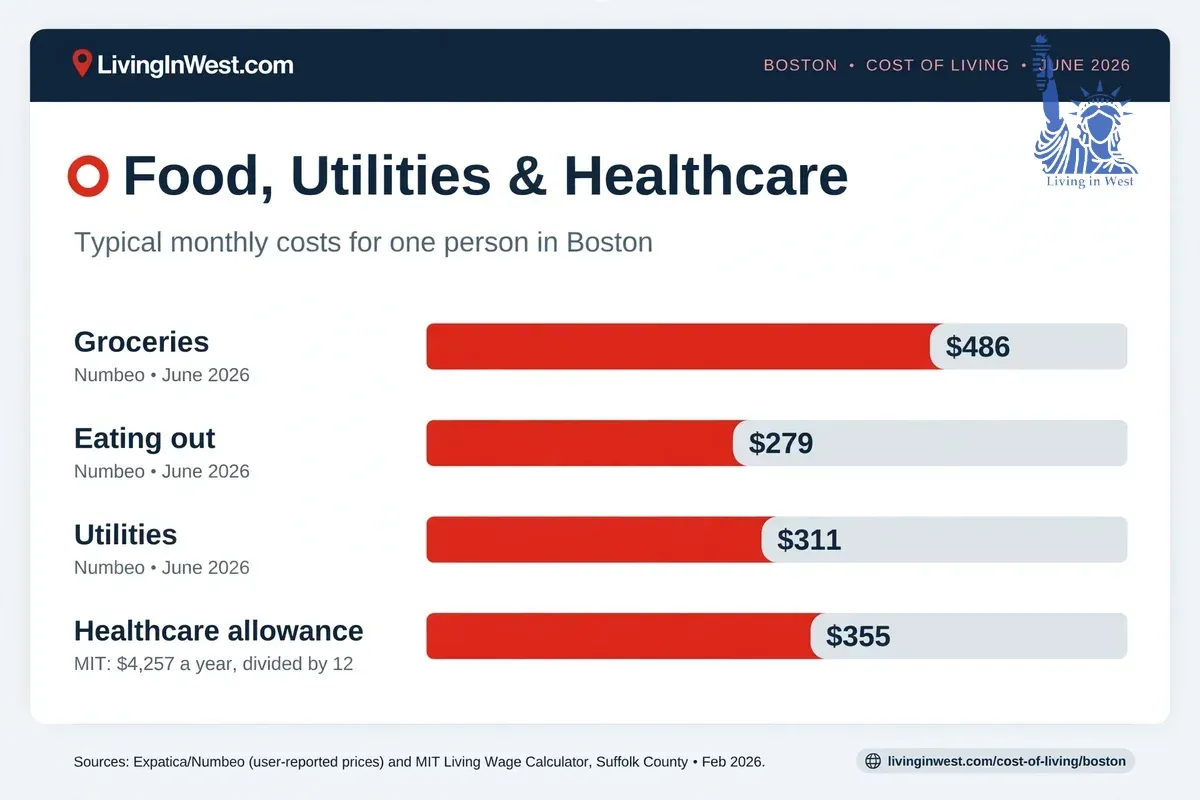
According to the June 2026 Numbeo data reported by Expatica, estimated grocery spending for one Boston resident was approximately $486 per month.
Monthly food budget
| Eating Habits | Estimated Monthly Spending |
|---|---|
| Mostly cooking at home | $400-$550 |
| Cooking with occasional takeout | $550-$750 |
| Frequent restaurant visits | $750-$1,000+ |
Source: USDA – September 2026 Food Plans.
How expensive is eating out in Boston?
Restaurant spending depends on the neighborhood, restaurant type, and frequency of visits.
A casual meal may cost around $18–$25, while a mid-range dinner can reach $45–$70 before tips.
Someone who regularly buys lunch during workdays and orders dinner several times each week may spend considerably more than someone who prepares most meals at home.
For newcomers, cooking at home is one of the easiest ways to control monthly expenses.
Utilities and internet
Utilities are another important part of the Boston budget.
Numbeo's June 2026 Boston snapshot estimated basic monthly utilities at approximately $311.
Actual costs depend on apartment size, heating arrangements, insulation, electricity consumption, and seasonal temperatures.
Renters should check whether their advertised rent includes:
- Heating.
- Hot water.
- Electricity.
- Water and sewer.
- Internet.
Boston winters can make heating expenses particularly important. An apartment with included heat may have a different overall cost from a cheaper unit where the tenant pays all utilities separately.
A practical monthly allowance of approximately $350–$420 for utilities and internet is useful for initial budgeting, although actual bills can fall outside that range.
Healthcare costs in Boston
Healthcare is another expense that should not be ignored when calculating a realistic cost of living.
MIT's February 15, 2026 Living Wage Calculator estimates annual medical expenses of $4,257 for one adult without children in Suffolk County.
That is approximately $355 per month.
This is a modelled expense category, not a standard health insurance premium. Actual costs depend on employment benefits, insurance coverage, deductibles, and out-of-pocket medical expenses.
Anyone relocating from another country should understand their health insurance arrangements before moving.
Sources:
4: Transportation in Boston – Can You Live Without a Car?
One advantage Boston has over many American cities is its public transportation network.
The Massachusetts Bay Transportation Authority, commonly known as the MBTA or The T, operates subway, bus, commuter rail, and ferry services.
People living near reliable public transportation may be able to manage their daily commute without owning a vehicle.
MBTA fares in 2026
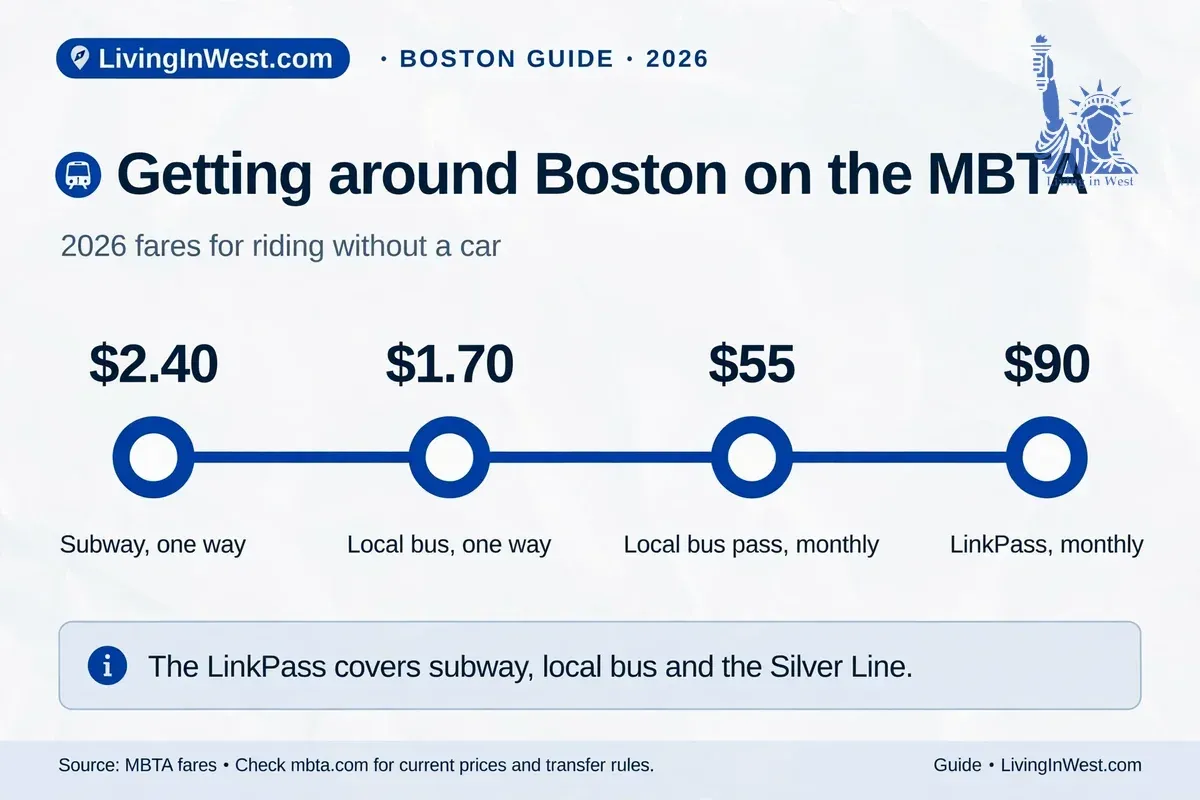
| Transportation | Fare |
|---|---|
| Subway one-way | $2.40 |
| Local bus one-way | $1.70 |
| Monthly LinkPass | $90 |
| Monthly local bus pass | $55 |
Official source: MBTA – Fares and Passes.
Important MBTA changes introduced in September 2026
The MBTA introduced a fare pilot beginning September 1, 2026.
Under the pilot:
- Express Bus fares are the same as Local Bus fares.
- Express Bus passes are no longer available for purchase.
- Riders can make unlimited transfers between subway, bus, and ferry within a two-hour window, paying only the highest-priced applicable service.
The transfer rules depend on pass type and payment method. The same form of payment must be used for the pilot transfers to apply.
This can make public transportation more convenient for people who need to combine different services during a single journey.
Check the official MBTA website for current conditions and eligibility.
What if you use Uber or Lyft?
Not everyone can complete every journey using public transportation.
People who occasionally use rideshare services should keep some additional money in their transportation budget.
A reasonable planning allowance might be:
- Public transportation only: $90–$120 per month.
- Public transportation with occasional rideshare: $120–$180 per month.
These are planning estimates, not official average rideshare expenditure figures.
Is owning a car expensive in Boston?
Owning a vehicle may be useful for people who work outside the MBTA network or regularly travel to suburban communities.
However, car ownership comes with additional costs:
- Gasoline.
- Auto insurance.
- Parking.
- Vehicle maintenance.
- Registration and inspection.
- Tolls and parking tickets.
Parking can be particularly challenging in central Boston, where residential spaces are limited and private garages can be expensive.
For someone living and working near public transportation, using the MBTA may be more economical than maintaining a personal vehicle.
The important thing is to choose housing based on the actual commute. An inexpensive apartment far from work may not save money if it requires frequent rideshare trips or a personal vehicle.
5: What Salary Do You Need to Live Comfortably in Boston?
The salary question is one of the most important considerations for anyone planning to move to Boston.
There is a difference between earning enough to cover basic necessities and earning enough to live comfortably while saving money.
Two useful research sources help explain this difference: MIT's Living Wage Calculator and SmartAsset's 2026 salary study.
The 30% rent affordability rule
A commonly used housing guideline recommends spending no more than 30% of gross income on rent.
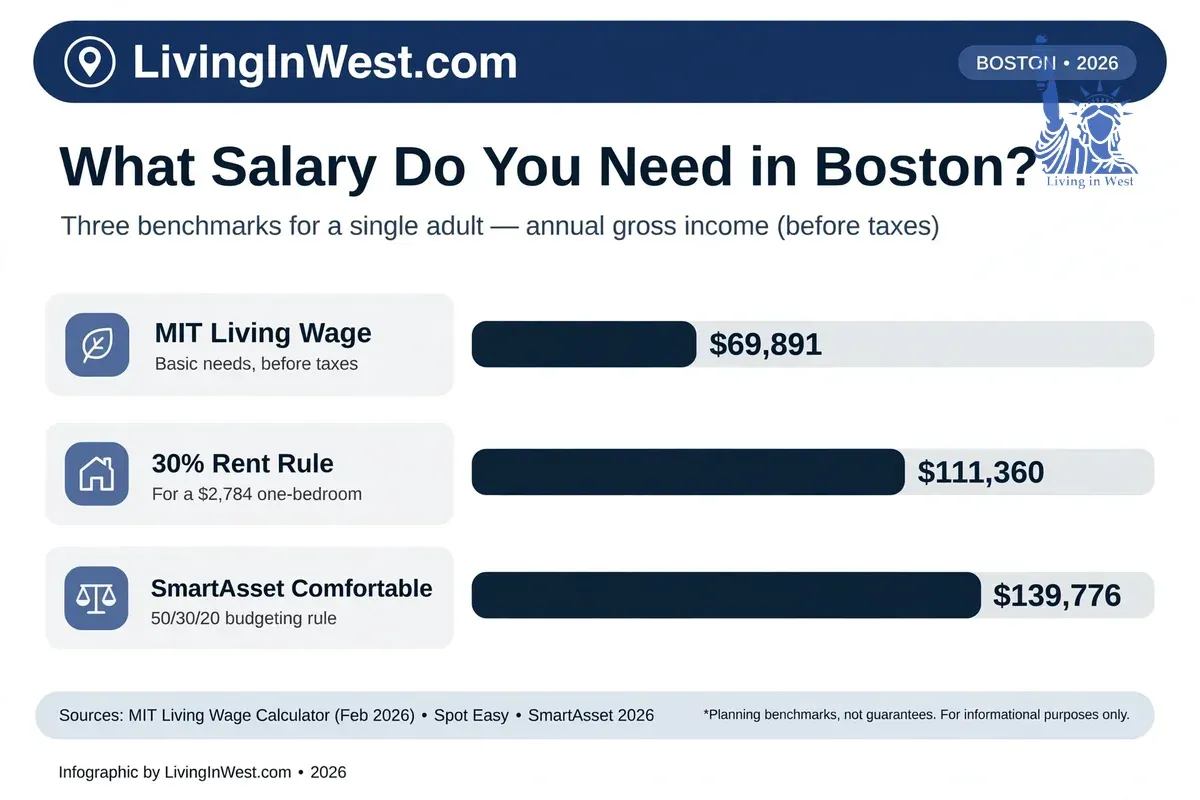
Using Spot Easy's October 2026 average one-bedroom asking rent of $2,784:
$2,784 × 12 = $33,408 annual rent.
To keep rent at 30% of gross income:
$33,408 ÷ 0.30 = $111,360.
This means someone renting an apartment at this price would need approximately $111,360 in annual gross income to keep rent within the traditional 30% guideline.
For RentCafe's $3,433 average one-bedroom rent, the corresponding income would be approximately $137,320.
These are housing affordability calculations, not guaranteed salary requirements.
What does MIT say about the basic living wage?
MIT's February 15, 2026 Living Wage Calculator estimates that one adult without children in Suffolk County needs approximately $33.60 per hour to cover basic expenses while working full-time.
That works out to approximately $69,888 annually before taxes, assuming 2,080 working hours per year.
MIT's calculation includes:
- Housing.
- Food.
- Medical expenses.
- Transportation.
- Other basic necessities.
A living wage is designed to estimate the income needed to meet basic needs. It does not mean someone can necessarily maintain a comfortable lifestyle, save substantial money, or afford every apartment in Boston.
Source: MIT Living Wage Calculator – Suffolk County.
SmartAsset's comfortable salary estimate for Boston
A different result comes from SmartAsset's 2026 study of the salary needed to live comfortably in major American cities.
According to the study, a single adult needs approximately $139,776 annually to live comfortably in Boston.
SmartAsset uses the 50/30/20 budgeting approach:
- 50% of income for necessities.
- 30% for discretionary spending.
- 20% for savings and debt repayment.
This helps explain why its comfortable salary estimate is much higher than MIT's basic living wage.
The two figures measure different financial goals and should not be treated as competing estimates.
Source: SmartAsset – Salary Needed to Live Comfortably in 2026.
Suggested income levels for a single Boston resident
| Annual Gross Salary | What It May Support |
|---|---|
| $65,000-$75,000 | Basic needs, particularly with shared housing |
| $80,000-$95,000 | More manageable expenses, depending on rent |
| $100,000-$120,000 | Greater flexibility, although housing can still consume a large share |
| Around $140,000 | SmartAsset's comfortable-living benchmark |
These are planning descriptions, not guarantees of affordability.
Someone earning $90,000 may manage reasonably well with roommates, but the same salary can feel restrictive when paying for a centrally located private apartment, healthcare, debt, and savings.
Is Boston more expensive than New York?
Boston is expensive, but it is not more expensive than New York or San Francisco when comparing the one-bedroom rental figures in Zumper's October 2026 report.
| City | Median One-Bedroom Rent |
|---|---|
| New York City | $4,610 |
| San Francisco | $4,430 |
| Boston | $2,980 |
The comparison shows that Boston's one-bedroom rental price is substantially lower than both cities in this particular dataset.
However, Boston remains an expensive rental market compared with most American cities.
Final Verdict: Is Boston Affordable for One Person in 2026?
Boston offers significant educational, healthcare, research, and professional opportunities, but living alone requires careful financial planning.
A renter searching for a modest one-bedroom apartment should consider a monthly budget of approximately $3,800–$4,300 for recurring expenses, including a healthcare allowance.
A more comfortable lifestyle, with higher rent and greater spending flexibility, can require approximately $4,700–$5,300 per month.
These estimates exclude income taxes, debt payments, and savings goals.
SmartAsset's $139,776 comfortable salary estimate provides another useful benchmark for people who want to understand the difference between covering bills and having room for savings and discretionary spending.
The best ways to manage Boston's high living costs are to compare neighborhoods, look for rental concessions, understand broker-fee rules, and choose an apartment with a practical commute.
For newcomers, sharing an apartment or living outside the most expensive central neighborhoods can make a significant difference.
Frequently Asked Questions
1. How much does one person need to live in Boston in 2026?
A single renter should plan for approximately $3,800–$4,300 per month for recurring expenses, including a modest one-bedroom apartment, utilities, food, transportation, phone service, and a healthcare allowance. Taxes, debt, and savings are additional.
2. What is the average one-bedroom rent in Boston in 2026?
Spot Easy reported an average Boston one-bedroom asking rent of $2,784 in October 2026. RentCafe reported $3,433, using data from larger apartment buildings. The difference reflects different rental datasets and methodologies.
3. What is the cheapest neighborhood to rent in Boston?
RentCafe's late-October 2026 neighborhood comparison identifies Mattapan as one of the most affordable areas, with an average rent of $2,439 across apartment sizes. West Roxbury and Dorchester are also worth comparing.
4. Is Boston more expensive than New York?
No, not when comparing one-bedroom rental prices in Zumper's October 2026 report. New York's median was $4,610, compared with $2,980 in Boston. San Francisco was also higher at $4,430.
5. What salary is needed to live comfortably in Boston?
SmartAsset estimates that one adult needs approximately $139,776 annually to live comfortably in Boston using the 50/30/20 budgeting rule. Basic living costs can be covered at a lower income, depending on housing and personal circumstances.
6. Can you live in Boston without owning a car?
Yes. Boston has subway, bus, and commuter rail services. Someone living near reliable MBTA connections can manage many daily activities without owning a vehicle.
7. How much does public transportation cost in Boston?
A subway trip costs $2.40, a local bus trip costs $1.70, and a monthly LinkPass costs $90. The MBTA also introduced a pilot fare and transfer policy in September 2026.
8. Why do so many Boston apartments have September 1 leases?
Boston's university calendar and rental traditions have contributed to a concentrated moving cycle. Boston.com reports that approximately two-thirds of the city's 165,000-plus apartment leases turn over on September 1. The City of Boston has also been reported as estimating approximately 70%.
9. Do tenants have to pay broker fees in Massachusetts?
Not automatically. Since August 1, 2025, the person who hires the broker must pay the fee. A tenant may still pay when independently hiring a broker to represent them.
10. Are Boston rents getting cheaper in 2026?
Some rental indicators show softer conditions. Spot Easy reported that Greater Boston's average one-bedroom asking rent fell by $58 month over month in October 2026. BMN Boston also reported that approximately 30% of Boston-area listings offered concessions during spring 2026. However, rental conditions differ by neighborhood and apartment type.

Editorial Team