1: Chicago Rent Prices in 2026
Housing is likely to be your largest monthly expense. Before choosing an apartment, compare the rent for your preferred bedroom count instead of relying only on a citywide average.
What does an apartment cost in Chicago?
Different rental platforms publish different figures because they may measure different properties, listings, and rental-market indicators.
| Rental data source | Monthly rent estimate | What it measures |
|---|---|---|
| Apartment List, August 2026 | $1,898 | Median across apartment sizes |
| Apartment List, August 2026 | $1,759 | Median one-bedroom rent |
| Apartment List, August 2026 | $1,915 | Median two-bedroom rent |
| Zillow, October 18, 2026 | $1,858 | Average one-bedroom rent across all home types |
| Zillow, October 18, 2026 | $2,050 | Overall average across home types and bedroom counts |
Sources: Apartment List and Zillow Chicago Rental Market.
Zillow's one-bedroom average of $1,858 is higher than Apartment List's one-bedroom median of $1,759. This does not necessarily mean either source is wrong: an average and a median are different measures, and the platforms use different datasets and methodologies.
For renters, the practical lesson is to use these figures as reference points and compare actual apartments before signing a lease.
How much of your $3,000 income would go toward rent?
| Monthly rent | Share of $3,000 income | Money left before other bills |
|---|---|---|
| $1,200 | 40% | $1,800 |
| $1,400 | 46.7% | $1,600 |
| $1,600 | 53.3% | $1,400 |
| $1,759 | 58.6% | $1,241 |
| $1,858 | 61.9% | $1,142 |
| $2,000 | 66.7% | $1,000 |
These calculations assume $3,000 is your monthly take-home income.
A one-bedroom at the Apartment List median would consume nearly 59% of that income before electricity, groceries, transportation, healthcare, and other expenses.
That is why a lower rent can make such a significant difference to your financial flexibility.
Should you live alone or share an apartment?
Living alone offers privacy and independence, but you are responsible for the entire rent and any tenant-paid utilities.
With a roommate, you can split the rent and potentially share electricity, gas, and internet costs. If you are moving to Chicago for your first job, studies, or a new opportunity, sharing an apartment can be a useful way to reduce financial pressure.
Before agreeing to a shared apartment, confirm the lease arrangements, utility responsibilities, and the amount each person must pay.

2: Affordable Chicago Neighborhoods and Their Rent
Chicago's rental market varies significantly by neighborhood. Apartments in the downtown area can be considerably more expensive than properties farther from the city center.
Apartments.com reported the following neighborhood averages in October 2026.
| Neighborhood | One-bedroom average | Two-bedroom average |
|---|---|---|
| Rogers Park | $1,326 | $1,692 |
| Edgewater | $1,479 | $2,051 |
| South Loop | $2,585 | $3,488 |
| Pilsen | Not included — current figure unverified | Not included — current figure unverified |
Sources: Rogers Park, Edgewater, and South Loop.
These are neighborhood averages from one rental platform, not guaranteed prices for every available apartment. The figures may also differ from citywide median rents because the underlying rental listings and calculation methods are different.
Rogers Park: A neighborhood to compare for lower rent
Rogers Park reported a one-bedroom average of $1,326 and a two-bedroom average of $1,692.
For someone earning $3,000 after taxes, a one-bedroom at this average would leave $1,674 before other expenses. A two-bedroom shared equally between two people would cost approximately $846 per person in rent.
That can provide more room in the budget than renting a more expensive apartment closer to downtown.
Edgewater: An alternative for renters
Edgewater's reported one-bedroom average was $1,479, while a two-bedroom averaged $2,051.
If two people shared a two-bedroom apartment equally, each would pay approximately $1,026 in rent before utilities.
This neighborhood is worth comparing if you want to balance residential living, transport access, and apartment costs.
South Loop: Convenient, but more expensive
South Loop's reported average was $2,585 for a one-bedroom and $3,488 for a two-bedroom.
At these average prices, a one-bedroom alone would consume more than 86% of a $3,000 take-home income. A typical two-bedroom at the reported average would exceed the entire budget.
A $3,000 monthly income is therefore a much tighter fit for someone determined to rent in this area.
What about Pilsen and other neighborhoods?
Pilsen, Logan Square, Albany Park, and other areas may offer options worth investigating. However, rental prices vary by property, and a current Pilsen figure could not be verified for this comparison.
Rather than treating an unverified estimate as fact, compare active listings and check the complete monthly cost, including utilities and commuting.
Practical recommendation: Start your search with several neighborhoods rather than choosing an apartment solely because it is close to downtown. Compare rent, transit, apartment condition, and commute time together.
3: Electricity, Gas, Water, Internet, and Phone Bills
Rent is not the only housing expense. Your utility costs depend on the apartment's size, heating system, electricity usage, lease arrangements, and the season.
Chicago's winter weather makes heating an important part of an annual budget.
Electricity
For initial planning, a single renter might set aside approximately $60–$120 a month for electricity.
Actual bills can be lower or higher depending on the property, heating and cooling equipment, and energy consumption.
ComEd is a major electricity provider in the Chicago area. Check your expected rate and bill details directly with ComEd before estimating your final expenses.
Natural gas and heating
Gas costs can increase substantially during cold weather when a household uses gas for heating.
A preliminary allowance of $40–$120 per month may help you build a budget, but the amount is not a guaranteed average. Some apartments include heat in the rent, while others bill tenants separately.
Ask the landlord whether the apartment uses gas or electric heating and whether historical utility bills are available.
Water and sewer
Water and sewer charges depend on the property's billing arrangements. Some leases include water, while other properties pass certain charges to the tenant.
For planning, allow $0–$50 a month if a separate charge applies, but do not count the same utility twice if it is already included in your rent.
Internet and mobile phone
A combined allowance of approximately $100–$150 per month for home internet and a mobile phone plan can be a starting point.
Your final bill will depend on the provider, speed, data plan, equipment fees, and promotional pricing.
Monthly utility planning table
| Expense | Illustrative monthly allowance |
|---|---|
| Electricity | $60–$120 |
| Natural gas | $40–$120 |
| Water and sewer | $0–$50 |
| Internet and phone | $100–$150 |
These estimates are for planning, not official citywide averages. Because internet and phone are included, this table covers more than utilities alone.
A renter paying most bills separately might initially budget $200–$350 for household utilities, internet, and phone combined. Check the property's actual arrangements before relying on that figure.

4: Groceries, Restaurants, and Everyday Food Costs
Food is another major expense, but it is more flexible than rent. Cooking at home, planning meals, and controlling delivery spending can help you stay within your budget.
For a single adult, the following ranges can be useful for initial planning.
| Eating habits | Illustrative monthly budget |
|---|---|
| Careful grocery shopping and home cooking | $300–$400 |
| More flexible grocery spending | $400–$500 |
| Groceries plus regular restaurant meals | $550–$750 or more |
These are budgeting ranges, not verified averages for every Chicago resident.
What does the USDA food plan say?
The U.S. Department of Agriculture publishes monthly food-at-home plans at different spending levels. Its September 2026 report is a useful reference for understanding grocery spending, although the figures are national estimates rather than Chicago-specific prices.
The USDA advises a 20% adjustment for a one-person household. Applying that adjustment to the September 2026 food plans gives approximate monthly ranges of:
- Thrifty plan: $305–$383.
- Low-cost plan: $332–$381.
- Moderate-cost plan: $404–$478.
These are approximate figures based on the age- and sex-specific plan amounts; individual needs and actual food prices will vary.
Source: USDA Food Plans — Monthly Cost of Food Reports.
How can you keep food costs under control?
- Prepare lunches at home instead of purchasing them every workday.
- Plan weekly meals before shopping.
- Compare grocery prices and store promotions.
- Limit frequent delivery orders and their additional fees.
- Keep a separate allowance for restaurants and entertainment.
A $400 grocery budget may be realistic for some adults who cook regularly, but it may not suit every dietary requirement or household.

5: Transportation — Public Transit or Owning a Car?
Transportation costs depend on where you live and how often you travel.
Chicago's public transportation system can help renters avoid the expense of owning a car, particularly when their home, workplace, or school is accessible by bus or train.
CTA fares
The Chicago Transit Authority's published regular fares include
| Transit option | Published fare |
|---|---|
| Bus | $2.25 per ride |
| 'L' train | $2.50 per ride |
| 30-day CTA/Pace pass | $75 |
Check the official CTA fares page for current fare rules and pass details.
A $75 monthly pass can make commuting expenses more predictable for someone who uses the network regularly.
What if you own a car?
Owning a car introduces additional expenses, including:
- Fuel and parking.
- Auto insurance.
- Maintenance and repairs.
- Registration and related vehicle expenses.
- Monthly loan payments, if applicable.
Downtown parking can be particularly expensive, and actual costs depend on the garage, neighborhood, and parking arrangement.
For some residents, the combined cost of a car and parking can be several hundred dollars a month before loan payments or major repairs.
If public transportation meets your needs, avoiding car ownership can make a $3,000 budget easier to manage.
6: Realistic Monthly Budgets — Living Alone vs. With a Roommate
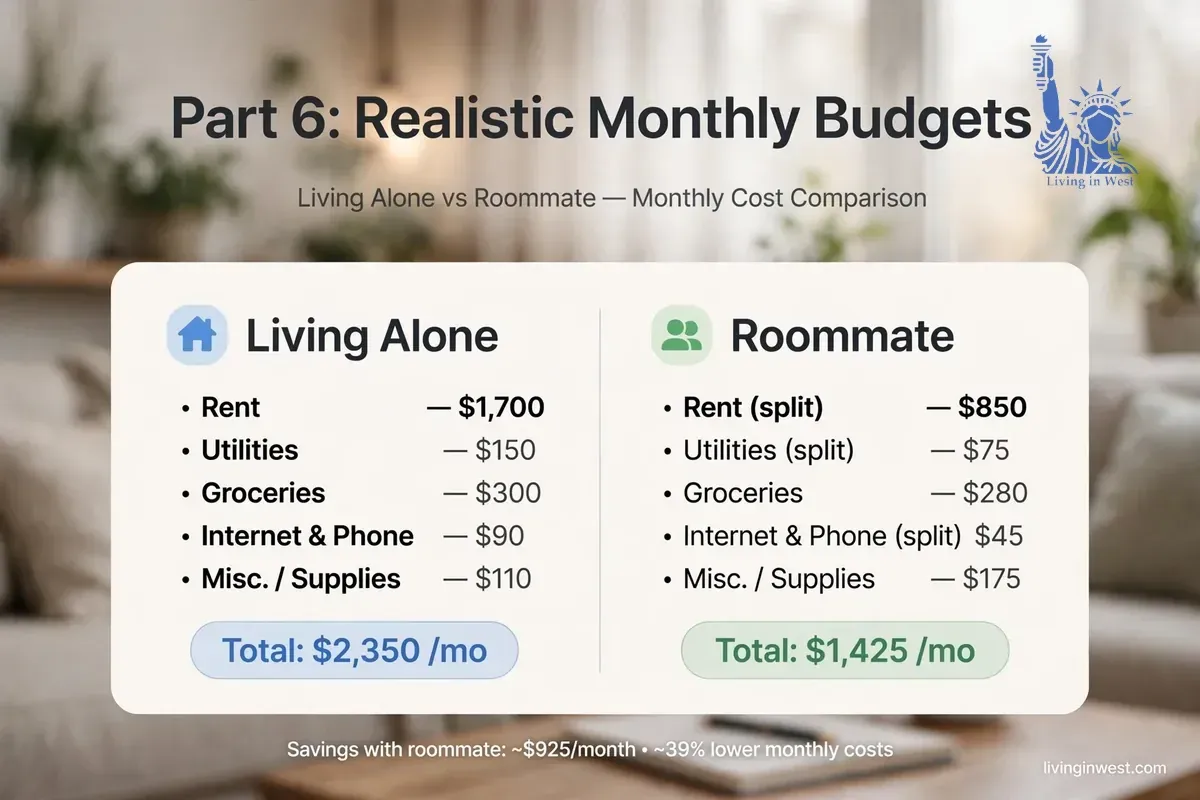
The following examples assume that $3,000 is your monthly income after taxes. They use Apartment List's August 2026 rent medians as reference points.
Scenario A: Living alone in a one-bedroom apartment
| Expense | Monthly cost |
|---|---|
| One-bedroom rent | $1,759 |
| Electricity | $90 |
| Natural gas | $60 |
| Water and sewer | $0 |
| Internet and phone | $130 |
| Groceries | $400 |
| CTA pass | $75 |
| Healthcare and insurance allowance | $250 |
| Household items and personal expenses | $100 |
| Total monthly expenses | $2,864 |
| Remaining from $3,000 | $136 |
This example assumes water is included in the rent. It also uses illustrative allowances for healthcare, groceries, and utilities rather than guaranteed costs.
The budget does not include car ownership, debt repayments, significant entertainment spending, or major emergencies.
Verdict: Living alone is possible, but the budget is tight. A small increase in utility bills or an unexpected expense could eliminate the monthly surplus.
Scenario B: Sharing a two-bedroom apartment
For this example, the Apartment List two-bedroom median of $1,915 is split equally between two roommates.
| Expense | Monthly cost per person |
|---|---|
| Half of two-bedroom rent | $958 |
| Electricity | $45 |
| Natural gas | $30 |
| Internet and phone | $130 |
| Groceries | $400 |
| CTA pass | $75 |
| Healthcare and insurance allowance | $250 |
| Household items and personal expenses | $100 |
| Total monthly expenses | $1,988 |
| Remaining from $3,000 | $1,012 |
This scenario assumes shared utilities, an equal rent split, and no separate water charge. It also uses the same illustrative healthcare and personal-expense allowances as the solo budget.
Actual expenses will depend on the apartment, individual insurance costs, household arrangements, and personal habits.
Verdict: Sharing a two-bedroom apartment can create substantially more financial flexibility. It may leave enough room for savings, leisure, debt payments, and unexpected expenses.
What if $3,000 is your gross salary?
The examples above use take-home income. If you earn $3,000 before taxes, your available spending money will be lower.
A $3,000 gross monthly salary equals $36,000 a year before applicable taxes and payroll deductions. You should calculate your expected take-home pay before deciding what rent you can afford.

7: Taxes, Apartment Approval, and Hidden Moving Costs
A realistic Chicago budget needs to include more than recurring bills. Taxes affect your take-home income, landlords may have screening requirements, and moving into an apartment can require substantial upfront spending.
The 30% rent guideline
A common budgeting guideline suggests spending no more than 30% of gross income on rent.
For an apartment costing $1,759 a month:
- Monthly rent: $1,759.
- Suggested gross monthly income: approximately $5,863.
- Suggested gross annual income: approximately $70,000.
This is an affordability guideline, not a universal landlord requirement or a guarantee that the remaining income will cover all expenses.
If you earn $36,000 gross per year, a $1,759 apartment would consume a large share of your income before taxes and other living costs.
Illinois income tax
Illinois has a flat individual income tax rate of 4.95% for 2026. Federal income tax, Social Security, Medicare, and other applicable deductions can also affect take-home pay.
Source: Illinois Department of Revenue — Withholding Tax Tables.
Use an appropriate paycheck calculator or official tax resources to estimate your own take-home income. The state tax rate alone does not determine your total tax bill.
Apartment approval requirements
Landlords and property managers may review:
- Employment and income documents.
- Credit history.
- Rental history.
- Background screening, where permitted.
- Application requirements and permitted fees.
- Guarantors or co-signers, where accepted.
Some landlords use an income screening formula equivalent to three times the monthly rent. For a $1,759 apartment, that would mean gross monthly income of approximately $5,277.
This is an example of a screening formula, not a universal Chicago legal requirement.
Ask about the income criteria before paying application fees or committing to a move.
Upfront and hidden expenses
Your first month may cost significantly more than a normal month because of:
- Moving services and transportation.
- Furniture and household essentials.
- Application and move-in charges.
- Security deposits, where applicable.
- Utility setup and other permitted fees.
- Winter clothing and seasonal purchases.
Healthcare costs can also vary widely. A $250 monthly allowance in a sample budget is not a quote for health insurance or a guarantee that all medical expenses will be covered.
Build an emergency fund over time so that unexpected expenses do not force you to rely on credit or miss essential payments.

8: Best Money-Saving Strategies and Final Verdict
Living in Chicago on $3,000 a month requires prioritizing the expenses that matter most. Housing usually has the greatest effect on how much money remains for other needs.
Choose a neighborhood based on total cost
Compare rent, utilities, transportation, and commute time together. A cheaper apartment farther away may not be a better deal if it requires an expensive car commute.
Consider sharing an apartment
If you are comfortable living with another person, splitting a two-bedroom apartment can reduce your share of the rent and some household bills.
Check the lease terms and agree in advance on rent, utilities, cleaning, and other responsibilities.
Use public transportation when practical
Compare the cost of a monthly transit pass with the full cost of car ownership, including parking, insurance, fuel, and repairs.
Cook at home more often
Plan meals, set a grocery allowance, and reserve a separate amount for restaurant visits. This makes food spending easier to track.
Compare actual apartment listings
Use published rental estimates as starting points rather than guarantees. Check the apartment's condition, lease length, included utilities, recurring fees, and move-in costs.
Leave room for unexpected expenses
Do not plan your finances around the lowest possible bill in every category. A sustainable budget should leave some money for emergencies, savings, and occasional discretionary spending.
Final verdict: Can you live in Chicago on $3,000 a month?
Yes, if $3,000 is your monthly take-home income, but the lifestyle you can afford depends on your housing choices.
Living alone in a one-bedroom apartment near the citywide median may be possible, but the sample budget leaves only $136 for anything not already included. That is a narrow margin for emergencies, savings, and entertainment.
Sharing a two-bedroom apartment can leave substantially more room in your budget. Choosing a reasonably priced neighborhood, cooking at home, and using public transportation can also help.
If $3,000 is your gross salary before taxes, affordability will be more challenging because your actual take-home income will be lower.
Before moving, compare current apartment listings, confirm utility arrangements, estimate your after-tax income, and account for healthcare and upfront moving expenses. Those steps will help you decide whether Chicago is a practical choice for your circumstances.
Frequently Asked Questions
1. Can you live in Chicago on $3,000 a month?
Yes. It can be possible when $3,000 is your take-home income and you manage rent, food, utilities, and transportation carefully. Sharing an apartment generally leaves more financial flexibility than living alone.
2. What is the average one-bedroom rent in Chicago in 2026?
Apartment List estimated a median of $1,759 in August 2026. Zillow reported an average of $1,858 across all home types for one-bedroom properties on October 18, 2026. These figures use different methodologies and should not be treated as identical measures.
3. Which Chicago neighborhoods have lower reported rents?
Rogers Park and Edgewater are worth comparing. Apartments.com reported October 2026 one-bedroom averages of $1,326 and $1,479, respectively. Actual prices depend on the property and current availability.
4. Is it cheaper to share an apartment in Chicago?
Sharing a two-bedroom apartment can substantially reduce your personal rent expense. Using Apartment List's $1,915 median, an equal split would cost about $958 per person before utilities.
5. How much should I budget for groceries in Chicago?
For initial planning, a single adult might allow $300–$500 monthly for groceries, depending on food choices and shopping habits. The USDA's September 2026 food plans offer additional national reference points, adjusted for a one-person household.
6. Can you live in Chicago without a car?
Yes, depending on where you live and travel. The CTA offers bus and rail services, with a published 30-day CTA/Pace pass price of $75. Check current fares and your commuting needs before deciding.
7. How much annual income is recommended for a $1,759 apartment?
Using the 30% rent guideline, approximately $70,000 in gross annual income would be a starting point. This is not a universal landlord requirement, and other housing and living expenses need to be considered.
8. Does this budget include taxes?
The two monthly budget examples assume $3,000 in take-home income after taxes. If $3,000 is your gross salary, calculate your expected take-home pay before deciding how much rent you can afford.
Sources and Editorial Note
This article uses the following sources for rental, grocery, tax, and transportation information:
- Apartment List — Chicago Rental Market
- Zillow — Chicago Rental Market Trends
- Apartments.com — Rogers Park Rent Trends
- Apartments.com — Edgewater Rent Trends
- Apartments.com — South Loop Rent Trends
- USDA — Monthly Cost of Food Reports
- Illinois Department of Revenue
- Chicago Transit Authority
Rental estimates reflect the dates shown and may change. Different providers use different datasets and methods, so figures should be compared carefully. Budget tables are illustrative examples, not guarantees of actual costs.
This article provides general educational information about housing and everyday expenses. It is not a guarantee of rental prices, apartment approval, or individual financial outcomes.
Last updated: October 20, 2026.

Editorial Team