Introduction: Which U.S. Visa Is Right for You?
The United States offers several visa categories for people who want to visit, study, work, invest, join family members or pursue permanent residence. The right option depends on the purpose of travel, qualifications, financial resources, employer sponsorship and nationality.
For example, an Indian technology professional may explore the H-1B or O-1 route, while a Singaporean or Japanese entrepreneur may investigate the E-2 treaty investor visa. A Pakistani student may consider an F-1 visa, while a professional researcher from Germany or Brazil may qualify for an employment-based category.
However, visa eligibility and approval are not the same thing. A country’s visitor-visa refusal rate does not predict an individual's chance of receiving an H-1B, F-1, O-1 or immigrant visa. Each category has different legal requirements and approval processes.
This guide explains 10 important U.S. visa categories, compares official visitor-visa refusal statistics for selected countries, and summarizes major immigration policy developments from 2024 through November 2026.
1. H-2A Visa: Temporary Agricultural Workers
The H-2A visa allows U.S. agricultural employers to hire foreign workers for temporary or seasonal agricultural jobs when sufficient qualified U.S. workers are not available.
Common jobs include:
- Crop planting and harvesting
- Fruit and vegetable picking
- Farm and nursery work
- Seasonal agricultural labor
- Certain livestock-related temporary jobs
Who can apply?
The process normally begins with a U.S. employer. The employer must obtain the required temporary labor certification and file an H-2A petition with U.S. Citizenship and Immigration Services (USCIS).
An individual generally cannot independently obtain an H-2A visa simply by expressing an interest in farm work. A qualifying U.S. employer must first complete the required process.
Does nationality determine eligibility?
A significant change took effect on January 17, 2025. DHS removed the requirement that H-2A and H-2B workers come from countries on a designated-country list.
This means that nationality alone is no longer restricted by the former designated-country list. Applicants from countries such as India, Pakistan, Bangladesh, the Philippines, Nigeria and other regions may be considered if the employer, petition and other legal requirements are satisfied.
Important: Removal of the country-list restriction does not guarantee a visa. Employer sponsorship, temporary employment requirements, petition approval and consular eligibility still matter.
2. O-1 Visa: Individuals With Extraordinary Ability
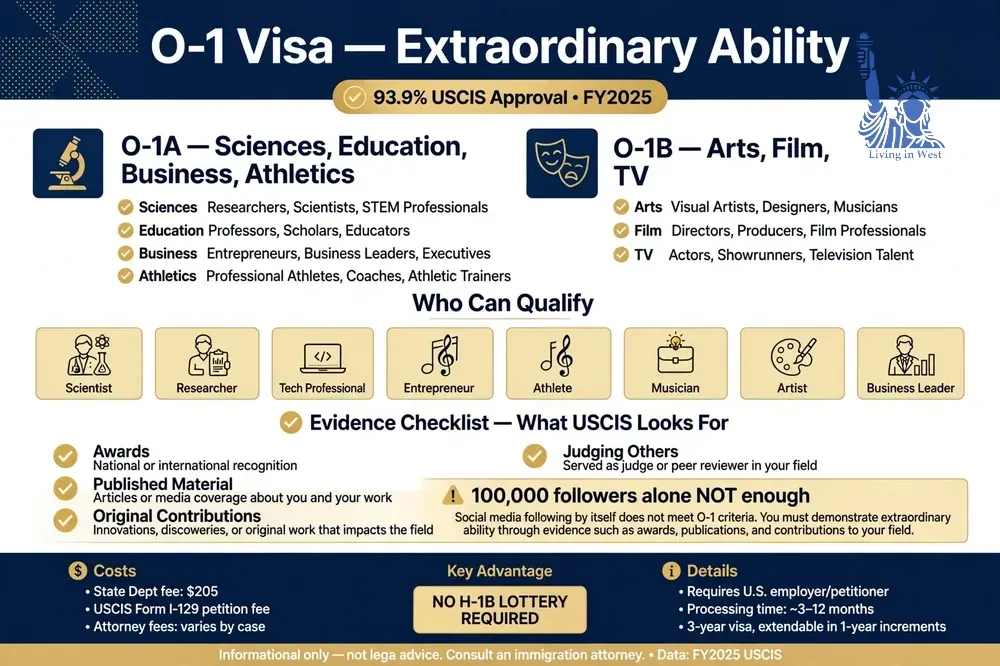
The O-1 visa is designed for individuals who can demonstrate extraordinary ability or achievement in a qualifying field.
It is commonly considered by:
- Scientists and researchers
- Technology professionals
- Entrepreneurs and business leaders
- Artists and designers
- Athletes
- Film and television professionals
- Academics and other specialists
There are two principal categories:
| Category | Field | Main Purpose |
|---|---|---|
| O-1A | Sciences, Education, Business, Athletics | Extraordinary ability |
| O-1B | Arts, Motion Pictures, Television | Extraordinary ability / Extraordinary achievement |
What evidence is required?
Applicants generally need to demonstrate sustained recognition or a record of significant achievement. Depending on the field, evidence may include:
- National or international awards
- Published material about the applicant
- Original contributions of major significance
- Judging the work of others
- Important publications or research
- Leading or critical roles
- High salary or other evidence of professional distinction
A U.S. employer or qualifying U.S. agent generally files the petition. Applicants should not assume that a successful career or a high salary automatically qualifies them.
Global perspective: A software engineer from India, a researcher from Germany, a designer from South Korea or an entrepreneur from Brazil may all explore O-1 eligibility. The assessment is based on the evidence and applicable legal criteria, not simply the applicant's passport.
3. L-1 Visa: Transfer Within an International Company
The L-1 visa allows qualifying international companies to transfer certain employees to a related U.S. office.
It is particularly relevant to businesses operating in multiple countries
| Category | Purpose | Kis Ke Liye Hai? |
|---|---|---|
| L-1A | Executives and Managers | Jo company ko manage karte hain, decisions lete hain |
| L-1B | Employees with Specialized Knowledge | Jinko company ke product, process ya system ka special knowledge hai |
Main requirements
Generally, the employee must have worked for a qualifying related organization outside the United States for at least one continuous year within the relevant three-year period before seeking admission in L-1 status.
The U.S. and foreign companies must have a qualifying relationship, such as a parent, subsidiary, branch or affiliate relationship.
Example
A technology company headquartered in Singapore may transfer a qualifying manager to its U.S. subsidiary. Similarly, a German manufacturing company may transfer an employee with specialized knowledge to its American operation.
The L-1 route is not a general work permit. It requires a qualifying company structure, an eligible position and the required employment history.
4. H-1B Visa: Specialty Occupation Workers
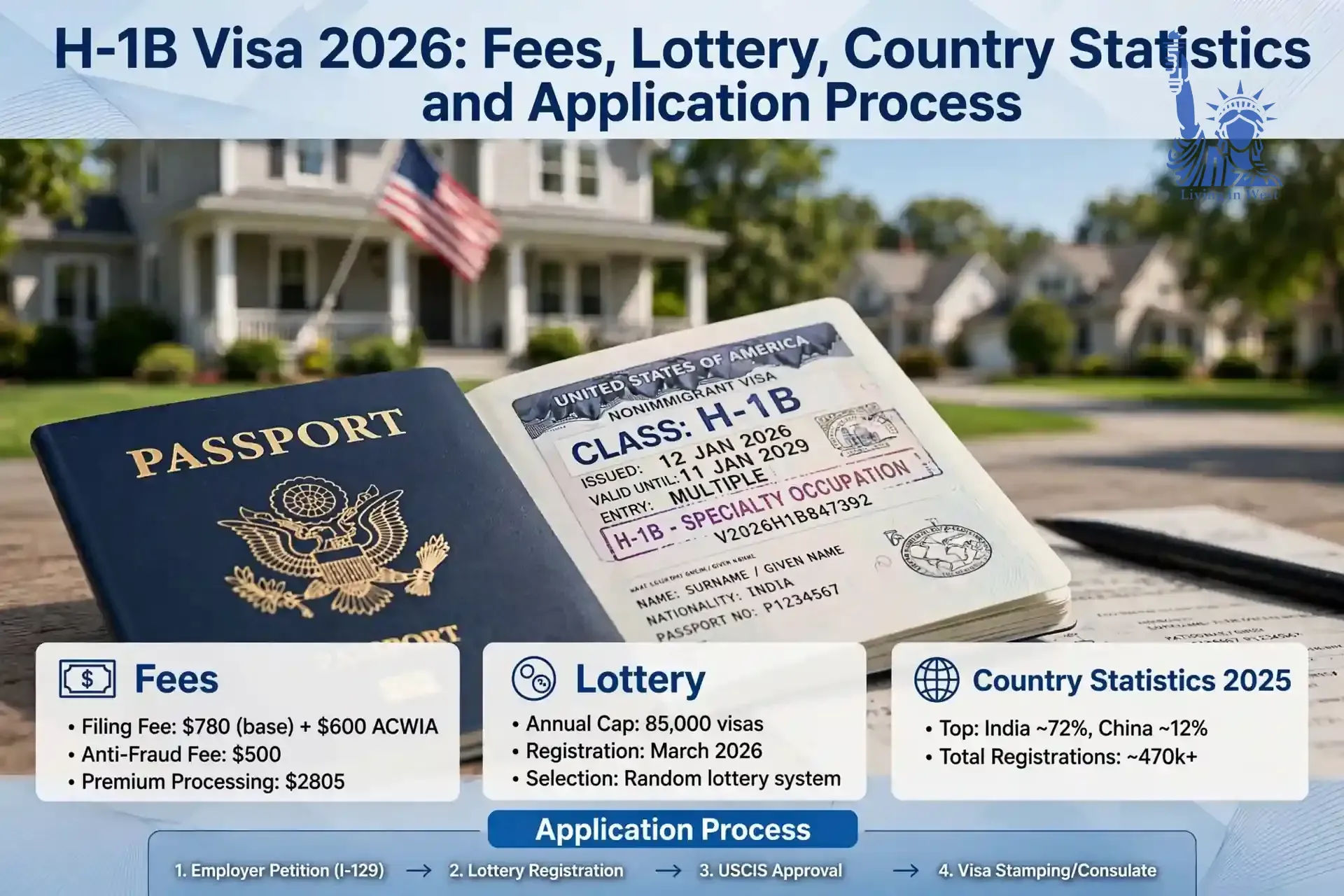
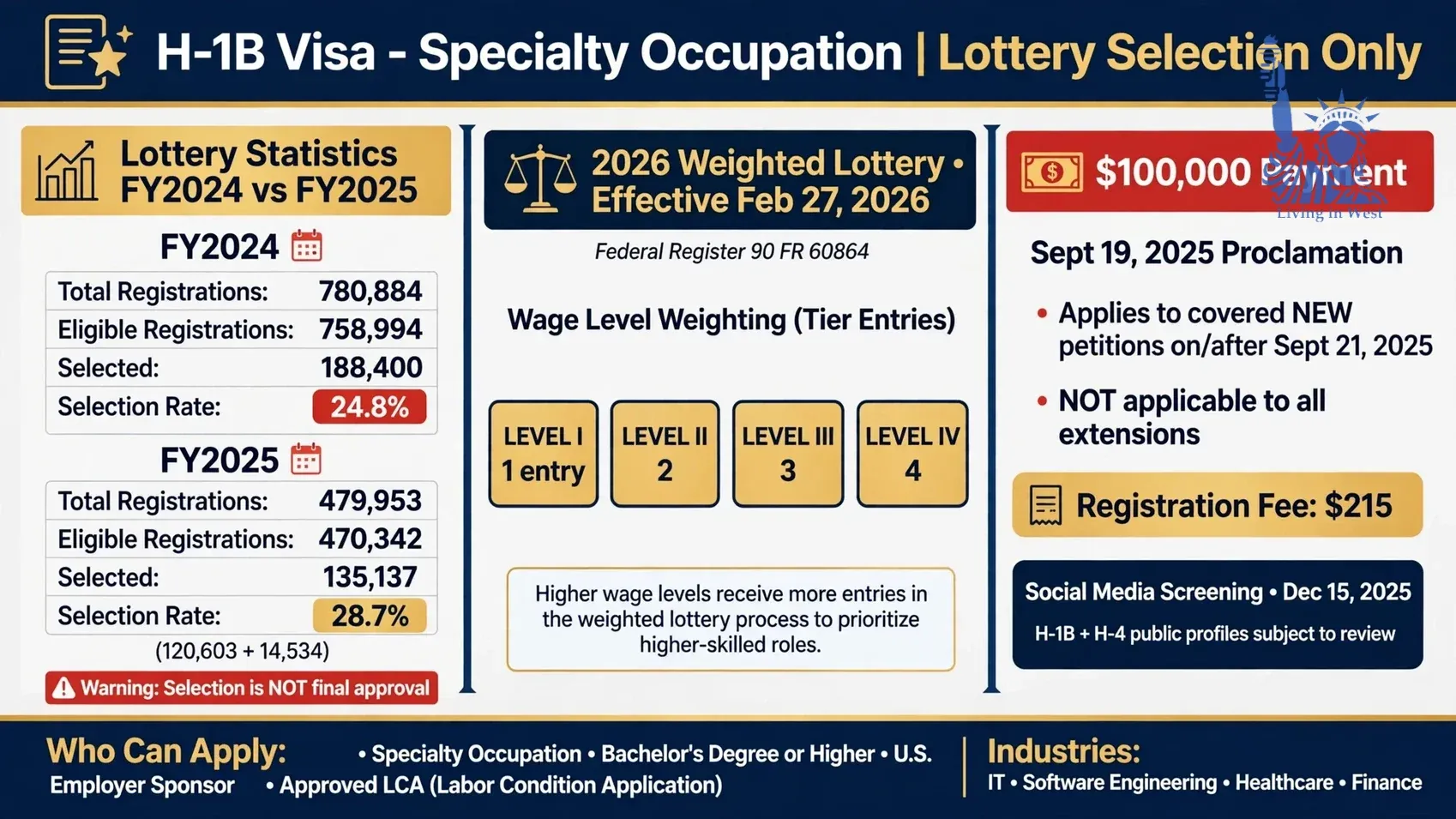
The H-1B visa is one of the best-known U.S. employment visa categories. It is commonly used by employers hiring professionals for specialty occupations that generally require specialized knowledge and at least a bachelor's degree in a directly related field or its equivalent.
Common sectors include:
- Software development and information technology
- Engineering
- Data science
- Healthcare occupations that meet the requirements
- Finance and accounting
- Scientific research
- Certain business and professional roles
H-1B registration figures: FY2024 and FY2025
USCIS reported the following registration figures:
| Registration Measure | FY2024 | FY2025 |
|---|---|---|
| Total registrations | 780,884 | 479,953 |
| Eligible registrations | 758,994 | 470,342 |
| Selections | 188,400 | 135,137 |
| Selection rate using eligible registrations | 24.8% | 28.7% |
FY2025 selections included two rounds
| Selection Round | Selections |
|---|---|
| Initial selection | 120,603 |
| Additional selection | 14,534 |
| **Total** | **135,137** |
These figures describe the registration selection process. They are not visa approval rates and do not mean that every selected registration resulted in an approved H-1B petition.
Weighted H-1B selection system for FY2027
A final rule published on December 29, 2025, became effective on February 27, 2026. It introduced a weighted selection system for the FY2027 H-1B registration season.
Under the rule, registrations receive entries according to the applicable OEWS wage level:
| Wage Level | Entries in Selection |
|---|---|
| Level I | 1 |
| Level II | 2 |
| Level III | 3 |
| Level IV | 4 |
A higher wage level therefore receives more entries in the selection process. It does not guarantee selection or petition approval. Employers must still meet the applicable H-1B requirements, including wage and job requirements.
The $100,000 H-1B payment policy
A separate presidential proclamation introduced a $100,000 payment requirement for certain new H-1B cases involving beneficiaries outside the United States. The relevant date is September 21, 2025, or later.
The policy includes distinctions and exceptions. For example, qualifying change-of-status cases inside the United States are treated differently from certain cases involving beneficiaries abroad without a valid visa. A National Interest Exception may also be relevant in qualifying circumstances.
Employers should check the current USCIS and Department of State instructions before filing or making payment. The requirement should not be described as a universal $100,000 fee for every H-1B worker or every H-1B petition.
5. J-1 Visa: Exchange Visitors, Researchers and Trainees
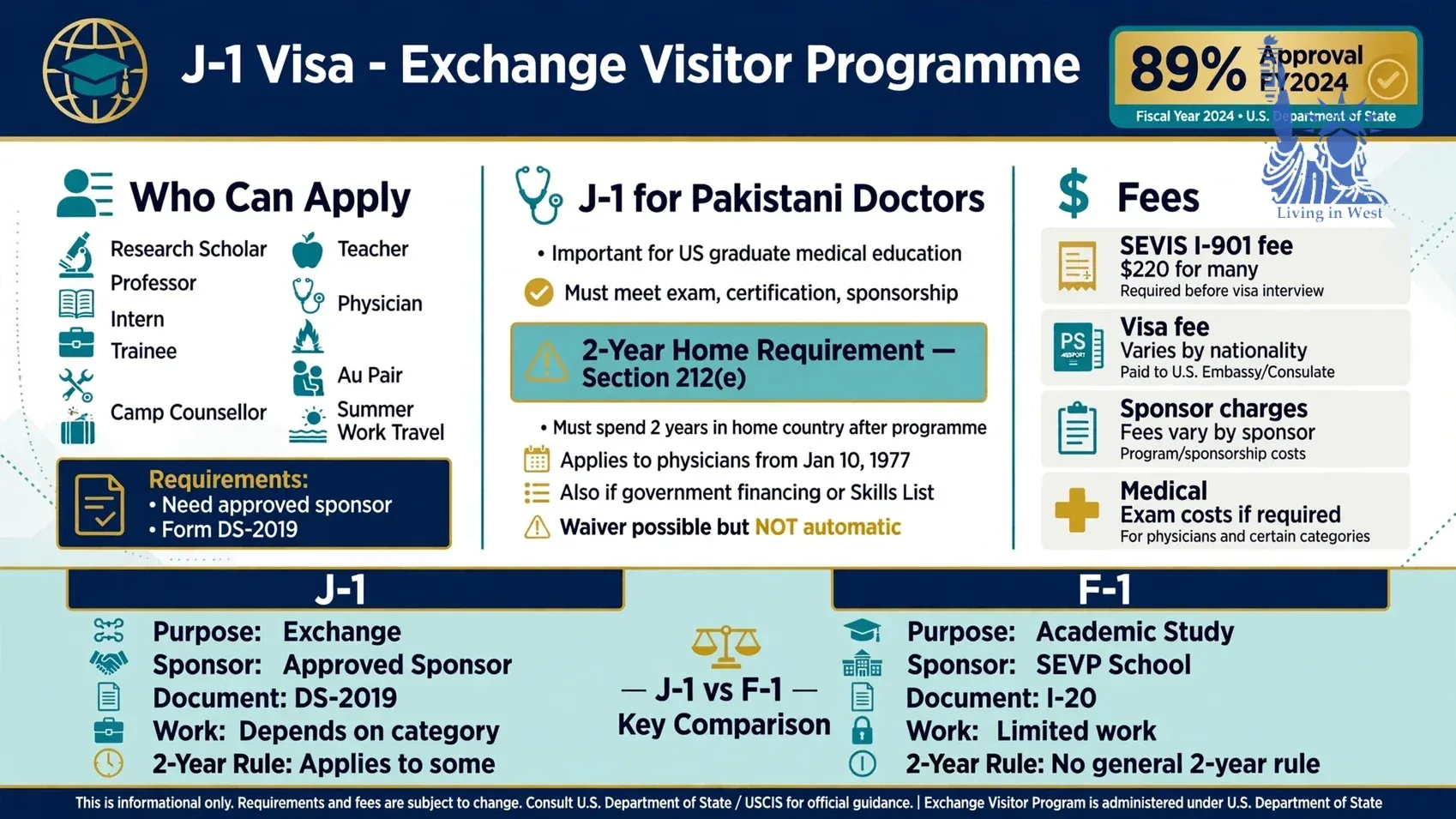
The J-1 visa supports approved exchange visitor programs in the United States.
It covers a range of program participants, including:
- Research scholars
- Professors
- University students
- Interns and trainees
- Teachers
- Physicians in qualifying exchange programs
- Au pairs and other approved exchange visitors
Important J-1 requirement: Section 212(e)
Some J-1 participants are subject to the two-year home-country physical presence requirement under Section 212(e) of the Immigration and Nationality Act.
This requirement may apply because of government funding, the Exchange Visitor Skills List or certain graduate medical education and training.
A person subject to Section 212(e) may need to satisfy the requirement or obtain an applicable waiver before qualifying for certain immigration benefits, including specified changes of status or immigrant visa processing.
Not every J-1 holder is automatically subject to this rule. Applicants should check their visa annotation, DS-2019 and individual circumstances.
6. K-1 Visa: Fiancé(e) of a U.S. Citizen
The K-1 visa allows the foreign fiancé(e) of a U.S. citizen to travel to the United States to marry the U.S. citizen petitioner.
The marriage must generally take place within 90 days of admission to the United States.
Main process
- The U.S. citizen files Form I-129F with USCIS.
- After petition approval and consular processing, the foreign fiancé(e) applies for the K-1 visa.
- The applicant completes the required medical examination and consular interview.
- If the visa is issued, the applicant travels to the United States.
- The couple must marry within 90 days.
- After marriage, the foreign spouse may apply for adjustment of status if eligible.
K-1 is not a general family visa
The K-1 category is specifically for the fiancé(e) of a U.S. citizen. It is not the same as a spouse immigrant visa, such as the CR-1 or IR-1.
Applicants should also distinguish petition approval from visa issuance. An approved I-129F petition does not automatically mean that a K-1 visa will be issued.
7. E-2 Visa: Treaty Investor Visa
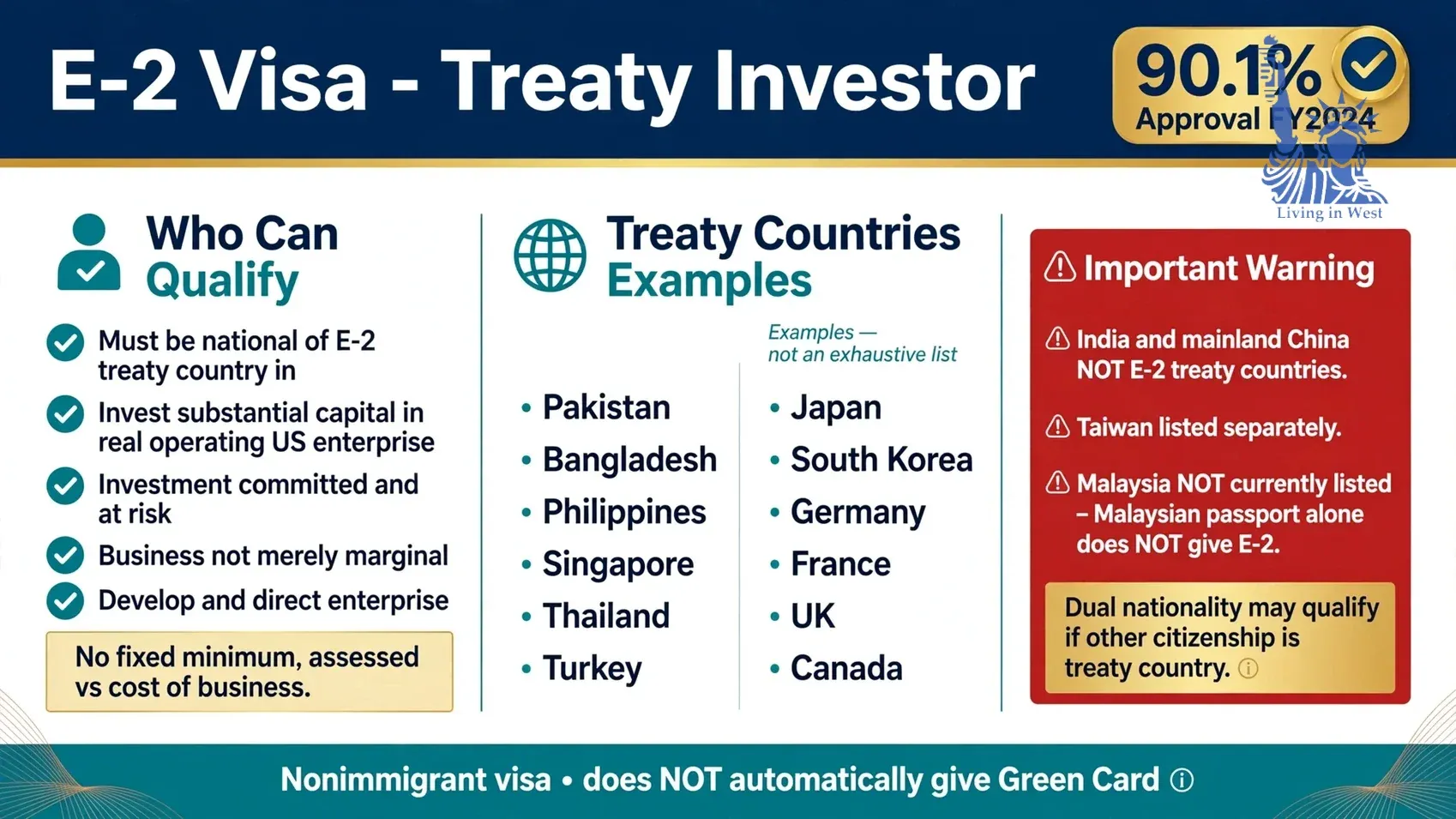
The E-2 visa allows qualifying nationals of treaty countries to enter the United States to develop and direct a business in which they have invested, or to work in a qualifying capacity for an eligible treaty enterprise.
It is a nonimmigrant visa category. It does not automatically provide permanent residence or a Green Card.
Who may qualify?
The applicant generally must:
- Be a national of an E-2 treaty country.
- Invest a substantial amount of capital in a real and operating U.S. enterprise.
- Show that the investment is committed and at risk.
- Demonstrate that the business is not merely marginal under the applicable rules.
- Develop and direct the enterprise, or qualify for an eligible employee role.
There is no single fixed minimum investment amount that applies to every E-2 business. The required investment is assessed in relation to the cost and nature of the enterprise.
Examples of E-2 treaty countries
The following are examples of countries with E-2 treaty eligibility:
- Pakistan
- Bangladesh
- Philippines
- Singapore
- Thailand
- Turkey
- Japan
- South Korea
- Germany
- France
- United Kingdom
- Canada
This is an illustrative list, not the complete treaty-country list. Applicants should always consult the current U.S. Department of State treaty-country information.
Important nationality distinction: India and mainland China are not E-2 treaty countries. Taiwan is listed separately as an E-2 treaty jurisdiction. Malaysia is also not currently listed as an E-2 treaty country. A Malaysian passport alone therefore does not provide E-2 eligibility.
A person with dual nationality may have a different result if they also hold citizenship of an eligible treaty country and meet the other requirements.
8. B-1/B-2 Visa: Business Visitors and Tourists
The B-1/B-2 visitor visa is commonly used for temporary business visits, tourism, family visits and certain other permitted short-term activities.
| Category | Main Purpose |
|---|---|
| B-1 | Permitted temporary business activities |
| B-2 | Tourism, family visits and certain medical visits |
| B-1/B-2 | Combined visitor visa classification |
A B-1 visitor may attend business meetings, conferences or negotiate contracts, where permitted. The category does not authorize ordinary employment in the United States.
A B-2 visitor may travel for tourism, visit relatives or seek qualifying medical treatment. The applicant must still demonstrate eligibility and satisfy the applicable visitor-visa requirements.
FY2025 U.S. B-visa adjusted refusal rates by nationality
The U.S. Department of State publishes adjusted refusal rates for B visas by nationality. These figures provide a useful way to compare visitor-visa refusal patterns across countries.
| Country | FY2025 Adjusted Refusal Rate |
|---|---|
| India | 22.04% |
| China | 20.21% |
| Pakistan | 52.32% |
| Bangladesh | 61.45% |
| Nepal | 69.47% |
| Malaysia | 7.92% |
| Indonesia | 26.69% |
| Japan | 5.68% |
| South Korea | 24.73% |
| Philippines | 30.76% |
| Nigeria | 57.00% |
| Ghana | 64.34% |
| Kenya | 68.23% |
| South Africa | 11.66% |
| Egypt | 47.61% |
| Germany | 12.22% |
| France | 9.67% |
| United Kingdom | 20.44% |
| Italy | 12.65% |
| Spain | 23.67% |
| Canada | 53.10% |
| Australia | 22.93% |
| Brazil | 14.87% |
| Mexico | 21.36% |
How should these figures be interpreted?
These are adjusted refusal rates, not direct approval rates. For example, Pakistan's 52.32% figure does not mean that every Pakistani applicant has a 47.68% chance of approval. Individual decisions depend on the applicant's circumstances, travel purpose, eligibility and evidence.
The figures also require careful interpretation for countries whose citizens commonly travel to the United States without a B visa. Japan, the United Kingdom, Germany and France are Visa Waiver Program countries. Many eligible citizens of these countries use ESTA rather than applying for a B visa. Canada is not a Visa Waiver Program member, but Canadian citizens generally have separate visa-exempt arrangements for ordinary visitor travel. Consequently, the people from these countries who do apply for B visas may be a smaller or unusual group. Their refusal rates should not be compared directly with countries where a B visa is the normal visitor route.
9. F-1 Visa: International Students
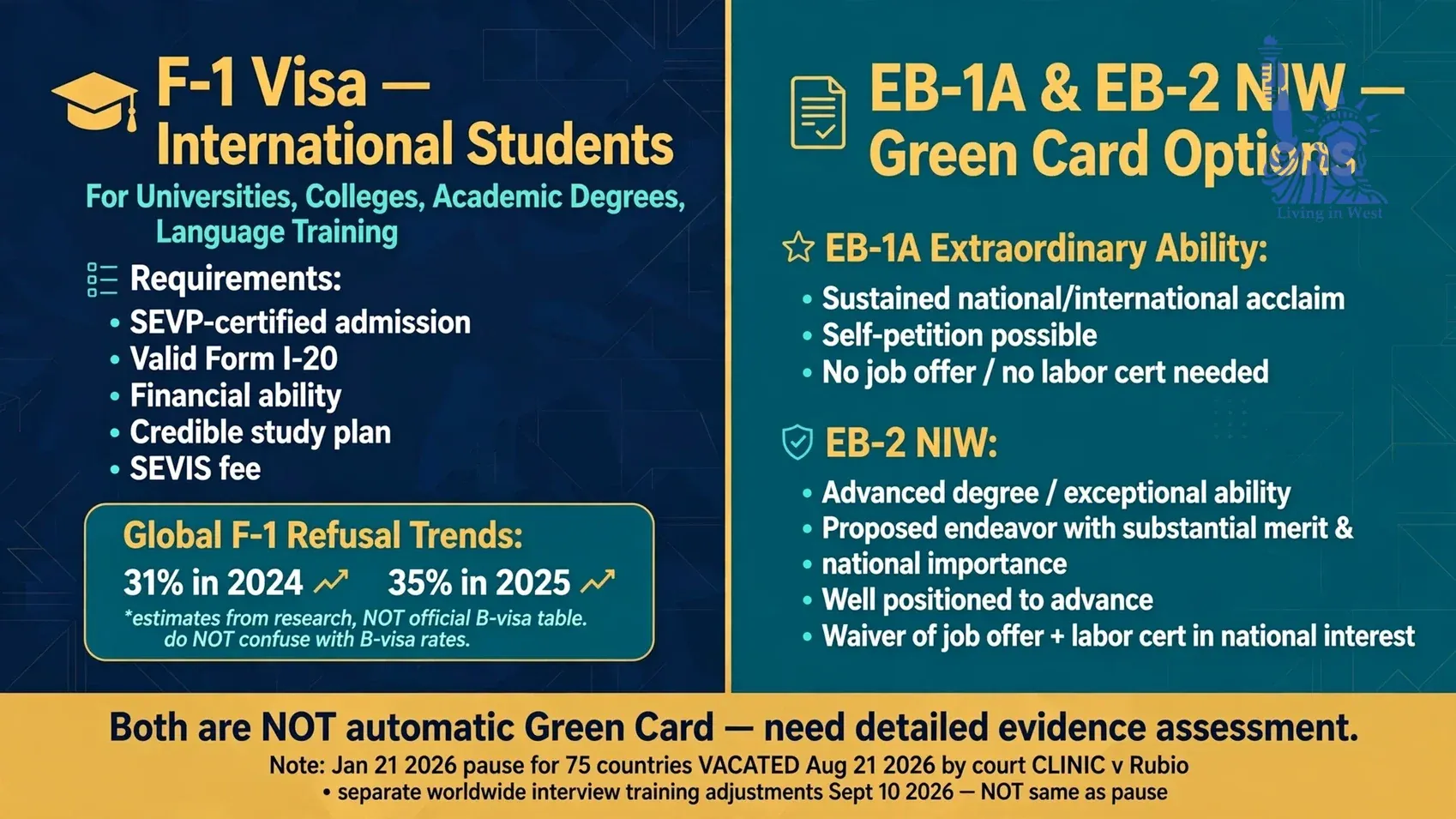
The F-1 visa allows eligible international students to study full-time at a U.S. school or institution authorized to enroll international students.
It is commonly used for:
- Universities and colleges
- Academic degree programs
- Certain language training programs
- Other qualifying academic studies
Main requirements
Applicants generally need:
- Admission to a qualifying SEVP-certified institution
- A valid Form I-20
- Evidence of financial ability to cover the expected costs
- A credible study plan
- Compliance with the applicable student visa requirements
Students normally pay the required SEVIS fee and apply for the F-1 visa through the relevant U.S. consular process.
Global student visa refusal trends
Third-party research has reported global F-1 refusal rates of approximately 31% in 2024 and 35% in 2025.
These figures should be treated as estimates from the cited research, not as a complete official Department of State country-by-country F-1 refusal table. They should not be confused with the official B-visa adjusted refusal rates presented earlier.
An applicant's academic history, funding, chosen course, study plans and individual circumstances remain important.
10. EB-1A and EB-2 NIW: Employment-Based Green Card Options
Unlike the temporary nonimmigrant visas discussed above, EB-1A and EB-2 NIW are employment-based immigrant classifications that may lead to U.S. permanent residence.
EB-1A: Extraordinary Ability
EB-1A is for individuals who can demonstrate extraordinary ability in the sciences, arts, education, business or athletics.
Applicants generally need to show sustained national or international acclaim and meet the applicable evidentiary requirements.
A qualifying applicant may self-petition without a specific U.S. job offer or labor certification.
EB-2 NIW: National Interest Waiver
The EB-2 National Interest Waiver is available to qualifying applicants who meet the underlying EB-2 requirements and demonstrate that waiving the job-offer and labor-certification requirements would be in the national interest of the United States.
Applicants commonly rely on evidence such as:
- Advanced degrees or exceptional ability
- A clearly defined proposed endeavor
- Evidence of the endeavor's substantial merit and national importance
- Qualifications and a record showing the applicant is well positioned to advance the endeavor
- Evidence supporting the case for waiving the job-offer and labor-certification requirements
Both categories require a detailed assessment of the applicant's evidence. Neither is an automatic Green Card route.
2026 immigrant-visa processing developments
Two separate developments in 2026 affected immigrant-visa processing. They should not be confused with the ordinary eligibility requirements for EB-1A or EB-2 NIW.
1. January 2026: Pause affecting nationals of 75 countries
The Department of State announced a pause on immigrant visa issuance for nationals of 75 countries, effective January 21, 2026. The policy was connected to a review of public-charge screening and concerns about applicants becoming dependent on public benefits.
Pakistan and several countries in Africa, Asia, Europe and Latin America were included in the original list.
On August 21, 2026, a federal court in CLINIC v. Rubio vacated the policy. The Department of State subsequently confirmed that the January 2026 pause was no longer in effect as of August 21.
On September 10, 2026, the Department sent instructions to U.S. embassies and consulates concerning implementation of the court decision and the resumption of immigrant-visa processing. The government later appealed. On October 19, the Second Circuit temporarily stayed the part of the district court's order dealing with the vacating and remanding of individual refusals based solely on the policy. It did not grant a temporary stay of the part that vacated the policy itself.
As of November 22, 2026, the appeal remains an active legal matter. Applicants whose cases were affected should check the latest court and Department of State updates rather than assume that every previously refused case has already been reopened or completed.
2. Separate worldwide adjustment of immigrant-visa interview appointments
A separate Department of State initiative involved additional training for consular officers worldwide on immigrant-visa screening and public-charge assessments.
A September 10, 2026 State Department cable instructed posts that immigrant-visa interview appointments would be adjusted to accommodate the global training initiative. Applicants whose appointments were rescheduled were to receive updated instructions directly from the relevant embassy or consulate.
This was separate from the January 2026 policy affecting nationals of 75 countries. It should not be described as the same nationality-based pause.
The distinction matters: the 75-country policy was vacated by the court, while the worldwide interview scheduling adjustments were connected to a separate training initiative. Appointment availability and processing timelines may vary by consular post and can change.
These developments concern immigrant-visa processing at U.S. embassies and consulates. They should not automatically be treated as a suspension of every USCIS petition or every adjustment-of-status application filed by someone already in the United States.
Practical advice: Before making travel, employment or relocation decisions, applicants should review the current Department of State immigrant-visa instructions, the relevant U.S. embassy or consulate notices and any applicable court developments.
What Do the Global Statistics Tell Us?
The available figures show why it is important to distinguish between visa categories and nationalities.
1. Visitor-visa refusal rates differ across countries
The FY2025 B-visa data show significant differences among countries. For example:
- Japan recorded a 5.68% adjusted refusal rate.
- Malaysia recorded 7.92%.
- France recorded 9.67%.
- India recorded 22.04%.
- Pakistan recorded 52.32%.
- Bangladesh recorded 61.45%.
- Nepal recorded 69.47%.
These figures describe B-visa refusal patterns only. They do not establish that a person from one country is more or less likely to qualify for an employment, student, investor or immigrant visa.
2. Treaty eligibility can matter more than a country's visitor-visa refusal rate
For E-2 investors, nationality is a threshold requirement. A Malaysian citizen cannot qualify for E-2 solely on the basis of Malaysian nationality because Malaysia is not currently an E-2 treaty country.
By contrast, nationals of treaty countries such as Singapore, Japan, Pakistan, Bangladesh and Turkey may explore E-2 eligibility if they meet the investment and other legal requirements.
3. H-1B selection is not the same as petition approval
The FY2024 and FY2025 H-1B registration figures show that selection rates can change between years. The weighted selection system effective for FY2027 adds another factor by giving more entries to higher wage levels.
However, selection is only one stage. Employers and beneficiaries must still satisfy the petition requirements.
4. Immigrant visa processing can change independently of eligibility
A person may qualify for an employment-based immigrant classification but still face delays in petition processing, visa availability, consular scheduling or administrative processing.
For this reason, applicants should separate three questions:
- Does the person qualify under the relevant immigration category?
- Is a visa number available, where required?
- Can the case proceed through the relevant USCIS or consular process at the present time?
Comparison: Which U.S. Visa Category May Fit Your Purpose?
| Your Main Purpose | Visa Category to Research |
|---|---|
| Temporary agricultural work | H-2A |
| Extraordinary professional or artistic ability | O-1 |
| Transfer within an international company | L-1A or L-1B |
| Specialty occupation employment | H-1B |
| Exchange program, research or training | J-1 |
| Marriage to a U.S. citizen fiancé(e) | K-1 |
| Investment in a U.S. business | E-2 |
| Tourism or permitted temporary business visit | B-1/B-2 |
| Full-time academic study | F-1 |
| Qualifying permanent immigration based on ability or national interest | EB-1A or EB-2 NIW |
Frequently Asked Questions
1. Which U.S. visa has the highest approval rate?
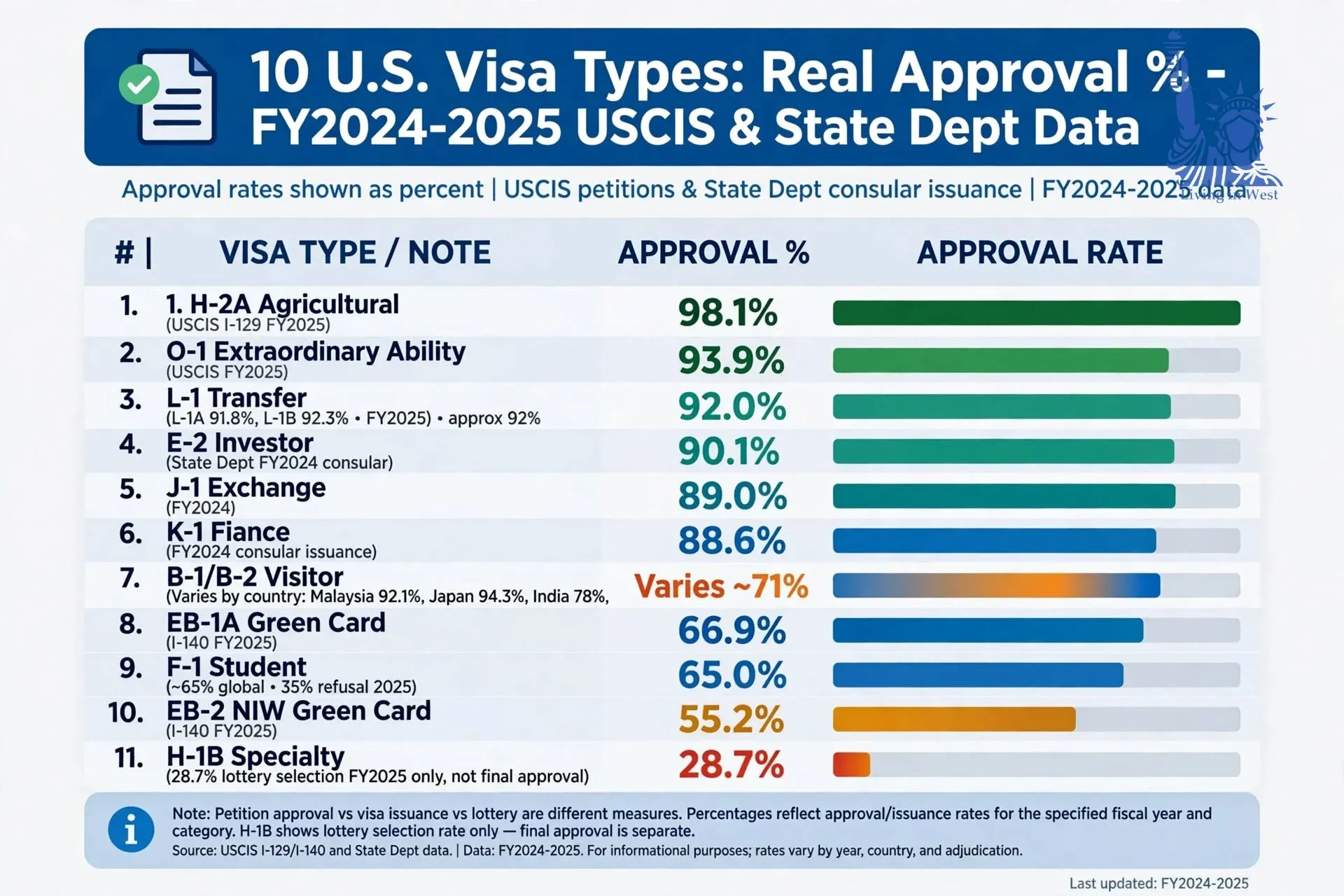
There is no reliable universal answer. Approval rates depend on the visa category, the applicant's circumstances, the year and the way the data is measured. B-visa refusal rates should not be used to rank employment or immigrant visa categories.
2. Does a high B-visa refusal rate mean applicants from that country cannot get a U.S. visa?
No. The adjusted refusal rate is a country-level statistic for B visas. It does not determine the outcome of an individual application and does not directly measure eligibility for H-1B, F-1, O-1, E-2 or employment-based immigrant categories.
3. Can Pakistani citizens apply for an E-2 visa?
Yes. Pakistan is an E-2 treaty country. Pakistani nationals may explore the E-2 category if they meet the investment, enterprise and other legal requirements.
4. Can Indian citizens apply for an E-2 visa?
India is not currently an E-2 treaty country. Indian nationality alone does not qualify someone for an E-2 visa. A person with another eligible treaty-country nationality may have a different result.
5. Can Malaysian citizens apply for an E-2 visa?
No, not on the basis of Malaysian nationality alone. Malaysia is not currently listed as an E-2 treaty country by the U.S. Department of State. A Malaysian citizen who also holds citizenship of an eligible treaty country may need a separate assessment of that nationality and the other E-2 requirements.
6. Does the H-1B weighted selection system guarantee selection for higher-paid workers?
No. The system gives more selection entries to registrations at higher applicable wage levels. It does not guarantee selection or approval of the H-1B petition.
7. Can an F-1 student work in the United States?
F-1 students may have access to certain authorized employment options, such as qualifying on-campus employment, Curricular Practical Training (CPT) and Optional Practical Training (OPT). These options have specific rules and limitations. Unauthorized employment can create serious immigration consequences.
8. Is the January 2026 pause on immigrant visas for 75 countries still in effect?
The Department of State confirmed that the January 2026 pause was no longer in effect as of August 21, 2026, following the federal court's order in CLINIC v. Rubio. The government appealed, and a portion of the order concerning individual prior refusals was temporarily stayed in October. Applicants should check the latest official instructions and court developments before relying on the status of a particular case.
9. Did the 2026 immigrant-visa interview adjustments affect tourist visas?
The worldwide interview scheduling adjustments discussed in this article concerned immigrant-visa services. They should not be confused with a general suspension of B-1/B-2 tourist visas. Applicants should always follow the current instructions of the embassy or consulate handling their application.
10. Which visa is best for someone who wants to move permanently to the United States?
There is no single best category for everyone. Depending on the person's background and circumstances, possible routes may include family-based immigration, employer-sponsored categories, EB-1A, EB-2 NIW or other immigrant classifications. Each has separate eligibility requirements and processing rules.
Conclusion
The U.S. immigration system offers different routes for visitors, students, temporary workers, investors, exchange participants and people seeking permanent residence. The most suitable option depends on the applicant's purpose, qualifications, nationality, employer or business arrangements and supporting evidence.
Global refusal statistics can help readers understand visitor-visa trends, but they should never be treated as personal approval predictions. Similarly, an H-1B selection, an approved petition or an E-2 treaty-country passport does not remove the need to satisfy the remaining legal requirements.
Immigration policies and court decisions can change quickly. Applicants should verify current rules through USCIS, the U.S. Department of State and the relevant U.S. embassy or consulate before taking action.
Sources and Official References
- U.S. Department of State — FY2025 Adjusted B-visa Refusal Rates:
- https://travel.state.gov/content/dam/visas/Statistics/Non-Immigrant-Statistics/RefusalRates/FY25.pdf
- USCIS — H-1B Electronic Registration Process:
- https://www.uscis.gov/working-in-the-united-states/temporary-workers/h-1b-specialty-occupations/h-1b-electronic-registration-process
- U.S. Department of State — Treaty Countries:
- https://travel.state.gov/content/travel/en/us-visas/visa-information-resources/fees/treaty.html
- U.S. Department of State — Treaty Trader and Treaty Investor Visas:
- https://travel.state.gov/content/travel/en/us-visas/employment/treaty-trader-investor-visa-e.html
- U.S. Department of State — Malaysia Visa Reciprocity Schedule:
- https://travel.state.gov/content/travel/en/us-visas/Visa-Reciprocity-and-Civil-Documents-by-Country/Malaysia.html
- U.S. Department of State — Immigrant Visa Processing Updates, August 28, 2026:
- https://travel.state.gov/en/newsroom/visas/2026/immigrant-visa-processing-updates-for-nationalities-at-high-risk-of-public-benefits-usage.html
- U.S. Department of State — Expanded Screening and Vetting for Visa Applicants:
- https://travel.state.gov/content/travel/en/us-visas/visa-information-resources/visas-news-archive/announcement-of-expanded-screening-and-vetting-for-visa-applicants.html
- U.S. Department of State — Visa Statistics:
- https://travel.state.gov/content/travel/en/legal/visa-law0/visa-statistics.html
Editorial note: Visa rules, court orders, fees and appointment procedures can change. This article is for general information and is not individualized legal advice. Readers should verify the current requirements for their own circumstances before filing an application.

Editorial Team