1: New York Homeownership in 2026 – How Many People Own Their Homes?
New York is home to millions of residents, but finding affordable housing remains a major challenge. Some households own properties they purchased years ago, while others continue paying mortgages or spend a significant portion of their income on rent.
The difference between New York State and New York City is particularly interesting.
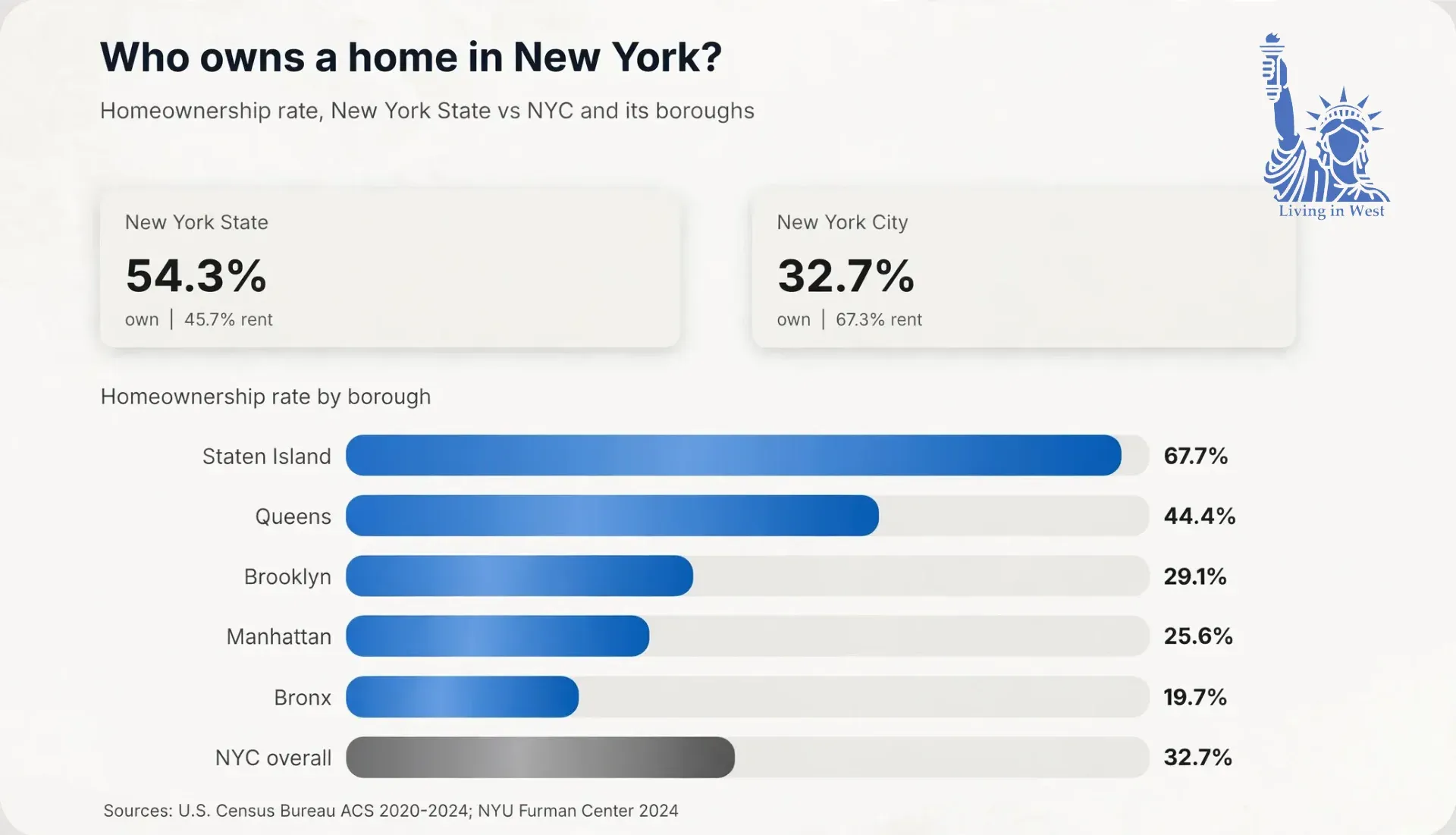
According to the latest available U.S. Census Bureau data for 2020–2024, approximately 54.3% of occupied housing units across New York State are owner-occupied.
In New York City, however, the homeownership rate is only 32.7%, according to NYU Furman Center's 2024 data.
This means that renting is much more common in NYC than in the rest of the state.
In this guide, we examine how New York's housing market works, how much people pay to rent or own properties, and what prospective homebuyers should understand before making a financial decision.
Quick Answer: New York Housing Statistics in 2026
| Housing Category | New York State | New York City |
|---|---|---|
| Homeownership Rate | 54.3% | 32.7% |
| Renter-Occupied Homes | 45.7% | 67.3% |
| Median Home Value | $423,800 | Varies by borough |
| Median Gross Rent | $1,621 | $1,641 (2023 contract rent) |
Sources: U.S. Census Bureau ACS 2020–2024 and NYU Furman Center 2024. NYC contract rent is from the 2023 Housing and Vacancy Survey.
These numbers reveal an important difference: homeownership is more common across New York State, while New York City remains predominantly a rental market.
1. How Many People Own Homes in New York?
New York State: 54.3% Homeownership
The latest available Census estimates show that 54.3% of occupied housing units across New York State are owner-occupied.
That means slightly more than half of households live in homes they own.
New York includes large metropolitan areas, suburban communities, smaller cities and rural towns. Housing prices and ownership opportunities vary considerably between these locations.
Some suburban communities offer traditional single-family houses, while densely populated urban neighborhoods have a much larger share of apartments and rental buildings.
New York City: Only 32.7% Own Their Homes
According to NYU Furman Center's 2024 homeownership data, approximately 32.7% of occupied housing units in New York City are owner-occupied.
The remaining 67.3% are renter-occupied.
NYC has a large rental housing market, with apartments, rent-stabilized buildings, condominiums and cooperative properties.
For many residents, purchasing a property requires considerably more savings than renting one.
2. Homeownership Rates by NYC Borough
The five boroughs have very different housing structures.
| Borough | Homeownership Rate |
|---|---|
| Staten Island | 67.7% |
| Queens | 44.4% |
| Brooklyn | 29.1% |
| Manhattan | 25.6% |
| Bronx | 19.7% |
| **NYC Overall** | **32.7%** |
Source: NYU Furman Center, 2024 data.
Why Does Staten Island Have More Homeowners?
Staten Island has a different housing structure compared with Manhattan and the Bronx.
It has more traditional residential neighborhoods and single-family housing opportunities.
Queens also has a comparatively high ownership rate because it includes a wider mix of residential property types.
Manhattan has a large concentration of rental apartments, condominiums and cooperative properties.
The Bronx has the lowest homeownership rate among the five boroughs.
For buyers considering NYC, these differences make neighborhood research especially important.
3. Why Is Homeownership Difficult in NYC?
Several factors make purchasing a home challenging.
- High Down Payments: A 20% down payment on an $800,000 property would require $160,000 upfront.
- Monthly Maintenance: Some co-op and condominium properties have substantial maintenance charges.
- Limited Space: Many available properties are apartments rather than traditional single-family homes.
- High Competition: Buyers often compete for desirable properties in established neighborhoods.
For people planning to settle in New York, understanding these differences is important before choosing a neighborhood.
2: How Many New Yorkers Still Pay a Mortgage?
Owning a home does not necessarily mean that the mortgage has been fully paid.
Many New York homeowners continue making monthly payments to their lenders. For some households, mortgage payments remain a major expense for 15, 20 or even 30 years.
The American Community Survey tracks housing costs for owners with and without mortgages.
According to the 2020–2024 Census data:
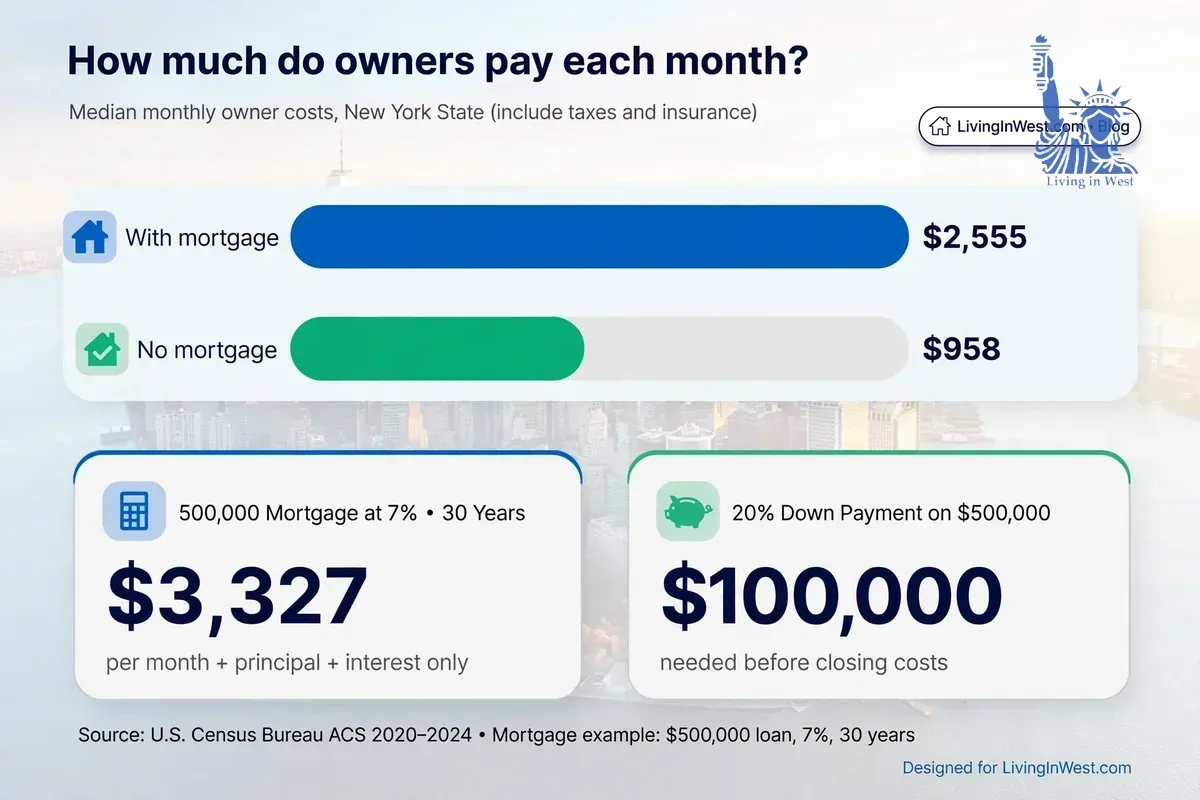
| Homeownership Expense | Median Monthly Cost |
|---|---|
| Owner Costs With a Mortgage | $2,555 |
| Owner Costs Without a Mortgage | $958 |
These are statewide median selected monthly owner costs, not mortgage principal and interest alone. They include relevant housing expenses such as property taxes and insurance.
4. Why Do So Many Homeowners Still Have Mortgages?
High Property Prices
New York's median owner-occupied home value was $423,800 in the 2020–2024 Census estimates.
For many households, purchasing a property without borrowing money is unrealistic.
In New York City, some neighborhoods have substantially higher property prices, making mortgage financing even more important.
Long Mortgage Repayment Periods
A 30-year fixed mortgage is a common financing option in the United States.
For example, a $500,000 mortgage at 7% interest over 30 years would require approximately $3,327 per month in principal and interest.
This amount excludes property taxes, insurance, maintenance and other expenses.
High Down Payment Requirements
Buyers who want to avoid private mortgage insurance on many conventional loans generally need a 20% down payment.
On a $500,000 property, that means saving $100,000 before closing costs.
This financial barrier can delay homeownership for younger households and first-time buyers.
Buying Homes Later in Life
In expensive housing markets, some residents delay purchasing until they have established careers, increased their savings and improved their financial position.
Consequently, some homeowners continue paying mortgages well into their later working years.
5. What Does Mortgage-Free Homeownership Mean?
A homeowner without a mortgage has paid off the loan used to purchase the property.
However, owning a property outright does not mean living there is completely free.
Homeowners may still pay:
- Property taxes.
- Homeowners insurance.
- Maintenance and repairs.
- Utilities.
- HOA or co-op charges, where applicable.
This is why mortgage-free homeowners still need to budget for housing expenses.
3: How Many People Rent in New York? NYC Rental Prices in 2026
Renting is a major part of New York's housing market.
Based on the 2020–2024 Census figures, approximately 45.7% of occupied housing units across New York State are renter-occupied.
In NYC, the share is substantially higher at approximately 67.3%.
This makes New York City one of the country's major renter-dominated housing markets.
6. NYC Rental Vacancy Rate: Why Is Finding an Apartment Difficult?
One of the biggest challenges for NYC renters is the limited availability of apartments.
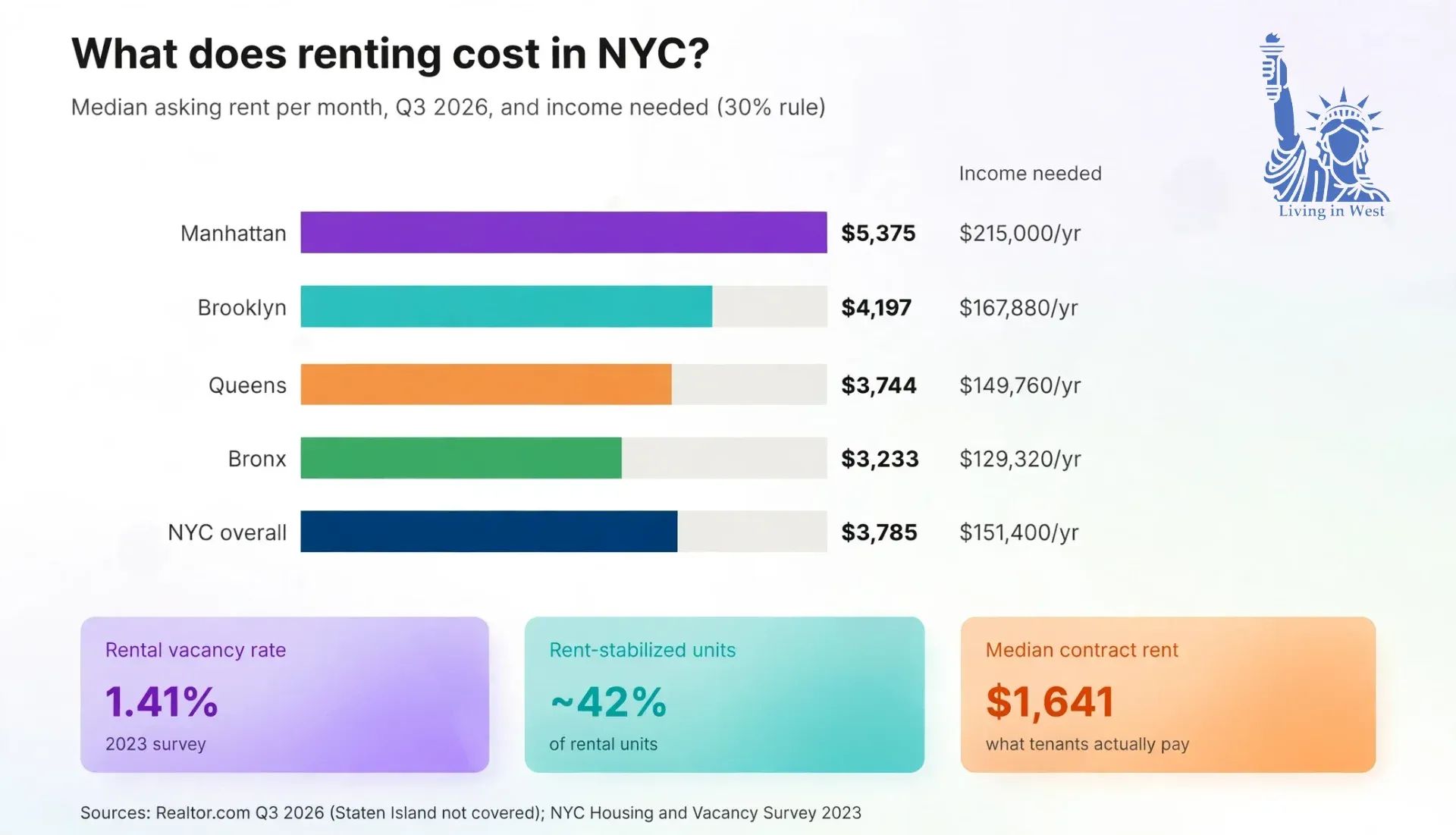
According to New York City's 2023 Housing and Vacancy Survey, the rental vacancy rate was just 1.41%.
The survey identified approximately 33,210 available rental units out of more than 2.3 million rental units.
This indicates a very tight rental market.
The vacancy rate for rent-stabilized apartments was even lower, at 0.98%, while private non-regulated rentals had a vacancy rate of 1.84%.
These are 2023 figures, not a newly measured 2026 vacancy rate.
7. What Are Rent-Stabilized Apartments?
Rent-stabilized apartments are subject to New York's rent regulation rules.
These regulations generally limit how much rent can increase for covered apartments and provide certain renewal protections to qualifying tenants.
For renters, these apartments can provide more predictable housing expenses compared with some market-rate rentals.
However, not every apartment in New York City is rent-stabilized.
According to the NYC housing data cited in this report, approximately 42% of rental units are rent-stabilized.
Eligibility depends on the building, apartment and applicable housing regulations.
8. Asking Rent vs. Actual Rent: What Is the Difference?
This is an important distinction when comparing New York rental statistics.
Median Asking Rent: The advertised price of apartments currently listed for rent.
Median Contract Rent: The rent paid under existing rental agreements by households already occupying their apartments.
These numbers can be very different.
For example, the 2023 NYC Housing and Vacancy Survey reported a median monthly contract rent of $1,641.
Meanwhile, newly advertised apartments can have much higher asking prices.
The reason is that existing tenants may have older leases, regulated rents or long-term rental arrangements.
Therefore, an advertised rent of $3,785 does not mean every NYC renter pays that amount.
9. NYC Median Asking Rents in Q3 2026
According to Realtor.com's Q3 2026 New York City Rental Report, median asking rents increased across the four boroughs covered in its analysis.
| Borough | Median Asking Rent | Annual Income Under 30% Rule |
|---|---|---|
| Manhattan | $5,375 | $215,000 |
| Brooklyn | $4,197 | $167,880 |
| Queens | $3,744 | $149,760 |
| Bronx | $3,233 | $129,320 |
| **NYC Overall** | **$3,785** | **$151,400** |
The income figures are based on the commonly used guideline that housing costs should not exceed 30% of gross household income.
Important: Realtor.com's Q3 2026 borough comparison does not include Staten Island because its data is under review.
10. Why Are NYC Rents So Expensive?
Several factors contribute to high rental prices.
- Limited Availability: The 2023 rental vacancy rate of 1.41% demonstrates how tight the housing market has been.
- Employment Opportunities: NYC attracts workers in finance, technology, healthcare, education and entertainment.
- Location: Apartments near major employment centers and public transportation can command higher rents.
- Housing Demand: Competition for available apartments puts pressure on advertised rental prices.
- Limited Affordable Supply: Rent-stabilized and other affordable housing options are not available to every household.
11. A New Rule About Rental Broker Fees
New York City introduced the Fairness in Apartment Rental Expenses Act, commonly known as the FARE Act.
The law became effective on June 11, 2025.
Under this law, landlords cannot pass the fees of brokers they hire onto prospective tenants.
However, tenants may still pay a broker fee if they independently hire a broker to represent them.
Landlords and their agents must also disclose rental fees before tenants sign a lease.
This is an important change for anyone planning to rent an apartment in NYC.
4: Buying vs. Renting in New York – Which Is Better in 2026?
One of the biggest financial decisions for New York residents is whether to continue renting or purchase a property.
Both options have advantages and disadvantages.
Renting can provide flexibility, while buying may help households build long-term property equity.
However, the difference in monthly expenses can be substantial.
12. How Much Does It Cost to Buy a Home in NYC?
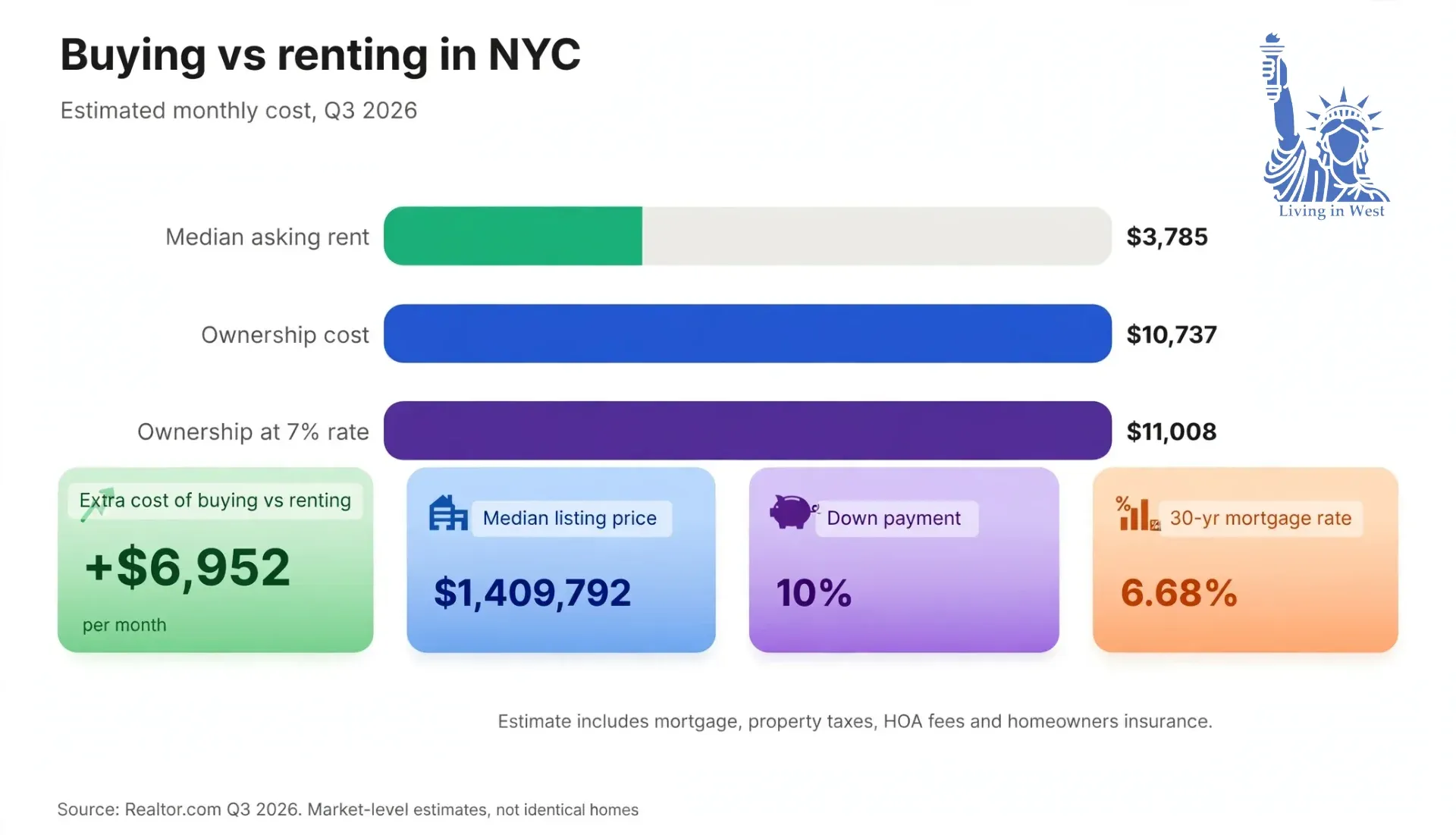
According to Realtor.com's Q3 2026 housing comparison, the estimated monthly cost of purchasing a median-priced home in NYC reached approximately $10,737.
The estimate uses the following assumptions:
| Calculation Detail | Q3 2026 Figure |
|---|---|
| Median Listing Price | $1,409,792 |
| Down Payment Assumption | 10% |
| Average 30-Year Mortgage Rate | 6.68% |
| Estimated Monthly Ownership Cost | $10,737 |
The monthly ownership estimate includes mortgage payments, HOA fees, property taxes and homeowners insurance.
At a 7% mortgage rate, the estimated monthly cost for the same property rises to approximately $11,008.
These are market-level estimates, not the monthly cost of every New York home.
13. Buying vs. Renting: Monthly Cost Comparison
| Housing Option | Estimated Monthly Cost |
|---|---|
| NYC Median Asking Rent | $3,785 |
| NYC Median Homeownership Cost | $10,737 |
| Ownership Cost at 7% Rate | $11,008 |
Based on these estimates, purchasing a median-priced NYC home costs approximately $6,952 more per month than renting at the city's median asking-rent level.
This represents a major affordability difference.
However, the comparison is between a median listing-price purchase and a median asking-rent property, not two identical homes.
14. When Does Renting Make More Sense?
Renting may be a practical choice if:
- You plan to stay in New York for only a few years.
- Your employment situation may change.
- You do not have sufficient savings for a down payment.
- You want flexibility to move between neighborhoods.
- You prefer not to handle property maintenance and repair costs.
15. When Should You Consider Buying?
Purchasing may be worth considering if:
- You have stable employment and reliable income.
- You have enough savings for the down payment and closing costs.
- You intend to remain in the same area for many years.
- You can comfortably manage property taxes, insurance and maintenance.
- You want to build long-term equity.
There is no universal rule that buying becomes cheaper after a fixed number of years.
The decision depends on mortgage interest, property appreciation, rent increases, transaction costs and the length of time you remain in the home.
5: New York Property Taxes, Cost of Living and Population Changes
16. New York Property Taxes – An Important Cost for Homeowners
Mortgage payments are not the only expense associated with purchasing a home.
Property taxes can significantly increase the cost of homeownership, particularly in some suburban and upstate communities.
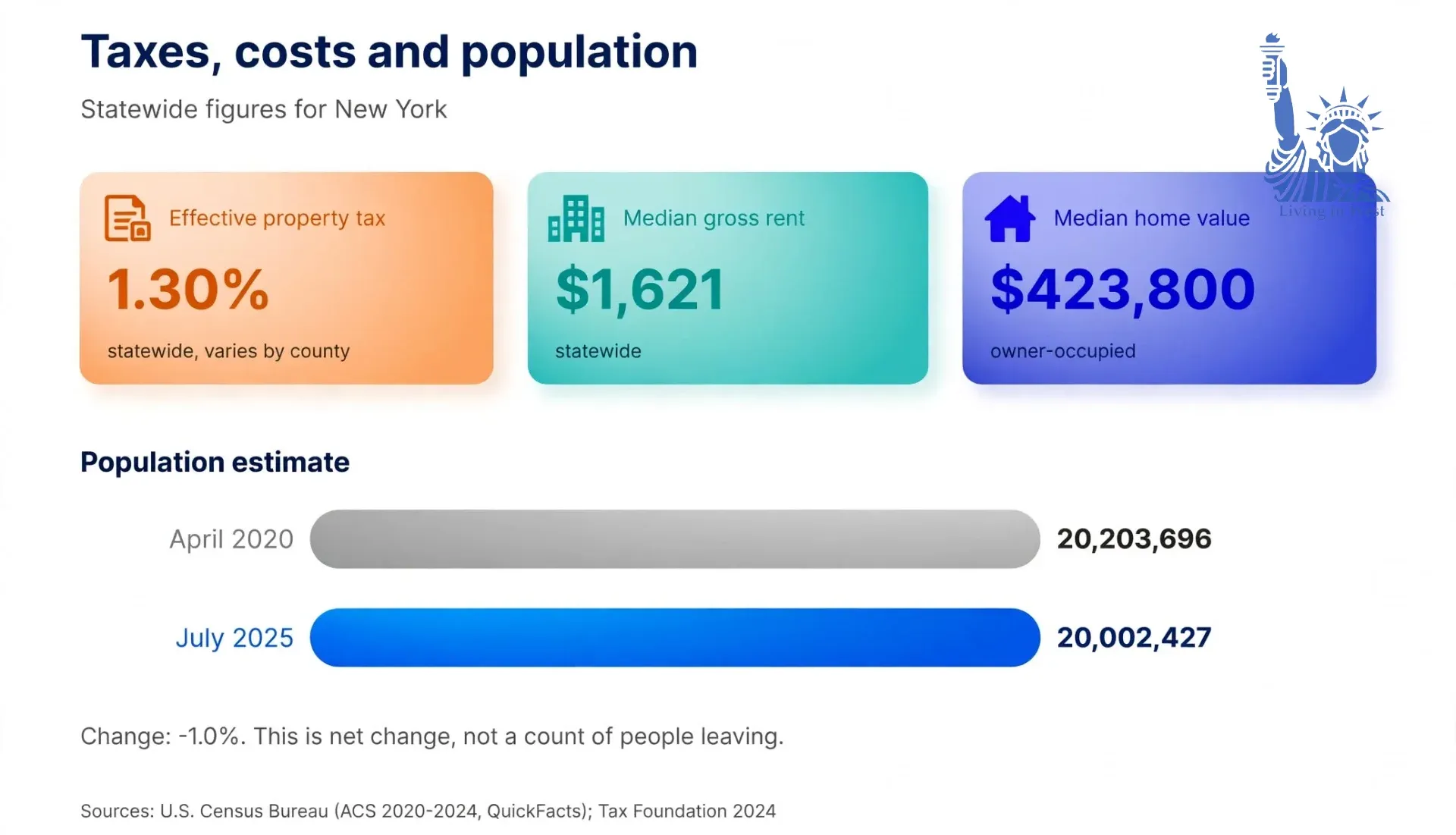
According to Tax Foundation's 2024 Census-based calculations, New York State had an effective property tax rate of approximately 1.30%.
This is the statewide effective rate, not a rate that applies equally to every county or property.
Why Do Property Taxes Differ Across New York?
Property taxes are generally determined through local tax systems.
School district levies, municipal budgets, property assessments and available exemptions all affect the final tax bill.
A homeowner in one county may face a considerably different annual bill from someone with a similarly priced home elsewhere.
What Should Buyers Check?
Before purchasing a home, compare:
- The property's current annual tax bill.
- The assessed value and assessment history.
- School district and municipal tax charges.
- Available exemptions.
- Homeowners insurance.
- HOA or condominium maintenance fees.
A property with an attractive purchase price may become considerably more expensive once taxes and other recurring costs are included.
For accurate comparisons, buyers should review individual county tax records rather than relying on a single statewide percentage.
17. Cost of Living in New York in 2026
Housing is generally one of the largest expenses for people living in New York.
However, the total cost of living also includes groceries, transportation, healthcare, utilities, insurance and other daily expenses.
The latest available Census figures provide a useful starting point for understanding housing costs.
Statewide Housing Expense Comparison
| Housing Expense | Median Monthly Cost |
|---|---|
| Owner Costs With Mortgage | $2,555 |
| Owner Costs Without Mortgage | $958 |
| Median Gross Rent | $1,621 |
Source: U.S. Census Bureau, 2020–2024 American Community Survey.
These are statewide figures and should not be treated as the cost of living in Manhattan or another specific NYC borough.
Why Does Location Matter?
A person living in Manhattan may face very different housing expenses from someone living in Queens, Buffalo, Rochester or Albany.
The same is true for transportation and everyday expenses.
- Manhattan residents may pay more for centrally located apartments.
- Queens offers a different mix of apartment and residential housing options.
- Buffalo and Rochester have different housing markets from NYC.
- Suburban residents may need to budget for commuting and car ownership.
There is no single salary that guarantees a comfortable lifestyle throughout New York State.
Household size, housing arrangements, transportation, healthcare coverage and savings goals all affect the amount of income required.
For people planning a move, comparing individual neighborhoods is more useful than relying on one statewide cost-of-living estimate.
18. Why Are People Leaving New York?
New York continues to experience changes in its population as residents move between states and international migrants arrive.
Housing affordability is one of the issues that influences relocation decisions.
Other considerations include employment opportunities, taxes, family circumstances, retirement plans and lifestyle preferences.
New York Population in 2025
According to U.S. Census Bureau QuickFacts, New York's estimated population was 20,002,427 on July 1, 2025.
The state's population estimate was approximately 1.0% lower than its April 2020 population estimate base of 20,203,696.
This provides a useful indication of the state's population change over the period.
However, population change is influenced by several factors, including domestic migration, international migration and natural population change. It should not be interpreted as a direct count of residents leaving New York.
Five Reasons Some Residents Consider Moving
1. Housing Affordability
High rents and home prices can make it difficult for families to save money or purchase property.
2. Tax Expenses
Residents may consider the combined impact of state income taxes, NYC income taxes where applicable, and local property taxes.
3. Remote Employment
Remote and flexible work arrangements allow some employees to consider living outside expensive metropolitan areas.
4. Larger Homes
Some families prefer suburban communities where they may have access to larger houses and additional living space.
5. Retirement Planning
Retirees sometimes compare housing costs, taxes, healthcare access and lifestyle options before choosing where to settle.
Does New York Still Attract New Residents?
Yes. New York remains an important destination for employment, education, international business, healthcare and financial services.
Its population trends reflect a combination of domestic movement and international migration.
For anyone considering relocation, comparing the full cost of living and employment opportunities is more useful than looking at housing prices alone.
6: First-Time Homebuyer Programs, FAQs and Final Verdict
19. First-Time Homebuyer Programs in New York
Purchasing a first home can be difficult, especially for people who have limited savings.
Fortunately, New York offers several programs designed to help eligible buyers with mortgage financing and down payments.
Two important options are the NYC HomeFirst Down Payment Assistance Program and SONYMA mortgage assistance programs.
1. NYC HomeFirst Down Payment Assistance Program
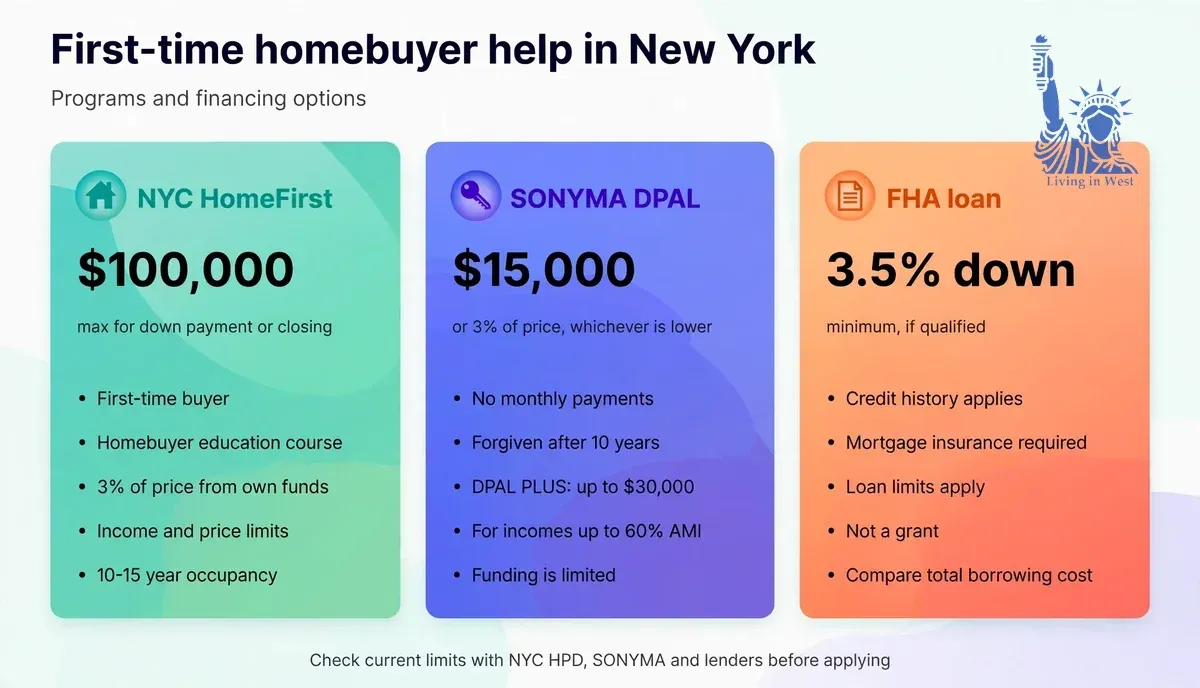
The HomeFirst program provides eligible first-time homebuyers with up to $100,000 toward the down payment or closing costs of an eligible property in New York City.
The program can be used for qualifying one-to-four-family homes, condominiums and cooperative apartments.
Some important requirements include:
- The applicant must qualify as a first-time homebuyer.
- Applicants must complete an approved homebuyer education course.
- Buyers must work with an approved housing counseling agency.
- Applicants must meet household income limits.
- Buyers must contribute at least 3% of the purchase price from their own funds.
- The property must be used as the buyer's primary residence.
The program also has purchase-price limits and occupancy requirements.
For assistance of $40,000 or less, the required occupancy period is generally 10 years. For assistance above $40,000, it is generally 15 years. City-funded loans have a 15-year occupancy requirement.
The program's published income limits effective June 1, 2026, range from $142,560 for a one-person household to $268,680 for an eight-person household.
Eligibility depends on household size, property location, purchase price and other program requirements.
2. SONYMA Down Payment Assistance
The State of New York Mortgage Agency (SONYMA) offers mortgage programs for eligible homebuyers.
Its standard Down Payment Assistance Loan (DPAL) has offered assistance of up to 3% of the purchase price or $15,000, whichever is lower.
The assistance can be used toward eligible down payment and closing costs.
Under the standard DPAL terms, there are no monthly payments and the loan is generally forgiven after 10 years, subject to program conditions.
SONYMA also introduced DPAL PLUS 2026, an enhanced program offering up to $30,000 to eligible lower-income homebuyers.
The enhanced program has a maximum household income of 60% of Area Median Income, and funding is limited.
Buyers should check current availability and conditions with SONYMA participating lenders before applying.
3. FHA Loans
FHA-insured mortgages are another financing option for eligible first-time buyers.
Depending on credit history and other requirements, qualified borrowers may be able to purchase a home with a down payment as low as 3.5%.
FHA loans include mortgage insurance requirements and are subject to loan limits and lender approval.
They are not the same as a down payment grant, and buyers should compare the total borrowing cost before choosing a mortgage.
20. First-Time Homebuyer Checklist
Before purchasing your first home in New York:
- Check your credit history.
- Calculate an affordable monthly payment.
- Save for the down payment.
- Keep money available for closing costs.
- Compare mortgage lenders.
- Check property taxes.
- Review HOA or co-op maintenance charges.
- Get mortgage pre-approval.
- Confirm eligibility for assistance programs.
- Keep an emergency savings fund.
Official program information should always be checked before submitting an application.
Frequently Asked Questions About New York Homeownership and Renting
Q1. What percentage of people own homes in New York?
According to the 2020–2024 Census estimates, approximately 54.3% of occupied housing units across New York State are owner-occupied.
Q2. What percentage of people own homes in NYC?
According to NYU Furman Center's 2024 data, approximately 32.7% of occupied housing units in New York City are owner-occupied.
Q3. How many New Yorkers rent their homes?
Approximately 45.7% of occupied housing units across New York State are renter-occupied. In New York City, the renter share is approximately 67.3%.
Q4. What is the median rent in New York City in 2026?
Realtor.com's Q3 2026 report puts NYC's median asking rent at $3,785 per month. This measures advertised rental listings, not the rent paid by every existing tenant.
Q5. Which NYC borough has the highest homeownership rate?
Staten Island has the highest homeownership rate among the five boroughs, at approximately 67.7% in the 2024 NYU Furman Center data.
Q6. Which NYC borough has the lowest homeownership rate?
The Bronx has the lowest rate, at approximately 19.7%, according to the same 2024 data.
Q7. Is buying a home more expensive than renting in NYC?
Based on Realtor.com's Q3 2026 market estimates, monthly ownership costs for a median-priced NYC home were approximately $10,737, compared with $3,785 in median asking rent.
Q8. What is the rental vacancy rate in New York City?
The 2023 NYC Housing and Vacancy Survey reported a rental vacancy rate of 1.41%.
Q9. What is the median home value in New York State?
The U.S. Census Bureau reported a median owner-occupied home value of $423,800 for New York State in its 2020–2024 estimates.
Q10. Are there first-time homebuyer assistance programs in New York?
Yes. Eligible buyers may qualify for NYC HomeFirst assistance, SONYMA mortgage programs and other financing options, depending on their income, property and eligibility.
Q11. Why are people moving away from New York?
Housing expenses, taxes, employment flexibility, family needs and retirement planning are among the factors that may influence relocation decisions.
Q12. Are property taxes high in New York?
New York's statewide effective property tax rate was approximately 1.30% in the 2024 Census-based Tax Foundation calculations. Actual rates and annual tax bills vary significantly by county and property.
Final Verdict: Should You Buy or Rent in New York in 2026?
New York's housing market offers different opportunities depending on where people choose to live.
Across the state, homeownership is more common than it is in New York City. In NYC, approximately two-thirds of occupied housing units are renter-occupied, reflecting the city's expensive and highly competitive housing market.
For people with limited savings, uncertain employment or plans to relocate within a few years, renting may offer greater flexibility.
For households with stable income, sufficient savings and long-term plans, purchasing a property may provide an opportunity to build equity and establish roots in a community.
However, buyers should never evaluate a property based only on its purchase price or mortgage payment. Property taxes, insurance, maintenance, interest rates and closing costs all matter.
The most important step is to compare the complete cost of renting and owning before making a decision.
New York remains an important place to live, work and build a career, but understanding its housing market is essential for anyone planning to settle there.
Disclaimer
This article is for general informational and educational purposes only. Housing statistics are based on different reporting periods and methodologies, as identified throughout the article. Rental prices, mortgage rates, property taxes and government assistance programs can change. Estimates should not be treated as guaranteed costs or individual financial advice. Always verify current information with official government agencies, lenders and housing authorities before making a property or financial decision.
Sources and Further Reading
- U.S. Census Bureau – New York QuickFacts and Housing Statistics
- NYU Furman Center – State of Homeowners and Their Homes 2025
- Realtor.com – New York City Rental Report Q3 2026
- NYC Government – Fast Facts About Housing in NYC
- NYC Government – FARE Act Information
- NYC HPD – HomeFirst Down Payment Assistance Program
- New York State Homes and Community Renewal – SONYMA DPAL PLUS 2026
- Tax Foundation – Property Taxes by State and County
Editorial Team