Introduction: Two Florida Cities, Two Different Housing Markets
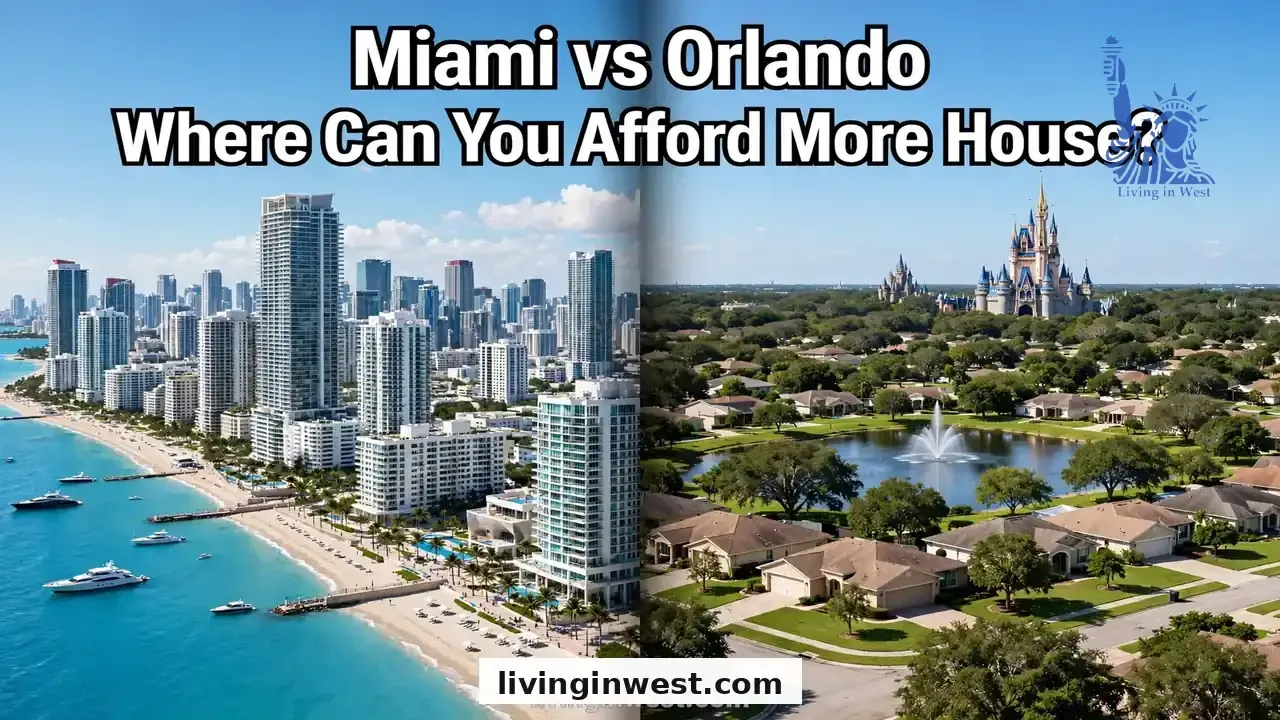
Choosing between Miami and Orlando in 2026 is not simply a decision between an expensive city and an affordable one. The two markets are moving differently, and those differences matter for homebuyers, renters, landlords and business owners.
Miami is known for its coastal neighborhoods, international business connections, luxury condominiums and diverse culture. Orlando has a strong tourism economy, major healthcare employers, universities and expanding suburban communities.
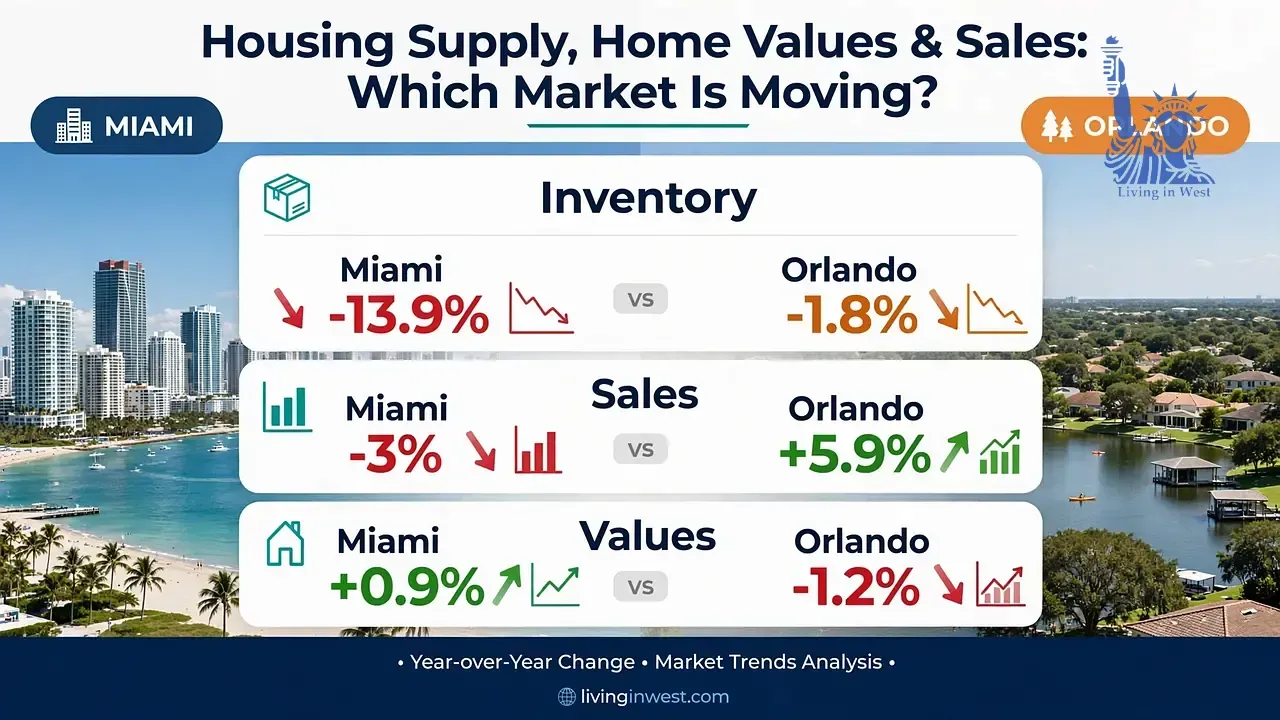
Recent Zillow data reveals an interesting contrast: Miami's typical home value increased by 0.9% over the year, while Orlando's declined by 1.2%. At the same time, Orlando's estimated home sales count increased by 5.9%, whereas Miami's fell by 3%. These figures suggest different market conditions rather than a simple winner and loser. <sup>Source: Zillow, September 2026 Market Report</sup>
For buyers, the bigger question is how much house their budget can support, what a mortgage will cost and whether the property fits their long-term plans.
1. Miami vs Orlando: Housing Market at a Glance
The following figures cover the metropolitan markets reported by Zillow, rather than only properties inside each city's municipal boundaries. This distinction matters because metro areas include surrounding communities with different housing prices and rental markets
| Housing indicator, September 2026 | Miami metro | Orlando metro |
|---|---|---|
| Typical home value | $478,411 | $383,561 |
| Year-over-year home value change | +0.9% | -1.2% |
| Typical monthly rent | $2,654 | $1,929 |
| Year-over-year rent change | +1.8% | +0.8% |
| Year-over-year inventory change | -13.9% | -1.8% |
| Estimated sales-count change | -3.0% | +5.9% |
Source: Zillow's September 2026 Market Report. Home values are Zillow Home Value Index estimates, rents use its Observed Rent Index, and sales figures are preliminary estimates. These measures are not the same as median closed-sale prices. Read the report.
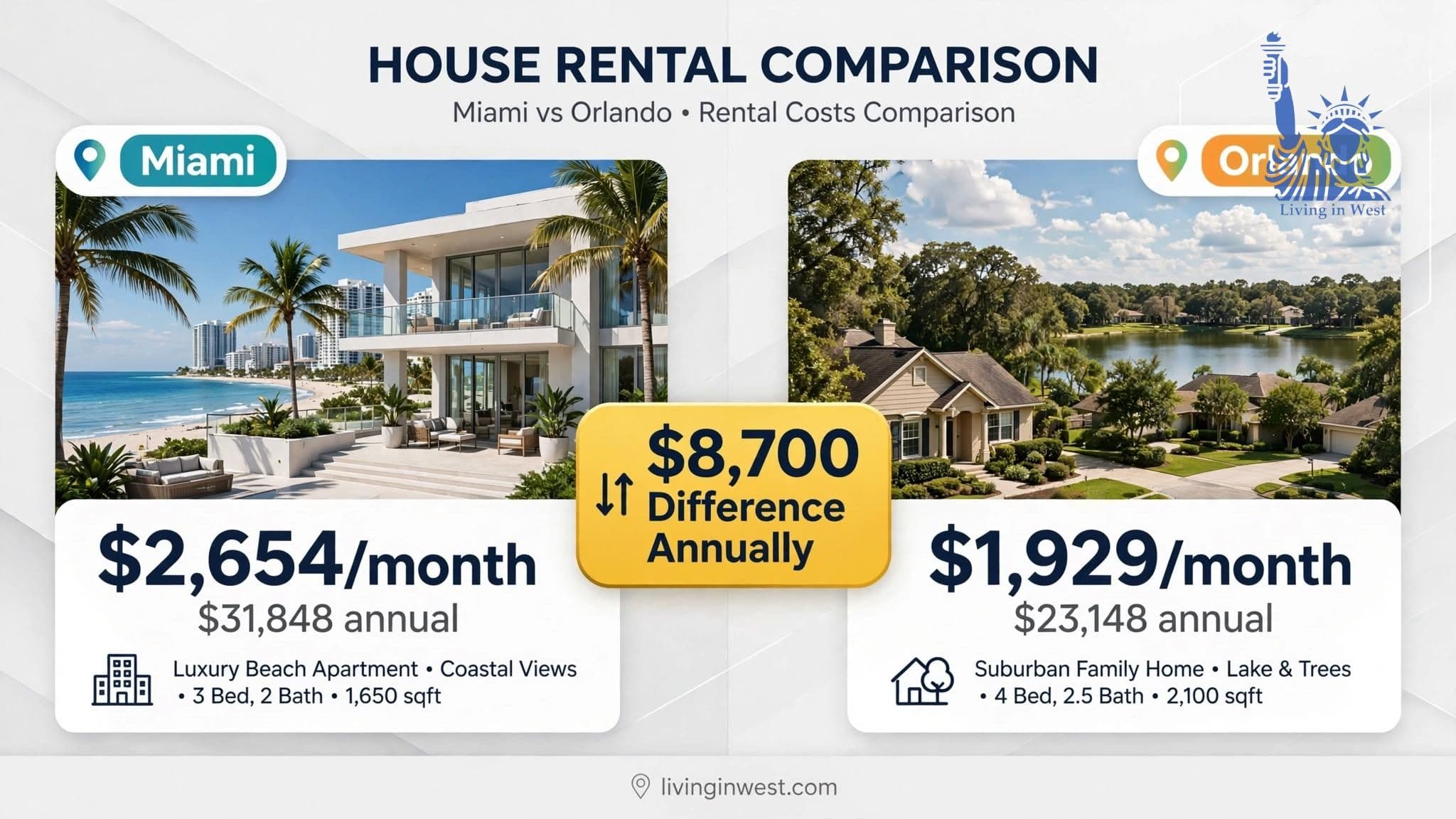
Three details stand out. First, Miami's typical home value is about $94,850 higher than Orlando's. Second, the typical rent difference is $725 per month, or $8,700 annually. Third, Miami's available inventory fell more sharply over the year, while Orlando recorded more sales than a year earlier.
These trends do not guarantee future appreciation. They provide a useful starting point for comparing the two markets.
2. Cost of Living: What Does It Really Cost to Live There?
Housing is usually one of the largest household expenses, but the full cost of living includes transportation, utilities, groceries, healthcare, insurance and entertainment.
Miami residents may pay more for housing in popular coastal or central neighborhoods. Parking and commuting can also add costs, particularly for people who work in busy business districts.
Orlando offers more choices in suburban communities, but a lower housing price does not automatically mean a lower total monthly budget. A home far from work may require additional driving, fuel and vehicle maintenance.
| Expense | Miami | Orlando |
|---|---|---|
| Typical rent | $2,654/month | $1,929/month |
| Annual rent at typical rate | $31,848 | $23,148 |
| Rent difference | $8,700 more annually | $8,700 less annually |
| Transportation | Traffic and parking can be expensive | Many suburbs require a car |
| Utilities | Depends on property size and energy use | Depends on property size and energy use |
| Insurance | Check wind, flood and building-specific risks | Check storm, flood and property-specific risks |
The rent comparison is particularly useful for people deciding whether to rent before buying. A household choosing Orlando could have more room in its budget for savings, a future down payment or retirement contributions, assuming its other expenses and income are comparable.
Florida also does not impose a personal state income tax. This applies to residents of both Miami and Orlando, so it is not a financial advantage that one city has over the other. Federal income taxes and other applicable taxes still matter. Florida Department of Revenue.
3. Mortgage Rates in 2026: The Cost Buyers Cannot Ignore
A property's asking price is only part of the affordability calculation. The mortgage rate determines how much interest a buyer pays over time and how much of their monthly income goes toward the loan.
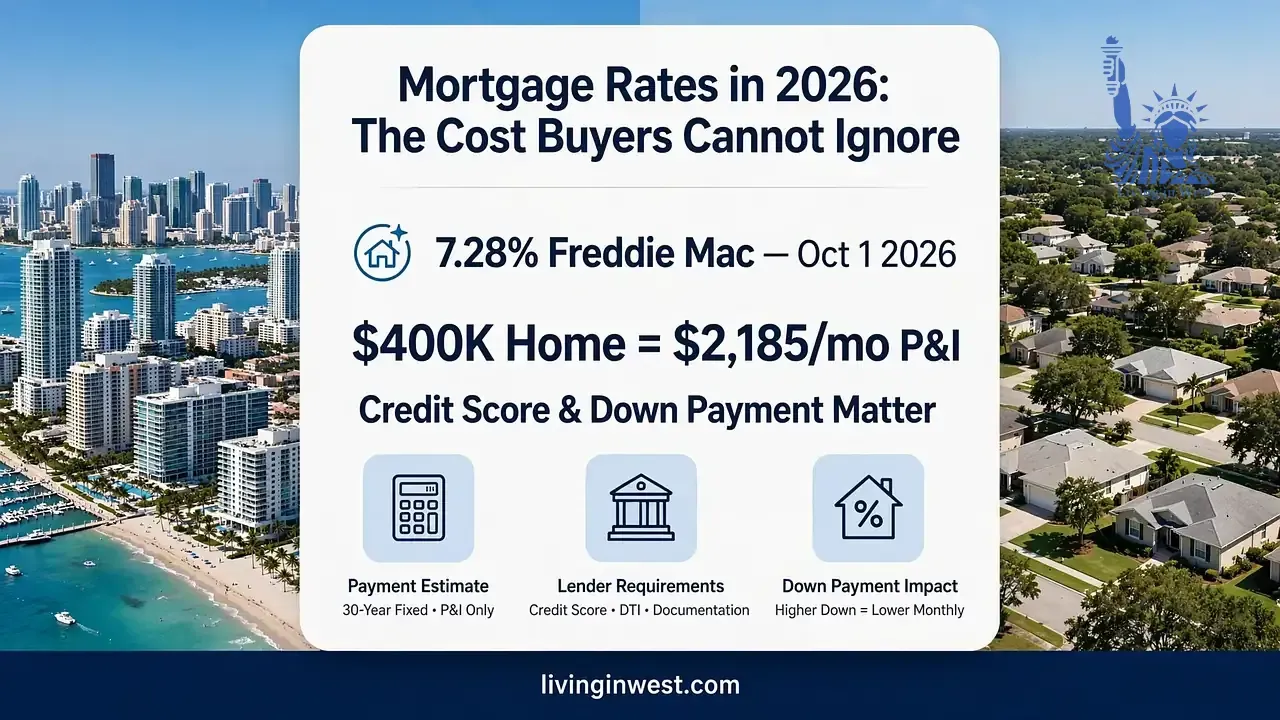
Freddie Mac reported an average 30-year fixed mortgage rate of 7.28% on October 1, 2026, up from 7.03% the previous week. This is a national benchmark, not a guaranteed rate for every borrower. Credit scores, down payments, loan type and lender terms can change the rate offered. Freddie Mac mortgage-rate archive.
At higher rates, a home that looked affordable when rates were lower may stretch a household's budget.
What would a $400,000 home cost each month?
Assume a buyer purchases a $400,000 home with a 20% down payment and a 30-year fixed mortgage at 7.28%.
| Mortgage calculation | Amount |
|---|---|
| Purchase price | $400,000 |
| Down payment, 20% | $80,000 |
| Mortgage principal | $320,000 |
| Illustrative interest rate | 7.28% |
| Loan term | 30 years |
| Estimated monthly principal and interest | About $2,185 |
This estimate covers principal and interest only. Property taxes, homeowners insurance, possible flood insurance, HOA fees and maintenance are additional.
The lesson is important for both markets: buyers should calculate the entire monthly ownership cost before deciding how much they can afford.

4. What Does the Same Budget Buy in Miami vs Orlando?
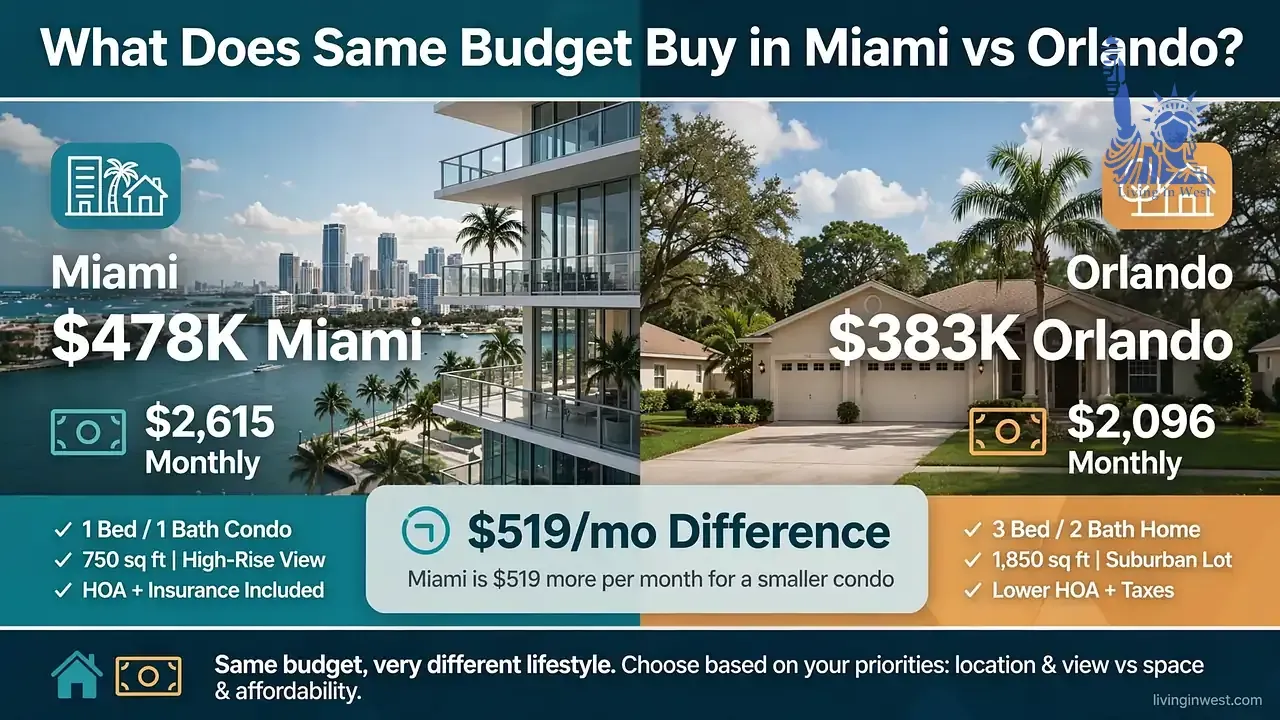
A $400,000 budget provides a useful comparison because it is close to Orlando's typical metropolitan home value but below Miami's typical home value.
It does not mean every $400,000 property will have the same size, condition or features. Neighborhood, property type and location can produce very different results.
Illustrative mortgage comparison
For a simple comparison, assume 20% down, a 30-year fixed mortgage and a 7.28% interest rate for both markets.
| Calculation | Miami metro typical value | Orlando metro typical value |
|---|---|---|
| Home value | $478,411 | $383,561 |
| 20% down payment | $95,682 | $76,712 |
| Mortgage principal | $382,729 | $306,849 |
| Estimated monthly principal and interest | About $2,615 | About $2,096 |
Estimates are rounded and exclude property taxes, insurance, HOA fees and maintenance. Actual loan offers may differ.
Under these assumptions, the Miami mortgage payment would be approximately $519 more per month, or about $6,228 more annually, before additional ownership expenses.
For a buyer with a fixed budget, Orlando may therefore offer a more manageable starting point. Miami may still make sense for someone who values its location, career opportunities or particular neighborhood enough to justify the higher cost.
5. Housing Supply, Home Values and Sales: Which Market Is Moving?
Property values alone do not tell the entire story. Inventory, sales activity and rental demand help explain whether buyers are facing a competitive market or have more room to negotiate.
Miami's reported inventory declined 13.9% year over year in September 2026. Orlando's inventory declined by a smaller 1.8%. In the same period, Miami's estimated sales count was down 3%, while Orlando's was up 5.9%. Zillow's market data.
What the figures may mean for buyers
Miami's combination of slightly higher home values and lower inventory may indicate that available choices are tightening in parts of the market. Buyers should still compare individual properties because condominium inventory and detached-home supply can behave differently.
Orlando's lower typical home value, declining annual value measure and higher estimated sales count may create opportunities to compare listings and negotiate. However, these citywide trends do not prove that every seller is willing to accept a discount.
Where to look
Miami: Brickell, Edgewater, Wynwood and Coconut Grove offer different combinations of apartments, condominiums and houses. Compare association fees, building finances, flood exposure and access to work.
Orlando: Lake Nona, Winter Garden, Horizon West and Lake Mary offer varied suburban housing options. Compare construction quality, commute times, community fees and the number of competing homes nearby.
The best neighborhood is the one whose total costs, location and property condition fit your needs—not simply the one with the most attractive market headline.
6. Jobs and Employment: Orlando's Growth Advantage
Employment matters to real estate because households need income to pay rent, qualify for mortgages and maintain homes.
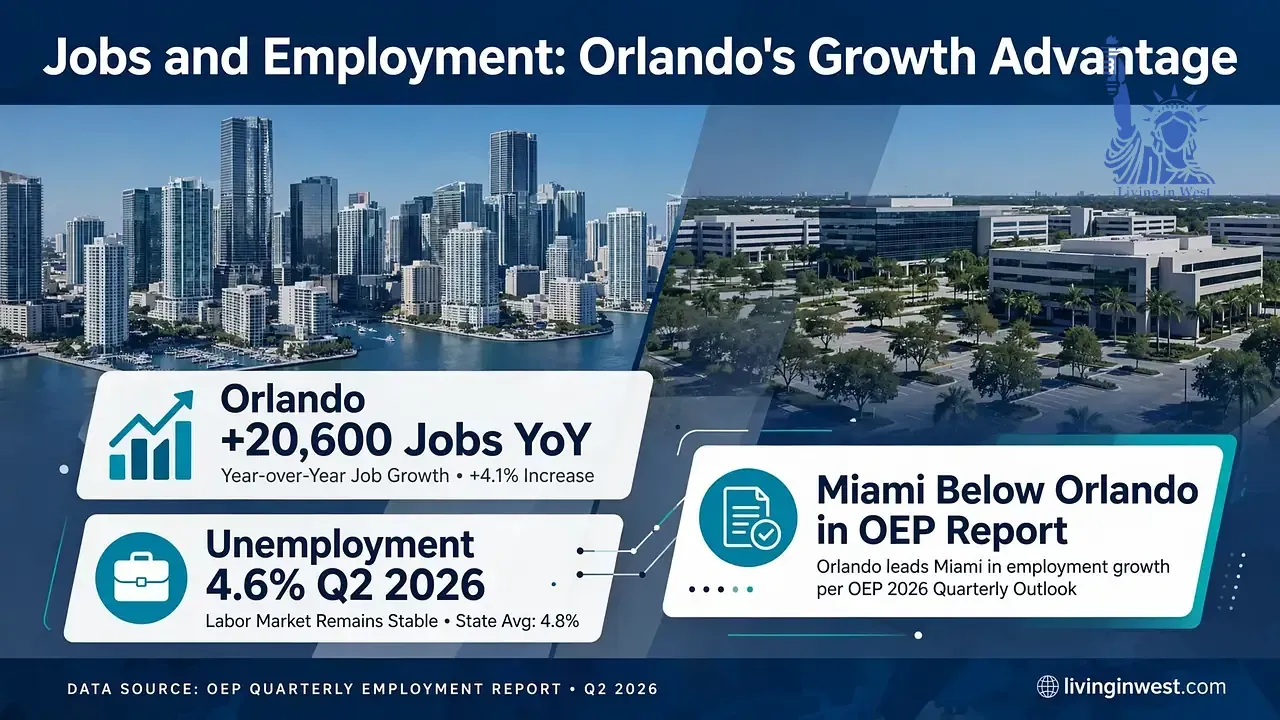
The Orlando Economic Partnership's Q2 2026 market update reported that the Orlando metropolitan area added 20,600 jobs in the year ending June 2026. The organization said that was more than Miami, Tampa and Jacksonville combined and represented half of Florida's total job growth over that period. The same report noted that Orlando's unemployment rate had risen to 4.6% in the second quarter. Orlando Economic Partnership market update.
That combination is worth understanding. Strong job additions can support housing demand, but rising unemployment suggests that not every job seeker will find work easily.
Miami has a broad employment base in finance, international trade, logistics, aviation, healthcare, hospitality and professional services. Orlando has significant activity in tourism, healthcare, education, technology-related work and entertainment.
| Employment factor | Miami | Orlando |
|---|---|---|
| International finance and trade | Major regional strength | Present, but less central to its identity |
| Tourism and hospitality | Important sector | Major regional sector |
| Healthcare and education | Established institutions and employers | Large healthcare systems and universities |
| Recent job-growth evidence | The OEP comparison places it below Orlando's reported job additions | 20,600 jobs added over the year ending June 2026 |
| What job seekers should check | Occupation-specific openings and salaries | Occupation-specific openings and salaries |
Orlando's reported job-growth advantage is meaningful, but it is not proof that everyone will find a better job there. Applicants should compare current vacancies, wages, benefits and commute costs in their own profession.
7. Business Opportunities: Where Should Entrepreneurs Start?
Miami can be attractive to companies serving international clients, Latin American markets, finance, import-export, hospitality and premium consumers. Its business connections can be valuable, although prime commercial locations and competition may be expensive.
Orlando may suit companies involved in tourism services, healthcare, technology, property management, home improvement, construction and services for growing residential communities.
For a small business, operating costs matter as much as the size of the market. Commercial rent, employee wages, insurance, permits and customer acquisition can affect profitability.
| Business type | Miami opportunity | Orlando opportunity |
|---|---|---|
| Import-export | International trade connections | Regional distribution and service opportunities |
| Real estate services | Condominiums, premium homes and property management | Suburban sales, rentals and new communities |
| Tourism | Hotels, restaurants and coastal experiences | Attractions, visitor services and family tourism |
| Home services | Dense urban neighborhoods and premium properties | Suburban homes, maintenance and renovation |
| Technology | Finance-related and international business services | Tourism technology, healthcare and simulation-related sectors |
Before opening a business, research the target customer, local competitors, lease terms and expected monthly expenses. Neither city's reputation guarantees higher sales or lower operating costs.
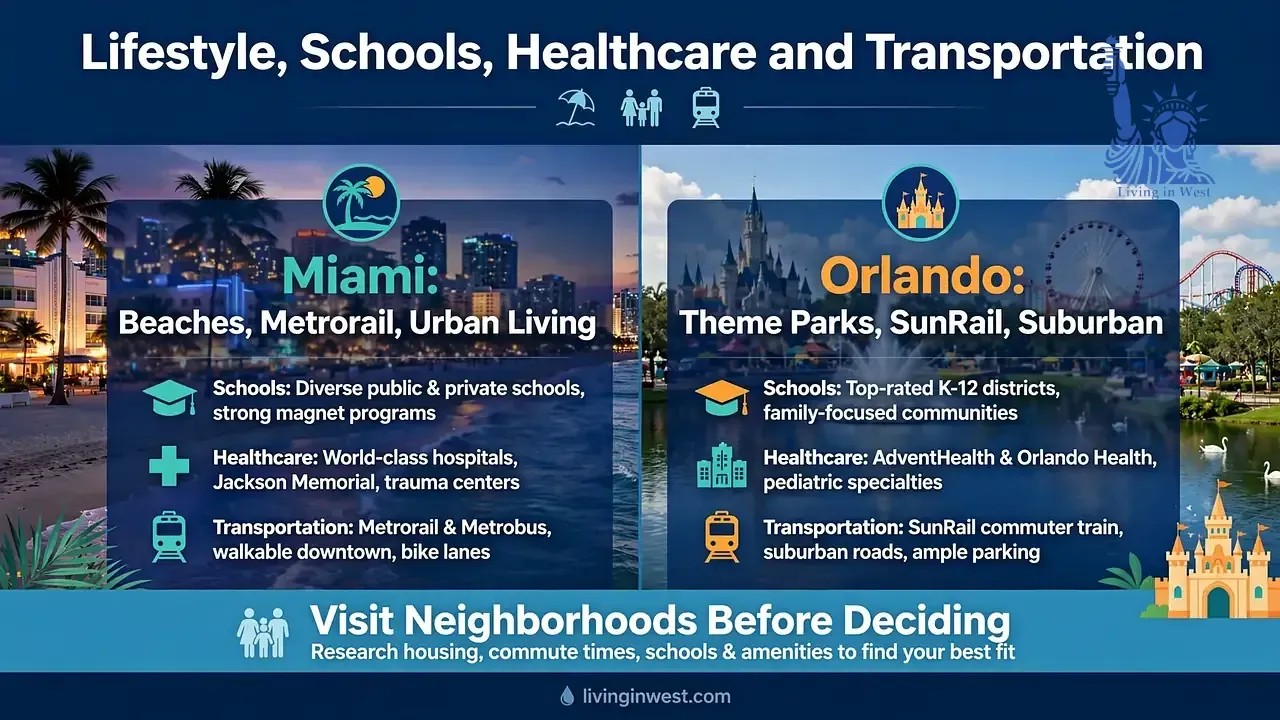
8. Lifestyle, Schools, Healthcare and Transportation
Miami offers beaches, restaurants, nightlife, cultural events and an internationally connected community. It may suit professionals who want an urban environment and convenient access to coastal activities.
Orlando offers lakes, theme parks, sports, entertainment and suburban neighborhoods. Families may appreciate its range of residential communities, but the right choice depends on school zones, work locations and daily travel.
Miami is home to institutions including the University of Miami and Florida International University. Orlando has the University of Central Florida and Valencia College, alongside major healthcare systems such as AdventHealth and Orlando Health.
Transportation deserves special attention. Miami has Metrorail and other transit options, although coverage varies by neighborhood. Orlando has SunRail and bus services, but many suburban residents depend on cars.
| Lifestyle factor | Miami | Orlando |
|---|---|---|
| Beaches | Convenient access to local Atlantic beaches | Beaches require a drive |
| Nightlife | Broad urban and waterfront options | Entertainment districts and attractions |
| Family activities | Beaches, parks, museums and cultural events | Theme parks, lakes, parks and sports |
| Public transportation | Metrorail and other services | SunRail and bus services |
| Housing lifestyle | Urban apartments, condos and established neighborhoods | Apartments, townhomes and suburban houses |
Neither city is automatically better for families or professionals. Visit the neighborhoods you are considering and check actual travel times, school assignments and access to healthcare
9. Property Taxes, Insurance and Investment Risks
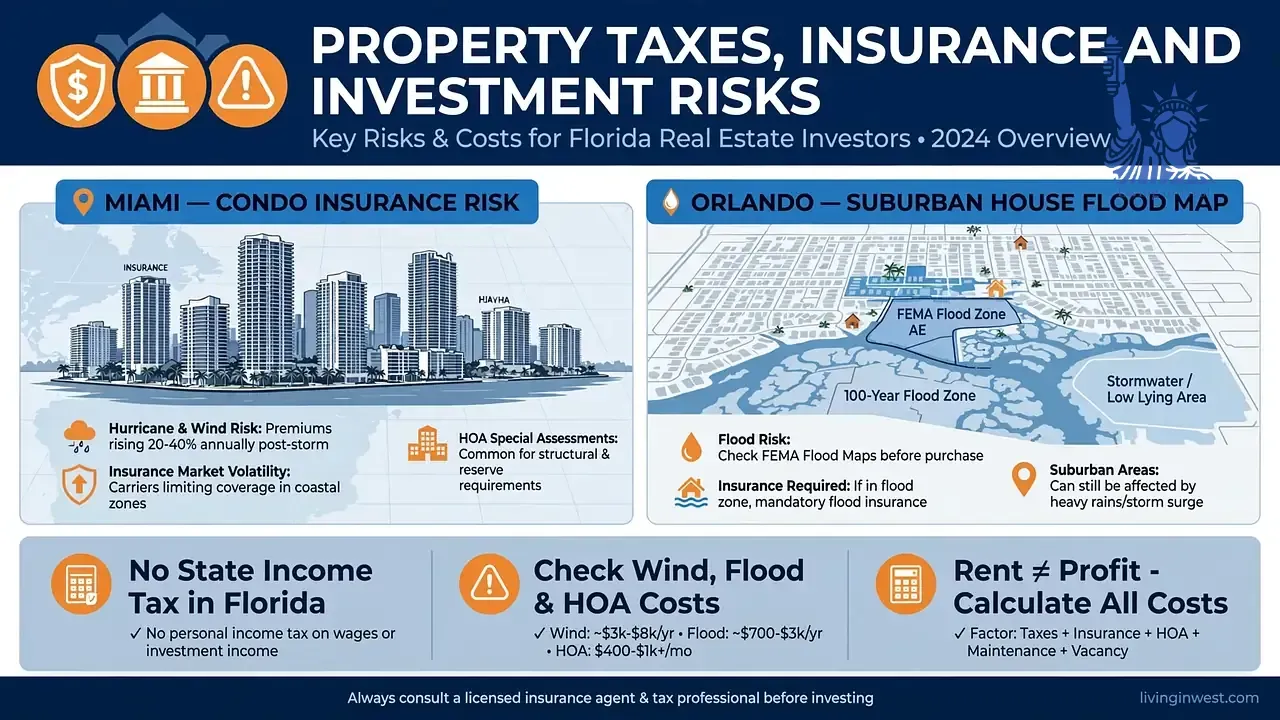
Florida's lack of a personal state income tax does not mean homeowners avoid other taxes and expenses. Property taxes vary with taxable value, local millage rates and eligibility for exemptions. Buyers should review the specific property's tax history and estimate future bills rather than relying solely on the previous owner's payment.
Insurance can also change the economics of a purchase. Miami buyers should investigate windstorm coverage, flood exposure, condominium association finances, special assessments and building maintenance. Orlando buyers should check storm damage, drainage, flood maps, roof condition and the availability and cost of suitable coverage.
Investors need to go further. Advertised rent is not profit. Vacancy, repairs, property management, taxes, insurance and financing can substantially reduce the money left over.
Short-term rental plans require an additional check of local rules, licensing requirements and condominium or homeowners association restrictions. A property close to a major attraction or beach is not automatically approved for vacation rentals.
10. Final Verdict: Miami or Orlando in 2026?
The data points to different strengths rather than a universal winner.
Orlando is worth prioritizing if you:
- Want to explore a comparatively lower-priced housing market.
- Prefer suburban communities and a wider selection of residential property types.
- Work in healthcare, education, tourism, technology-related industries or professional services.
- Want to compare properties near employment centers without starting at Miami's higher typical home-value level.
Miami is worth prioritizing if you:
- Need access to international business networks or particular professional sectors.
- Prefer coastal living, urban entertainment and a globally connected community.
- Can comfortably afford the higher typical home value and rental costs.
- Find a property whose location and long-term costs justify its price.
Final comparison table
| Category | Miami | Orlando | Practical takeaway |
|---|---|---|---|
| Typical metro home value | $478,411 | $383,561 | Orlando has the lower typical value |
| Typical monthly rent | $2,654 | $1,929 | Orlando is lower by $725 |
| Annual home-value change | +0.9% | -1.2% | Miami was stronger in this period |
| Inventory change | -13.9% | -1.8% | Miami's supply fell more sharply |
| Estimated sales-count change | -3.0% | +5.9% | Orlando recorded stronger activity |
| Reported job additions | Below Orlando's reported additions in the OEP comparison | 20,600 over the year ending June 2026 | Orlando led the reported period |
| Business advantage | International connections and premium markets | Regional services and suburban growth | Depends on business model |
| Lifestyle | Coastal and urban | Inland, suburban and attraction-focused | Personal preference matters |
| Main ownership concerns | Insurance, condo fees and higher entry costs | Insurance, commuting and neighborhood selection | Get property-specific estimates |
For many buyers with a moderate budget, Orlando is a sensible place to begin comparing homes. Miami may be the better fit for buyers whose work, lifestyle or investment strategy specifically benefits from its location.
Before making a decision, compare actual listings, mortgage offers, property taxes, insurance quotes and expected maintenance. A property that looks affordable on its listing price can become expensive once the full monthly cost is calculated.
Frequently Asked Questions
Is Miami more expensive than Orlando in 2026?
According to Zillow's September 2026 metro-level indicators, Miami had a typical home value of $478,411 and typical rent of $2,654, compared with Orlando's $383,561 and $1,929. Individual neighborhoods and property types can differ considerably.
What is the monthly mortgage payment on a $400,000 home?
With a 20% down payment, a $320,000 mortgage, a 30-year term and a 7.28% interest rate, principal and interest would be approximately $2,185 per month. Taxes, insurance, HOA fees and maintenance are additional.
Is Orlando better for first-time homebuyers?
Orlando may be more accessible for buyers whose budgets are limited because its typical metro home value is lower. The right decision still depends on income, loan approval, property condition and the full monthly ownership cost.
Which city has stronger job growth?
The Orlando Economic Partnership reported 20,600 Orlando-area job additions in the year ending June 2026, exceeding the combined additions reported for Miami, Tampa and Jacksonville. Orlando's unemployment rate also rose to 4.6% in the second quarter, so job seekers should examine their own industry.
Does Florida have a state income tax?
Florida does not impose a personal state income tax. Residents may still owe federal income taxes, property taxes and other applicable taxes and fees.
Is Miami or Orlando better for rental property investment?
Neither guarantees a better return. Compare purchase price, achievable rent, vacancy, taxes, insurance, repairs, management fees and financing. Use realistic local figures before estimating cash flow.
Should I buy a home in Florida in 2026?
That depends on your budget, how long you expect to stay, mortgage terms and ability to handle maintenance and insurance costs. Compare multiple properties and obtain quotes for the actual address before committing.
Disclaimer: This article is for general educational purposes and is not financial, tax or real estate investment advice. Market conditions, mortgage rates, insurance premiums and property expenses can change.

Editorial Team