PART 1: HOW TO BUY A HOUSE IN THE USA — 8 STEPS
Buying a home in the U.S. usually takes several weeks, especially when a mortgage is involved.
Step 1: Get Mortgage Pre-Approval
Before seriously looking at homes, most financed buyers should speak with a lender.
The lender reviews your income, debts, credit history and assets and provides a pre-approval showing approximately how much you may be able to borrow.
Typical time: A few days
Cost: Often $0 upfront, depending on the lender
Important: Pre-approval is not final loan approval.
Step 2: Choose a Real Estate Agent
A buyer can work with a licensed real estate agent to find properties and negotiate the transaction.
However, don't assume the buyer's agent is automatically free. Buyer-agent compensation is negotiable and should be explained in a written buyer agreement.
Ask before signing:
- How is the agent paid?
- What happens if the seller doesn't offer compensation?
- How long is the agreement?
- Can you cancel the agreement?
Step 3: Find a Home and Make an Offer
Once you find a property, your agent can help prepare the offer.
The offer may include:
- Purchase price
- Earnest money
- Financing terms
- Closing date
- Inspection contingency
- Appraisal contingency
- Financing contingency
- Seller concessions
The seller can accept, reject or counter your offer.
Step 4: Pay Earnest Money
Earnest money is a deposit showing that you're serious about buying.
There is no nationwide fixed amount. It can vary considerably depending on the local market and contract.
If the transaction closes, it is generally credited toward your purchase.
Step 5: Home Inspection
The inspection looks for potential problems with:
- Roof
- Foundation
- Electrical
- Plumbing
- HVAC
- Water damage
- Mold
- Structural problems
A buyer may negotiate repairs or credits depending on the contract.
Step 6: Appraisal
If you're getting a mortgage, the lender may require an appraisal.
Remember:
Inspection = condition of the house
Appraisal = estimated market value
If the appraisal comes in below the purchase price, the buyer and seller may have to renegotiate.
Step 7: Title Search, Insurance & Escrow
A title search checks ownership records for issues such as:
- Liens
- Unpaid claims
- Ownership disputes
- Recording problems
Depending on the state, a title company, escrow company or attorney may handle different parts of the transaction.
Step 8: Closing & Keys
Before closing, review your final documents and complete a final walk-through.
At closing, documents are signed, funds are transferred and the transaction is completed.
After the deed is properly recorded, you become the legal owner according to the applicable state process.

PART 2: HOW MUCH DOES IT COST TO BUY A HOUSE?
The biggest mistake first-time buyers make is thinking the down payment is the only major expense.
There are several additional costs.
Common Buyer Costs
ExpenseTypical Situation
Down payment
Depends on loan
Home inspection
Often a few hundred dollars
Appraisal
Usually several hundred dollars
Loan costs
Varies by lender/loan
Title services
Varies by location
Title insurance
Often required by mortgage lender for lender coverage
Recording fees
Varies by county
Property taxes
Depends on location
Homeowners insurance
Depends on property
HOA fees
If applicable
Closing costs
Often around 2%–5% as a rough planning estimate
The CFPB says buyers can use 2%–5% of the purchase price as a rough estimate for closing costs, excluding the down payment, although actual costs vary.
For example:
$400,000 home
2% = $8,000
5% = $20,000
So you could potentially need $8,000–$20,000 in closing costs, in addition to your down payment and other expenses.
Don't Forget the Monthly Cost
Your mortgage isn't necessarily your entire monthly housing bill.
You may also have:
Mortgage + Property Tax + Homeowners Insurance + HOA + Maintenance
That's why a $2,000 mortgage payment doesn't necessarily mean your house costs only $2,000 per month.

PART 3: HOW TO SELL A HOUSE IN THE USA — 6 STEPS
Selling a house is more than putting a "For Sale" sign outside.
Step 1: Decide the Right Price
A real estate agent can prepare a Comparative Market Analysis (CMA) using recently sold homes in your area.
Pricing is important.
Too high → fewer buyers.
Too low → you may leave money on the table.
Step 2: Prepare the House
Depending on the property, sellers may spend money on:
- Repairs
- Painting
- Cleaning
- Landscaping
- Staging
- Professional photography
You don't necessarily need a major renovation.
Sometimes a clean house, good photos and fixing obvious problems can make a bigger difference.
Step 3: List & Market the Property
The home may be listed through MLS and marketed through real estate websites, social media, open houses and professional photography.
Your listing should clearly explain:
- Price
- Location
- Bedrooms
- Bathrooms
- Property size
- Major upgrades
- HOA information
- Important disclosures
Step 4: Review Offers
Don't automatically choose the highest offer.
Compare:
- Price
- Cash vs mortgage
- Financing strength
- Inspection contingency
- Appraisal contingency
- Closing date
- Seller concessions
- Earnest money
A lower offer with stronger terms can sometimes be safer than a higher but risky offer.
Step 5: Escrow & Buyer Financing
After accepting an offer, the buyer normally works through:
Inspection → Appraisal → Mortgage → Title → Contingencies
The seller may need to provide disclosures and documents required by state or local law.
Step 6: Closing & Seller's Money
At closing, documents are signed and the buyer's funds are transferred according to the settlement process.
The seller's mortgage payoff, taxes, fees and other agreed expenses are deducted.
The remaining amount becomes the seller's net proceeds.
PART 4: STATE-BY-STATE DIFFERENCES — WHAT CHANGES ACROSS 50 STATES?
This is where your original draft needed the biggest correction.
There isn't a simple nationwide rule that says:
"22 states are attorney states and 28 are escrow states."
Real estate closing practices are more complicated than that.
Some states require attorney involvement in certain parts of the closing, while others commonly use title or escrow companies. In some locations, attorneys are heavily involved because of local practice even where a simple statewide rule doesn't tell the whole story.
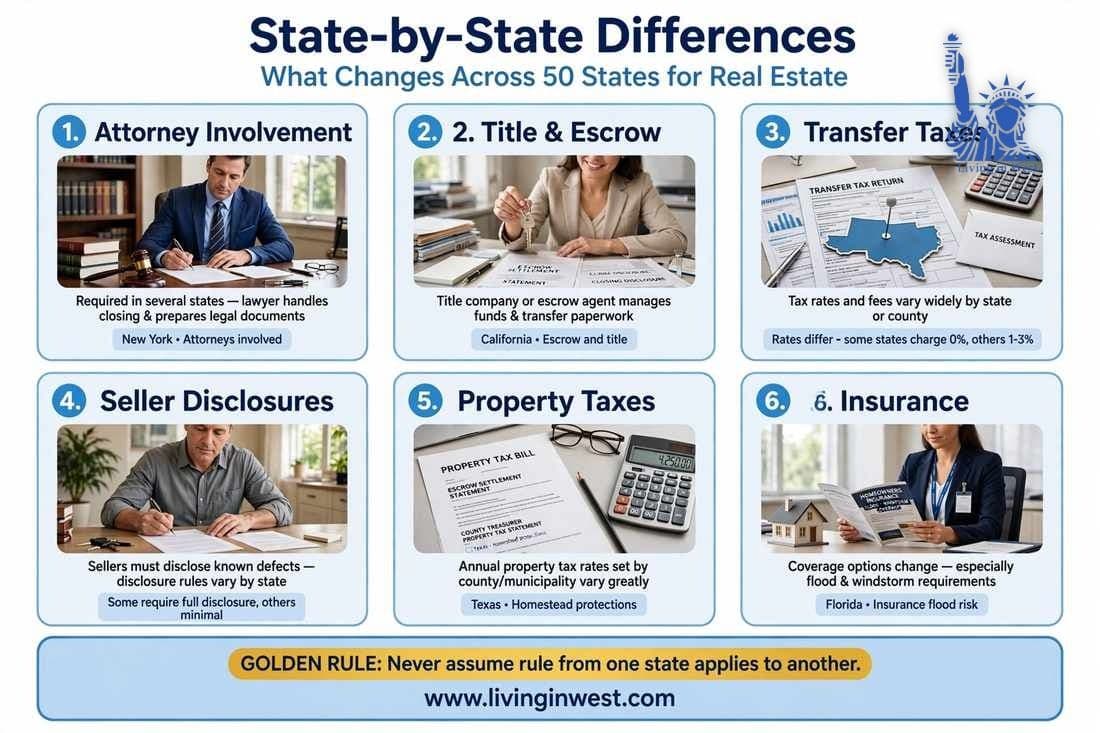
What Can Change From State to State?
1. Attorney Involvement
Some states have stronger attorney requirements or customs around residential closings.
2. Title & Escrow
Some states commonly use title companies or escrow companies to handle settlement.
3. Transfer Taxes
The amount and who pays them can vary by state and locality.
4. Seller Disclosures
States have different rules about what sellers must disclose.
5. Property Taxes
Property taxes are highly local and can vary dramatically.
6. Insurance
Homeowners, flood, windstorm and other insurance requirements can depend on location, property risk and lender requirements.
New York
New York commonly involves attorneys in residential transactions, and its contract and attorney-review practices can differ from many other states.
Florida
Florida buyers need to pay close attention to property insurance, flood risk, windstorm exposure and local closing costs.
Flood insurance is not automatically mandatory for every Florida homeowner, but lenders can require it for properties in certain flood-risk situations.
Texas
Texas has important homestead protections and property-tax exemptions for qualifying homeowners. The exact benefit depends on eligibility and local taxing authorities.
California
California commonly uses escrow and title companies, and buyers should pay close attention to property taxes, insurance, disclosures and local rules.
The Golden Rule
Never assume that a rule from one state automatically applies to another state.
For an actual transaction, check the law where the property is located.

PART 5: FOREIGN BUYERS + FAQ + FINAL CHECKLIST
Can a Non-U.S. Citizen Buy a House in America?
Generally, yes.
You do not automatically need a Green Card or U.S. citizenship to own U.S. real estate.
But buying a property and getting a mortgage are two different things.
Foreign buyers may face:
- Larger down-payment requirements
- More documentation
- Different loan programs
- Higher interest rates
- Additional tax considerations
An ITIN can be useful for certain tax situations, but it is not a universal requirement that every foreign buyer must have one before purchasing property.
Foreign sellers also need to understand FIRPTA, which can create federal withholding obligations when a foreign person sells U.S. real estate.
USA House Buying & Selling FAQ
1. Do I need a Realtor to buy a house?
No. You can potentially buy without a buyer's agent, although professional representation can make negotiations and paperwork easier.
2. Is 20% down payment required?
No.
The required down payment depends on the mortgage program, lender, borrower and property.
3. Can I buy a house with cash?
Yes.
Cash buyers don't need mortgage underwriting, but they still need to handle contracts, title, inspections, taxes and closing.
4. How long does buying a house take?
There is no fixed nationwide timeline.
A financed purchase can take several weeks, while a straightforward cash purchase may close faster.
5. Is a home inspection legally required?
Not necessarily.
However, it is strongly recommended for many buyers.
6. Is title insurance mandatory?
Not universally.
Lenders commonly require lender's title insurance when financing a property. Owner's title insurance is separate.
7. Who pays the real estate agent?
It is negotiable.
Don't automatically assume the seller pays all agent compensation. Your buyer agreement should explain your financial responsibility.
8. What is escrow?
Escrow is a neutral arrangement where money and/or documents are held and released according to the contract and closing requirements.
9. What are closing costs?
Closing costs can include lender fees, title services, recording fees, taxes, insurance-related charges and other transaction expenses.
10. Can foreigners buy property in the USA?
Generally yes, but financing and tax rules can be more complicated.
11. Which state is cheapest to buy a house?
There is no single answer.
Home prices, property taxes, insurance and closing costs vary dramatically between states and even cities.
12. What is the biggest mistake first-time buyers make?
Ignoring the total cost of ownership.
Don't look only at the mortgage.
Consider:
Mortgage + Tax + Insurance + HOA + Maintenance + Utilities
Final Checklist for Buying a House
Before closing, make sure you understand:
☑ Mortgage terms
☑ Down payment
☑ Closing costs
☑ Inspection results
☑ Appraisal
☑ Title status
☑ Insurance
☑ Property taxes
☑ HOA fees
☑ Closing Disclosure
☑ Final walk-through
☑ Cash required to close
Final Bottom Line
The U.S. home-buying process looks complicated because there are several professionals involved, but the basic journey is straightforward:
Pre-Approval → Home Search → Offer → Inspection → Appraisal → Title → Loan Approval → Closing → Keys
For sellers:
Pricing → Preparation → Listing → Offers → Contract → Buyer Financing → Closing → Net Proceeds
The biggest thing to remember is that America does not have one identical real-estate law for all 50 states.
The basic process is similar, but taxes, disclosures, attorney involvement, insurance, title practices and closing procedures can change depending on the state and sometimes the county.
So before buying or selling, always check the rules that apply to the specific property you're dealing with.
This article is a general 2026 real-estate guide and is not legal, tax or financial advice.

Editorial Team