Hawaii Construction Market: What the Latest Numbers Reveal
Hawaii's construction industry faces a unique combination of limited land, expensive transportation, housing shortages, and regulatory complexity. However, the latest figures show that the market is not declining in every area.
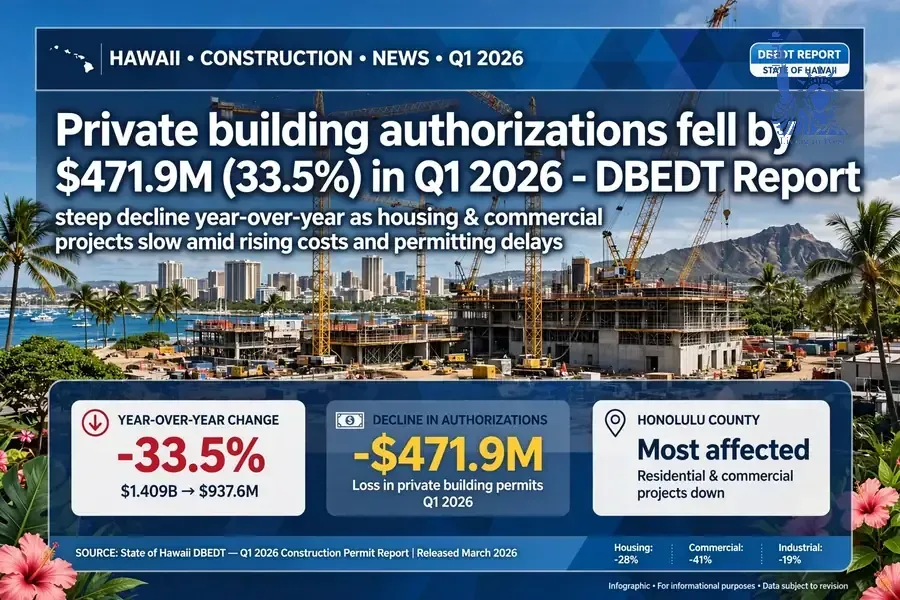
According to the Hawaii Department of Business, Economic Development and Tourism (DBEDT), private building authorizations fell by $471.9 million, or 33.5%, in the first quarter of 2026 compared with the same quarter in 2025.
At the same time, government contracts awarded increased by $720.1 million, or 202.4%, largely because of Hawaii Department of Transportation highway paving contracts. State capital improvement project (CIP) expenditures also increased 11.8%.
Construction employment grew by 1,200 jobs, representing a 3.0% increase.
These figures suggest that public infrastructure work remained comparatively strong even as private building authorizations weakened. They do not mean every construction business experienced the same conditions. Source: DBEDT.
2: Honolulu and Oahu: High Costs and Long Permit Timelines
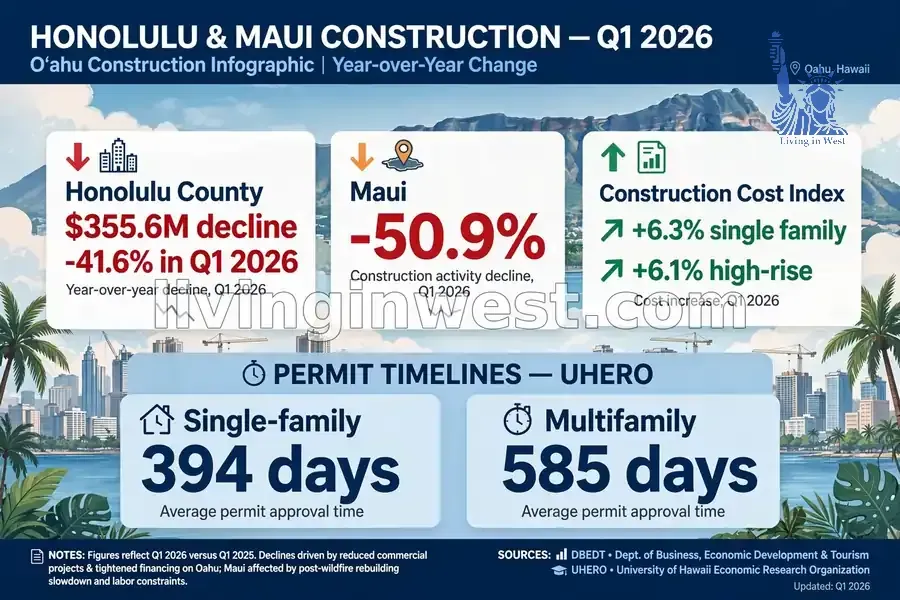
Honolulu County recorded a $355.6 million decline in private building authorizations, equivalent to 41.6%, during the first quarter of 2026. This was the largest county decline in dollar terms, although Maui County experienced the steeper percentage decline at 50.9%.
Building costs are another concern. DBEDT's Honolulu Construction Cost Index increased 6.3% year over year for single-family residences and 6.1% for high-rise buildings in the first quarter of 2026.
Permit processing can also delay projects. The University of Hawaii Economic Research Organization (UHERO) reported median processing times of 394 days for single-family permits and 585 days for multifamily permits issued during the first half of 2025. These historical figures predate Honolulu's new permitting software introduced in summer 2025 and should not be presented as current processing-time averages.
For developers, the lesson is straightforward: confirm zoning, infrastructure capacity, application completeness, professional requirements, and realistic approval timelines before purchasing property or committing to construction financing.
3. Maui: Lahaina Rebuilding Remains a Major Challenge
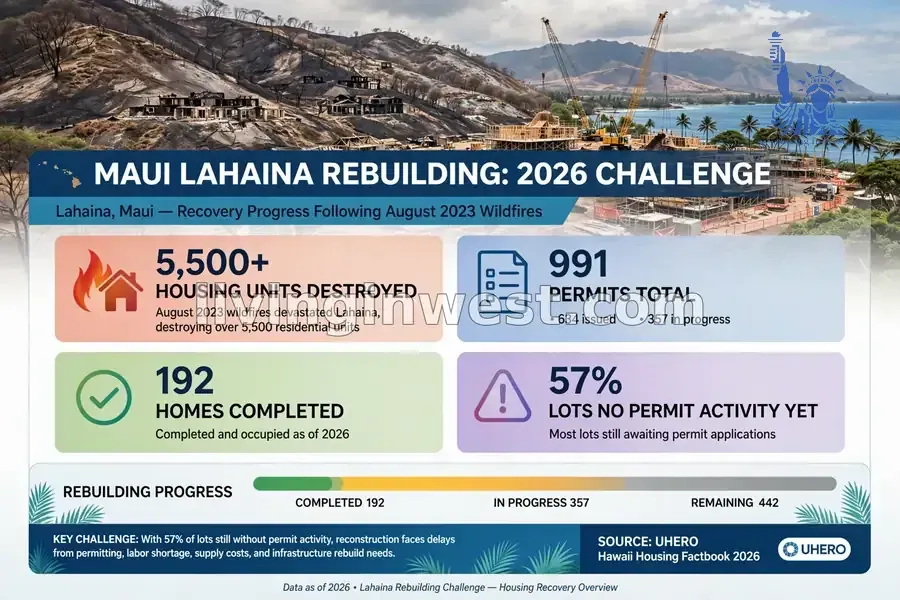
The August 2023 wildfires destroyed more than 5,500 housing units in Lahaina and created a prolonged rebuilding effort.
The 2026 Hawaii Housing Factbook reported 991 permits associated with rebuilding permanent structures. Of those, 634 had been issued and 357 were still in progress. Within the issued permits, 192 were associated with homes completed and ready for habitation at the time of the report.
A particularly concerning finding is that 57% of wildfire-damaged lots showed no permit activity in the data analyzed by UHERO. This means rebuilding applications had not yet begun on many affected properties; it does not necessarily establish that every owner has permanently abandoned reconstruction.
Insurance shortfalls can make rebuilding financially difficult. Lahaina Community Land Trust's Keep Lahaina Home Insurance Gap Program is one initiative intended to help eligible property owners address gaps between insurance proceeds and rebuilding expenses.
Residential reconstruction, roofing, electrical work, plumbing, and other qualified services may create opportunities for contractors. However, demand does not guarantee profitability: builders must account for local permitting, labor availability, insurance, materials, and project-specific funding.
4. Hawaii Island: DHHL's Panaewa Housing Development
Hawaii Island, also known as the Big Island, has a different development environment from densely populated Oahu. Land availability varies, and construction still depends on zoning, utilities, road access, infrastructure, and financing.
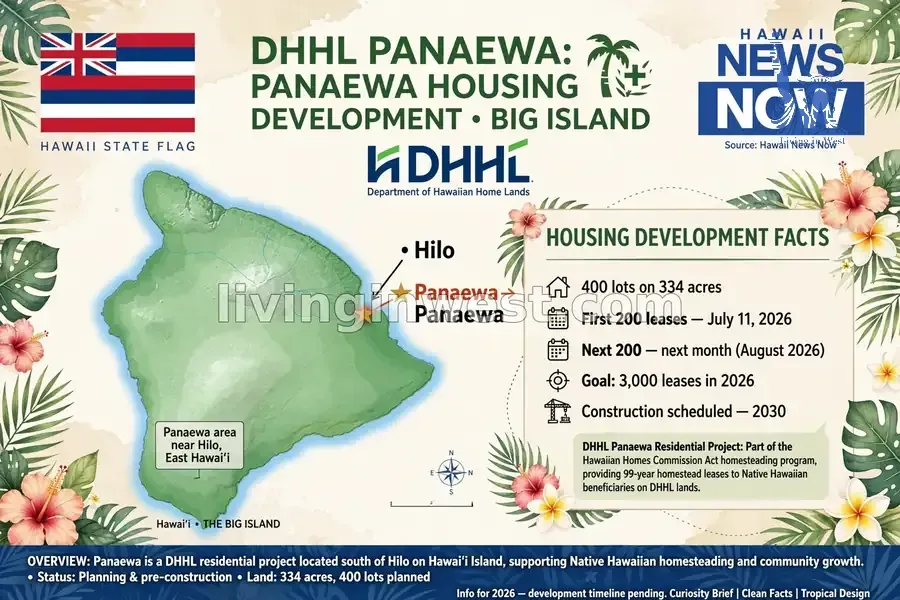
The Department of Hawaiian Home Lands (DHHL) has announced a goal of issuing nearly 3,000 leases during 2026. This is a target for the year, not a claim that all those leases have already been awarded.
At Panaewa near Hilo, DHHL offered the first 200 residential leases on July 11, 2026, with another 200 scheduled to be offered the following month. The development covers approximately 334 acres and is planned for 400 residential lots. Construction was scheduled for 2030.
The project represents an important step for eligible Native Hawaiian beneficiaries who have waited years for land opportunities.
For contractors, future development may create demand for site preparation, utilities, residential construction, and related services. However, the planned construction date should not be confused with current building activity.
5. Kauai: Residential Authorizations Move Against the Trend
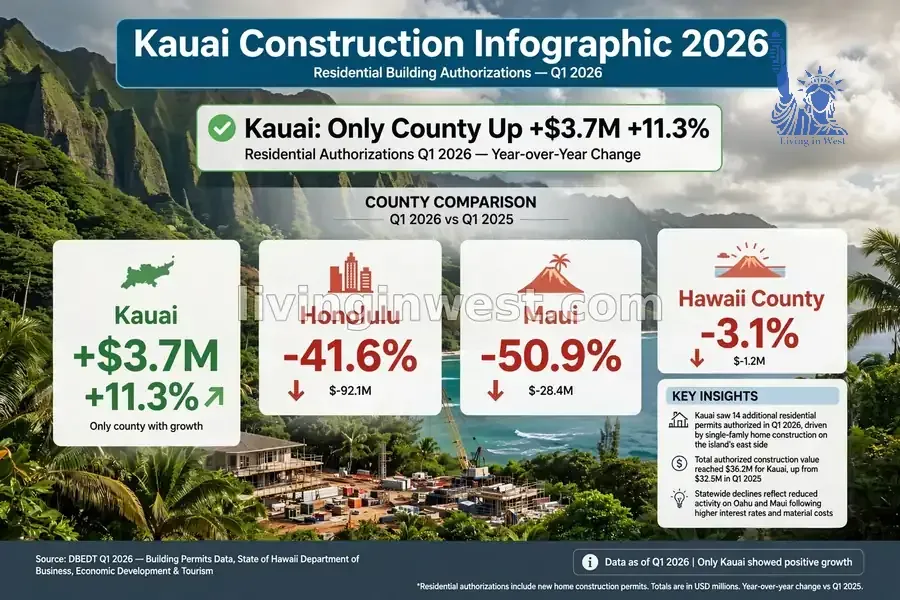
Kauai was the only county to record an increase in private residential building authorizations in the first quarter of 2026.
Residential authorizations rose by $3.7 million, or 11.3%, year over year. By comparison, Hawaii County's private building authorizations declined 3.1%, Honolulu County declined 41.6%, and Maui County declined 50.9%.
Kauai's result is encouraging, but it does not prove that the island's entire construction industry is expanding. Residential authorizations represent a specific category of activity, and quarterly figures can fluctuate significantly.
Potential developers should assess land-use restrictions, infrastructure, environmental considerations, labor costs, insurance, and local housing demand before investing.
6. SB66 and Bill 18: What Developers Need to Know
SB66: A conditional expedited permitting process
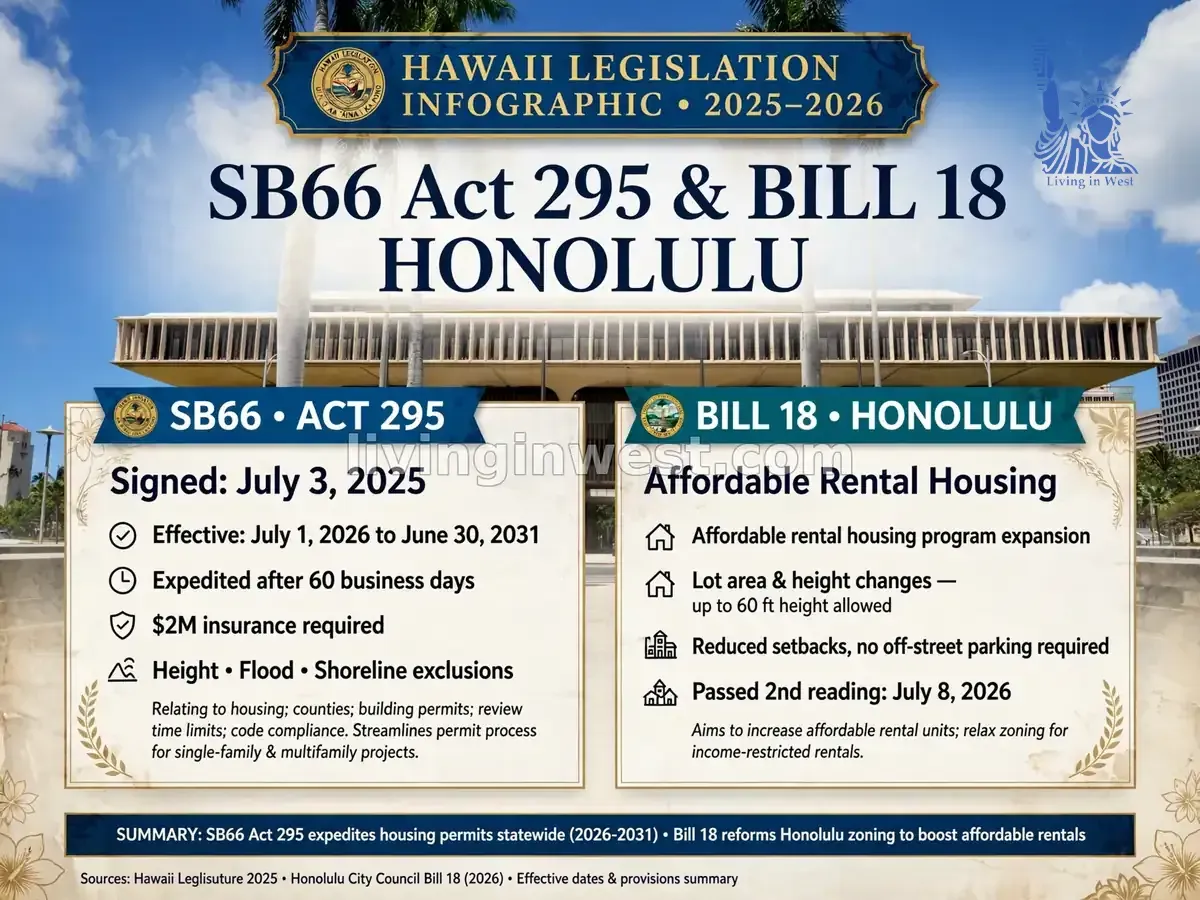
Hawaii's SB66 became Act 295 when Governor Josh Green signed it on July 3, 2025. It took effect on July 1, 2026, and is scheduled to sunset on June 30, 2031.
The law establishes a process through which eligible single-family and multifamily housing applicants can seek an expedited permit using the required certifications from licensed professionals.
Importantly, the law does not guarantee that every project will receive a permit within 60 days. The statutory process allows an eligible applicant to seek expedited treatment after 60 business days have elapsed without approval following the point when the application would be considered complete, subject to the law's requirements.
These include applicable height restrictions, flood-zone and shoreline exclusions, infrastructure capacity, required documentation, professional insurance of at least $2 million, and indemnification obligations. The final statutory text and county implementation guidance should be consulted to determine whether a specific project qualifies.
Honolulu Bill 18 (2026): Affordable rental housing
Bill 18 proposes changes to affordable rental housing development standards, including provisions concerning maximum lot area and building height.
The Honolulu City Council's official records show that the amended bill passed second reading on July 8, 2026, and subsequently appeared in further committee materials. Final enactment should not be assumed without checking the latest legislative record.
Developers should confirm the bill's current status and applicable rules before relying on proposed zoning or height changes.
7. Kakaako: A 370-Unit Leasehold Housing Project
Kakaako remains an important area for Honolulu's mixed-income housing development.
The Hawaii Community Development Authority reported that Ko Laila LLC's proposed 99-year leasehold development would provide approximately 370 residential units near Ward Avenue and Kapiolani Boulevard. The site covers approximately 26,626 square feet.
The project allocates 60% of its units to reserved housing for residents earning at or below 140% of area median income. For a family of four in Honolulu, the reported threshold was $212,800. The remaining 40% would be market-rate units.
Senate Bill 2061 eased leasehold restrictions affecting the project's sales prospects. Reserved units have a 10-year owner-occupancy requirement, while the initial sales rules also address owner-occupancy for market units. The precise restrictions and resale conditions should be reviewed before purchasing.
Presales were anticipated for early 2027 in the authority's 2026 update. That is a planned milestone, not a guarantee that sales or construction will proceed on schedule.
8. Insurance, Flood Risk, and Disaster Recovery
Construction decisions in Hawaii increasingly require careful assessment of environmental and insurance risks.
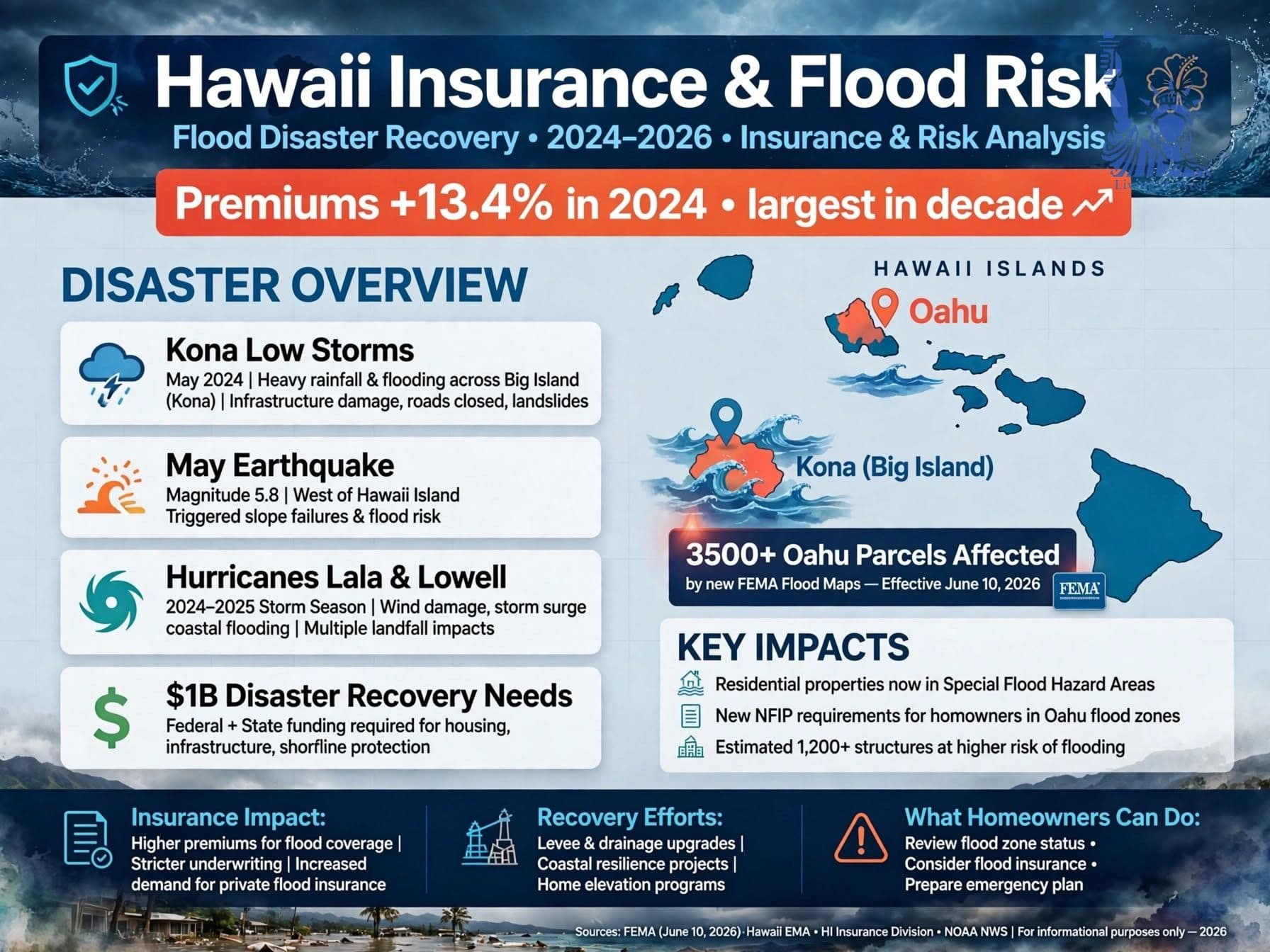
UHERO reported that statewide property insurance premiums increased 13.4% in 2024, the largest annual increase in at least a decade and significantly above the national increase.
The March and April 2026 Kona Low storms caused severe flooding and infrastructure damage. By September 2026, state officials estimated approximately $1 billion in disaster recovery and resilience needs associated with four major disasters, including the Kona Low storms, the May earthquake, Hurricane Lala, and Hurricane Lowell.
Updated FEMA flood maps also affected more than 3,500 Oahu parcels, with changes taking effect June 10, 2026. Some properties newly designated as high-risk may face additional flood-insurance requirements for federally backed mortgages.
These developments can influence construction design, financing, insurance costs, and property demand. Before building or buying, investigate flood maps, drainage, elevation, structural requirements, and available insurance coverage.
9. Construction Opportunities: What to Research Before Investing
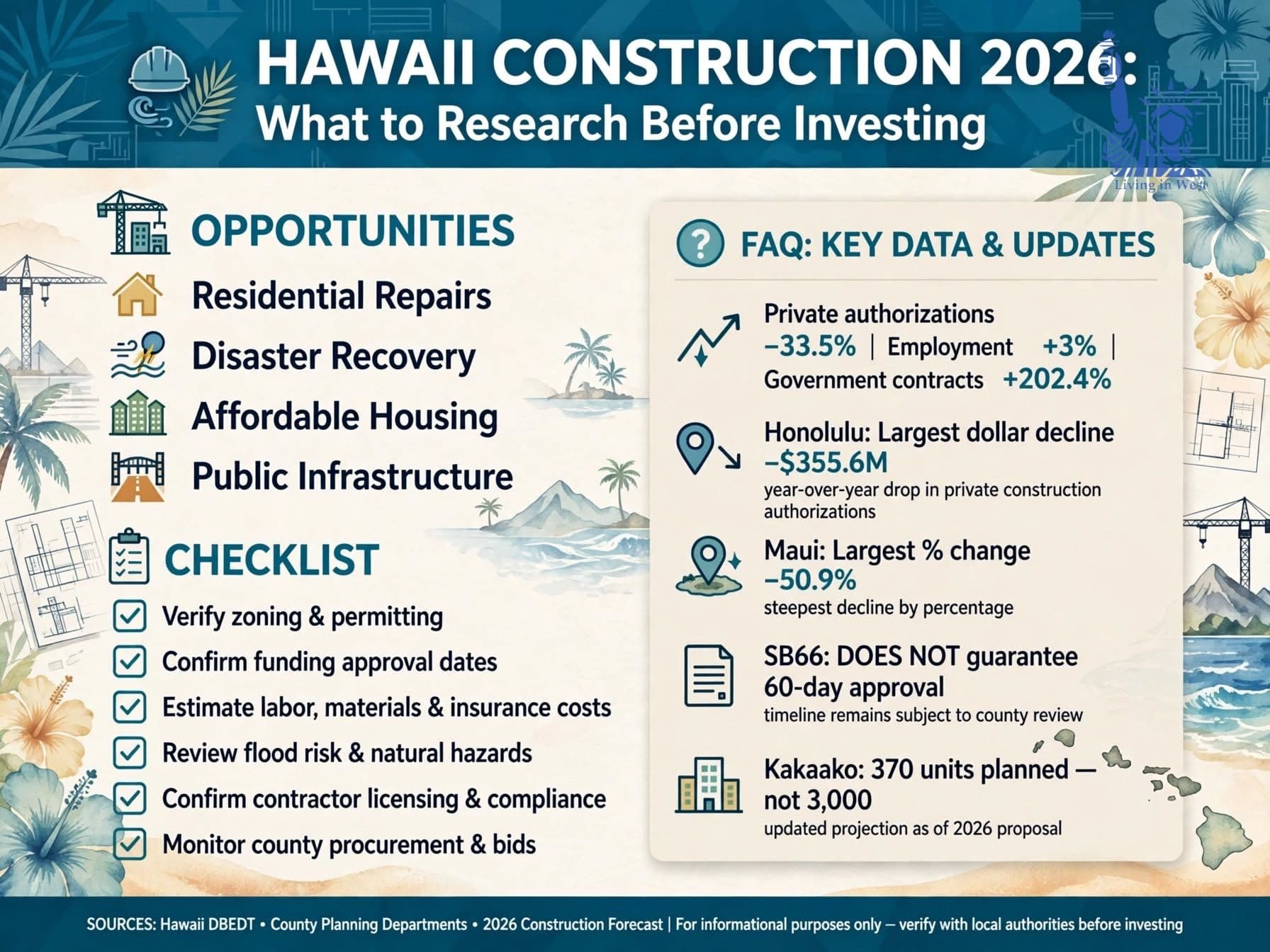
Hawaii's construction market presents potential opportunities in residential repairs, disaster recovery, affordable housing, public infrastructure, and future residential developments.
However, a promising headline or permit increase is not enough to establish that a project will be profitable.
Before committing money, developers and contractors should:
- Verify the latest zoning rules and permitting requirements.
- Confirm project funding, approval status, and realistic construction dates.
- Obtain written estimates for labor, materials, insurance, utilities, and financing.
- Review flood risk and other location-specific hazards.
- Confirm professional licensing and contractor requirements.
- Monitor official county procurement notices and housing-development announcements.
The most reliable opportunities are those supported by documented local demand, realistic costs, and a clear path to approval.
Frequently Asked Questions
Is Hawaii construction declining in 2026?
Private building authorizations declined 33.5% in the first quarter of 2026, but construction employment grew 3.0%, government contracts awarded increased 202.4%, and state CIP expenditures rose 11.8%.
Which county experienced the largest decline?
Honolulu had the largest decline in dollar terms at $355.6 million. Maui experienced the largest percentage decline, at 50.9%.
Does SB66 guarantee a building permit in 60 days?
No. It creates a conditional expedited process for eligible projects after the statutory waiting period and subject to professional certification and other legal requirements.
Is the Kakaako development a 3,000-unit project?
No. The specific Ko Laila LLC development described by the Hawaii Community Development Authority is planned for approximately 370 residential units.
Where can I check Hawaii building requirements?
Consult the relevant county permitting department, the Hawaii Department of Business, Economic Development and Tourism, UHERO's housing research, and the Hawaii Community Development Authority for project-specific information.
Conclusion
Hawaii's 2026 construction market reflects a complicated balance between weaker private building authorizations, stronger public infrastructure activity, housing shortages, and substantial disaster-recovery needs. Honolulu faces significant permitting challenges, Lahaina's recovery remains incomplete, and developments such as Panaewa and Kakaako offer longer-term housing prospects.
For homeowners, contractors, and investors, the best approach is to evaluate each project using verified regulations, current cost estimates, insurance information, and confirmed approvals rather than relying on market-wide predictions alone.
Sources: Hawaii DBEDT, University of Hawaii Economic Research Organization, Hawaii State Legislature, Honolulu City Council, Hawaii Community Development Authority, DHHL reporting, and the Hawaii Insurance Division.

Editorial Team