Key takeaways
- F-1 students can generally purchase U.S. residential property, subject to applicable state laws.
- Mortgage approval depends on lender requirements, income, credit history and documentation.
- Rental income can create U.S. tax obligations, and personal property-management activities may raise immigration questions.
- Seven potential Green Card pathways exist, but each has its own eligibility requirements.
- Buying a home alone does not qualify an investor for the EB-5 Green Card program.
Part 1 of 6: Can F-1 Students Buy a House in the USA?
For many international students, studying in America is the first step toward building a career and establishing financial stability. Some students also consider purchasing a home instead of renting, while others are interested in real estate as a long-term investment.
The good news is that U.S. federal immigration law does not impose a blanket prohibition on F-1 students owning ordinary residential real estate. However, that does not mean every purchase is automatically permitted under every state law or that every student can obtain financing.
Property ownership, immigration status, employment authorization and mortgage eligibility are four different matters.
What type of property can an F-1 student buy?
| Property type | General position |
|---|---|
| Single-family house | Generally possible, subject to applicable laws |
| Condominium or apartment | Generally possible, subject to state and association rules |
| Home for personal use | Generally possible |
| Rental property | Potentially possible, subject to tax and other rules |
| Commercial real estate | Depends on ownership structure and applicable law |
| Property purchased for a Green Card | Ownership alone does not qualify |
Some states restrict particular real estate purchases based on factors such as a buyer's domicile, nationality-related legal classification, ownership structure or property location. Florida and Texas are examples where specific restrictions require careful review before closing a transaction.
Does buying a house change F-1 status?
No. Purchasing property does not extend an F-1 student's authorized stay, replace the requirement to maintain eligible student status, or provide work authorization.
An F-1 visa stamp and immigration status are also not the same thing. The visa generally allows a person to seek admission to the United States, while the terms of their stay depend on applicable immigration rules and admission records.
Students should therefore make property decisions without assuming that homeownership will secure their future immigration status.
2: Mortgage Options, Rental Income and Taxes
Can an F-1 student get a mortgage?
Yes, some F-1 students may qualify for mortgage financing, but approval is not guaranteed. Lenders can consider income, credit history, existing debts, available assets, immigration documents, property use and repayment ability.
A student with limited U.S. credit history or no qualifying income may find it difficult to obtain a conventional mortgage. Specialized lenders may offer other products, but their availability and terms vary.
| Financing option | Main consideration | Down payment |
|---|---|---|
| Conventional mortgage | Credit, income and lender eligibility rules | Varies |
| ITIN mortgage | Offered by certain lenders; an ITIN is not immigration status | Varies |
| Foreign-national loan | Specialized underwriting and potentially higher costs | Varies |
| Cash purchase | Avoids mortgage underwriting but not legal or tax requirements | Full purchase price |
There is no universal rule that every F-1 student must put down 20%, 30% or 40%. Interest rates also vary with the lender, borrower, loan structure and market conditions. Obtain written loan estimates instead of relying on generic rates advertised online.
Before accepting financing, review the annual percentage rate (APR), closing costs, points, reserve requirements, prepayment terms and whether the loan allows the property to be rented.
Can an F-1 student rent out a property?
Property ownership and employment are separate questions. An owner who hires a property manager may have a different situation from a student who personally performs paid renovation work or actively operates a real estate business.
F-1 students should not assume that every hands-on management activity is permitted simply because they own the property. Seek qualified immigration advice before carrying out activities that could constitute unauthorized employment.
What taxes apply to rental income?
U.S. rental income may be taxable even when the owner is not a U.S. citizen or permanent resident.
The IRS generally applies a 30% rate, or a lower applicable treaty rate, to certain U.S.-source rental income that is not effectively connected with a U.S. trade or business. Eligible nonresident owners may be able to elect to treat qualifying real-property income as effectively connected income, report it on the appropriate tax return and deduct eligible expenses.
For example, a rental property generating $24,000 annually with $15,000 in potentially deductible expenses has $9,000 before other tax adjustments. The final tax treatment depends on the owner's circumstances, applicable deductions and elections; this simple calculation is not a tax estimate.
Owners should also budget for property taxes, insurance, repairs, vacancies, association fees and potential tax withholding when selling the property.
3: Seven Potential Green Card Pathways for F-1 Students
An F-1 visa does not automatically convert into permanent residence. A student must qualify for a separate immigrant category and complete the applicable process.
1. OPT → H-1B → EB-2 or EB-3
Some graduates pursue Optional Practical Training (OPT), then qualifying employment and potentially H-1B status. Eligible STEM graduates may qualify for a 24-month STEM OPT extension, subject to the relevant requirements.
USCIS
An employer may later sponsor an eligible employee for permanent residence under EB-2 or EB-3. Depending on the case, the process can involve labor certification, an immigrant petition and visa-number availability. H-1B selection and employer sponsorship are not guaranteed.
2. EB-1A extraordinary ability
EB-1A may suit applicants who can demonstrate extraordinary ability in fields such as science, education, business, arts or athletics. Eligible applicants may self-petition without a job offer, but the evidentiary standard is demanding.
Academic qualifications alone do not automatically establish eligibility.
3. EB-2 National Interest Waiver (NIW)
The EB-2 NIW route allows certain eligible applicants to request a waiver of the job-offer and labor-certification requirements. Applicants must qualify for the underlying EB-2 category and demonstrate that their proposed endeavor meets the national-interest standard.
Filing Form I-140 does not itself provide a Green Card, employment authorization or permission to remain in the United States. The impact on an F-1 student's future visa applications, admission and status must be considered individually.
4. EB-5 immigrant investor program
EB-5 is an investment-based immigrant category. Investors must meet the program's capital investment, lawful source-of-funds, commercial-enterprise and job-creation requirements.
The statutory minimums currently established for the relevant categories are generally $1,050,000 for a standard investment and $800,000 for qualifying targeted employment area or infrastructure investments. These amounts are subject to the applicable statutory adjustment schedule.
USCIS
+1
Buying a personal house does not ordinarily qualify as an EB-5 investment. The program requires a qualifying commercial investment, not simply ownership of U.S. property.
5. Marriage to a U.S. citizen or permanent resident
A genuine qualifying marriage may provide a family-based immigration route. Requirements and procedures differ depending on whether the spouse is a U.S. citizen or permanent resident.
Marriage does not automatically grant permanent residence, and a marriage entered into solely to obtain immigration benefits is not a legitimate route.
6. Family sponsorship
Eligible U.S. citizens and permanent residents may petition for certain qualifying relatives. The available categories, waiting periods and visa limits depend on the family relationship and sponsor's status.
7. EB-1C multinational manager or executive
EB-1C may apply to certain managers or executives transferring from a qualifying foreign company to a related U.S. business. Applicants must meet detailed requirements concerning the companies, their relationship and the applicant's managerial or executive employment.
Buying property or simply starting a U.S. company does not establish EB-1C eligibility.
Comparing the seven pathways
| Pathway | Key requirement |
|---|---|
| OPT → H-1B → EB-2/EB-3 | Qualifying employment and, where required, sponsorship |
| EB-1A | Extraordinary ability and substantial evidence |
| EB-2 NIW | EB-2 eligibility and national-interest criteria |
| EB-5 | Qualifying investment and job creation |
| Marriage | Genuine qualifying spousal relationship |
| Family sponsorship | Eligible family relationship and visa availability |
| EB-1C | Qualifying multinational managerial or executive role |
There is no universal F-1-to-Green-Card timeline. Processing time and visa availability depend on the category, individual circumstances and, in some categories, the applicant's country of chargeability.

4: Does Buying Property Help You Get a Green Card?
The short answer is no, not directly. A property deed is not an immigration document, and buying a house does not replace the requirements of an employment-based, family-based or investor immigrant category.
Property ownership can still be part of a person's overall financial position, but it must not be confused with immigration eligibility.
| Property-related situation | What it means for immigration |
|---|---|
| Buying a house with cash | Establishes ownership, not permanent residence |
| Buying with a mortgage | Creates a financial obligation, not immigration benefits |
| Renting the property to tenants | May create taxable income |
| Showing property as an asset | May help document finances, but liquidity matters |
| Investing in a qualifying EB-5 enterprise | May support an EB-5 case if all requirements are met |
| Buying a house to improve visa chances | Creates no automatic immigration advantage |
Can property help with financial documentation?
Potentially, but a house is not the same as readily available cash. It may be difficult to convert into funds quickly, and an existing mortgage reduces the owner's equity.
Students should follow the specific financial documentation requirements of their educational institution or immigration process and provide accurate evidence of the funds actually available to them.
Does buying property affect F-1 nonimmigrant intent?
Buying a home does not automatically prove or disprove a person's intention to immigrate permanently. However, F-1 status and future immigration applications raise distinct legal questions.
A student considering an immigrant petition should obtain individualized legal advice before filing, renewing a visa or travelling internationally. Do not assume that property ownership makes immigration approval easier, or that every immigrant petition automatically ends F-1 status.
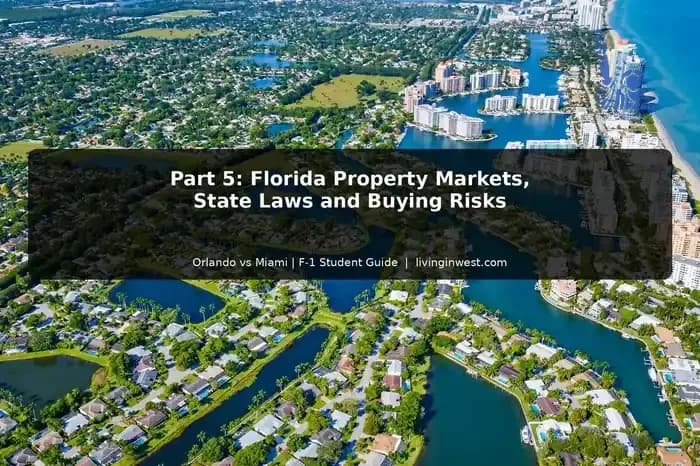
5: Florida Property Markets, State Laws and Buying Risks
Florida cities such as Orlando and Miami attract homebuyers and property investors. But location alone does not make a property a good investment, and students should compare actual purchase prices, ongoing costs, rental rules and their likely length of stay.
Orlando vs. Miami: What should buyers compare?
| Factor | Orlando | Miami |
|---|---|---|
| Property choices | Suburban homes, condos and apartments | Condos, apartments and single-family homes |
| Costs to investigate | Insurance, HOA fees, property taxes and maintenance | Condo fees, assessments, insurance and flood exposure |
| Rental considerations | Local rules, vacancy and actual rental demand | Building rules, local restrictions and short-term rental limits |
| Main financial risk | Overestimating rental demand or underestimating costs | Underestimating ownership costs and building assessments |
Do not treat a metro-wide average home value as the price of a property available to you. Prices vary by neighborhood, property type, size, condition and date.
Important state-law considerations
Florida's SB 264 and Texas's SB 17 restrict certain real estate purchases by specified persons or entities. Their scope, exceptions and legal application differ. Florida's statutory provisions include specific requirements and exceptions for certain buyers, while Texas law contains restrictions relating to designated countries and entities.
Before purchasing, check the current statute, any applicable court rulings and the exact ownership arrangement with a qualified local real estate attorney. Do not assume that all international students are covered by the same restrictions.
Five mistakes F-1 students should avoid
- Assuming homeownership improves Green Card eligibility. Property ownership alone does not qualify someone for permanent residence.
- Performing unauthorized work. Personally conducting renovations, house flipping or paid property-management activities may raise immigration issues depending on the facts.
- Ignoring state restrictions. Check whether the buyer, ownership structure and property are affected by applicable laws.
- Underestimating costs and taxes. Rental income is not the same as profit after expenses and taxes.
- Buying more than you can afford. Do not rely on a future job, unapproved loan, expected Green Card or optimistic rental projections.
Checklist before purchasing
Pre-purchase checklist
1/7 completed
*Check the applicable state property laws and ownership restrictions.
*Get written financing estimates from lenders if a mortgage is needed.
*Calculate closing costs, insurance, taxes, maintenance and emergency reserves.
*Ask a tax professional about rental income and potential sale-related withholding.
*Check whether your intended property-management activities are compatible with F-1 employment rules.
*Consult an immigration attorney before making decisions about petitions, visa renewals or travel.
*Have the purchase contract and property title reviewed by a qualified professional.
FAQ
Can I get a Green Card if I buy a house in the USA?
No. Ordinary residential property ownership does not qualify you for a Green Card. You must qualify under a separate immigration category.
Can an F-1 student buy a house in the United States?
Generally, yes, subject to applicable state laws, transaction requirements and other restrictions.
Can an F-1 student get a mortgage?
Potentially. Approval depends on the lender's requirements, income, credit history, assets, documentation and property use. ITIN and foreign-national loan programs are available through some lenders, but approval and terms vary.
Can an F-1 student rent out a property?
Rental ownership may be possible, but it can create U.S. tax obligations. Students should also distinguish passive ownership from personally performing work that could require employment authorization.
How long does it take to go from F-1 to a Green Card?
There is no fixed timeline. It depends on the immigration category, eligibility, processing time and visa availability, among other factors.
Does EB-5 let me buy a house and get a Green Card?
No. EB-5 requires a qualifying investment in a commercial enterprise and satisfaction of the program's job-creation and other requirements. Buying a personal residence does not ordinarily meet those criteria.
Can I apply for EB-2 NIW while on an F-1 visa?
An eligible person may pursue an EB-2 NIW petition, but eligibility for that petition and the ability to maintain F-1 status are separate questions. Filing a petition does not itself grant work authorization or an extended stay.
Can my parents buy a house for me while I study?
Potentially, subject to applicable property laws, financing and tax requirements. Clarify who will legally own the property, who supplies the funds and whether any gift or reporting obligations apply.
Is it better to rent or buy on an F-1 visa?
It depends on your budget, expected length of stay, local housing market and financial risks. Renting offers flexibility while graduation and employment plans remain uncertain. Buying may suit some students or families who can manage the full costs without depending on an uncertain immigration outcome.
Conclusion: Should F-1 Students Buy Property in the USA?
Buying a home while studying in the United States may be a reasonable financial decision for some international students, but it should not be treated as an immigration strategy.
F-1 students can generally own property, subject to applicable laws. However, mortgage eligibility, rental income taxes, employment restrictions and Green Card requirements must be considered separately.
Before investing, compare the full cost of ownership with renting, check state-specific property laws, and understand the immigration pathway for which you may actually qualify. A property can be an asset, but it cannot replace the legal requirements for permanent residence.
Disclaimer: This article is for educational purposes only and does not constitute legal, tax, financial or investment advice. Immigration rules and property laws can change. Consult qualified U.S. immigration and tax professionals before making decisions based on your circumstances.

Editorial Team