1. What Is the H-1B Visa?
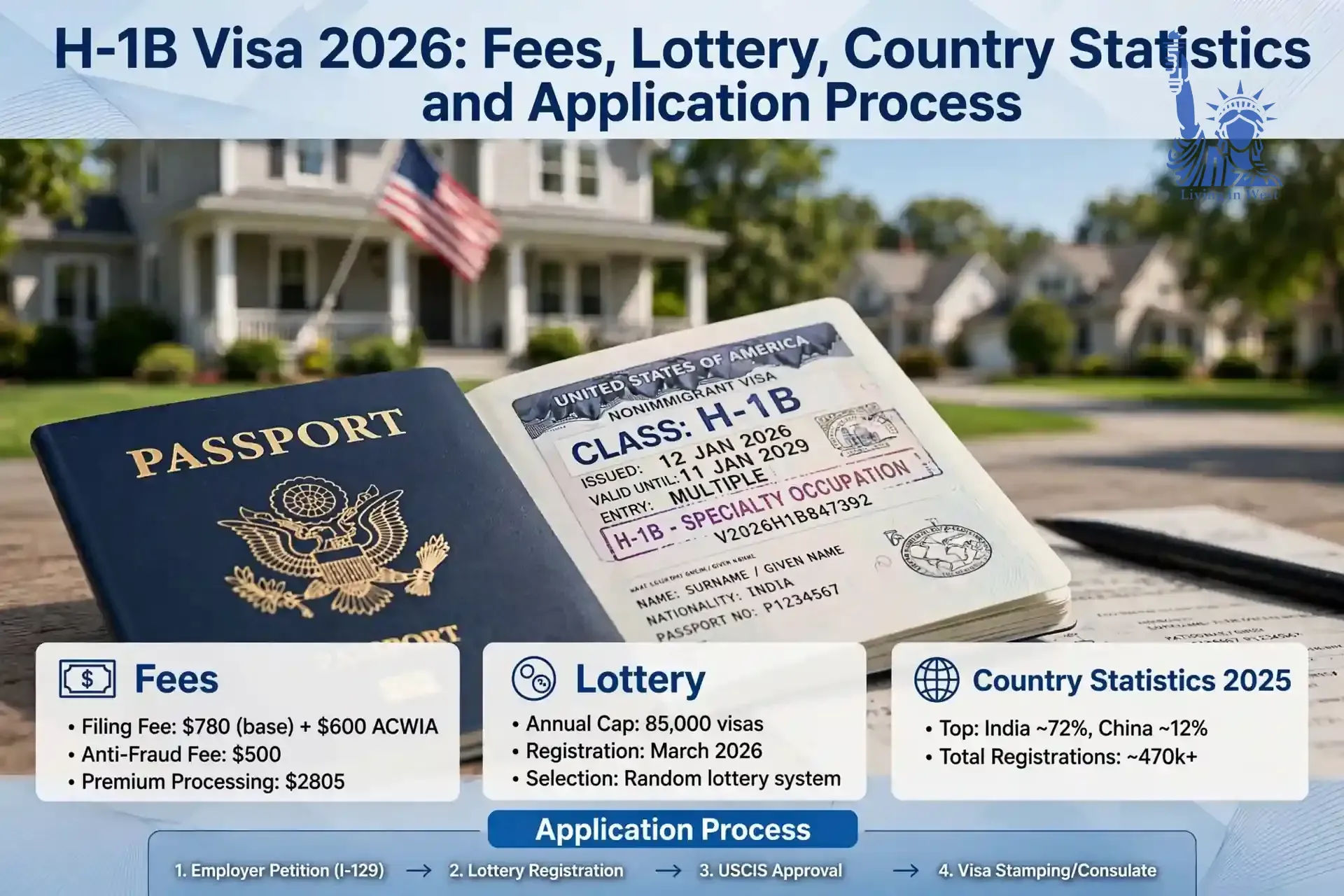
The H-1B is a nonimmigrant visa classification for eligible specialty occupations. These positions generally require the theoretical and practical application of specialised knowledge and a bachelor’s degree or higher in a directly related specific specialty, or its equivalent, as the normal minimum entry requirement.
Examples of occupations that may qualify include:
- Software developers and certain IT professionals
- Electrical, mechanical and other engineers
- Data scientists and specialised analysts
- Certain accountants and financial professionals
- Architects and research professionals
- Some specialised teaching and healthcare positions
A job title alone does not establish eligibility. The actual duties, education requirements, employer evidence and the worker’s qualifications must meet the relevant rules.
Can someone qualify with a foreign degree?
Yes. A degree obtained outside the United States can qualify if it meets the applicable equivalency requirements. Depending on the case, education, training and progressively responsible experience may be considered when establishing equivalency.
The frequently repeated claim that three years of work experience automatically equals one year of university study is not a universal rule guaranteeing H-1B eligibility. The evidence must establish the required equivalent qualification for the specific occupation.
Official source: USCIS — H-1B Specialty Occupations.
2. Which Countries Have the Most H-1B Approvals?
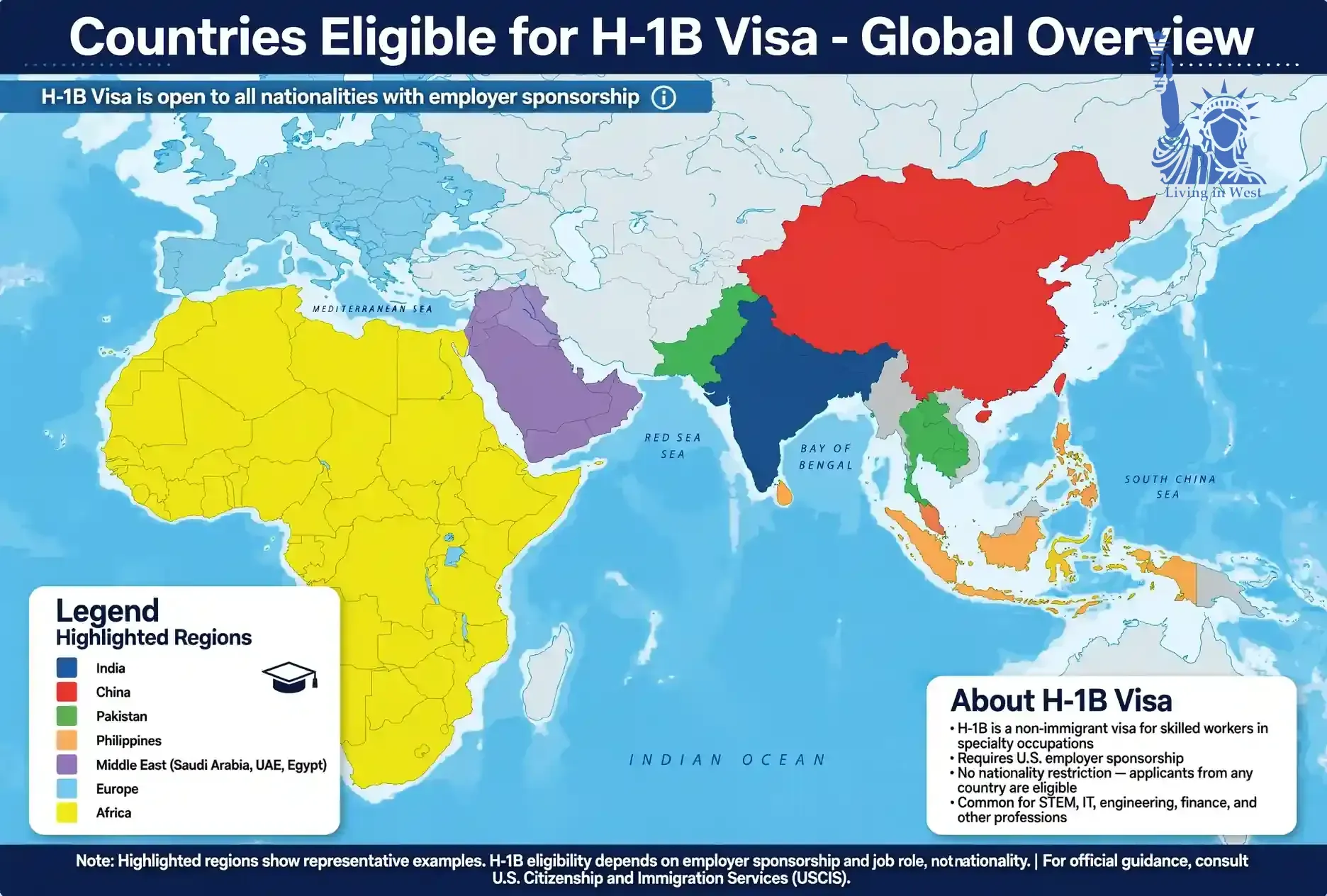
India accounts for the largest share of approved H-1B petitions, followed by China. According to the USCIS FY2025 report, these two countries represent the largest country-of-birth groups among approved H-1B beneficiaries.
H-1B Approved Petitions by Country of Birth
| Measure | FY2025 figure |
|---|---|
| Total approved H-1B petitions | 406,348 |
| Beneficiaries born in India | 69.9% |
| Beneficiaries born in China | 12.1% |
| Median annual compensation for all approved beneficiaries | $133,000 |
Source: USCIS — Characteristics of H-1B Specialty Occupation Workers, FY2025 Annual Report.
These figures describe approved petitions, not just first-time applicants or people entering the lottery. Approvals can include petitions for continuing employment, extensions and other eligible employment situations. The report measures country of birth, which may differ from a person’s current citizenship or nationality.
Why Do India and China Have the Largest Shares?
Several factors help explain the strong representation of Indian and Chinese professionals in the H-1B program:
- Technology and engineering talent: Both countries have large workforces in software development, IT, engineering, data science and other specialized fields.
- International recruitment: US companies recruit professionals through established networks connecting employers with overseas talent.
- Multinational employers: Technology, consulting, finance and other companies hire skilled workers internationally.
- Existing H-1B employment: Approved petitions include more than first-time entries, so continuing employment and extensions also contribute to the figures.
Professionals from other countries across Asia, the Middle East, Europe, Africa, North America and Latin America may also qualify for H-1B employment. Their representation varies by occupation, employer demand and petition activity.
Can Professionals from Asia and the Middle East Apply for an H-1B Visa?
Yes. Eligible professionals from countries such as Pakistan, Bangladesh, Nepal, the Philippines, Japan, South Korea, China, India, Saudi Arabia, the United Arab Emirates, Egypt, Jordan and other countries can pursue H-1B employment in the United States.
Nationality alone does not determine eligibility. Applicants generally need a qualifying US job offer in a specialty occupation, the required educational background or equivalent qualifications, and an employer willing to file the relevant petition. They must also meet the applicable filing and selection requirements, unless an exemption applies.
For applicants in Asia and the Middle East, the practical starting point is to identify US employers hiring internationally for suitable professional roles. Applicants should verify employer legitimacy, understand sponsorship requirements and review the current USCIS rules before paying recruitment or immigration-related fees.
Important data note: The percentages above are for FY2025 and must not be described as FY2026 or FY2027 results. They represent approved petitions by beneficiaries’ country of birth, not each country’s lottery selection rate or the probability that an individual applicant will receive approval.
3. H-1B Visa Eligibility Requirements
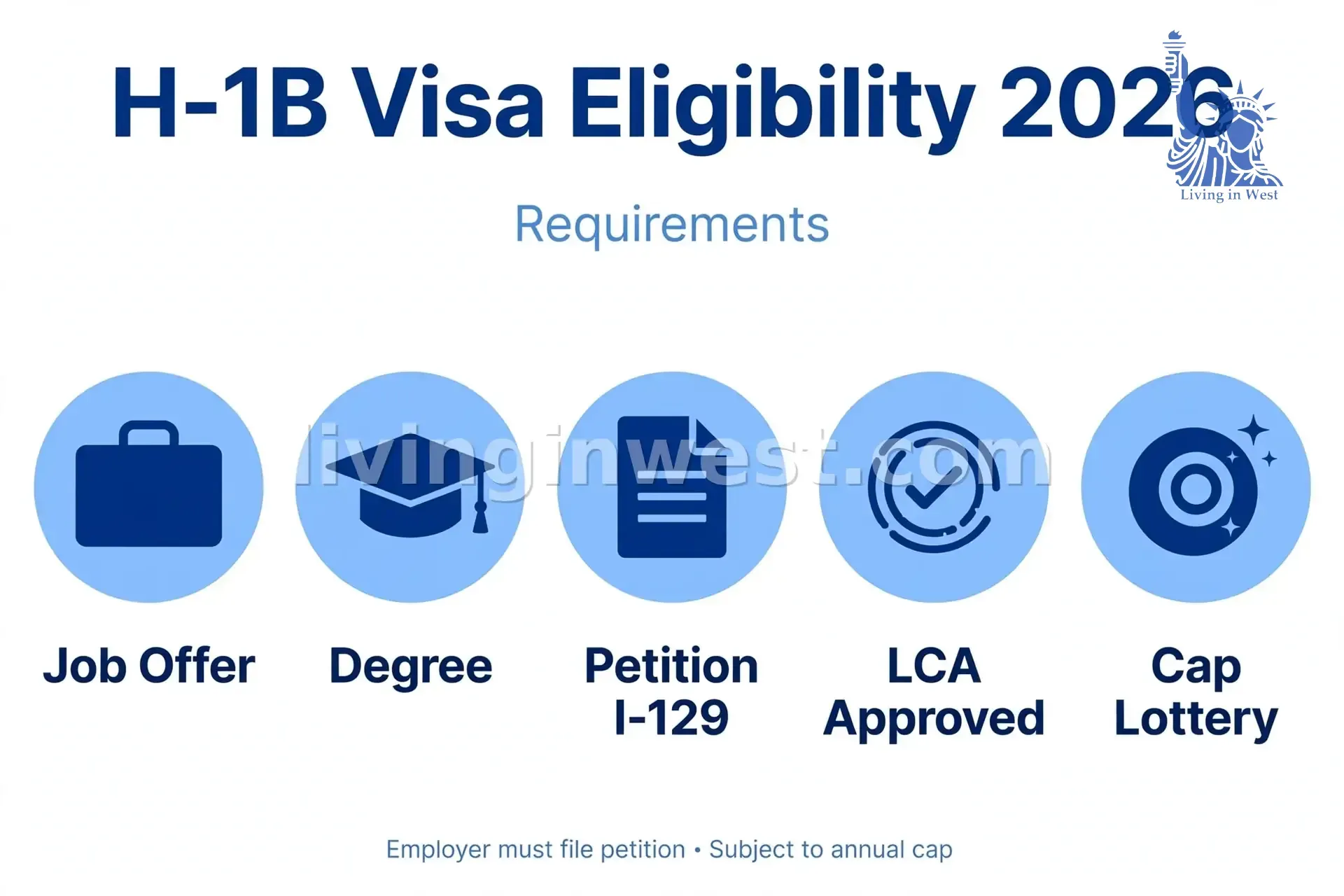
Most cap-subject applicants need to meet the following requirements.
A qualifying job offer
A US employer must offer a position that meets the specialty-occupation requirements. Having a degree without a qualifying job offer is not enough for the standard employer-sponsored H-1B process.
Relevant education or equivalent qualifications
The applicant generally needs a US bachelor’s degree or higher in a directly related specific specialty, or an acceptable equivalent qualification.
An employer-sponsored petition
The employer generally files Form I-129 with USCIS and provides evidence about the job, the employer-employee relationship, the applicant’s qualifications and the terms of employment.
A Labor Condition Application
The employer generally obtains an approved Labor Condition Application (LCA) from the US Department of Labor before filing the H-1B petition. The LCA includes required wage and working-condition attestations.
Cap selection, where applicable
Many H-1B petitions are subject to the annual cap and selection process. Some qualifying employers and positions, including certain positions with institutions of higher education and research organisations, may be cap-exempt.
Selection does not automatically mean approval. USCIS still reviews the petition and supporting documents.
4. How to Apply for an H-1B Visa: Step by Step
For a professional applying from outside the United States, the general process is as follows.
Step 1: Find a US employer willing to sponsor you
Look for positions that match your qualifications and experience. Job advertisements may mention “H-1B sponsorship,” “visa sponsorship available” or “will sponsor qualified candidates.”
Not every employer sponsors international workers. Confirm the employer’s sponsorship policy early in the recruitment process.
Step 2: Check the position and qualifications
The employer assesses whether the job duties and educational requirements meet the specialty-occupation rules. The applicant’s degree, experience and supporting records are reviewed as part of this process.
Step 3: Complete registration, if the case is cap-subject
For cap-subject cases, the employer generally submits an electronic registration during the designated USCIS registration period and pays the applicable registration fee. An individual worker cannot independently register themselves as a substitute for the employer.
Step 4: Wait for selection and petition filing
If selected, the employer may file the H-1B petition within the applicable filing window. Selection only allows the employer to proceed; it does not guarantee that USCIS will approve the petition.
Step 5: USCIS reviews the petition
USCIS assesses the filing, supporting evidence and eligibility. It may approve the petition, request further evidence or deny it if the requirements are not met.
Step 6: Complete the visa process abroad, if required
An applicant outside the United States generally follows the Department of State’s visa application process after the relevant petition is approved. This can involve an application form, visa fee, supporting documents and an interview where required.
A petition approval is not itself a visa stamp or a guarantee of admission at the US border.
Official resources:
5. H-1B Visa Fees in 2026
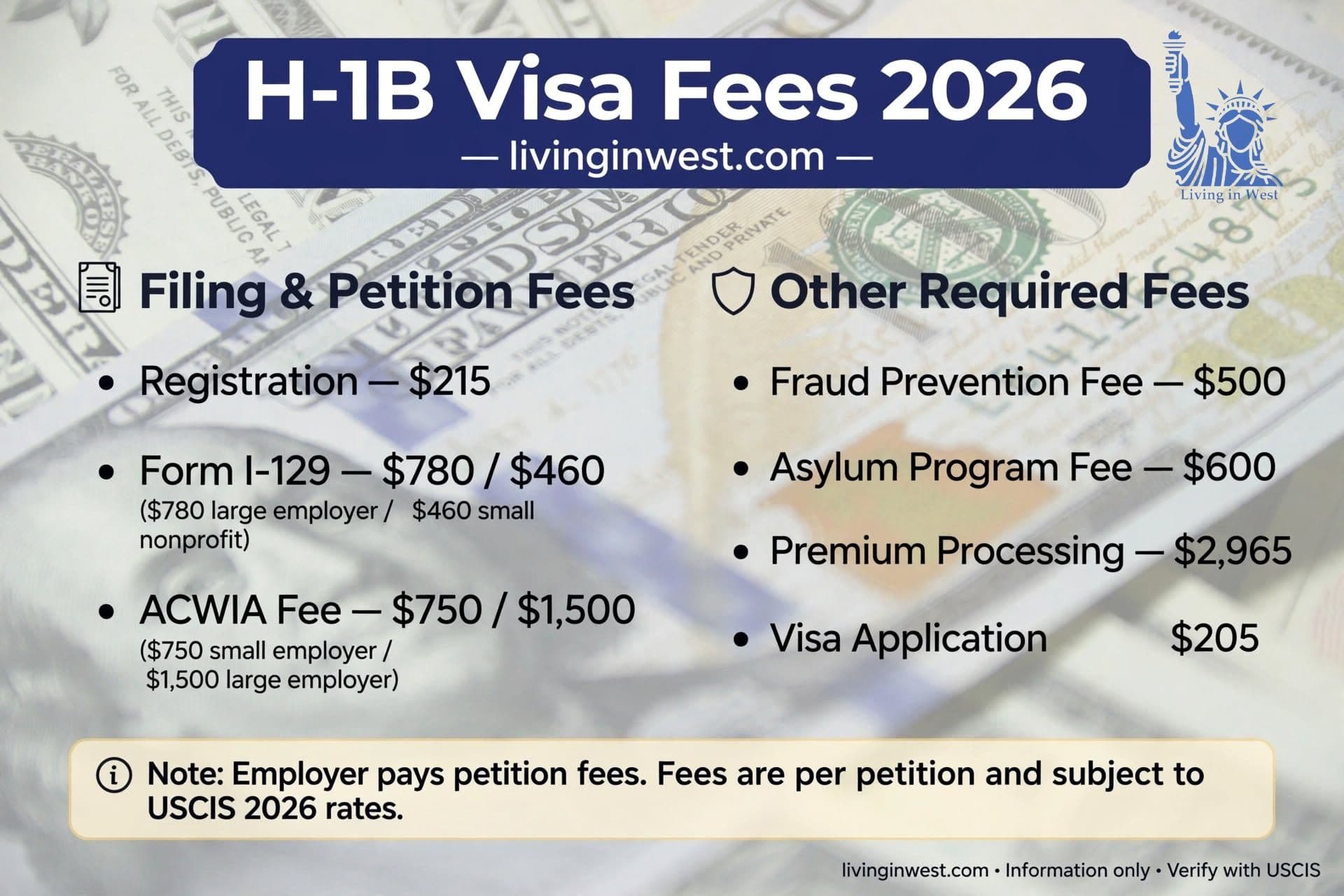
The total cost depends on the petition category, employer size, optional premium processing, legal services and any additional fee that applies to the specific case. There is no single total that applies to every H-1B petition.
Common filing fees and expenses
| Fee or expense | Amount or explanation |
|---|---|
| Electronic registration | $215 for the applicable cap registration |
| Form I-129 | Commonly $780 for a regular petitioner; $460 for qualifying small employers or nonprofits, subject to the current fee schedule and category |
| ACWIA training fee | Generally $750 for qualifying employers with 25 or fewer full-time-equivalent employees; $1,500 for larger covered employers |
| Fraud prevention fee | Generally $500 for covered initial petitions and changes of employer |
| Asylum Program Fee | Generally $600; $300 for qualifying small employers; $0 for qualifying nonprofits |
| Premium processing | $2,965 under the fee effective March 1, 2026 |
| Temporary-worker visa application | $205, where the petition-based visa application fee applies |
| Attorney fees | Vary according to the lawyer, employer arrangement and complexity of the case |
The table is a guide to common charges, not a complete invoice. Different petition types, exemptions, employer circumstances and additional requirements can change the total. Check the current USCIS fee schedule before filing.
Official sources:
Who pays the H-1B fees?
The employer must pay certain required petition expenses under applicable immigration and labour rules. The law does not mean that every possible expense in the entire immigration process must always be paid by the employer.
The worker may have separate expenses, such as personal document preparation, travel or certain visa-related costs. The parties should confirm the payment arrangement and ensure it complies with the applicable rules.
6. What Is the Current Status of the $100,000 H-1B Payment?
Status as of October 13, 2026: the payment is subject to ongoing litigation and should not be treated as a universally payable fee.
A presidential proclamation in September 2025 introduced a $100,000 payment requirement associated with certain H-1B petitions involving workers outside the United States. The government subsequently extended the restriction in September 2026.
However, a federal court in Massachusetts vacated the policy implementing the payment on June 8, 2026. On July 24, the US Court of Appeals for the First Circuit rejected the government’s request to pause that ruling while the appeal continued.
A further development occurred on September 30, 2026, when a federal court in California issued an injunction concerning the related presidential proclamations in the Global Nurse Force case.
These court actions are critical to understanding the policy’s status. The extension of a proclamation does not, by itself, remove a court order affecting its enforcement.
Does every new H-1B applicant have to pay $100,000?
No. The payment should not be described as a fee that every H-1B worker or every extension applicant automatically owes. Its implementation is affected by court orders and ongoing litigation.
Employers filing a petition should check the latest USCIS guidance and the current status of the relevant court orders. Immigration policy can change, and an article’s publication date cannot replace a case-specific legal review.
Sources:
- First Circuit — State of California v. Mullin, July 24, 2026
- University of Alabama — Immigration Updates, including September 30 litigation update
- September 2026 Presidential Proclamation
7. What Is the Proposed $103,265 H-1B Fee?
On August 24, 2026, USCIS announced a proposal to establish a $103,265 additional fee for H-1B cap-subject petitions, including petitions eligible for the US advanced-degree exemption. The proposed rule was published in the Federal Register on August 25, 2026, and the public comment period closed on September 24.
The proposal is separate from the $100,000 payment described in the previous section.
Is the $103,265 fee final?
The rulemaking document reviewed for this article identifies the $103,265 charge as a proposed rule, not a final fee. The proposal would apply to the cap-subject petitions covered by the rule if finalised as written. Certain cap-exempt petitions would be excluded.
The fact that the comment period has closed does not mean that the proposal automatically became law. Before making a hiring or filing decision, employers should check whether a final rule has been issued and what effective date it specifies.
Official sources:
8. The Additional $4,000 H-1B Fee for Certain Employers
A separate rule concerns covered employers that have at least 50 employees in the United States and more than 50% of their employees in H-1B or L-1 nonimmigrant status.
The fee is:
- $4,000 for covered H-1B petitions
- $4,500 for covered L-1 petitions
The rule became effective on September 9, 2026, and is scheduled to apply to covered petitions filed on or before September 30, 2027.
The updated rule requires covered employers to pay the H-1B fee for extension-of-status petitions, including qualifying extensions with the same employer. An amended petition that does not seek an extension of the worker’s currently authorised H-1B status is exempt under the rule.
This is an employer-specific charge, not a universal fee that every H-1B applicant must pay.
Official source: Federal Register — 9-11 Response and Biometric Entry-Exit Fee for H-1B and L-1 Visas.
9. H-1B Lottery 2027: How Selection Works
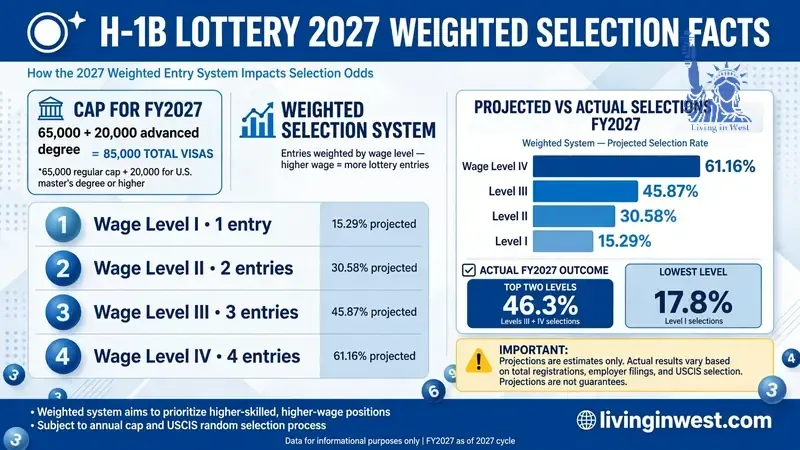
The standard annual H-1B cap is 65,000, with an additional 20,000 places under the US advanced-degree exemption for eligible applicants who hold a qualifying US master’s degree or higher. This is commonly described as an annual total of 85,000 cap places.
Some employers and petitions qualify for cap-exempt treatment and are handled separately from the standard cap selection.
The weighted selection system
For the FY2027 cap season, the selection system gives more entries to registrations associated with higher Department of Labor wage levels for the relevant occupation and work location.
| Wage level | Entries in the selection system |
|---|---|
| Level I | 1 |
| Level II | 2 |
| Level III | 3 |
| Level IV | 4 |
This weighting gives higher wage levels more entries in the selection pool. It does not mean that every applicant at a particular wage level has a fixed probability of selection.
The wage level depends on the occupation, work location and relevant wage data. A higher salary does not automatically prove that a position qualifies for a particular wage level.
What do the projected selection chances mean?
DHS’s analysis projected selection probabilities of approximately 15.29% for Level I, 30.58% for Level II, 45.87% for Level III and 61.16% for Level IV under the weighted system’s modelling assumptions.
These are projections, not guaranteed personal odds. Actual outcomes depend on the registration pool and the applicable selection process. A worker’s wage level alone does not guarantee selection.
What do the FY2027 selection figures show?
The government’s September 2026 proclamation cites FY2027 selection data indicating that registrations with wages at the two highest levels accounted for approximately 46.3% of selections, while the lowest wage level accounted for approximately 17.8%.
Those figures illustrate how the weighted process changes the distribution of selections. They should not be confused with the percentage of all applicants who will ultimately receive approved petitions or visas.
Official source: Federal Register — September 2026 Proclamation and FY2027 selection data.
10. How Long Can You Stay on an H-1B Visa?
The standard H-1B period is generally up to three years initially, with an extension usually available for a total of up to six years.
Some workers may qualify for extensions beyond six years under specific employment-based permanent-residence provisions. Eligibility depends on the worker’s circumstances and the relevant statutory requirements; extensions beyond six years are not automatic.
The H-1B is a temporary nonimmigrant classification, but it permits dual intent. This means a worker may pursue a qualifying Green Card process while holding H-1B status.
An H-1B visa does not itself grant permanent residence or US citizenship.
11. Can H-1B Workers Bring Their Families?
An eligible H-1B worker’s spouse and unmarried children under 21 may generally apply for H-4 dependent status.
H-4 status does not automatically authorise every spouse to work. Certain H-4 spouses can qualify for employment authorisation under specific rules, including requirements related to the principal H-1B worker’s employment-based permanent-residence process.
Family members should check their own status and eligibility requirements before working or making immigration plans.
12. Can an H-1B Worker Change Employers?
In many cases, an H-1B worker can move to another qualifying employer through the applicable H-1B portability process.
The new employer generally files a petition, and the worker must meet the relevant eligibility and timing requirements. A job change is not simply a transfer of a visa sticker: the new role and petition must satisfy the rules.
Workers who are pursuing a Green Card should also consider how a job change affects their permanent-residence process.
13. Can You Buy a House While on an H-1B?
H-1B status does not, by itself, prevent a person from buying property in the United States. However, the ability to purchase a home and the ability to qualify for a mortgage are different matters.
Lenders may assess income, credit history, employment stability, down payment, debt obligations and immigration documentation. Requirements vary by lender and loan programme, so there is no universal rule that every H-1B borrower needs a 700 credit score or a 15–20% down payment.
Buying a home does not provide a Green Card, permanent immigration status or citizenship.
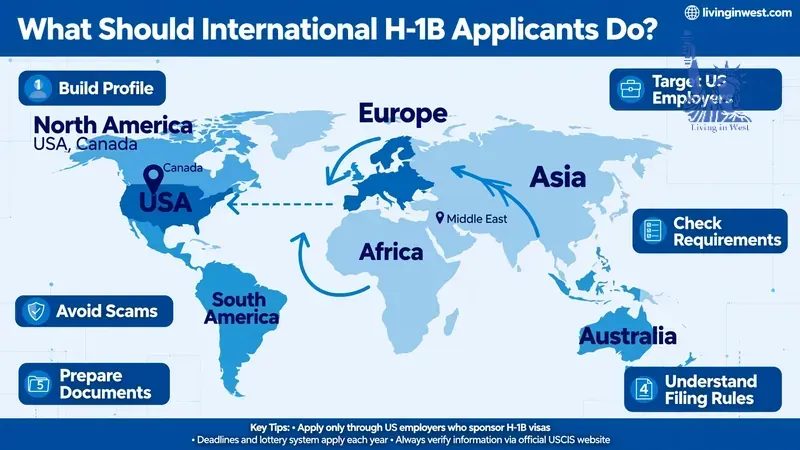
14. What Should International H-1B Applicants Do?
For professionals living outside the United States, the first step is to identify a suitable occupation and find a legitimate US employer willing to sponsor the position. This applies to eligible applicants from Asia, the Middle East, Africa, Europe and other regions.
Build the right professional profile. Match your education and work experience to occupations requiring specialised knowledge. Prepare a clear résumé and highlight relevant qualifications, projects, technical skills and professional achievements.
Target US employers offering visa sponsorship. Search for genuine job advertisements mentioning H-1B sponsorship or employment visa sponsorship. Confirm the employer’s sponsorship policy before investing significant time or money in the recruitment process.
Check the actual job requirements. A job title or high salary does not automatically make a position eligible. The job duties, educational requirements and applicant’s qualifications must meet the applicable specialty-occupation rules.
Understand the current filing rules. Employers should review the annual cap calendar, registration requirements, fee schedule, weighted selection system and any court decisions affecting additional payments. Requirements may differ depending on the employer, position and petition category.
Prepare your documents early. Applicants may need academic records, degree evaluations where applicable, employment references, a résumé and evidence of relevant experience. The exact documents depend on the position and individual circumstances.
Avoid guaranteed-visa promises. No private agent can guarantee lottery selection, USCIS approval or visa issuance. Be cautious of recruiters demanding suspicious upfront payments in exchange for a promised job or visa. Verify employers and recruitment agencies before sharing sensitive documents or money.
A Separate H-1B1 Visa Option for Singaporean and Chilean Professionals
Singapore and Chile have a separate H-1B1 visa classification for eligible professionals working in specialty occupations. Although related to the H-1B programme, H-1B1 has its own eligibility rules, procedures and country-specific numerical allocations.
The relevant annual allocations are up to 5,400 for Singapore and 1,400 for Chile. These limits are separate from the standard H-1B cap and its weighted selection process.
Professionals from other countries should review the standard H-1B requirements rather than assume that the H-1B1 category is available to them.
Official source: US Department of Labor — H-1B1 Programme
General guidance: Applicants worldwide should verify current requirements through official US government sources and consider consulting a qualified US immigration attorney for advice about their specific circumstances.
Conclusion: Is the H-1B Visa Worth Pursuing in 2026?
The H-1B visa can provide an opportunity for qualified international professionals to work in the United States. Applicants from Asia, the Middle East, Africa, Europe and other regions may qualify if they meet the relevant requirements and obtain sponsorship from a US employer for an eligible position.
USCIS FY2025 data show that beneficiaries born in India accounted for 69.9% of approved H-1B petitions, while beneficiaries born in China accounted for 12.1%. These figures describe approved petitions by country of birth; they do not represent individual lottery odds or guarantee future results.
For the FY2027 cap season, the weighted selection system gives more entries to registrations associated with higher wage levels. However, selection does not guarantee petition approval, and the applicable rules depend on the specific case.
The fee situation also requires careful attention. The $100,000 payment has been affected by court litigation, the proposed $103,265 charge should not be treated as a final fee without confirmation, and the $4,000 H-1B fee applies only to covered employers and petitions.
For international applicants, the practical starting point is to identify legitimate US employers offering suitable positions, confirm sponsorship availability, prepare the required qualifications and documents, and check the latest official immigration rules before filing.
Frequently Asked Questions
Which countries have the most H-1B approvals?
According to the USCIS FY2025 report, India was the largest country-of-birth group among approved H-1B beneficiaries, accounting for 69.9% of approved petitions. China ranked second at 12.1%. These figures relate to approved petitions, not the selection probability for an individual applicant.
Can professionals from Asia apply for an H-1B visa?
Yes. Eligible professionals from countries across Asia—including India, China, Japan, South Korea, the Philippines, Bangladesh and other countries—can pursue H-1B employment if they meet the applicable requirements and have a qualifying US employer sponsor.
Can applicants from the Middle East apply for an H-1B visa?
Yes. Eligible professionals from countries such as Saudi Arabia, the United Arab Emirates, Qatar, Kuwait, Bahrain, Oman, Jordan, Egypt and other countries in the region can pursue H-1B employment. Eligibility depends on the position, qualifications, employer sponsorship and applicable immigration rules, not nationality alone.
Can professionals from Africa apply for an H-1B visa?
Yes. Eligible applicants from African countries, including Nigeria, Kenya, Ghana, South Africa, Egypt and others, may qualify for H-1B employment. They generally need a qualifying specialty-occupation job and a US employer willing to file the required petition.
Can people from any country apply for an H-1B visa?
The H-1B programme is available to eligible foreign professionals from many countries. Applicants must meet the relevant requirements, and most cap-subject cases follow the applicable registration and selection process. Certain other requirements or visa categories may differ by circumstance.
Can I apply for an H-1B visa without a US employer?
The standard H-1B process generally requires a US employer to file the petition. An applicant cannot replace the employer-sponsored process simply by submitting an independent application.
Is the $100,000 H-1B payment currently required?
The payment has been affected by court orders and ongoing litigation. It should not be described as a universal fee that every H-1B applicant must pay. Employers should check the latest USCIS guidance and applicable court orders before filing.
Is the proposed $103,265 H-1B fee final?
The August 2026 announcement and Federal Register publication described the $103,265 charge as a proposed rule. Check for a final rule and its effective date before treating the amount as a payable fee.
Does a higher wage guarantee H-1B lottery selection?
No. The FY2027 weighted selection system gives more entries to registrations associated with higher wage levels, but it does not guarantee selection or approval of the subsequent petition.
Can H-1B workers apply for a Green Card?
Eligible H-1B workers may pursue an employment-based Green Card process. H-1B status does not itself grant permanent residence, and the Green Card process has separate eligibility requirements and timelines.
Can an H-1B worker bring a spouse and children?
Eligible H-1B workers’ spouses and unmarried children under 21 may generally apply for H-4 dependent status. Work authorisation for an H-4 spouse is available only to those who meet specific requirements.
Official Sources
- USCIS — H-1B Specialty Occupations
- USCIS — FY2025 H-1B Characteristics Report
- USCIS — Fee Schedule, Form G-1055
- US Department of State — Temporary Worker Visas
- US Department of State — Visa Fees
- First Circuit — State of California v. Mullin, July 24, 2026
- University of Alabama — Immigration Updates
- Federal Register — September 2026 Proclamation
- USCIS — Proposed $103,265 H-1B Fee
- Federal Register — $4,000 H-1B and $4,500 L-1 Fee Rule
- US Department of Labor — H-1B1 Programme for Eligible Singaporean and Chilean Professionals
Disclaimer: This article provides general educational information, not legal advice. H-1B rules, fees and court decisions can change. Applicants and employers should verify the latest official guidance and consult a qualified US immigration attorney for advice about individual circumstances.

Editorial Team