1. Austin vs Dallas: Population and Metropolitan Size
The first important distinction is between a city and its metropolitan area. Austin city is not the same as the Austin metropolitan area, and Dallas city is not the same as the wider Dallas–Fort Worth region.
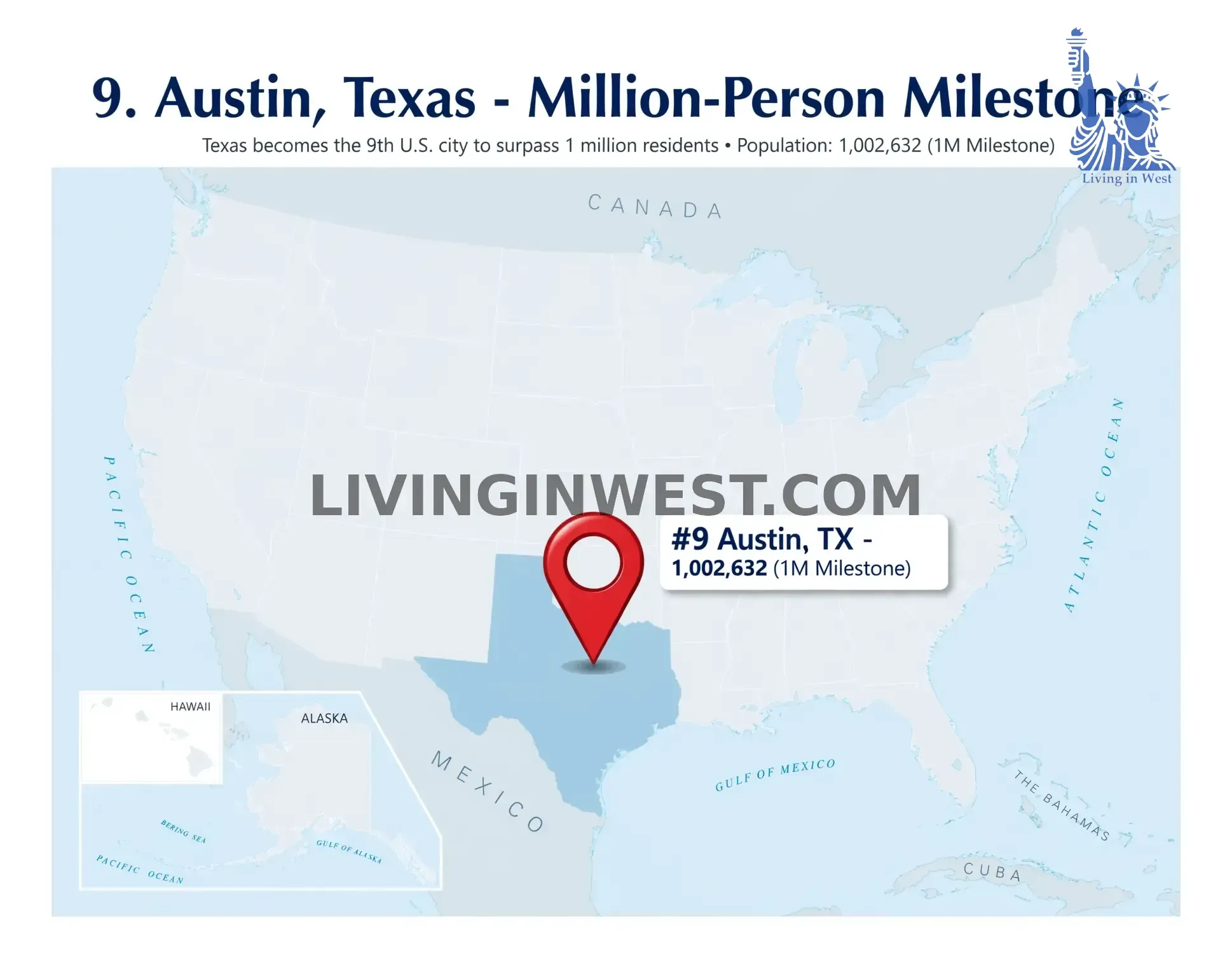
According to the U.S. Census Bureau’s Vintage 2025 estimates, Austin crossed the one-million-resident mark between 2024 and 2025. Dallas and Fort Worth also ranked among the 15 most populous US cities.
City population in 2025
| City | Estimated population |
|---|---|
| Dallas, Texas | 1,329,491 |
| Fort Worth, Texas | 1,028,117 |
| Austin, Texas | 1,002,632 |
Source: U.S. Census Bureau — Vintage 2025 city and town population estimates.
Dallas has a larger population than Austin within city limits. Fort Worth is also a separate major city; it should not be treated as a Dallas neighbourhood or included in Dallas city’s population.
Metropolitan population in 2025
| Metropolitan area | Estimated population |
|---|---|
| Dallas–Fort Worth–Arlington | 8,477,157 |
| Austin–Round Rock–San Marcos | 2,620,945 |
Sources: Federal Reserve Bank of St. Louis — DFW metro population and Austin metro population. Both series use US Census Bureau estimates.
The DFW metropolitan area is substantially larger. That scale supports a wider regional network of employers, communities, commercial centres and residential markets. Austin’s metro is smaller, but it has its own established technology, manufacturing, government and university-related economy.
What this means for residents: Dallas–Fort Worth offers a much larger geographic job and housing market. Austin is a more compact regional choice, although actual travel times depend heavily on where someone lives and works.

2. Cost of Living: Which City Is Cheaper?
Cost of living is not a single number. Rent, home prices, property taxes, insurance, transport, childcare and healthcare all affect the final budget.
For a clear comparison, start with housing costs and then calculate the other expenses for the particular household.
Average one-bedroom apartment rent
Zillow’s Rental Manager data, last updated October 10, 2026, reports the following averages for one-bedroom apartments and condominiums:
| Measure | Austin | Dallas |
|---|---|---|
| Average monthly rent | $1,360 | $1,182 |
| Annualised rent | $16,320 | $14,184 |
| Difference | — | $178 less per month |
Source: Zillow Austin rental market and Zillow Dallas rental market.
At these averages, a renter paying the Dallas figure would spend $2,136 less per year than someone paying the Austin figure. This is a straight annualisation of the monthly averages, not a guarantee of what an individual renter will pay.
Apartment prices vary by neighbourhood, building age, size, amenities and lease terms. A particular apartment in Austin can cost less than one in Dallas, and premium apartments in either city can be much more expensive than the citywide average.
Home purchase prices
Redfin’s housing-market pages reported these median sale prices:
| City | Median sale price | Reporting period |
|---|---|---|
| Austin | $537,244 | September 2026 |
| Dallas | $450,000 | August 2026 |
Sources: Redfin Austin housing market and Redfin Dallas housing market.
The reporting months differ, so this is not a same-month comparison. The figures nevertheless show why buyers should examine recent local sales rather than assume that all of Texas has one housing price.
Before buying, compare the property’s location, square footage, condition, insurance, mortgage rate, homeowners’ association fees and estimated property taxes. A lower sale price does not automatically mean a lower monthly ownership cost.

3. Texas Taxes: No State Individual Income Tax, but Property Taxes Matter
Texas does not levy a state individual income tax. That applies whether someone lives in Austin or Dallas. It does not mean residents pay no taxes.
The Texas Comptroller explains the state’s tax system and provides information on sales taxes, franchise taxes and property-tax matters. Property taxes are levied by local taxing authorities, including counties, school districts and other local entities.
Official reference: Texas Comptroller — Taxes.
For a homebuyer, the important figure is the combined tax burden attached to the actual property. Two homes with similar purchase prices can have different annual tax bills because they may fall under different taxing districts or have different taxable assessed values and exemptions.
A responsible comparison should therefore use the specific property’s tax records rather than quote one universal “Austin rate” or “Dallas rate” as if it applies to every home.
Renters should also remember that property-related costs can influence landlords’ operating expenses, but a property-tax increase does not translate into an identical or automatic rent increase for every tenant.

4. Jobs and Major Employers: Austin vs Dallas–Fort Worth
Austin and Dallas–Fort Worth both have diverse economies, but their industry mix differs.
Austin: Technology, manufacturing and regional services
Austin has an established technology and advanced-manufacturing presence. Dell Technologies is associated with the region, while Samsung’s semiconductor operations and Tesla’s manufacturing activity contribute to its industrial profile. Oracle and other software-related businesses are also part of the regional economy.
However, Austin should not be described as a technology-only city. H-E-B is the Austin metro’s largest private employer in the Austin Business Journal’s 2025 employer coverage, with Tesla ranked second. That is an important reminder that retail, distribution and other large-scale services are also central to the local labour market.
Sources: Austin Business Journal — H-E-B remains the largest private employer and Texas Comptroller’s 2025 headquarters and industry report.
Dallas–Fort Worth: A broad corporate economy
DFW has a wide corporate base, including businesses in financial services, professional services, technology, telecommunications, manufacturing, transport and logistics. Its size also means that employment opportunities are spread across several cities and suburbs rather than concentrated in Dallas city alone.
The Texas Comptroller’s 2025 analysis identifies 21 Fortune 500 headquarters in the Dallas–Fort Worth–Arlington metro area, compared with three in the Austin–Round Rock–San Marcos metro. These figures refer to headquarters within the metropolitan areas, not the total number of companies that employ people there.
Source: Texas Comptroller — Headquarters of Headquarters, 2025.
The headquarters count is one indicator of corporate concentration, not a complete measure of job quality or the number of available vacancies. A smaller company, hospital, university, government agency or local business can be a better employment option for a particular worker.
5. What Do Wages Look Like in Austin and DFW?
Instead of giving one salary figure for everyone in a city, it is more useful to examine industry-specific wage data.
The Texas Comptroller’s 2025 Q3 industry-cluster analysis, using Chmura JobsEQ data, reported the following average annual wages:
| Industry cluster | Metro area | Average annual wage |
|---|---|---|
| Electric/electronics manufacturing | Austin metro | $180,599 |
| Media, including software | Austin metro | $139,632 |
| Financial services | DFW metro | $138,773 |
| Electric/electronics manufacturing | DFW metro | $143,953 |
Source: Texas Comptroller — 2025 statewide economic and industry-cluster report. Data are identified as 2025 Q3.
These are industry-cluster averages, not median salaries, starting salaries or guaranteed individual earnings. A cluster may include workers with different roles, experience levels and pay structures.
The figures show that Austin has a strong average-wage profile in electric/electronics manufacturing and media/software-related work, while DFW has substantial employment and wages in financial services and electronics manufacturing.
For a realistic job comparison, compare the exact occupation, experience level, benefits, remote-work policy and likely commute. Then compare the expected take-home pay with housing and transport costs.

6. Fast-Growing Texas Suburbs: Celina, Princeton, Anna, Forney and Hutto
Population growth can indicate rising demand for housing, schools, roads, shops and public services. It does not, by itself, prove that a location is affordable or that a home will appreciate in value.
The Census Bureau’s Vintage 2025 estimates identified the following growth rates for cities and towns with populations of at least 20,000 between July 1, 2024, and July 1, 2025.
| City or town | Population growth | 2025 population |
|---|---|---|
| Celina, Texas | 24.6% | 64,427 |
| Princeton, Texas | 18.1% | 43,524 |
| Anna, Texas | 10.2% | 35,245 |
| Forney, Texas | 8.5% | 41,658 |
| Hutto, Texas | 7.9% | 46,048 |
Source: U.S. Census Bureau — Vintage 2025 population estimates.
Celina was the fastest-growing qualifying city or town in the country in this Census comparison. Princeton ranked third nationally, Anna fifth, Forney eighth and Hutto thirteenth among the qualifying places shown in the Census table.
Four of these five communities are in the wider DFW growth story, while Hutto is in the Austin area. Their growth rates are not a direct affordability ranking: housing costs, commute times, infrastructure and local services need to be considered separately.
Why fast growth matters
Rapidly expanding communities can attract new residential construction and retail development. They can also experience traffic pressure, school-capacity challenges and infrastructure projects that take time to complete.
When evaluating a suburb, check current listings, local planning and development information, school boundaries, road access and the location of the actual workplace. A home that appears cheaper on a listing may require a longer commute or additional transport expenses.

7. New Construction and Real Estate Opportunities
Austin and DFW both contain established neighbourhoods, new subdivisions, apartments, townhomes and larger suburban developments. The right market depends on whether the buyer wants an existing home, a newly built property, a rental investment or a home for personal use.
Austin area
Austin-area buyers may compare homes in Austin itself with communities such as Hutto and other surrounding locations. A property outside the central city may offer a different balance of price, space and travel time, but the outcome depends on the specific development and its location.
Technology and manufacturing activity are part of the regional economy, but a new employer announcement should not be treated as proof that every nearby property will rise in value.
Dallas–Fort Worth area
DFW’s large metropolitan footprint gives buyers many separate local markets to investigate. Celina, Princeton, Anna and Forney are examples of growing communities, but they differ in distance, local services, housing inventory and development patterns.
Before purchasing a newly built home, check the builder’s track record, completion timetable, warranty, included features, lot premium, community fees, estimated property taxes and any additional costs for upgrades. Compare the full contract price with comparable completed homes.
For investors: population growth and new construction are starting points for research, not an investment recommendation. Rental demand, vacancy, insurance, financing costs, taxes, maintenance and resale liquidity all affect the result.

8. Lifestyle, Transport and Daily Living
Austin and Dallas offer different urban experiences, but lifestyle is highly neighbourhood-specific.
Austin
Austin is known for its technology sector, live-music culture, outdoor recreation and access to the wider Central Texas region. Residents may value parks, trails, entertainment venues and the city’s cultural scene.
Traffic and travel times depend on the route, time of day and distance between home and work. Living near an employer or frequently used services can make a meaningful difference to a household’s routine.
Dallas–Fort Worth
DFW offers a much larger collection of urban centres, suburbs, business districts and entertainment destinations. Residents may choose between living in Dallas, Fort Worth or one of the many surrounding communities.
The region’s scale is an advantage for people seeking a broad choice of locations and employers, but it can also mean longer trips when home, work and leisure activities are far apart.
Which lifestyle fits better?
Choose based on the daily routine you want, not only on the city’s reputation. Compare commute times at the actual hours you would travel, proximity to grocery stores and healthcare, outdoor space, schools where relevant, and access to activities you use regularly.

9. International Residents and Overseas Property Buyers
Austin and Dallas–Fort Worth can both be relevant to international professionals, students, families and people researching US property markets. The better location depends on employment, education, immigration status, budget and personal priorities.
For someone moving for work, the first step is to identify realistic employers and job locations. A job in one part of DFW may be inconvenient from a distant suburb, just as a role outside central Austin may change the value of living downtown.
For overseas property buyers, the research process should start with the purpose of the purchase: personal use, a future move or a rental investment. Each has different financing, tax and management considerations.
Non-US buyers should not assume that the ability to purchase a property automatically gives them permission to live or work in the United States. Immigration status, financing eligibility, tax obligations and any applicable legal requirements are separate questions that should be checked with qualified professionals.
For a rental property, calculate income after property taxes, insurance, repairs, vacancy, management fees and financing costs. A growing population alone is not enough to establish that a property will be profitable.
10. Austin vs Dallas:

10. Austin vs Dallas: Which Is Better for You?
There is no single winner for every household. The available data points to several practical differences.
| Your priority | What the evidence suggests |
|---|---|
| Lower average one-bedroom apartment rent | Dallas had the lower Zillow average in October 2026. |
| Larger metropolitan job market | DFW's 2025 metro population was about 8.48 million, versus 2.62 million in the Austin metro. |
| Technology and software-related industries | Austin has a notable concentration in these sectors. |
| Broad corporate headquarters presence | The Texas Comptroller counted 21 Fortune 500 headquarters in DFW and three in Austin's metro. |
| Fast-growing suburban communities | Both regions have growing communities; Census growth rates show particularly rapid expansion in Celina and Princeton, and growth in Hutto near Austin. |
| Buying a home | Compare current, same-period sales data and the full monthly ownership cost for the specific property. |
Final verdict
Dallas–Fort Worth is worth a closer look if you want a larger metropolitan area, a broad corporate economy and a lower average one-bedroom apartment rent based on the October 2026 Zillow figures. Austin deserves close consideration if your career is connected to its technology, software or advanced-manufacturing sectors, or if its lifestyle and location suit your priorities.
Neither choice is automatically cheaper for every household. The strongest decision comes from matching a real job or income plan with current housing costs, taxes, transport and the neighbourhood where you would actually live.
Frequently Asked Questions
Is Austin more expensive than Dallas in 2026?
For one-bedroom apartments, Zillow reported an average of $1,360 per month in Austin and $1,182 in Dallas on October 10, 2026. Housing costs vary by property and location, and the full cost of living also includes transport, taxes, insurance and other expenses.
Is Dallas bigger than Austin?
Within city limits, Dallas had an estimated 1,329,491 residents in July 2025, compared with Austin’s 1,002,632. The difference is larger when comparing metropolitan areas: DFW had approximately 8.48 million residents and the Austin metro approximately 2.62 million.
Which area has more Fortune 500 headquarters?
The Texas Comptroller’s 2025 analysis counted 21 Fortune 500 headquarters in Dallas–Fort Worth–Arlington and three in Austin–Round Rock–San Marcos. These are metropolitan-area headquarters counts, not a count of every company operating in each region.
Does Texas have a state income tax?
Texas does not levy a state individual income tax. Residents still pay applicable federal taxes and may pay sales taxes, property taxes and other charges.
Which Texas suburbs are growing quickly?
The Census Bureau’s 2024–2025 estimates recorded population growth of 24.6% in Celina, 18.1% in Princeton, 10.2% in Anna, 8.5% in Forney and 7.9% in Hutto. Growth does not automatically mean lower housing costs or higher investment returns.
Are the wage figures in this article typical individual salaries?
No. The wage figures from the Texas Comptroller’s report are average annual wages for specified industry clusters in 2025 Q3. They should not be interpreted as starting pay, median salaries or guaranteed earnings for an individual worker.
Is buying property in Austin or DFW a guaranteed investment?
No. Property performance depends on the purchase price, financing, rental demand, vacancy, insurance, taxes, maintenance and resale conditions. Population growth is useful context, but it does not guarantee appreciation or rental profit.
Sources and Data Notes
- U.S. Census Bureau — Vintage 2025 city and town population estimates
- Federal Reserve Bank of St. Louis — Austin metro population
- Federal Reserve Bank of St. Louis — Dallas–Fort Worth metro population
- Texas Comptroller — 2025 headquarters and industry-cluster report
- Zillow — Austin one-bedroom apartment rental data
- Zillow — Dallas one-bedroom apartment rental data
- Redfin — Austin housing market
- Redfin — Dallas housing market
- Austin Business Journal — Austin metro’s largest private employer
- Texas Comptroller — Taxes
Editorial note: Population figures are 2025 estimates. Rent figures are Zillow averages last updated October 10, 2026. The cited Redfin sale-price figures cover September 2026 for Austin and August 2026 for Dallas; they are not same-month figures. Industry wage figures refer to 2025 Q3. All averages and medians describe the stated datasets, not the price or earnings of every individual household.

Editorial Team