9 Austin, Texas — A Million-Person City
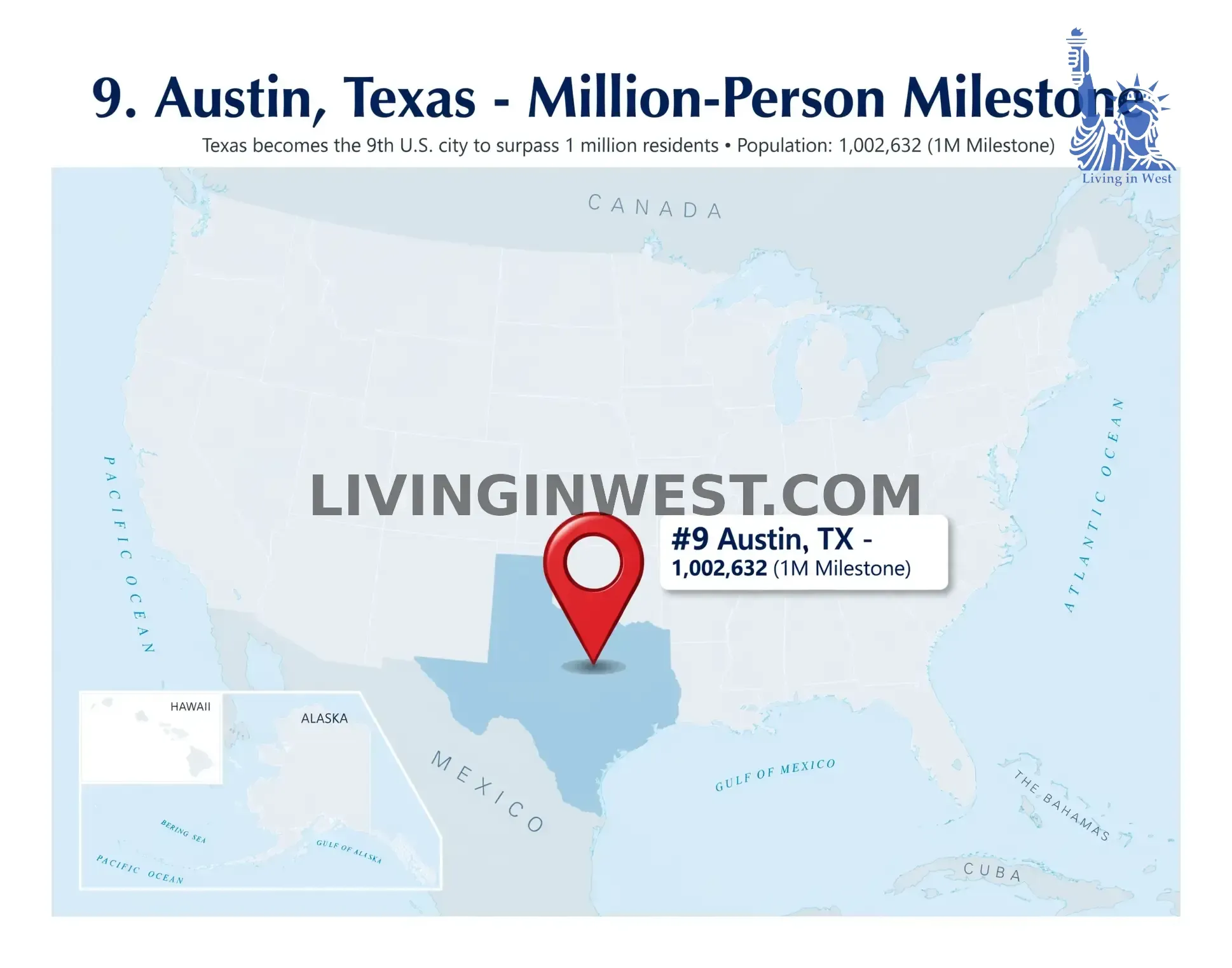
Austin has officially joined America's million-person cities. According to the U.S. Census Bureau's Vintage 2025 estimates, Austin reached 1,002,632 residents on July 1, 2025, adding 4,025 people, or 0.4%, from the previous year. That makes Austin the 12th-largest U.S. city.
Austin is different from the other cities in this article because it is no longer one of America's fastest-growing cities by percentage. Its importance comes from reaching a major population milestone while remaining one of the country's major technology, business and employment centers.
People move to the Austin area for a combination of employment opportunities, higher education, technology and a large suburban region surrounding the city. The metro area's growth also means that people can live outside Austin while remaining connected to the same regional economy.
The Census Bureau's latest estimates show that Austin's growth has slowed compared with its earlier boom years. Still, crossing one million residents confirms that the city has moved into a different category of American urban growth.
Austin therefore belongs in this list as a major population milestone, not as one of the nine fastest-growing cities by percentage.
8 Fort Worth, Texas — 19,512 New Residents
Fort Worth represents the big-city side of America's population-growth story.
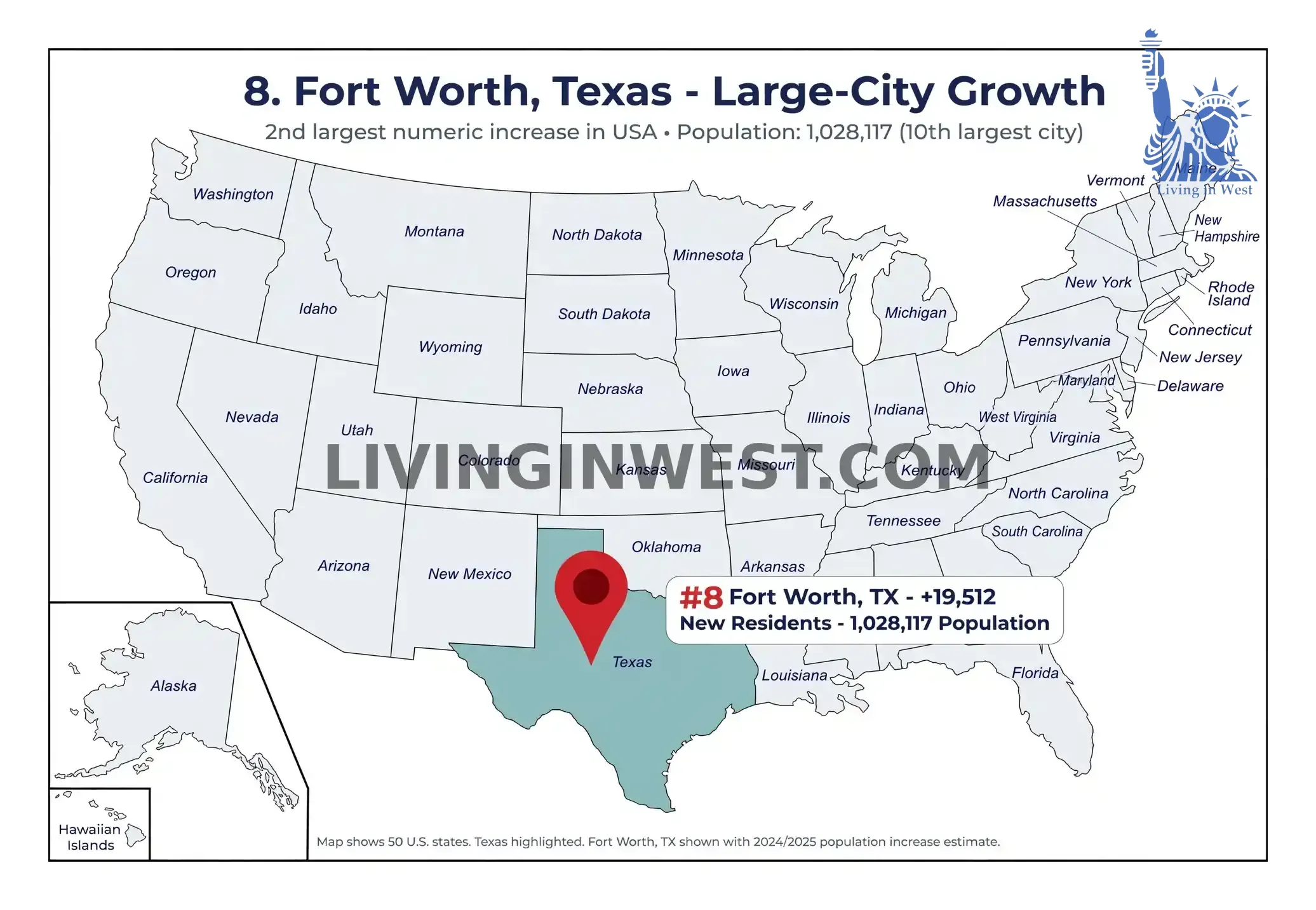
The Census Bureau estimates that Fort Worth added 19,512 residents between July 2024 and July 2025, the second-largest numeric increase among U.S. cities with populations of at least 20,000. Its population reached 1,028,117, making Fort Worth the nation's 10th-largest city.
The reason Fort Worth matters is scale. A city of more than one million people adding nearly 20,000 residents in one year represents substantial population growth even though its percentage increase is much lower than smaller cities such as Celina or Princeton.
Fort Worth is part of the broader Dallas-Fort Worth economy, one of the country's largest metropolitan regions. Residents can access employment across the metro while living in a city with extensive residential and commercial development.
The growth pattern also shows why America's population story cannot be explained simply as people leaving big cities for small towns. Fort Worth itself continues to gain residents while smaller communities around the DFW region are growing even faster.
Fort Worth is therefore an example of large-city growth occurring alongside rapid suburban expansion.
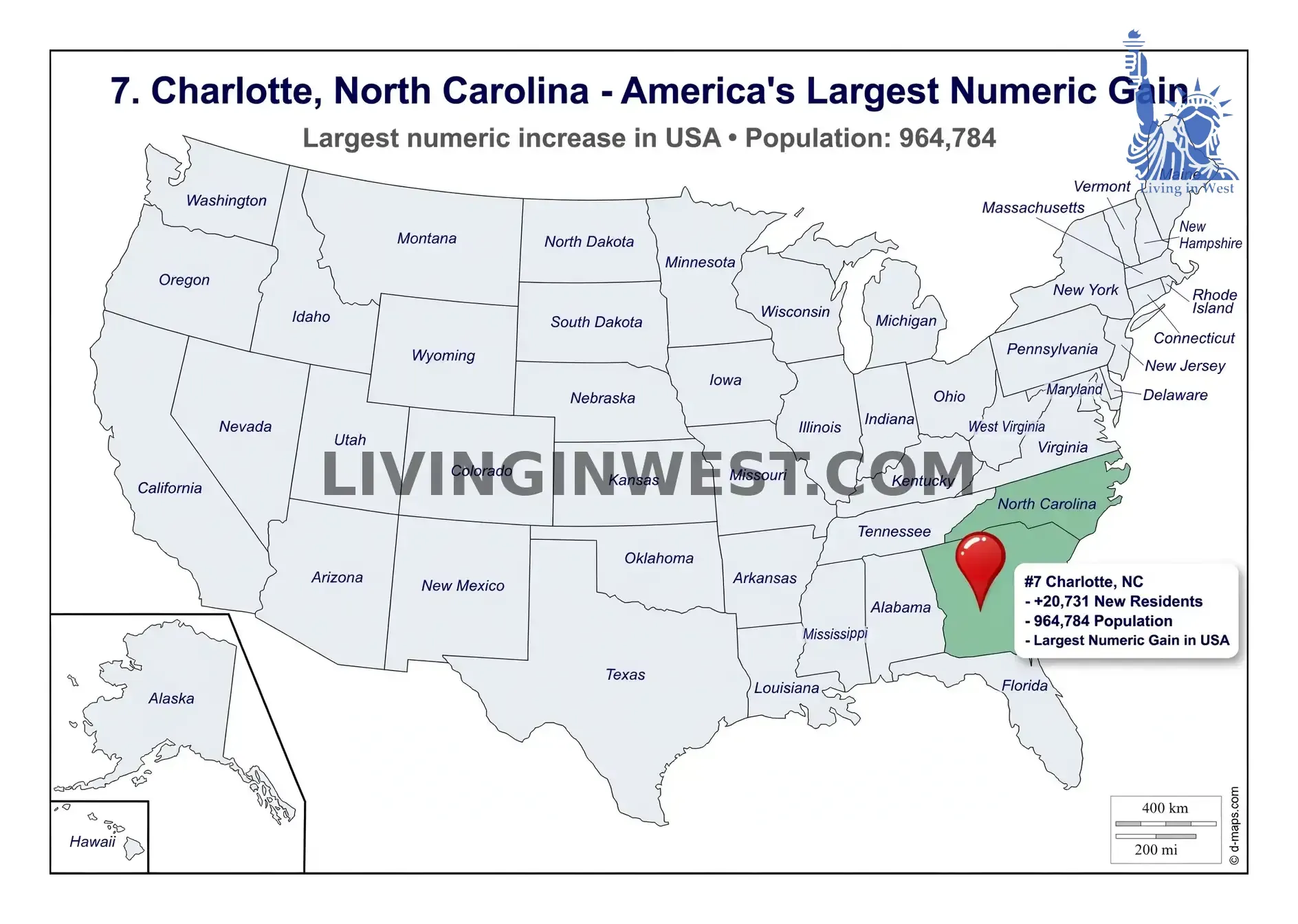
7 Charlotte, North Carolina — America's Largest Numeric Gain
Charlotte recorded the largest numeric population increase of any U.S. city between July 2024 and July 2025.
The Census Bureau estimates that Charlotte gained 20,731 residents, bringing its population to 964,784.
Charlotte is important because its growth looks different from the Texas suburbs. The city already has a large population, so even a relatively moderate percentage increase can produce tens of thousands of additional residents.
The wider Charlotte metropolitan area is also expanding. The Census Bureau highlighted a common pattern in which midsized communities surrounding major cities grow faster than the central city itself. Fort Mill, South Carolina, is a strong example of this pattern.
People can therefore move within the same metropolitan economy rather than completely leaving it. A household may choose Charlotte itself, a nearby North Carolina suburb, or a community across the South Carolina border while remaining connected to the same regional employment market.
Charlotte's population gain demonstrates that major employment centers and their surrounding suburbs can grow at the same time.
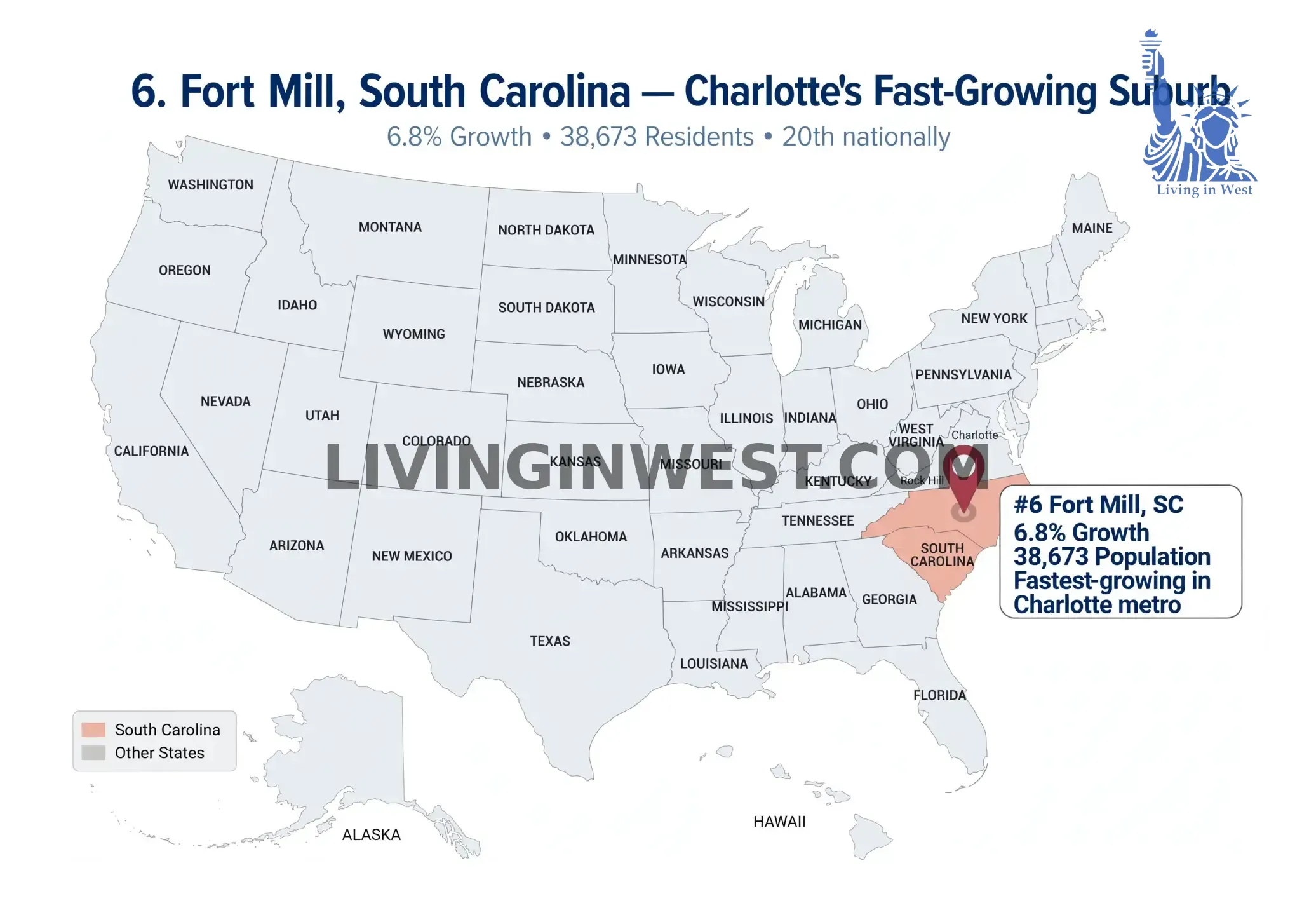
6 Fort Mill, South Carolina — Charlotte's Fast-Growing Suburb
Fort Mill shows how metropolitan growth can spread across state borders.
The Census Bureau reports that Fort Mill grew 6.8% between 2024 and 2025, reaching 38,673 residents. It ranked 20th nationally among cities and towns with populations of at least 20,000. The Census Bureau also identified Fort Mill as the fastest-growing community in the Charlotte metropolitan area by percentage growth.
Fort Mill is about 20 miles from downtown Charlotte, giving residents access to the larger Charlotte economy while living outside the central city.
This is an important clue about why people move to fast-growing suburbs. The decision is not always about leaving a metropolitan area. It can be about finding housing, space and a different suburban environment while remaining close to jobs and services in the same metro.
Fort Mill's growth also demonstrates why city-by-city rankings can sometimes hide the larger story. Charlotte added more people numerically, but a much smaller community such as Fort Mill can grow faster when measured by percentage.
Together, Charlotte and Fort Mill show the central-city plus suburb growth model now visible across many U.S. metropolitan areas.
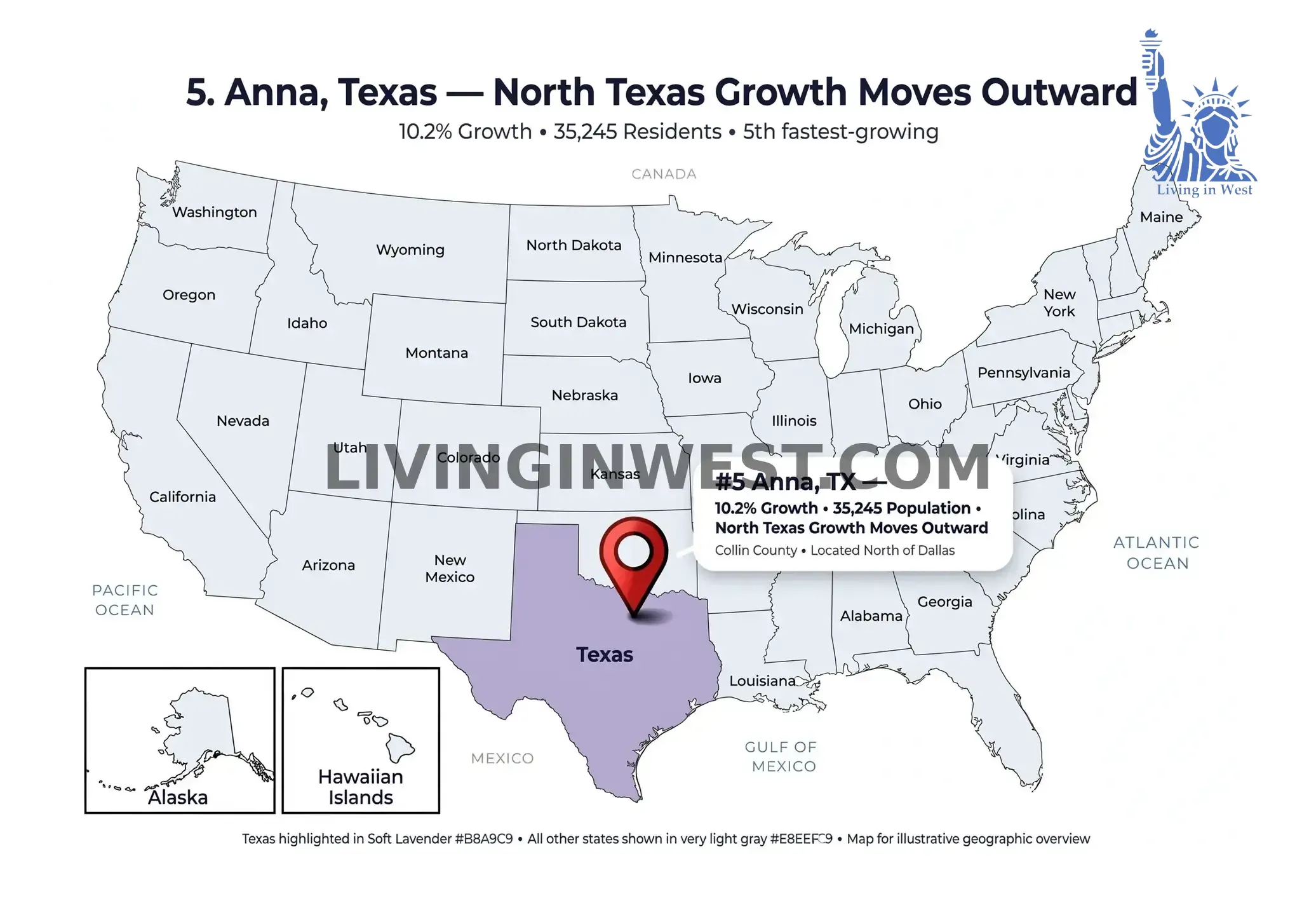
5 Anna, Texas — North Texas Growth Moves Outward
Anna grew 10.2% between 2024 and 2025, reaching 35,245 residents. That placed it fifth among America's fastest-growing cities and towns with populations of at least 20,000.
Anna's growth is part of the continuing expansion of the Dallas-Fort Worth metropolitan area.
One important reason communities like Anna grow rapidly is the availability of new residential development. As established suburbs become more developed, households looking for newer homes and more space can look farther from the central parts of the metropolitan area.
That does not necessarily mean residents are leaving the DFW economy. Many can continue working in major employment centers elsewhere in the metro while living in a newer outer-ring community.
This creates a powerful cycle: population growth increases demand for housing, housing construction attracts additional residents, and growing populations support new retail, services and infrastructure.
Anna therefore illustrates a broader American trend: metropolitan growth is increasingly spreading into communities that were once much smaller and more rural in character.
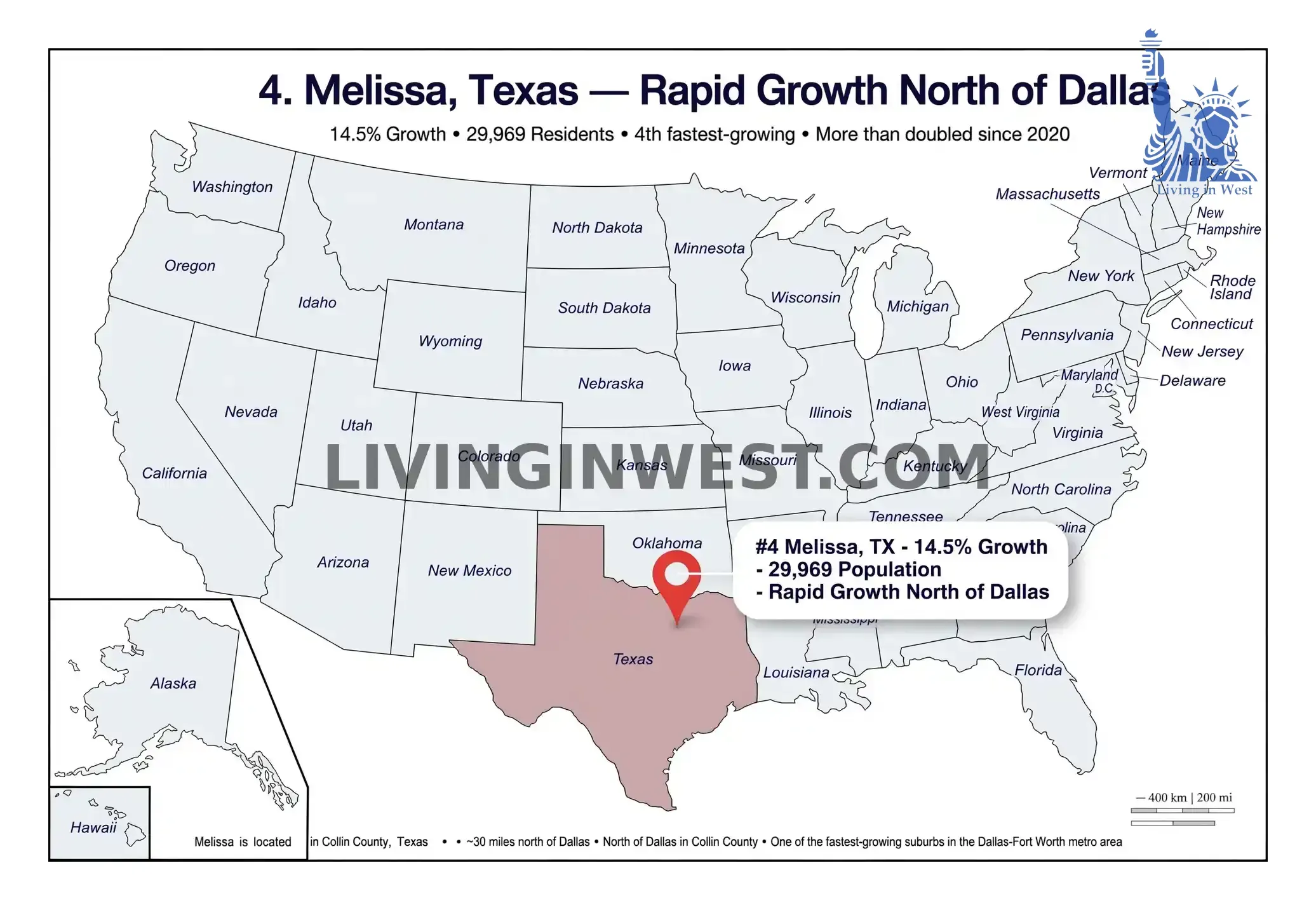
4 Melissa, Texas — Rapid Growth North of Dallas
Melissa grew 14.5% from 2024 to 2025, reaching 29,969 residents. The Census Bureau ranked it fourth among U.S. cities and towns with populations of at least 20,000 by percentage growth.
The longer-term change is even more striking. Melissa's population has more than doubled since the 2020 Census, showing that its recent growth is part of a broader expansion rather than a single-year spike.
Melissa benefits from its position within the Dallas-Fort Worth metropolitan region. For households, the attraction can be the combination of newer housing, suburban space and access to a much larger regional economy.
This is one reason it is misleading to describe all migration to fast-growing Texas cities as people simply moving because of taxes.
Taxes can influence a relocation decision, but the Census population estimates do not establish taxes as the reason individual residents moved to Melissa.
Housing availability, household preferences, employment access and metropolitan expansion can all play a role.
Melissa is therefore best understood as an outer-ring DFW community benefiting from continued suburban expansion.
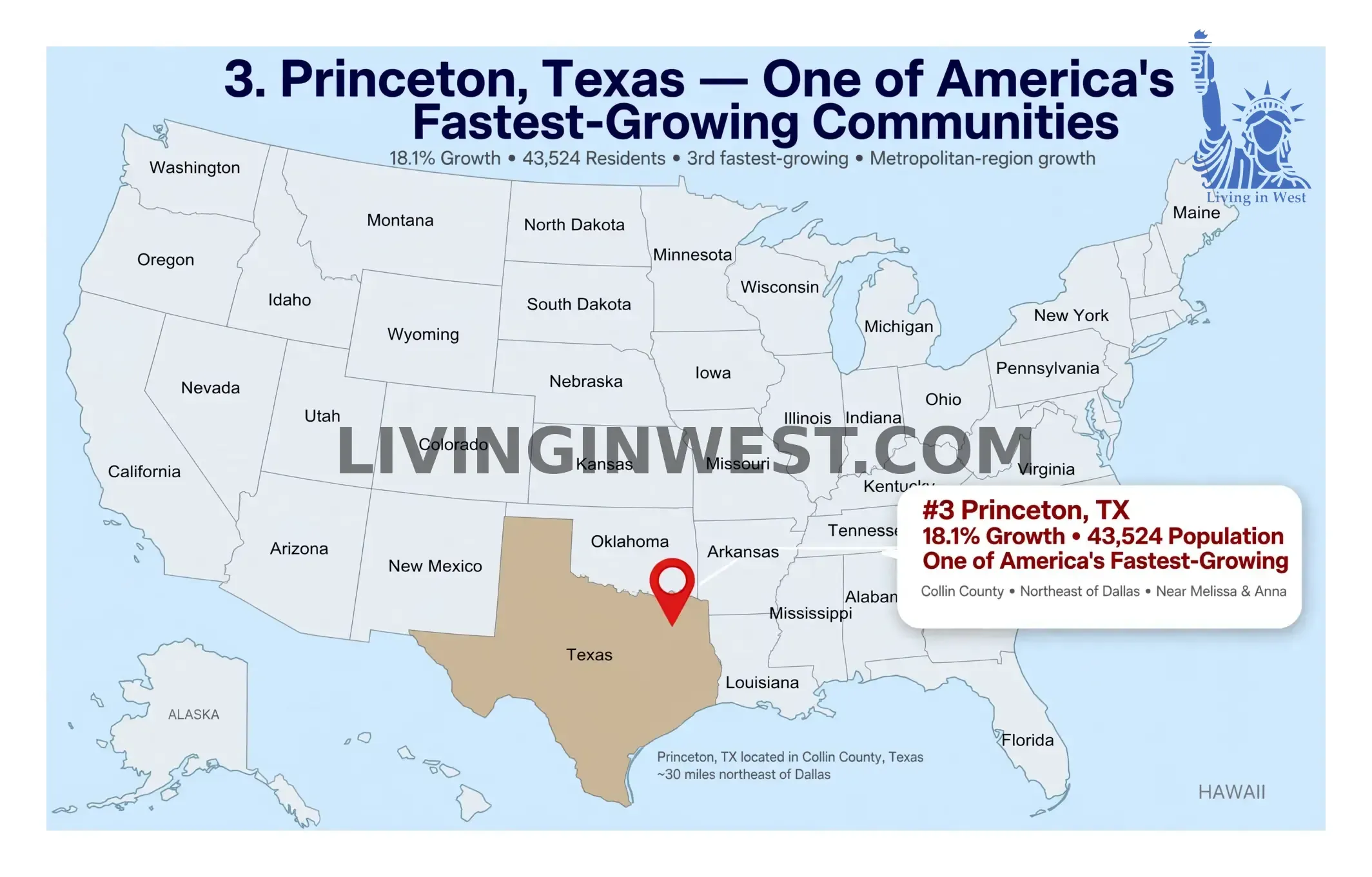
3 Princeton, Texas — One of America's Fastest-Growing Communities
Princeton recorded 18.1% population growth from 2024 to 2025, reaching 43,524 residents. That made it the third-fastest-growing U.S. city or town with at least 20,000 residents.
Princeton's growth is closely connected to the expansion of the Dallas-Fort Worth metropolitan area.
The key factor is not simply that people are moving to a small Texas city. Princeton is becoming part of a much larger suburban network. As DFW expands, communities farther from the traditional urban core become increasingly connected to the region's housing market, roads, employment centers and services.
New housing is particularly important. Outer-ring communities generally have more land available for large residential developments than established urban areas.
For households, this can create choices that may be harder to find in older, more built-out communities: newer homes, additional space and planned neighborhoods while remaining within the wider DFW region.
Princeton's growth demonstrates how a metropolitan area's population can increase far beyond the boundaries of its best-known cities.
The result is a shift from city-centered growth to metropolitan-region growth.
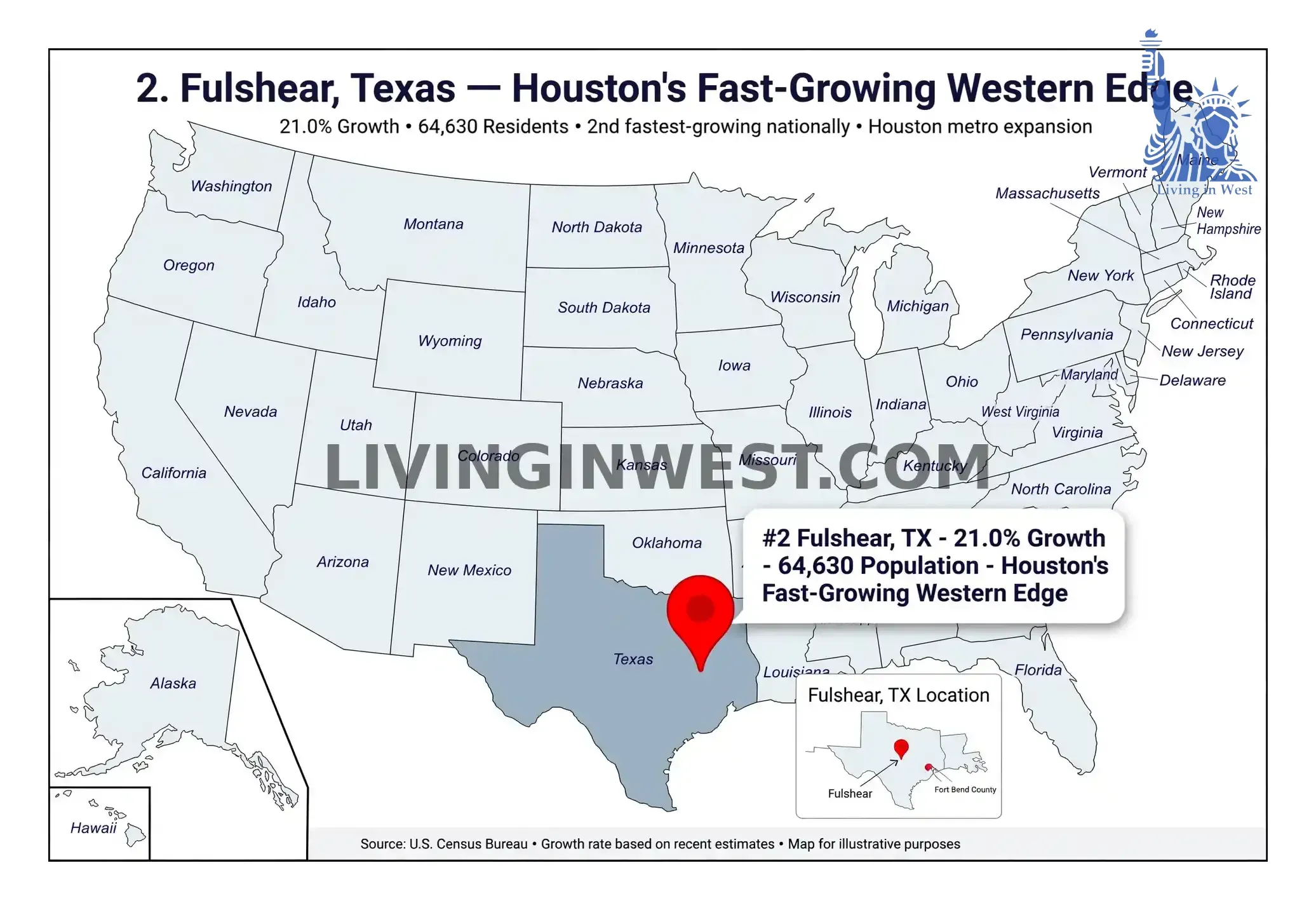
2 Fulshear, Texas — Houston's Fast-Growing Western Edge
Fulshear grew 21.0% between 2024 and 2025, reaching 64,630 residents. The Census Bureau ranked it second nationally among cities and towns with populations of at least 20,000.
Fulshear is important because it shows that the Texas growth story is not limited to Dallas-Fort Worth.
The city is part of the Houston metropolitan area and represents the outward expansion of the region's residential footprint.
For people looking for newer housing and suburban space, an outer-ring community can provide another option while keeping them connected to a major metropolitan economy.
This pattern is visible across the country. The Census Bureau found that midsized communities in the outer portions of metropolitan areas often grew faster than the larger central cities around them. It identified domestic and international migration combined with new housing as important factors helping midsized communities maintain growth.
That distinction matters. Population growth should not automatically be described as people leaving other states specifically for Fulshear.
Some residents may be moving from elsewhere in the Houston metro, while others may come from other parts of Texas or outside the state.
Fulshear is therefore an example of Houston's metropolitan expansion into a rapidly developing suburban community.
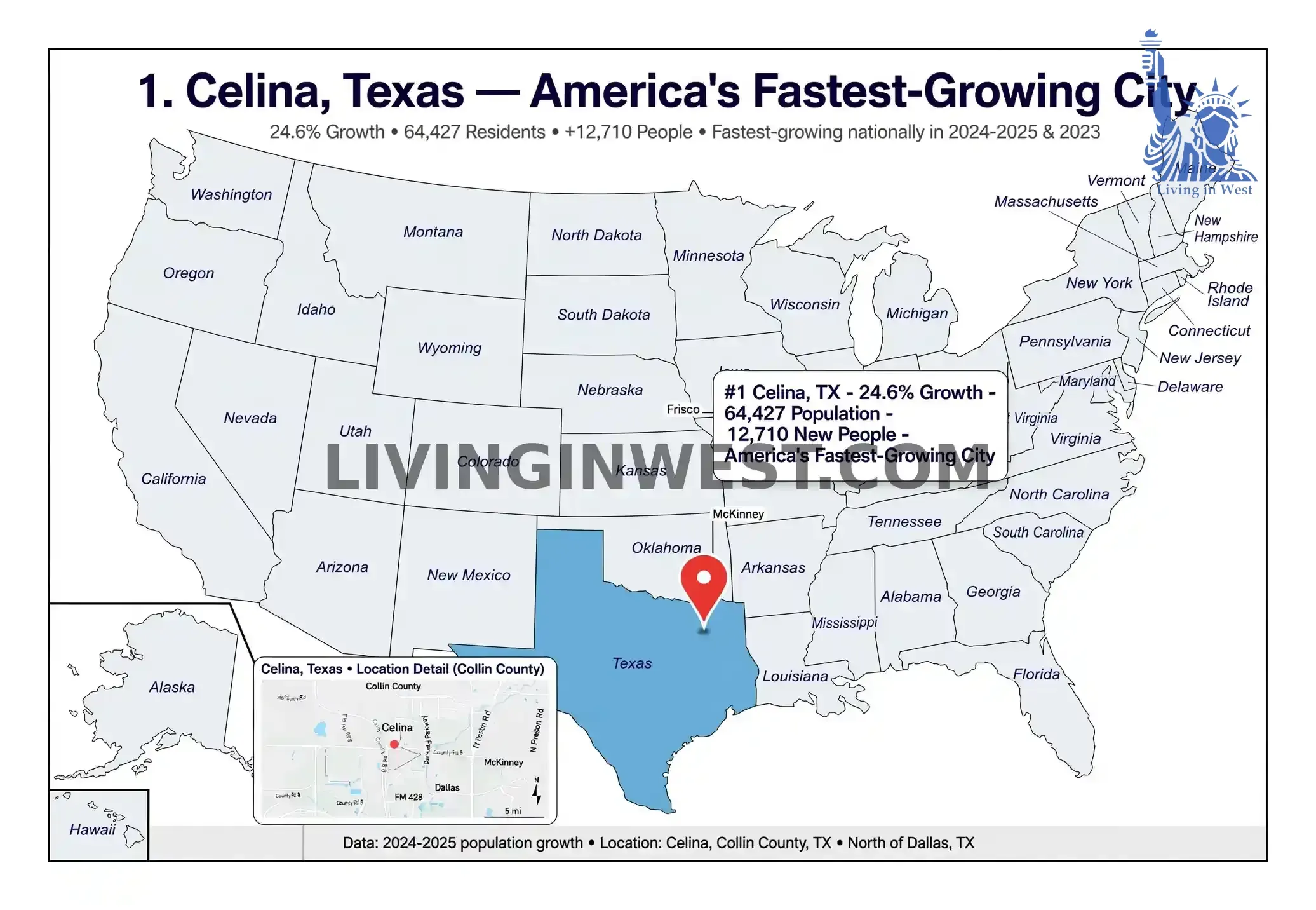
1 Celina, Texas — America's Fastest-Growing City
Celina is the clearest headline from the latest Census estimates.
Between July 2024 and July 2025, Celina's population increased 24.6%, reaching 64,427 residents. The city added 12,710 people in one year, making it the fastest-growing U.S. city or town with a population of at least 20,000.
The growth is not entirely new. The Census Bureau also identified Celina as the nation's fastest-growing city in 2023.
Celina's story is closely tied to the northward expansion of Dallas-Fort Worth.
As established communities become more developed, population growth can move toward outer suburbs where new residential construction is possible. People can live farther from Dallas while remaining connected to the DFW employment market.
Housing availability is therefore a major part of the story. The Census Bureau's national analysis found that new housing combined with domestic and international migration helped midsized communities maintain stronger population growth than many larger cities.
Celina illustrates this broader pattern better than almost any other city in the country.
Its growth does not prove that every new resident moved because of taxes, cheaper housing or jobs. Instead, the Census data show the result of several forces coming together: metropolitan expansion, new housing, migration and continued demand for suburban communities.
Frequently Asked Questions
Why are so many of the fastest-growing cities in Texas?
The latest Census estimates show that all five of America's fastest-growing cities and towns with populations of at least 20,000 were in Texas: Celina, Fulshear, Princeton, Melissa and Anna. Four are in the Dallas-Fort Worth area and Fulshear is in the Houston area.
Are people leaving big cities for small towns?
Not necessarily. A major part of the pattern is movement within metropolitan areas. People can move from established urban or suburban communities into outer-ring cities while continuing to work in the same regional economy. The Census Bureau specifically found that midsized cities in outer portions of metropolitan areas were often growing faster than central cities.
Is population growth the same as migration?
No. Population change can reflect domestic migration, international migration, births and deaths. Therefore, a city gaining 10,000 residents does not necessarily mean 10,000 people moved there.
Why is Charlotte included if it is not one of the five fastest-growing cities?
Charlotte had the largest numeric population gain, adding 20,731 residents between 2024 and 2025. That is a different measure from percentage growth.
Why is Austin included?
Austin is included because it crossed the 1-million population threshold. Its 2025 population was 1,002,632, but its year-over-year growth was only 0.4%, so it should not be described as one of the country's fastest-growing cities by percentage.
Conclusion
The latest U.S. Census Bureau data reveal a broader population story than a simple “people are moving to Texas” headline.
America's growth is increasingly spreading across metropolitan regions. Large cities such as Charlotte and Fort Worth continue to add substantial numbers of residents, while smaller communities such as Celina, Fulshear, Princeton, Melissa and Anna are growing much faster by percentage.
New housing is an important part of this pattern. Migration, employment access, suburban space and continued metropolitan expansion also contribute.
The biggest lesson is that America's next population centers may not always be traditional downtown cities. Many are communities on the outer edges of major metropolitan areas, where new housing and access to established employment markets come together.
Disclaimer
This article is based primarily on the U.S. Census Bureau Vintage 2025 Population Estimates, released May 14, 2026. The figures cover population estimates from July 1, 2024, to July 1, 2025.
Population growth does not by itself identify why individual residents moved. Reasons can vary by household and may include housing, employment, family circumstances, migration, lifestyle preferences and other factors.
Distances, housing costs, taxes, schools, insurance and employment conditions can also change over time. Readers should verify current local information before making relocation, housing or investment decisions.
Editorial Team