Introduction
Gun laws in the United States can be confusing because the rules are not the same in every state.
Federal law establishes important baseline requirements for firearm sales and possession, while individual states can add their own requirements involving permits, waiting periods, carry restrictions, firearm types and eligibility.
One of the biggest points to understand is that buying a firearm, possessing a firearm, carrying a firearm and obtaining a concealed-carry permit are not necessarily the same legal process.
In 2026, 29 states generally allow some form of permitless carry, commonly referred to as constitutional carry. However, this does not mean that every person can carry a firearm everywhere or without restrictions.
This guide provides a general overview. State laws can change, so anyone considering purchasing, possessing or carrying a firearm should verify the current rules with the relevant state authority and federal sources.
PART 1: How Gun Laws Work in the United States
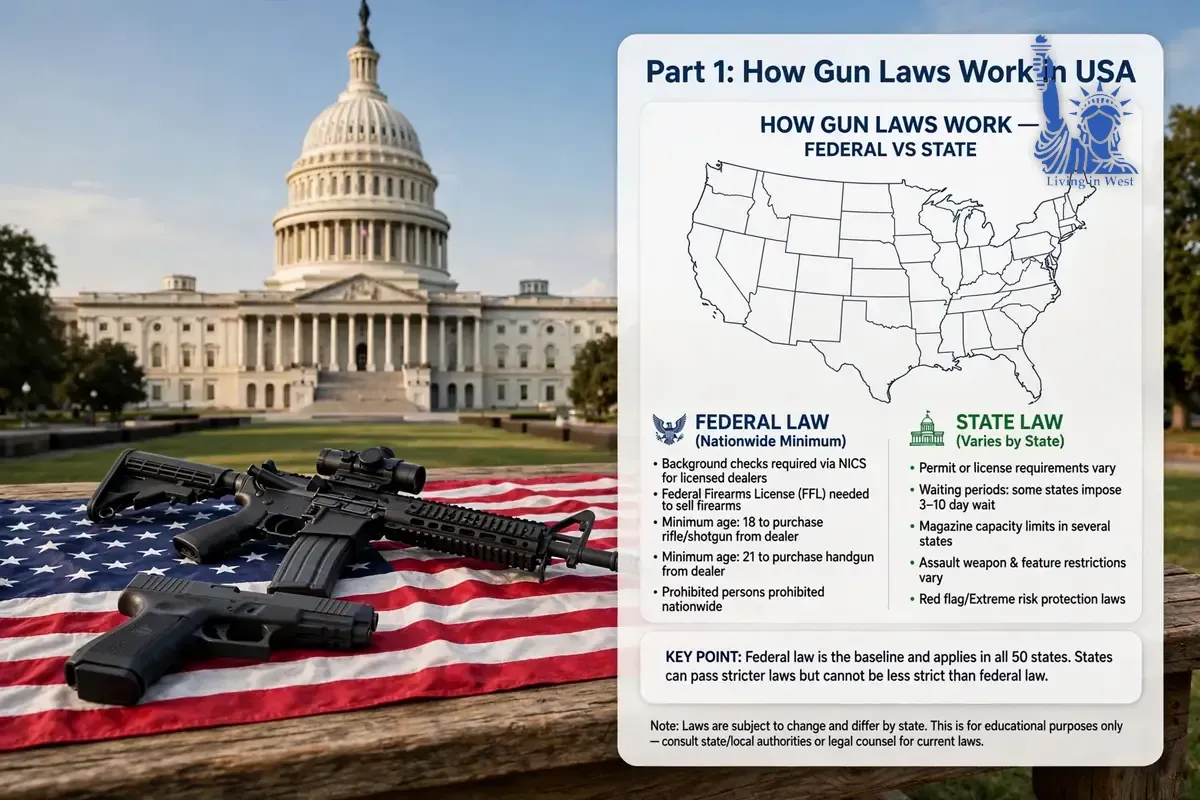
The United States does not have one nationwide firearm license that every gun owner must obtain.
Instead, firearm regulations generally come from two levels:
Federal law
Federal law establishes nationwide rules covering areas such as:
- Firearm sales by federally licensed dealers
- Prohibited persons
- Background checks for licensed dealer sales
- Minimum federal dealer-sale ages
- Certain interstate transactions
- Restrictions involving certain categories of firearms and individuals
State law
States can establish additional requirements involving:
- Carry permits
- Permitless carry
- Purchase permits or identification cards
- Waiting periods
- Firearm safety certificates
- Registration or reporting requirements
- Magazine restrictions
- Restricted locations
- Storage requirements
- Red-flag or extreme-risk protection laws
This means that a person who legally purchases a firearm in one state may face different requirements when traveling to or carrying a firearm in another state.
Why State Law Matters
A common mistake is assuming that a firearm rule that applies in Texas, Florida or Arizona automatically applies across the entire country.
It does not.
For example, a state may allow permitless concealed carry while another state may require a specific carry license. Some states also have different rules for residents and nonresidents.
Bottom line: Always check the law of the state where the firearm will be purchased, possessed or carried.
PART 2: Buying a Gun From a Licensed Dealer
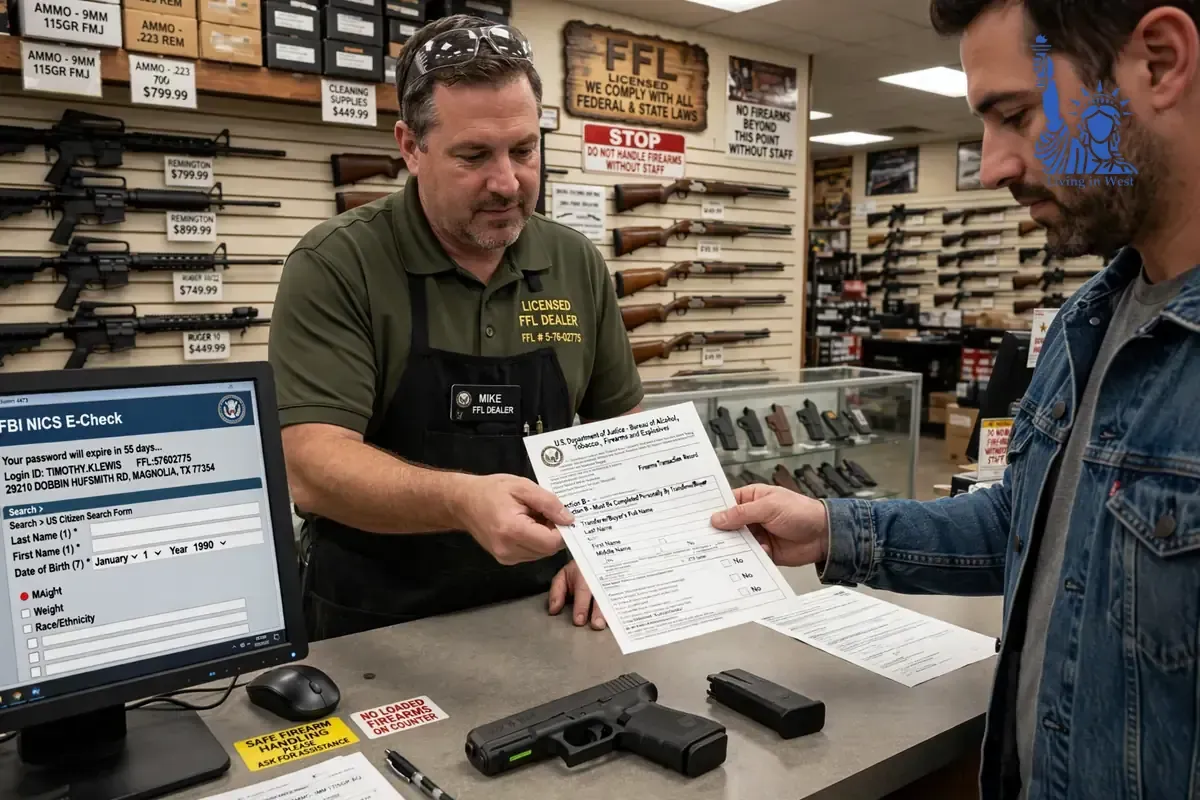
When a firearm is purchased from a federally licensed firearms dealer, commonly called an FFL, federal requirements generally apply.
An FFL is a person or business licensed by the federal government to engage in the business of importing, manufacturing or dealing in firearms, depending on the type of license.
For a typical dealer transaction, the buyer may need to complete ATF Form 4473.
The dealer then uses the required information to conduct the applicable background check.
What Is NICS?
NICS stands for the National Instant Criminal Background Check System.
The FBI operates NICS to help determine whether a person is prohibited from receiving firearms under federal or applicable state law.
A NICS response can generally result in:
- Proceed
- Deny
- Delay
A very important correction to a common internet claim is that a background check is not guaranteed to finish in 15 minutes.
Some checks may be completed quickly, while others require additional research.
A delayed transaction does not automatically mean that the buyer has been approved.
State law may also impose additional requirements beyond federal dealer procedures.
Federal Dealer Sale vs. State Requirements
Even when federal requirements are satisfied, a state may have its own:
- Waiting period
- Purchase authorization
- Identification requirements
- Safety certificate
- Registration or reporting system
Therefore, passing a federal background check does not automatically mean that every state requirement has been satisfied.
PART 3: Federal Minimum Age Rules
Age is another area where online summaries can become misleading.
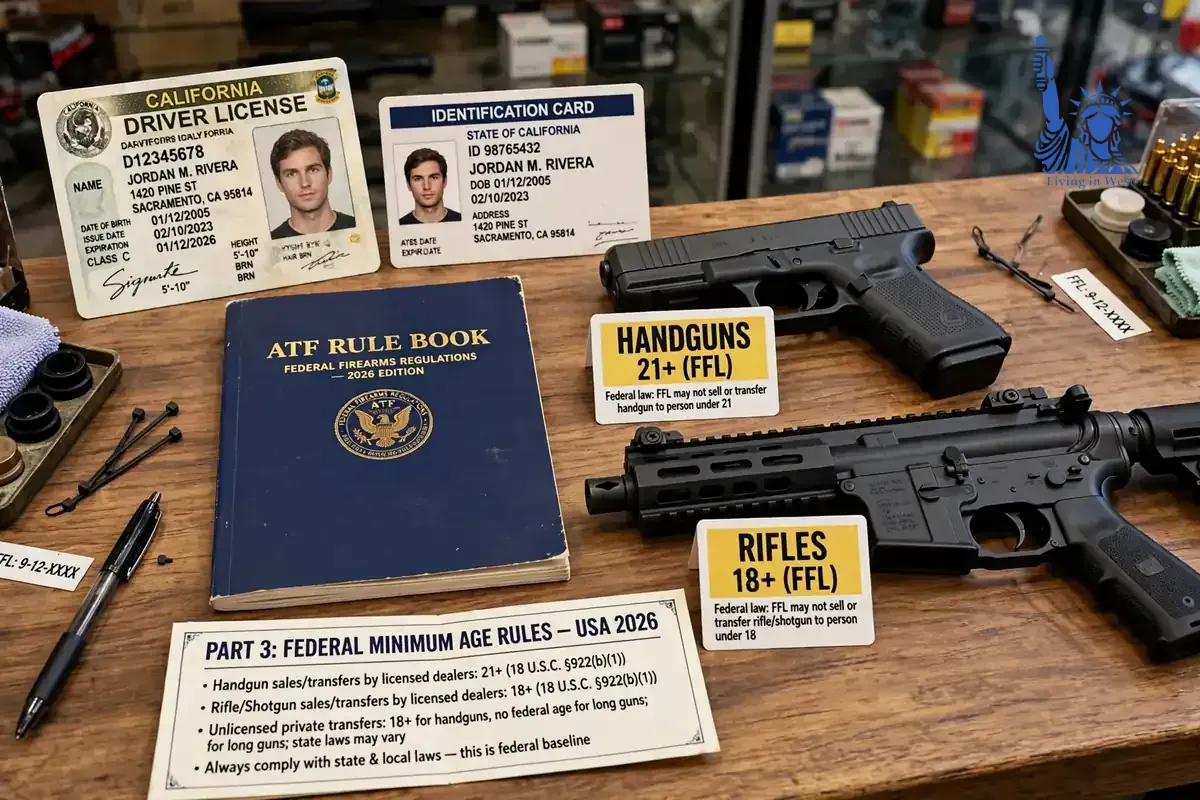
Under federal law, federally licensed dealers generally cannot sell or deliver:
Handguns to anyone under 21
Long guns, such as rifles and shotguns, to anyone under 18
These are federal minimum rules for sales by FFLs.
However, this does not mean that every firearm-related age question in America has the same answer.
State laws can establish additional age restrictions, and rules for private transfers can differ from dealer transactions.
Some states also have special rules involving minors, hunting, supervision and particular types of firearms.
Why “You Must Be 21 to Own a Gun” Is Too Broad
The statement that every person in America must be 21 to own a firearm is an oversimplification.
The federal dealer-sale rule is different from the broader question of firearm possession under federal and state law.
For this reason, anyone researching firearm eligibility should ask:
Am I buying from an FFL?
What type of firearm is involved?
Which state law applies?
Is this a private transfer or dealer transaction?
The answer can change depending on those circumstances.
PART 4: Who May Be Prohibited From Possessing a Firearm?
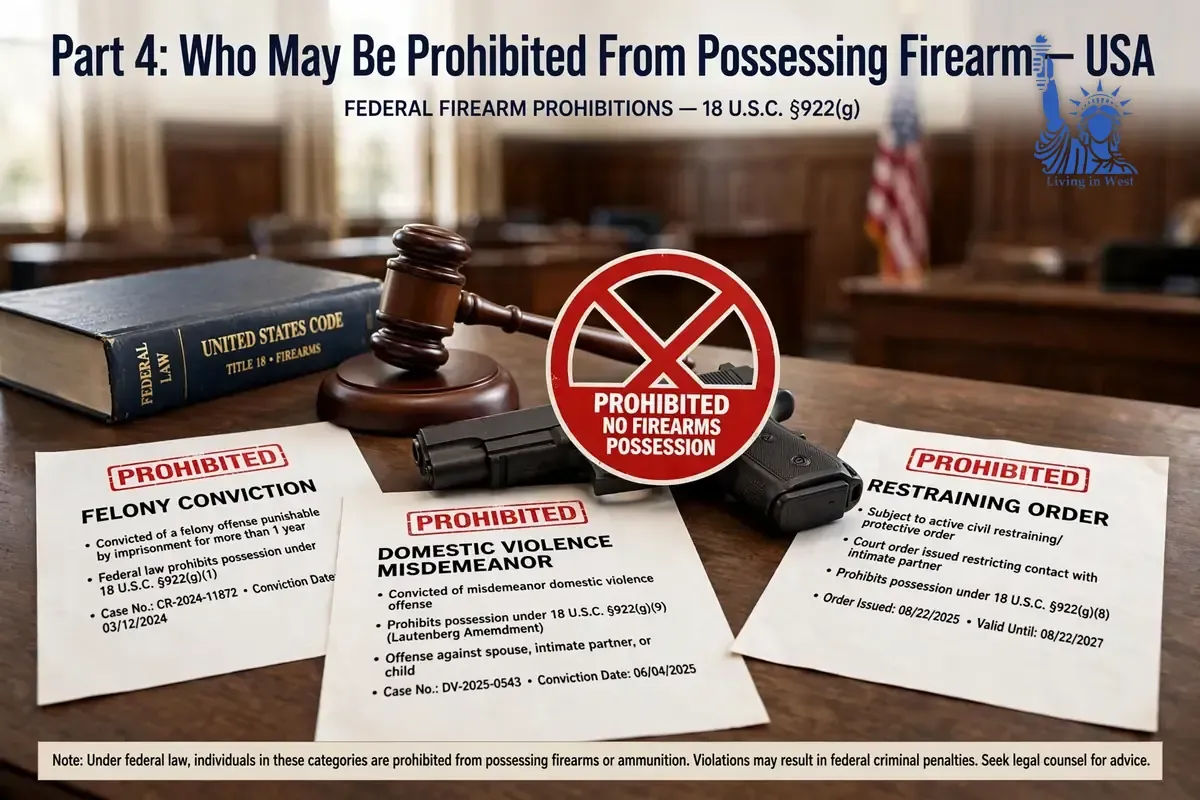
Federal law prohibits certain categories of people from receiving or possessing firearms.
The restrictions can involve circumstances such as:
- Certain felony convictions
- Certain domestic-violence convictions
- Qualifying restraining orders
- Certain mental-health adjudications or commitments
- Unlawful use or addiction to controlled substances
- Certain fugitive situations
- Certain categories of unlawful immigration status
- Certain other federally prohibited categories
The exact legal definitions matter.
For example, simply saying someone is "mentally unfit" is not an accurate description of the federal rule. Federal firearm restrictions involving mental health depend on specific legal circumstances such as qualifying adjudications or commitments.
Likewise, having a criminal record does not automatically mean every conviction creates the same firearm restriction. The type of conviction and applicable law matter.
State Restrictions Can Be Stricter
Even if a person is not prohibited under federal law, state law may impose additional restrictions.
This is why firearm eligibility should be checked under both federal and state law.
Anyone with a criminal conviction, restraining order, immigration issue or qualifying mental-health adjudication should obtain advice from a qualified attorney before attempting to purchase or possess a firearm.
PART 5: What Are FFL, Form 4473 and NICS?
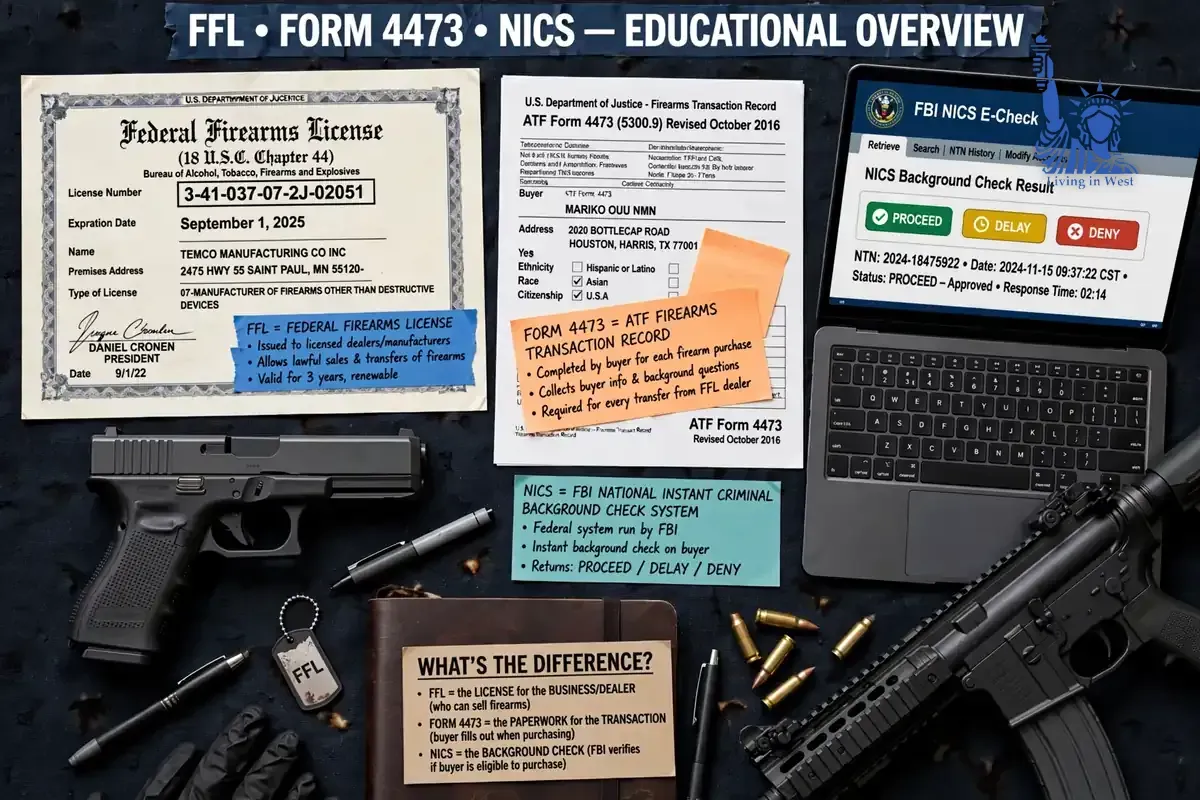
These three terms are often mixed together, but they are different.
FFL
FFL = Federal Firearms License
It is a federal license for businesses or individuals who engage in regulated firearms business activities.
An FFL is not a general firearm ownership license for the public.
ATF Form 4473
This is the federal firearms transaction record used by licensed dealers for applicable firearm transfers.
The buyer provides required information and answers eligibility questions.
NICS
NICS = National Instant Criminal Background Check System
NICS is the federal background-check system operated by the FBI.
The system helps determine whether a prospective firearm recipient is prohibited under applicable federal law.
These Are Not the Same Thing
A useful way to remember the difference is:
FFL = licensed firearm dealer/business
Form 4473 = firearm transaction form
NICS = background-check system
A state may separately require a purchase permit, firearm-owner identification card, safety certificate or other authorization.
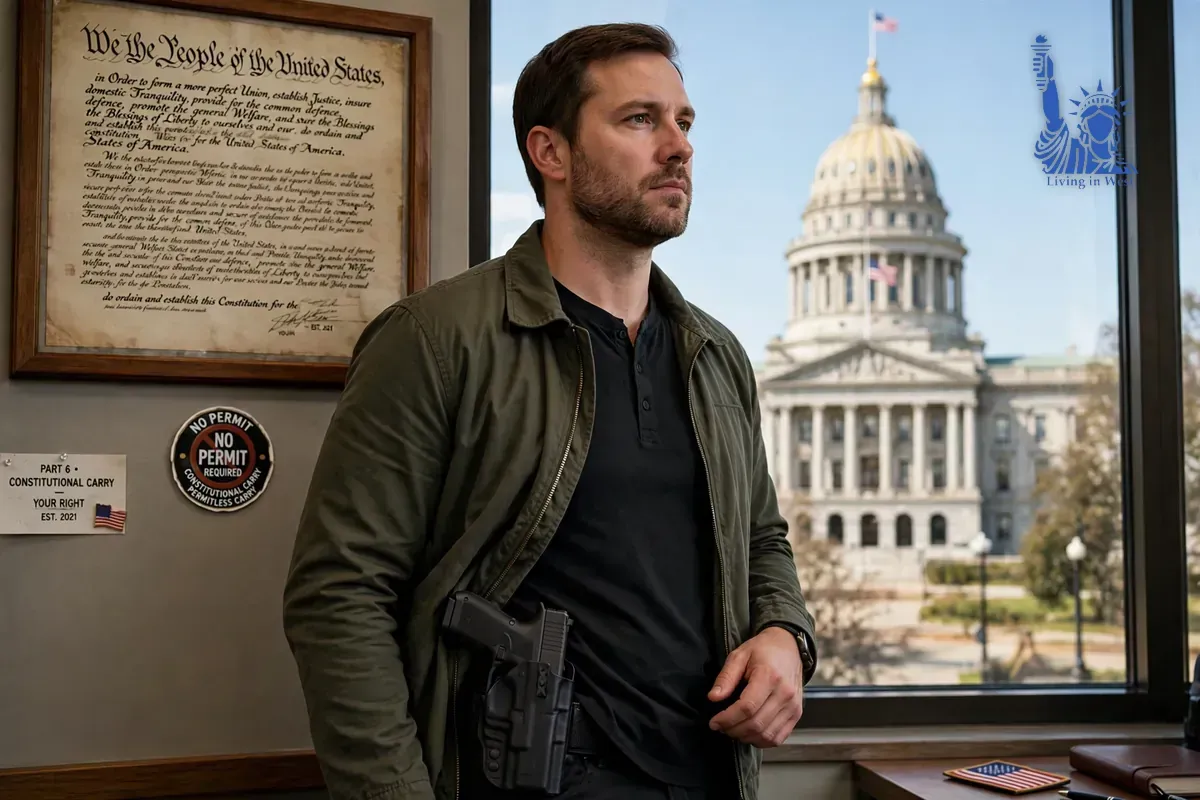
PART 6: What Is Constitutional or Permitless Carry?
The term constitutional carry is commonly used to describe laws allowing eligible people to carry a firearm without first obtaining a traditional carry permit.
The more precise term is often permitless carry.
This does not mean that the state has no firearm laws.
A state can allow permitless carry while still restricting:
- Who may carry
- Minimum age
- Certain locations
- Certain government buildings
- Schools
- Courthouses
- Private property
- Alcohol-related locations
- Sensitive places
- Firearm possession by prohibited persons
Rules can also differ between open carry and concealed carry.
Therefore, seeing a state described as a "constitutional carry state" should never be interpreted as:
“Anyone can carry a gun anywhere without restrictions.”
That is not what the term means.
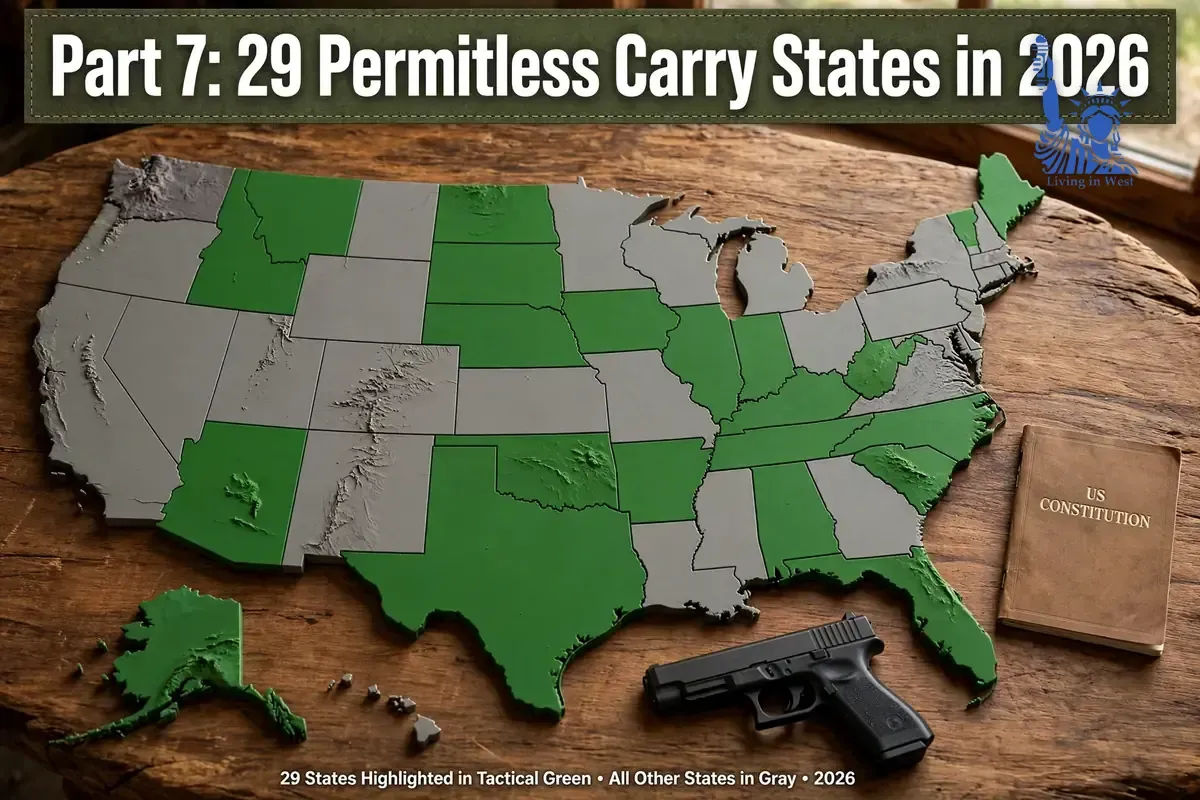
PART 7: The 29 Permitless-Carry States in 2026
As of 2026, the commonly recognized list of 29 states with permitless-carry laws includes:
- Alabama
- Alaska
- Arizona
- Arkansas
- Florida
- Georgia
- Idaho
- Indiana
- Iowa
- Kansas
- Kentucky
- Louisiana
- Maine
- Mississippi
- Missouri
- Montana
- Nebraska
- New Hampshire
- North Dakota
- Ohio
- Oklahoma
- South Carolina
- South Dakota
- Tennessee
- Texas
- Utah
- Vermont
- West Virginia
- Wyoming
Important: The 29 States Do Not Have Identical Rules
This list should not be treated as a single nationwide legal standard.
The states have different laws concerning:
- Minimum age
- Resident and nonresident eligibility
- Open carry
- Concealed carry
- Restricted locations
- Vehicle carry
- Private property
- School zones
- Government buildings
- Alcohol-related locations
- Prohibited persons
For example, a person who can legally carry without a permit in one state may still be prohibited from carrying in a particular location.
Permitless Carry Does Not Mean No Permit Is Useful
Some permitless-carry states still issue concealed-carry permits.
People may obtain permits for reasons such as interstate recognition, depending on the laws of other states.
However, reciprocity is complicated and changes from state to state.
A permit issued by one state is not automatically valid throughout the United States.
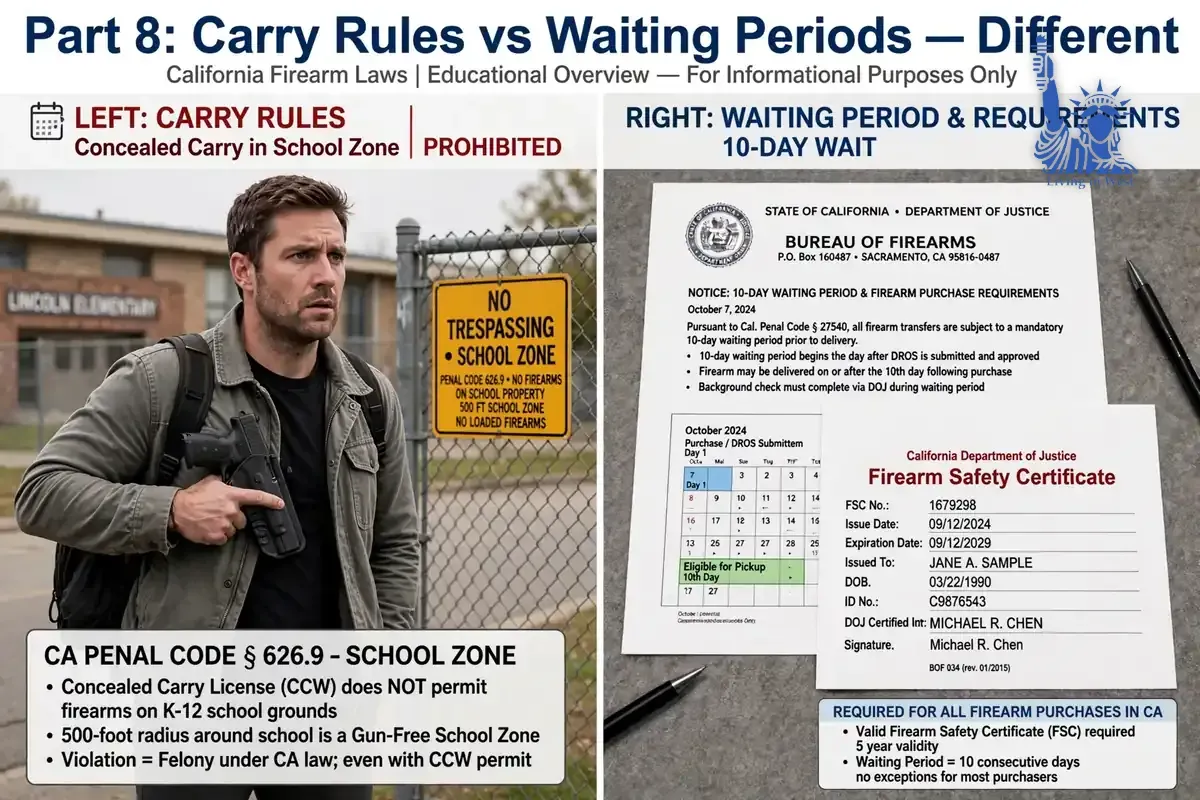
PART 8: Carry Rules and Waiting Periods Are Different
One of the most important things to understand about U.S. firearm law is that carry laws and purchase laws are separate issues.
A state can allow permitless carry while still imposing a waiting period or other requirements for purchasing a firearm.
Example: California
California is not a permitless-carry state.
California also has additional firearm requirements, including a firearm safety certification system, background-check procedures and a 10-day waiting period for firearm deliveries under state law.
This demonstrates why the following assumptions can be wrong:
“Permitless carry means no waiting period.”
Wrong.
“No carry permit means buying a firearm is automatic.”
Wrong.
“Passing NICS means the state has no additional requirements.”
Wrong.
Carrying Across State Lines
Another common mistake is assuming that a permit or carry right automatically travels with you.
Firearm laws can change when you cross a state border.
A permit issued by one state may be recognized by another state, may be recognized only under certain conditions, or may not be recognized at all.
Before traveling with a firearm, a person should check the current law of:
- The state of departure
- Every state being traveled through
- The destination state
Official state government sources should be used whenever possible because reciprocity and carry restrictions can change.
FAQ: USA Gun Laws 2026
1. Is there one nationwide gun license in the USA?
No. The United States does not have one universal firearm license that applies to every owner. Federal law and state law work together.
2. How many states have permitless carry in 2026?
There are commonly 29 states recognized as having permitless-carry laws in 2026. However, the eligibility, age and location restrictions are different in each state.
3. Can someone under 21 legally own a firearm?
The federal rules for dealer sales are different from the broader question of possession. FFLs generally cannot sell handguns to people under 21 or long guns to people under 18, while state and private-transfer rules can differ.
4. Does NICS always approve a background check immediately?
No. A NICS transaction can receive a Proceed, Deny or Delay response. There is no universal guarantee that every background check will be completed within 15 minutes.
5. Does constitutional carry mean I can carry anywhere?
No. Permitless carry does not eliminate restrictions on prohibited persons or sensitive/restricted locations.
6. Does a carry permit work in every state?
No. Recognition depends on the laws of the state where the person is carrying. Reciprocity is not nationwide.
7. Does passing a federal background check mean I can buy a firearm in every state?
No. States can impose additional requirements such as waiting periods, purchase authorizations, identification cards or safety certification.
8. Are green card holders automatically prohibited from owning firearms?
Not simply because they are lawful permanent residents. However, federal and state eligibility rules still apply, and other circumstances can create firearm prohibitions.
9. Can someone on a temporary U.S. visa possess a firearm?
Nonimmigrant visa holders are generally subject to federal firearm restrictions, although federal law provides specific exceptions in certain circumstances. Immigration status and the exact exception involved matter.
10. Can I rely on an old gun-law article when traveling?
No. Firearm laws can change. Travelers should check current official federal and state government information before transporting, purchasing or carrying a firearm.
Legal Disclaimer
This article is provided for general educational and informational purposes only and is not legal advice.
U.S. firearm laws can vary significantly by state and may change over time. Federal, state and local laws may apply differently depending on a person's age, residency, immigration status, criminal history, firearm type, method of purchase and location.
Do not rely on this article alone to determine whether you may legally purchase, possess, transport or carry a firearm.
For a specific legal situation, consult a qualified attorney and verify the current requirements with the relevant federal and state government authorities.
Last reviewed: September 2026
Official Sources
ATF — Bureau of Alcohol, Tobacco, Firearms and Explosives
Federal firearms laws, dealer requirements and firearm-related guidance.
FBI — National Instant Criminal Background Check System (NICS)
Federal background-check information and NICS procedures.
California Department of Justice
California firearm laws, safety certification and waiting-period information.
Pennsylvania State Police
Pennsylvania firearm carrying information.
Florida Department of Agriculture and Consumer Services
Florida concealed-weapon licensing and reciprocity information.

Editorial Team