PART 1: Milwaukee's Major Neighborhoods and Their Advantages
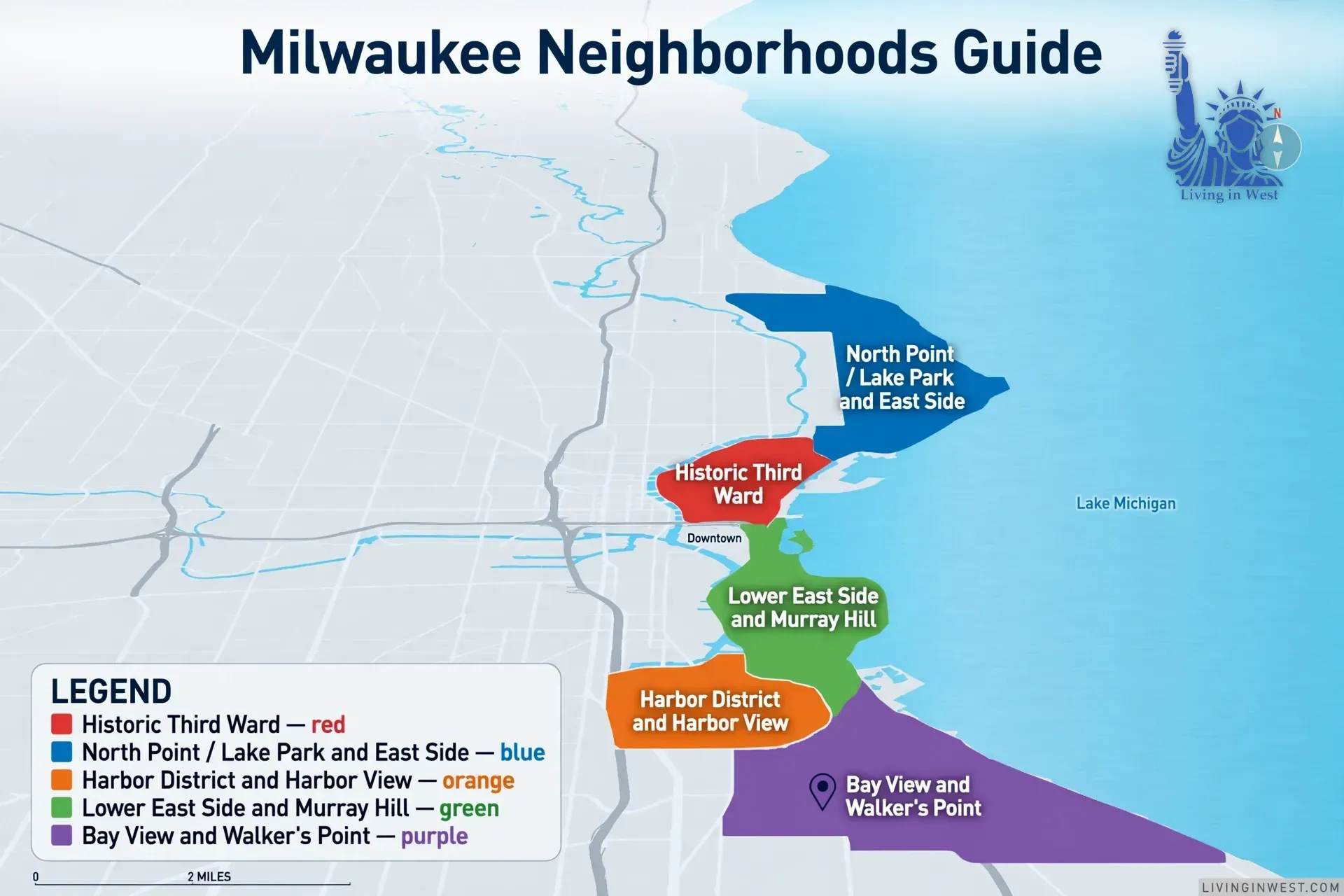
1. Historic Third Ward — Modern Urban Lifestyle
The Historic Third Ward is one of Milwaukee's best-known mixed-use neighborhoods.
The area combines converted historic warehouses with modern apartments, restaurants, galleries, boutiques, offices and entertainment.
Milwaukee Public Market is one of the neighborhood's best-known destinations, while the area is also close to the Milwaukee River and Lake Michigan waterfront.
The Third Ward is particularly attractive to people who want a walkable urban lifestyle with restaurants, shopping, cultural attractions and modern apartment buildings nearby.
Apartment prices vary significantly depending on the building and amenities. Current listings can range from the mid-$1,600s to more than $2,200 for one-bedroom apartments, so a fixed rent figure should not be treated as the neighborhood-wide price.
2. North Point, Lake Park and the East Side
North Point and the Lake Park area offer a quieter residential environment compared with downtown.
The area is known for historic houses, mature streets, parks and access to Lake Michigan.
The Historic Water Tower District also borders or is close to UWM, Lake Park, North Point Lighthouse, Bradford Beach and the Downer Avenue retail district.
The City of Milwaukee describes the area as largely residential, with a large collection of historic homes and a walkable retail district.
For families and residents who prefer established neighborhoods rather than high-rise downtown living, this part of the city provides a different type of Milwaukee lifestyle.
3. Harbor District and Harbor View — Waterfront Redevelopment
The Harbor District is one of Milwaukee's major redevelopment areas.
Former industrial and underused waterfront land has increasingly been transformed into housing, commercial space, restaurants and public spaces.
Rather than describing the entire district as a luxury neighborhood, it is more accurate to call it an area experiencing significant redevelopment and new residential investment.
4. Lower East Side and Murray Hill
The Lower East Side and Murray Hill are associated with students, young professionals, restaurants, cafes and neighborhood businesses.
Murray Hill also has a strong historic residential character and provides relatively easy access to the University of Wisconsin-Milwaukee and the East Side commercial corridors.
5. Bay View and Walker's Point
Bay View has a neighborhood-oriented atmosphere with restaurants, cafes, independent businesses and residential streets.
Walker's Point has developed into one of Milwaukee's most recognizable food, beverage, nightlife and creative-business districts.
The area is particularly known for restaurants, bars, coffee shops, breweries and other food and hospitality businesses.
For someone who wants a neighborhood with an active restaurant and nightlife scene without living directly in the downtown core, Walker's Point is an important area to consider.
PART 2: Milwaukee Population, Immigrants and International Communities
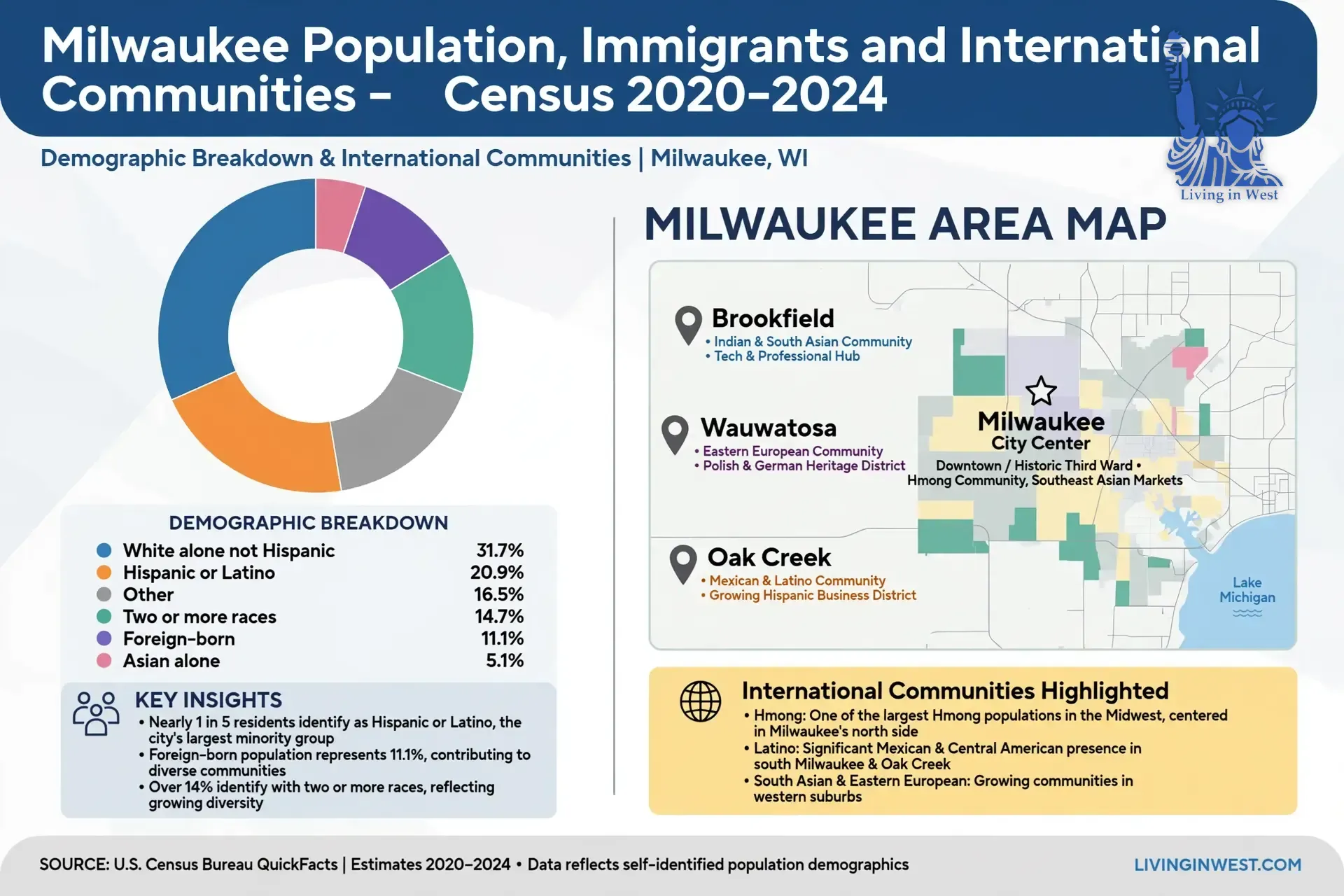
Milwaukee is a diverse city, but demographic numbers need to be tied to a specific Census period rather than presented as timeless statistics.
The latest U.S. Census Bureau Quick Facts data currently available for Milwaukee show that during the 2020–2024 period, approximately 5.1% of the city's population was Asian alone, 20.9% was Hispanic or Latino, and 11.1% of residents were foreign-born.
The Census also reports 14.7% of residents as belonging to two or more races and 31.7% as White alone and not Hispanic or Latino.
These numbers describe Milwaukee as a whole. They should not be used to claim that a particular nationality dominates a particular neighborhood unless current Census tract-level data support that conclusion.
Milwaukee has established Hispanic/Latino, Black, Asian, Hmong, African, European and other immigrant and international communities.
People researching Indian, Chinese or other international communities should also consider the wider Milwaukee metropolitan area rather than limiting their search to the city boundary.
Suburbs such as Brookfield, Wauwatosa and Oak Creek are part of the wider regional housing and employment market.
This is important because demographic patterns can change significantly from one neighborhood or suburb to another.
PART 3: New Developments and Major Milwaukee Projects
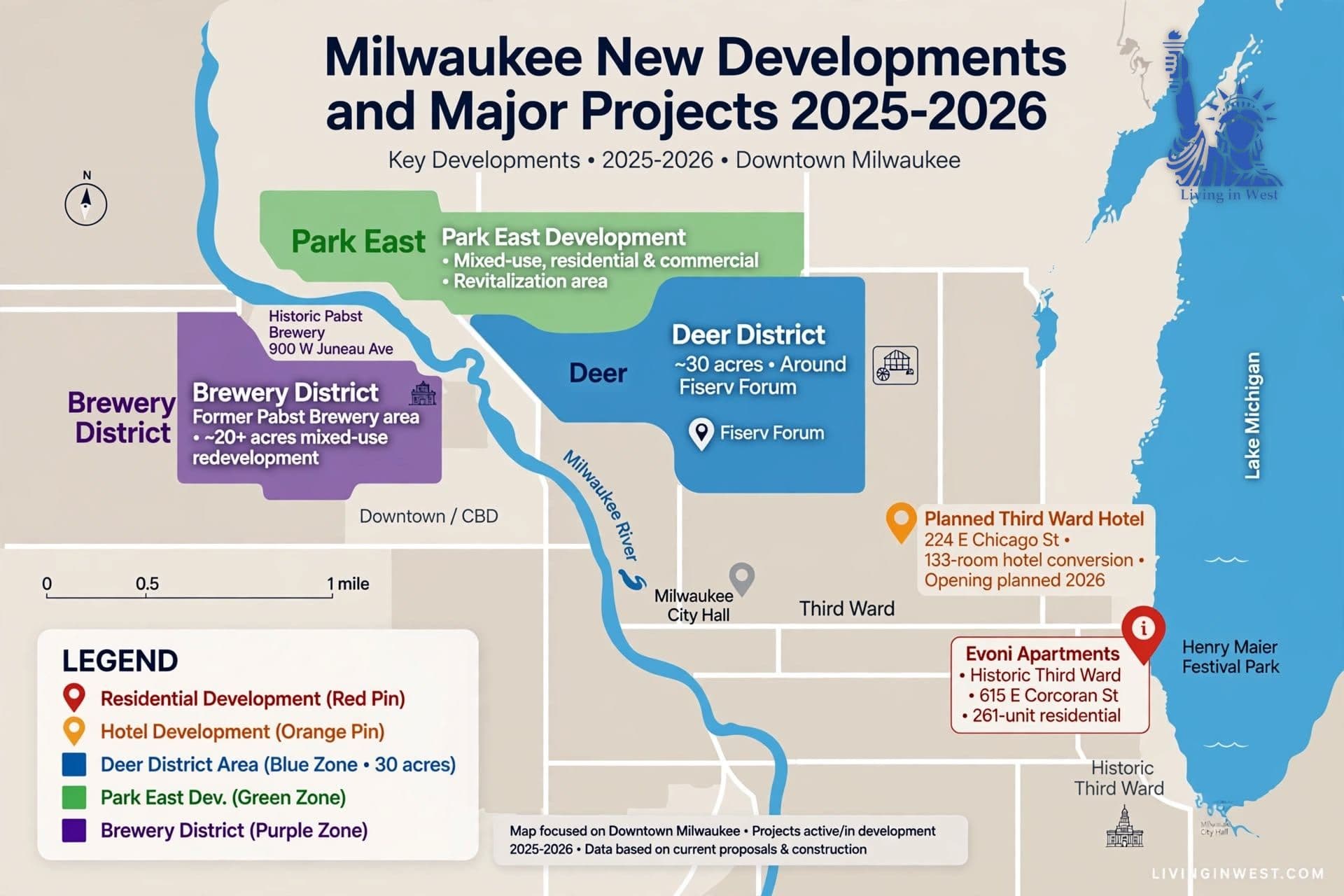
Milwaukee continues to experience redevelopment in downtown, the Third Ward, Park East, the Harbor District and other parts of the city.
Evoni Apartments
Evoni is one of the major recent apartment developments in the Historic Third Ward.
The project was developed for Kaeding Development Group and contains 261 apartment units across five floors.
The building was completed in summer 2025 and covers approximately 275,000 square feet.
Its amenities include a fitness center, outdoor pool and hot tub, recreation space, conference and coworking areas, dog facilities and a rooftop lounge.
The project is another example of how the Historic Third Ward continues to attract modern residential development.
Planned Third Ward Hotel
A major hotel project is also planned for 224 E. Chicago Street in the Historic Third Ward.
According to a September 2026 report, NCG Hospitality acquired the property for $7 million and plans to convert the building into a 134-room upscale boutique hotel.
The project represents another effort to add hospitality capacity to the Third Ward.
Deer District
The Deer District is one of Milwaukee's most visible modern redevelopment projects.
The City of Milwaukee describes the district as approximately 30 acres of mixed-use development centered around Fiserv Forum.
The district includes sports, entertainment, dining and other commercial activity and is designed as a place to live, work and play.
Fiserv Forum, home of the Milwaukee Bucks, anchors the district.
The Deer District has helped transform the former Park East area into a major downtown destination.
Park East Development
Park East is another important part of Milwaukee's redevelopment story.
The city has an established Park East redevelopment plan, and the broader area has experienced new housing, commercial and entertainment investment.
The city's redevelopment planning documents list Park East among Milwaukee's formal redevelopment areas.
The Brewery District
The former Pabst Brewery area has been transformed into a mixed-use neighborhood.
The City of Milwaukee says the area now includes hundreds of new housing units, restaurants, offices, universities and a boutique hotel.
Historic brewery buildings have been adapted for modern uses, while new public spaces and sustainability features have also been added.
Milwaukee vs. Other U.S. Cities: Full Tax Comparison
Taxes are often the single biggest factor separating Milwaukee's real cost of living from cities like Chicago, Austin, Columbus, Detroit, and Minneapolis. Below is a side-by-side comparison of state income tax, local/city income tax, combined sales tax, and effective property tax rates as of 2026.
| City | State Income Tax | City/Local Income Tax | Combined Sales Tax | Effective Property Tax Rate |
|---|---|---|---|---|
| **Milwaukee, WI** | 3.50%–7.65% (progressive) | None (WI bars city income tax) | 7.9% (5% state + 0.9% county + 2% city) | ~2.0%–2.4% (among the highest in the Midwest) |
| **Chicago, IL** | 4.95% (flat) | None | 10.25% | ~1.9%–2.2% (Cook County average) |
| **Austin, TX** | 0% (no state income tax) | None | 8.25% | ~2.0%–2.07% (Travis County/Austin ISD combined) |
| **Columbus, OH** | 2.75% (flat, 2026) | 2.5% (resident city tax) | ~8.0% (Franklin County) | ~1.5%–1.6% (Ohio average) |
| **Detroit, MI** | 4.25% (flat) | 2.4% resident / 1.2% non-resident | 6.0% (Michigan allows no local add-on) | ~1.4%–1.9% (Wayne County, varies by source) |
| **Minneapolis, MN** | 5.35%–9.85% (progressive) | None | 9.03% | ~1.0% (Minnesota statewide average) |
PART 5: Milwaukee Business Areas — Where Different Businesses Are Located
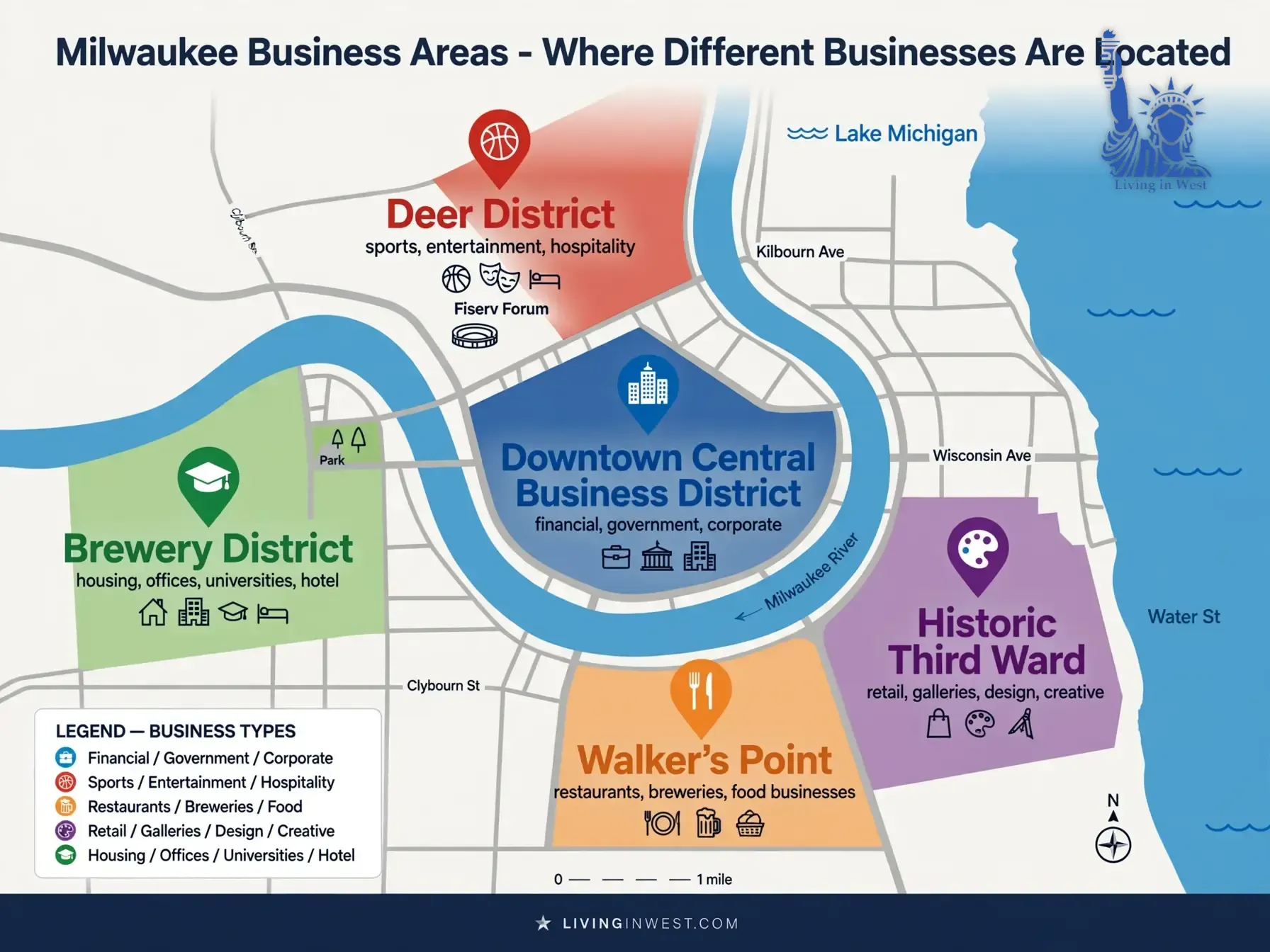
1. Downtown Central Business District
Downtown Milwaukee is the city's traditional central business area.
It contains government offices, corporate offices, financial services, hotels, restaurants and professional services.
City Hall and other major institutions make the downtown area an important employment center.
2. Deer District
The Deer District is centered around Fiserv Forum.
Its business environment is focused heavily on sports, entertainment, restaurants, events and hospitality.
The official City of Milwaukee description calls it a 30-acre mixed-use district and a central downtown attraction.
3. Walker's Point
Walker's Point has become an important destination for restaurants, food businesses, bars, coffee shops, breweries and hospitality companies.
The area is also associated with creative businesses and redevelopment.
Its location close to downtown makes it strategically important for businesses looking for an urban customer base.
4. Historic Third Ward
The Third Ward has a strong concentration of restaurants, retail stores, galleries, design businesses, professional services and creative companies.
Its historic architecture combined with new apartments and offices has created a distinctive mixed-use business environment.
5. The Brewery District
The Brewery District demonstrates how former industrial property can be converted into a mixed-use business and residential area.
The City of Milwaukee lists housing, restaurants, offices, universities and a boutique hotel among the district's current uses.
PART 6: Government Programs and Benefits for Milwaukee Residents
Milwaukee residents may have access to different city, county and state programs.
However, these programs do not automatically apply to every resident. Eligibility can depend on income, household size, employment status, pregnancy, homeownership and other requirements.
Residents Preference Program
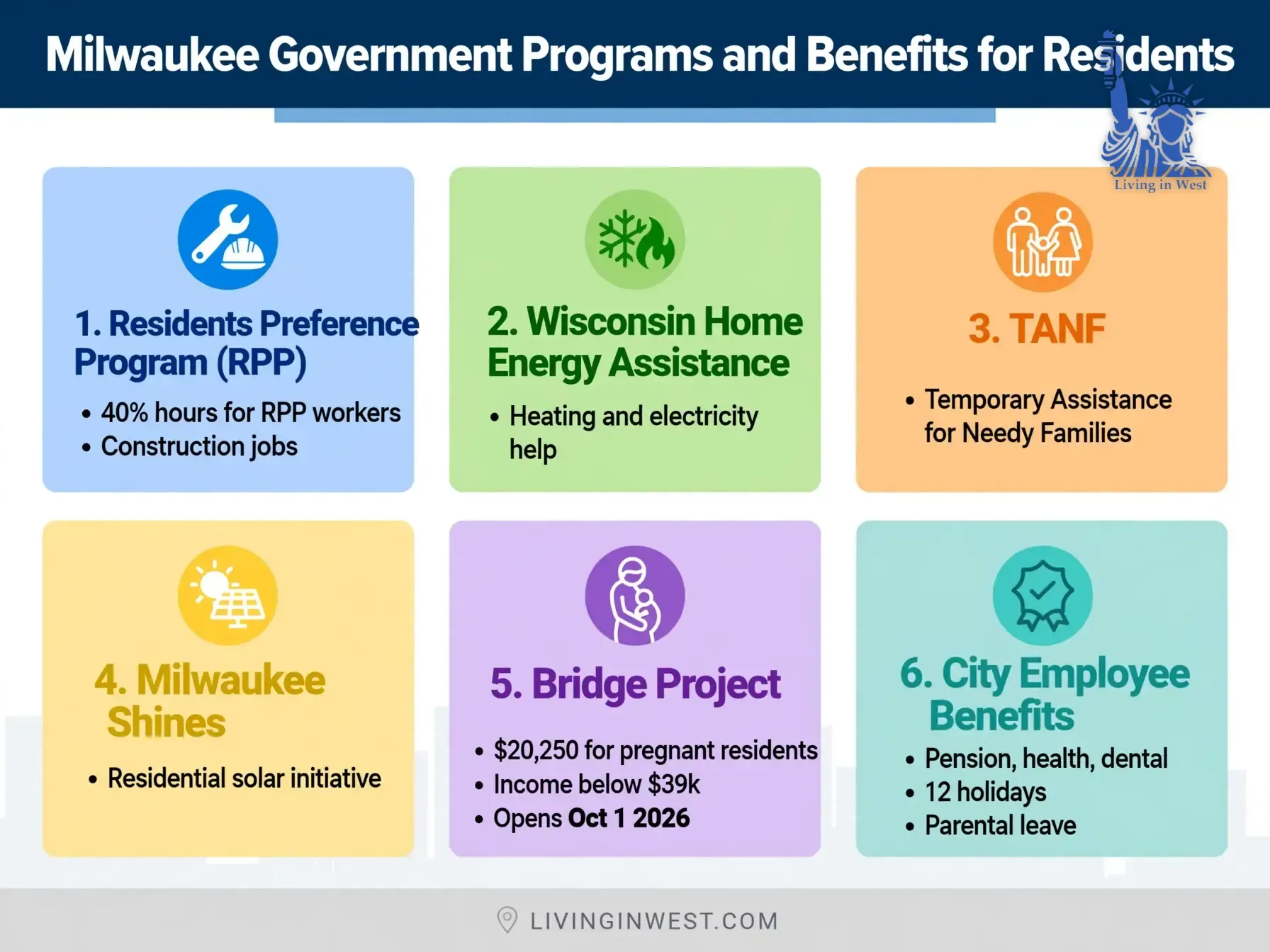
The Residents Preference Program, or RPP, is designed to help unemployed and underemployed Milwaukee residents gain access to construction employment opportunities.
The City of Milwaukee states that most Department of Public Works contracts require contractors to employ RPP-certified workers, with an overall requirement that 40% of all hours be attributed to RPP-certified employees.
The City also introduced additional requirements for construction contracts awarded in excess of $500,000 under rules applying to contracts published from June 25, 2026 onward.
This is an employment preference program and does not guarantee a job to every applicant.
Wisconsin Home Energy Assistance
Eligible households may qualify for Wisconsin Home Energy Assistance Program support.
Energy assistance can help qualifying households with heating and electricity costs, subject to program rules and income requirements.
Residents should check current Wisconsin and Milwaukee County information before applying because program eligibility and funding can change.
TANF
Temporary Assistance for Needy Families, or TANF, is a public assistance program for qualifying families.
Milwaukee County administers TANF-related assistance for eligible households subject to income, household and other program requirements.
People should apply through the appropriate county or state program rather than assuming eligibility from residency alone.
Milwaukee Shines
Milwaukee Shines is the city's residential solar initiative.
The program provides information and resources intended to help Milwaukee homeowners consider solar energy, including financing options.
Because loan terms, funding and incentives can change, residents should check the current City of Milwaukee Milwaukee Shines information before making a solar investment.
Do not assume that a temporary promotional offer is automatically available unless it is currently listed by the city.
Bridge Project
The Bridge Project is a major guaranteed-income-style program available to qualifying pregnant Milwaukee residents.
According to the program's current 2026 information, applications for the second Milwaukee cohort are scheduled to open October 1, 2026.
Applicants must be at least 18 years old, live in the City of Milwaukee, be 23 weeks pregnant or less and have annual household income below $39,000.
Selected participants receive $20,250 in unrestricted cash support over three years.
The program uses a randomized selection process among eligible applicants.
The program is open citywide, although some funding is designated to prioritize eligible residents in specified neighborhoods and ZIP codes.
City of Milwaukee Employee Benefits
These benefits apply to City of Milwaukee employees, not automatically to every Milwaukee resident.
The city's current employee-benefits information lists a defined-benefit pension plan, health and dental insurance, paid parental leave, wellness programs, long-term disability insurance, group life insurance, tuition benefits, paid vacation, 12 paid holidays, paid sick leave, flexible spending arrangements and a 457 deferred compensation plan.
For someone considering a municipal job, these benefits can be an important part of evaluating total compensation.
FAQ: Milwaukee City Guide 2026
Is Milwaukee a good city for people looking for different types of neighborhoods?
Milwaukee has a wide range of neighborhood environments, from downtown mixed-use districts such as the Historic Third Ward to established residential areas around Lake Park, Murray Hill, Bay View and other parts of the city.
What is one of Milwaukee's most well-known upscale neighborhoods?
The Historic Third Ward is one of the city's most prominent upscale mixed-use districts, with modern apartments, restaurants, galleries, shopping and entertainment.
How many Milwaukee residents are foreign-born?
The latest Census QuickFacts figure currently available for the city reports 11.1% foreign-born residents for 2020–2024.
Are there Indian and Chinese communities in Milwaukee?
Milwaukee has international and Asian communities, but neighborhood-level nationality percentages should be verified using current Census or ACS tract data before making specific claims about where a particular nationality lives.
Is Milwaukee still seeing new development?
Yes. Recent examples include the 261-unit Evoni apartment project, continued Deer District development, the planned 134-room Third Ward hotel and redevelopment in areas such as Park East, the Harbor District and The Brewery.
What is Milwaukee's sales tax in 2026?
For taxable transactions within the City of Milwaukee, the Wisconsin Department of Revenue lists a combined 7.9% rate, consisting of 5% state tax, 0.9% Milwaukee County tax and 2% City of Milwaukee tax.
Does Milwaukee have a city income tax?
Milwaukee does not have a general individual city income tax comparable to Columbus or Detroit. Wisconsin's state individual income tax applies instead.
What is Milwaukee's 2026 property-tax rate?
The City's 2026 proposed budget documents show a property-tax rate of $7.52 per $1,000 of assessed value. The document also shows this was down from $8.29 in 2025.
Property taxes should not be compared only by headline percentages across cities because states use different assessment and local-tax systems.
What government assistance may be available to Milwaukee residents?
Depending on eligibility, residents may have access to energy assistance, TANF, housing-related programs, employment preference programs, solar financing and other city, county or state resources.
Is the Bridge Project available to everyone in Milwaukee?
No. The program has specific eligibility requirements. For the second Milwaukee cohort, applicants must be at least 18, live in Milwaukee, be 23 weeks pregnant or less and have household income below $39,000. Applications are scheduled to open October 1, 2026.
Does the City of Milwaukee give every resident employee benefits?
No. The employee-benefit package applies to City of Milwaukee employees. It includes a defined-benefit pension, health and dental insurance, paid vacation, 12 paid holidays and other benefits.
Final Takeaway
Milwaukee in 2026 combines established residential neighborhoods with significant downtown and waterfront redevelopment.
The Historic Third Ward provides a modern mixed-use lifestyle, Lake Park and the East Side offer established residential surroundings, Walker's Point has become an important food and hospitality district, while Deer District and The Brewery demonstrate the city's continuing redevelopment.
For people comparing Milwaukee with Chicago, Austin, Columbus, Detroit or Minneapolis, taxes are only one part of the decision. Income, rent, home prices, property taxes, transportation, employment opportunities and household circumstances can all change the final cost of living.
The city's demographic profile is also diverse, with the latest Census QuickFacts reporting 11.1% foreign-born residents for 2020–2024.
For residents, programs such as RPP, energy assistance, TANF, Milwaukee Shines and the Bridge Project may provide opportunities or support for qualifying households.
Because rents, tax rules, development schedules and government-program eligibility can change, readers should verify current information with the relevant official agency before making financial, housing or relocation decisions.
Disclaimer
This article is for general informational and educational purposes only. Tax rates, rents, development schedules, government programs, eligibility rules and financial incentives can change. Information about government benefits does not guarantee eligibility or approval. Readers should verify current requirements, deadlines, tax rates and program availability directly with the relevant government agency, program administrator, property manager or developer.
Sources
U.S. Census Bureau — Milwaukee City QuickFacts
Demographic and foreign-born population information.
Wisconsin Department of Revenue
Wisconsin individual income-tax rates and sales-tax information.
City of Milwaukee — Residents Preference Program
RPP requirements, 40% work-hour requirement and 2026 contract changes.
City of Milwaukee — City Employee Benefits
Current municipal employee benefits, including 12 paid holidays.
City of Milwaukee — Deer District
Official information about the 30-acre mixed-use district.
City of Milwaukee — The Brewery
Official information about redevelopment of the former Pabst Brewery area.
City of Milwaukee — Neighborhoods
Information about Milwaukee's East Side, Historic Water Tower District, Lake Park and surrounding neighborhoods.
City of Milwaukee — 2026 Budget
2026 proposed property-tax rate information.
Bridge Project
2026 Milwaukee eligibility requirements, application date and $20,250 cash-support information.
RAMLOW/STEIN — Evoni
261-unit Third Ward apartment development information.
Urban Milwaukee — Third Ward Hotel
September 2026 reporting on the planned 134-room hotel at 224 E. Chicago Street.
Illinois Department of Revenue
2026 Illinois individual income-tax rate.
Texas Comptroller
Texas sales-tax structure and maximum combined rate.
City of Columbus
2.5% Columbus municipal income-tax information.
Michigan Department of Treasury
2026 Michigan state income-tax rate and Detroit municipal income-tax information.
Minnesota Department of Revenue
2026 Minnesota income-tax brackets and sales-tax information.
Editorial Team