Part 1: What Is the $640 Billion U.S. Semiconductor Investment Boom?
The story began with the CHIPS and Science Act, signed into law on August 9, 2022.
The law was designed to encourage semiconductor manufacturing and research in the United States after decades of production moving toward Asia.
The semiconductor portion of the law included $39 billion in manufacturing incentives, while the broader CHIPS semiconductor program totaled about $50 billion in appropriated funding for incentives, research and related programs. The law also established up to $75 billion in loan and loan-guarantee authority for semiconductor manufacturing.
The government funding was intended to encourage companies to put much larger amounts of their own capital into American manufacturing.
That is where the investment boom came from.
In 2024, the SIA-related figure frequently cited was $327 billion in announced semiconductor-related investment over the following decade.
But that number is now outdated.
By 2025, SIA reported more than half a trillion dollars in private investment, covering more than 100 projects across 28 states. The projects were projected to support more than 500,000 U.S. jobs and help roughly triple U.S. chipmaking capacity by 2032.
Then, in 2026, congressional testimony stated that total public and private semiconductor investment had exceeded $640 billion since the CHIPS and Science Act.
So the best way to describe the numbers is:
- $327 billion: earlier 2024 investment milestone
- $500B+: private-sector semiconductor investment announced by July 2025
- $640B+: combined public and private semiconductor investment cited in 2026 congressional testimony
These numbers should not be treated as three separate piles of money. They represent different measurements and different points in time
Part 2: Why Is America Investing So Much in Chips?
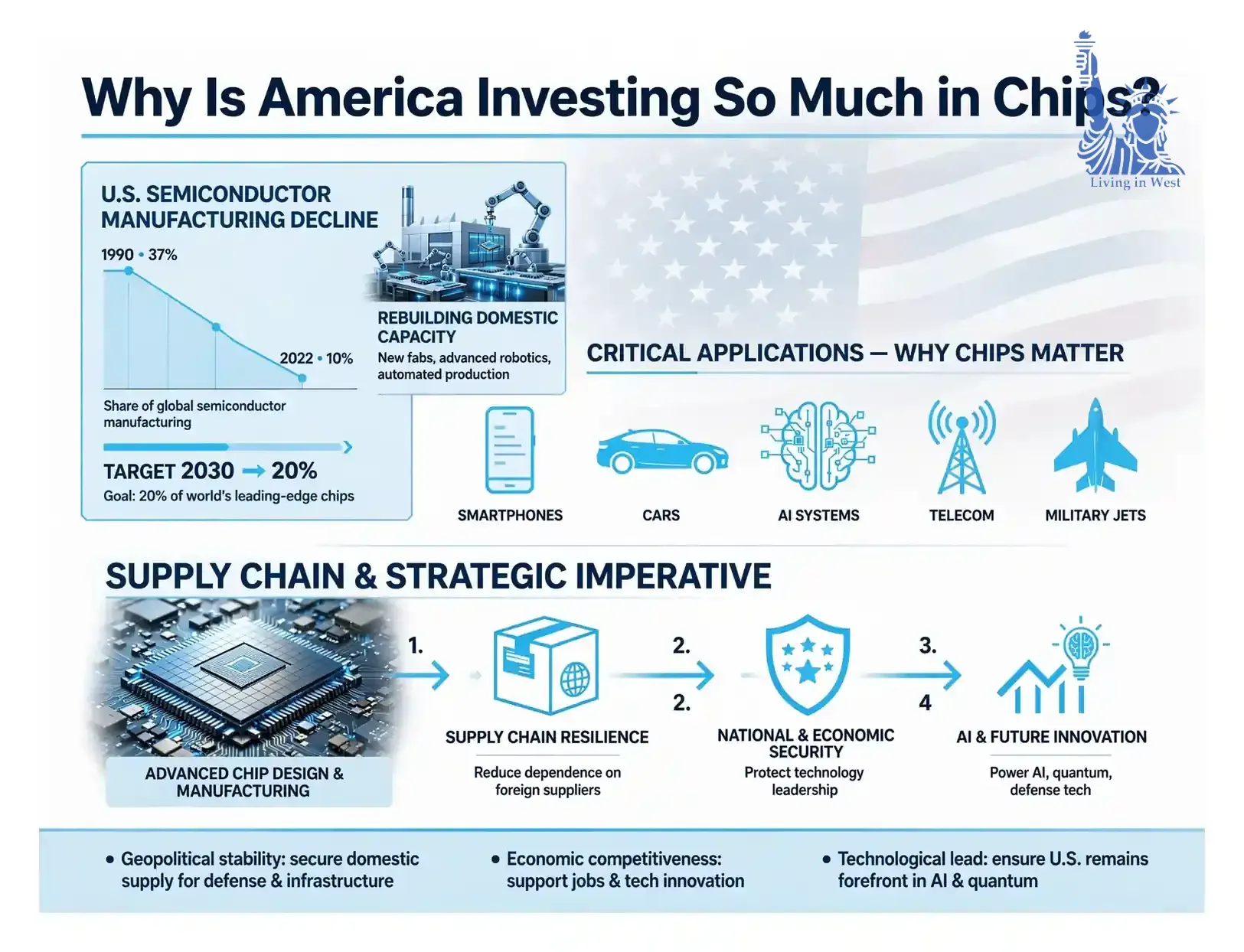
Semiconductors are used in almost everything from smartphones and computers to cars, artificial intelligence systems, telecommunications equipment and advanced military systems.
The United States remains extremely important in semiconductor design and technology, but its share of global manufacturing capacity declined dramatically.
SIA data shows that the U.S. share of global semiconductor manufacturing capacity fell from about 37% in 1990 to 10% in 2022.
The CHIPS strategy is therefore aimed at rebuilding domestic manufacturing capacity.
The goal is not necessarily to manufacture every semiconductor inside the United States.
Instead, the strategy focuses heavily on advanced chips, mature-node chips that are important to automobiles and defense, advanced packaging, semiconductor equipment and a stronger domestic supply chain.
The U.S. Department of Commerce previously projected that CHIPS-supported investments could put the country on track to produce roughly 20% of the world's leading-edge logic chips by 2030, compared with essentially zero domestic production at the beginning of the decade.
Part 3: TSMC’s Massive Arizona Expansion
One of the most important projects is being built by Taiwan Semiconductor Manufacturing Company, better known as TSMC.
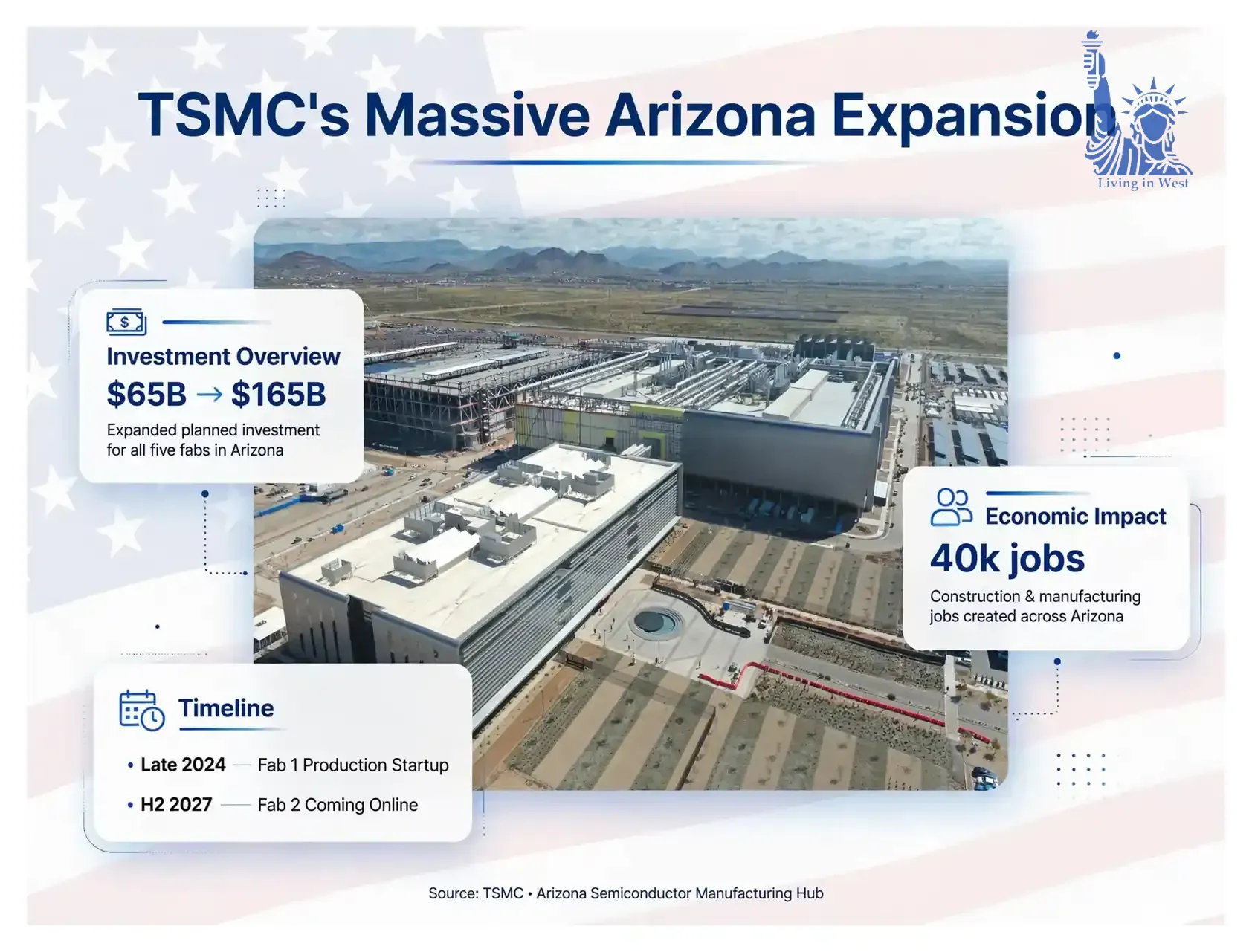
TSMC originally planned to invest more than $65 billion in three advanced semiconductor fabs in Phoenix, Arizona.
In March 2025, TSMC announced another $100 billion in planned U.S. investment.
That brought its announced U.S. investment plan to approximately $165 billion.
The expanded plan includes:
- Three additional fabs
- Advanced packaging facilities
- A major research and development center
- Expansion of the Arizona semiconductor ecosystem
TSMC says the expanded investment could support 40,000 construction jobs over four years and create tens of thousands of high-tech jobs over time.
TSMC's first Arizona fab entered high-volume production in late 2024, while the company has continued construction on additional facilities. Its second Arizona fab is expected to enter high-volume manufacturing in the second half of 2027, according to TSMC's 2025 annual report.
The U.S. Department of Commerce describes the TSMC Arizona investment as the largest single foreign direct investment in U.S. history.
That description refers specifically to the TSMC investment, not to the entire CHIPS program.
Part 4: Intel Is Expanding Across Four States
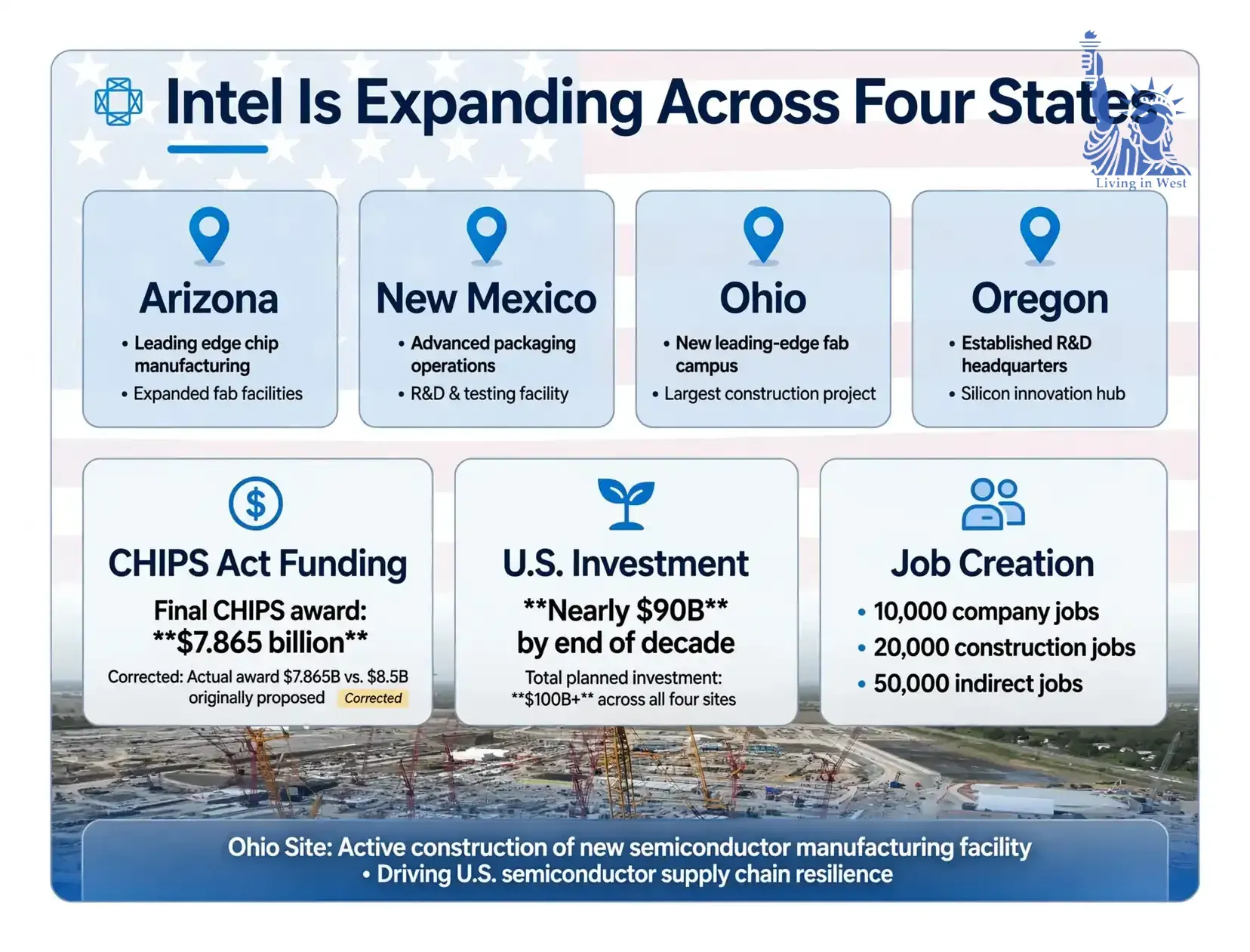
Intel is another major part of the U.S. semiconductor expansion.
Its projects cover:
- Arizona
- New Mexico
- Ohio
- Oregon
In November 2024, the Department of Commerce finalized up to $7.865 billion in direct CHIPS funding for Intel.
That was lower than the earlier proposed $8.5 billion figure.
The award supports Intel's expected U.S. investment of nearly $90 billion by the end of the decade, within a broader company expansion plan exceeding $100 billion.
Intel's projects include advanced manufacturing and packaging facilities, with Ohio becoming an important part of its future leading-edge manufacturing network.
Intel has also described its broader U.S. investment plans as supporting more than 10,000 company jobs, nearly 20,000 construction jobs and more than 50,000 indirect jobs through suppliers and supporting industries.
One correction to the original article is important here:
Intel's final CHIPS award should be listed as about $7.86 billion, not $8.5 billion.
The $8.5 billion figure was the earlier proposed amount.
Part 5: Samsung Is Building a Major Texas Semiconductor Hub
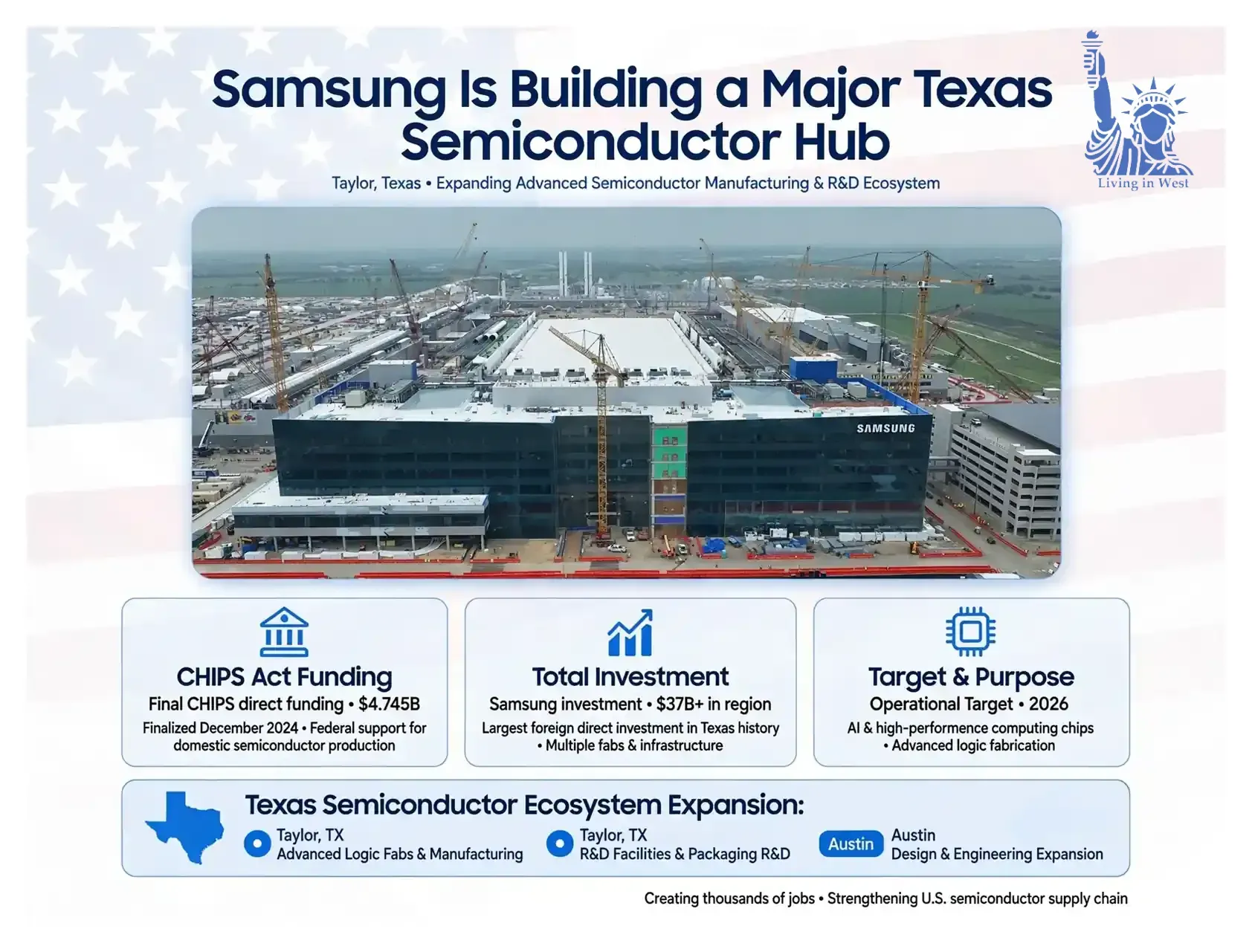
Samsung is expanding its semiconductor manufacturing presence in Central Texas.
The company plans a major semiconductor ecosystem around Taylor, Texas, including advanced logic fabs and research and development facilities, while also expanding its existing Austin operations.
The U.S. Department of Commerce finalized up to $4.745 billion in direct CHIPS funding for Samsung in December 2024. Samsung was expected to invest more than $37 billion in the region.
Samsung's current information on the Taylor project says the facility is targeted to be operational in 2026 and is designed to support advanced semiconductor production, including technologies relevant to AI and high-performance computing.
So the older figure of $6.4 billion Samsung grant should not be used as the final figure.
The finalized CHIPS direct funding figure is approximately $4.745 billion.
Part 6: Micron’s $200 Billion U.S. Memory-Chip Expansion
Micron has become another enormous part of the American semiconductor investment story.
Its original CHIPS-supported plan focused on Idaho and New York, with a long-term vision of as much as $125 billion in investment.
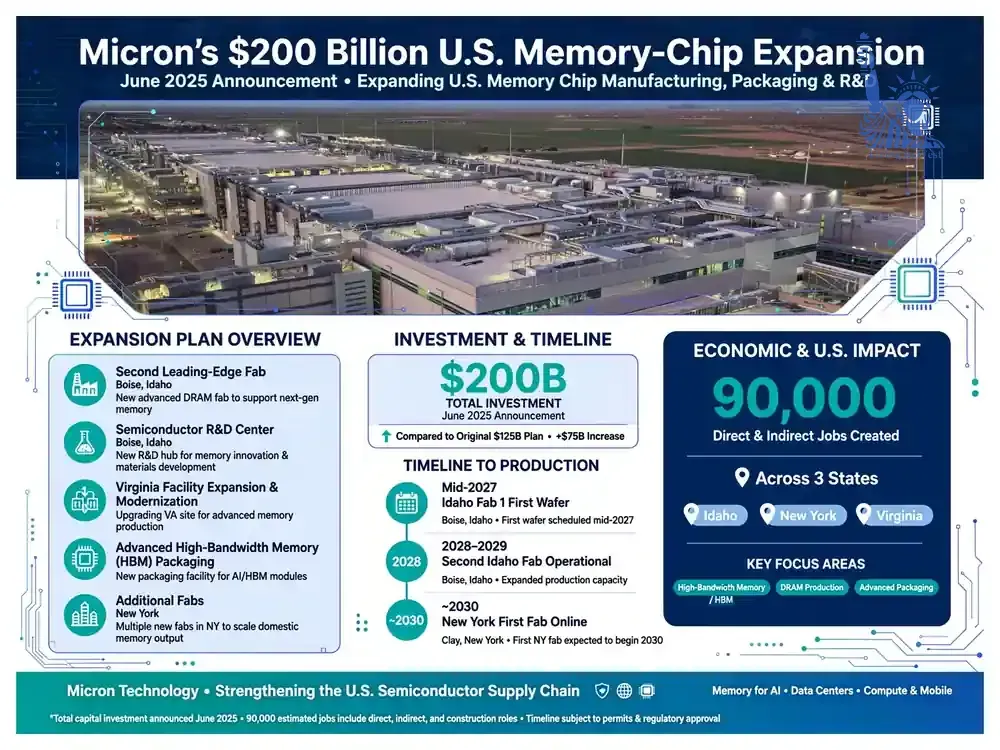
But in June 2025, Micron announced a much larger U.S. plan.
The company said it planned to invest approximately $200 billion in U.S. semiconductor manufacturing and R&D across Idaho, New York and Virginia.
The expanded plan includes:
- A second leading-edge fab in Boise, Idaho
- Expansion and modernization of the Virginia facility
- Advanced High Bandwidth Memory packaging
- Additional New York fabs
- Semiconductor R&D
Micron's expanded projects are expected to create approximately 90,000 direct and indirect jobs according to the company's announcement and the Department of Commerce.
The timeline has also changed from older projections.
As of 2026, Micron says first wafer output from its first Idaho fab is expected in mid-2027, while the second Idaho fab is expected to begin production later. Its New York project has moved into active construction, with the first New York fab expected to supply production from around 2030 and beyond.
Part 7: How Many Jobs Could This Semiconductor Boom Create?
The original estimates of 56,000 or 100,000 jobs are now too narrow to describe the full investment wave.
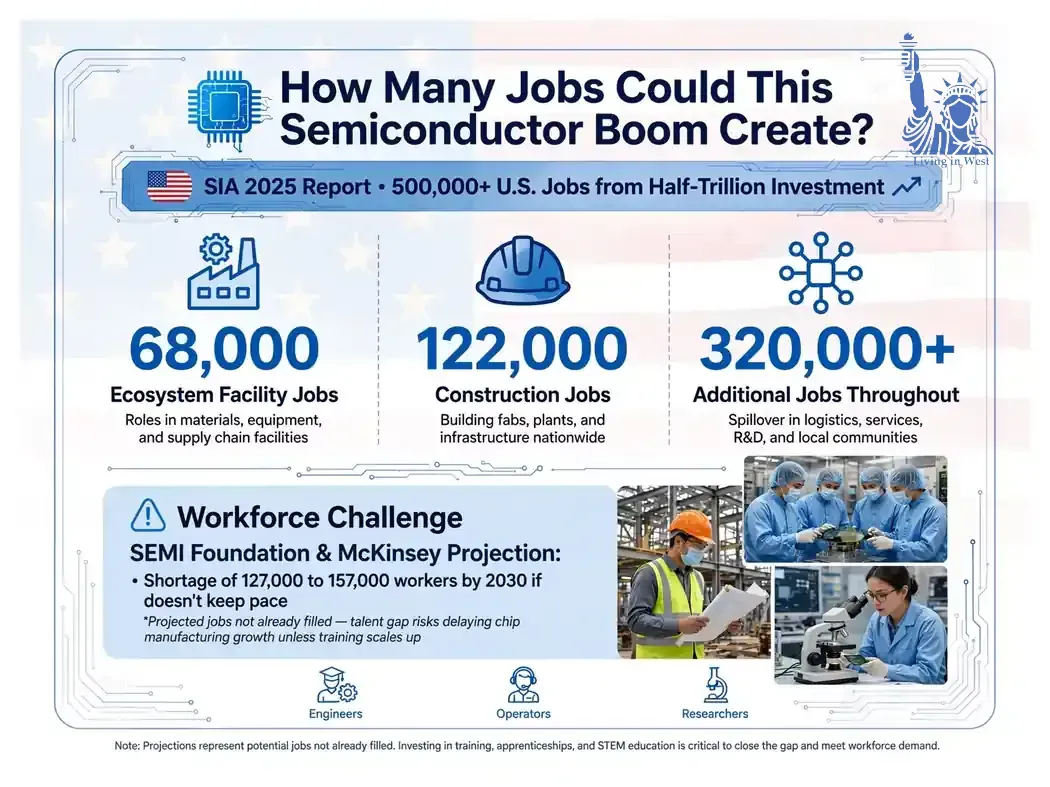
SIA's 2025 industry report estimated that the more than half-trillion dollars in announced private semiconductor investment could create or support more than 500,000 U.S. jobs.
That estimate included approximately:
- 68,000 semiconductor ecosystem facility jobs
- 122,000 construction jobs
- More than 320,000 additional jobs supported throughout the U.S. economy
These are projected jobs, not all jobs already filled.
There is also a major workforce challenge.
A SEMI Foundation and McKinsey analysis projects that the United States could face a shortage of approximately 127,000 to 157,000 semiconductor and microelectronics workers by 2030 if workforce development does not keep pace with the industry's expansion.
That means building factories is only one part of the challenge.
America also needs engineers, technicians, operators, researchers and other skilled workers to operate them.
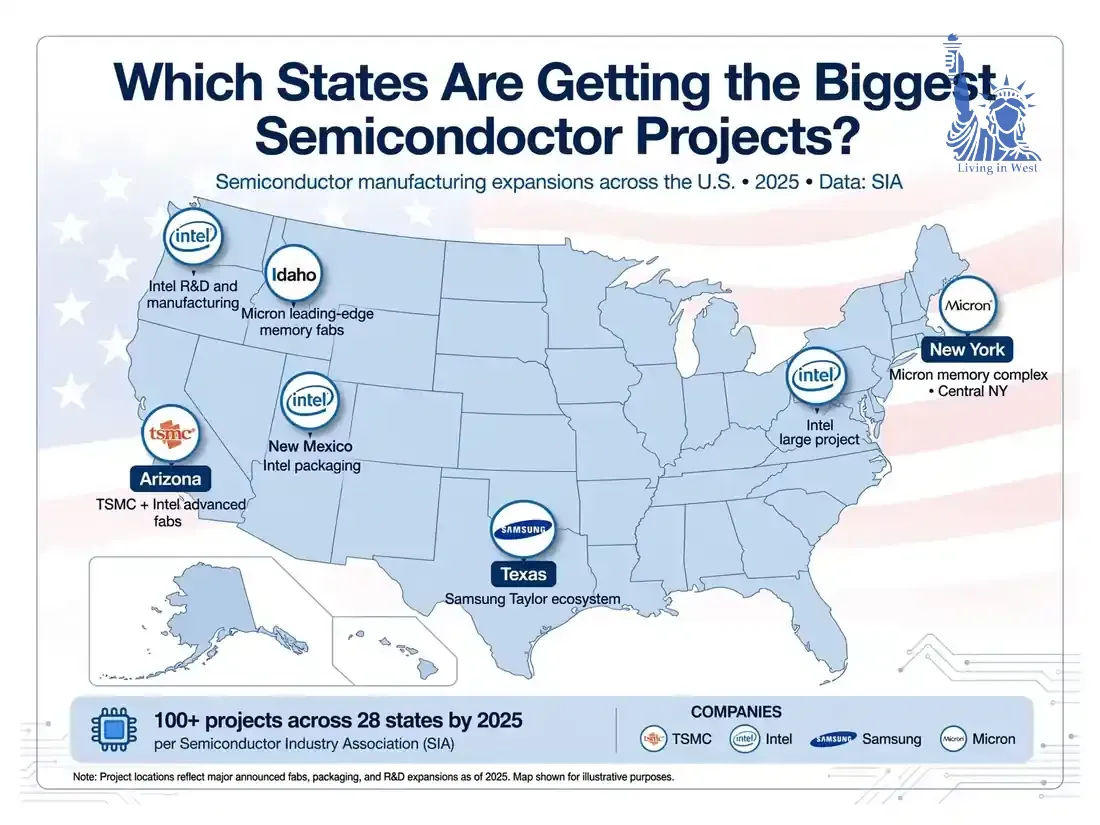
Part 8: Which States Are Getting the Biggest Semiconductor Projects?
The investment is spread across a large part of the United States.
SIA reported more than 100 semiconductor-related projects across 28 states by 2025.
Some of the most important locations include:
Arizona
TSMC and Intel are building and expanding advanced semiconductor manufacturing and packaging capabilities.
Texas
Samsung is developing its major Taylor semiconductor ecosystem.
New York
Micron is developing a large memory-chip manufacturing complex in Central New York.
Idaho
Micron is building leading-edge memory fabs alongside its existing R&D operations.
Ohio
Intel is developing its large Ohio semiconductor manufacturing project.
New Mexico
Intel is expanding advanced packaging and manufacturing capabilities.
Oregon
Intel's long-established semiconductor R&D and manufacturing operations remain an important part of its U.S. network.
Other states are also benefiting from semiconductor materials, equipment, packaging and supply-chain projects.
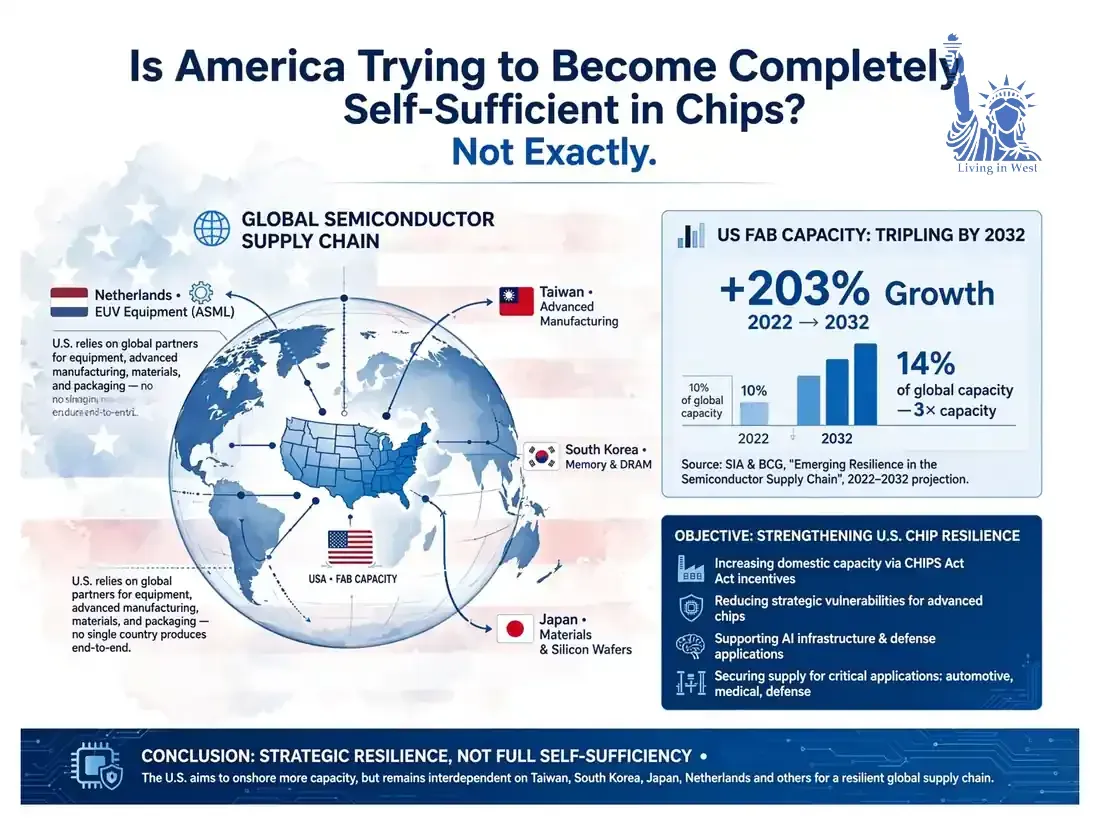
Part 9: Is America Trying to Become Completely Self-Sufficient in Chips?
Not exactly.
The United States is still part of a global semiconductor supply chain.
Taiwan, South Korea, Japan, the Netherlands and other countries remain extremely important to different parts of semiconductor manufacturing, equipment and materials.
The objective is better described as increasing domestic capacity and reducing strategic vulnerabilities, particularly for advanced chips, defense-related technologies, AI infrastructure and other critical applications.
SIA projects that U.S. semiconductor fabrication capacity could roughly triple by 2032 based on announced projects.
So the goal is not to isolate the United States from the global chip industry.
It is to make sure that America has significantly more manufacturing capability at home.
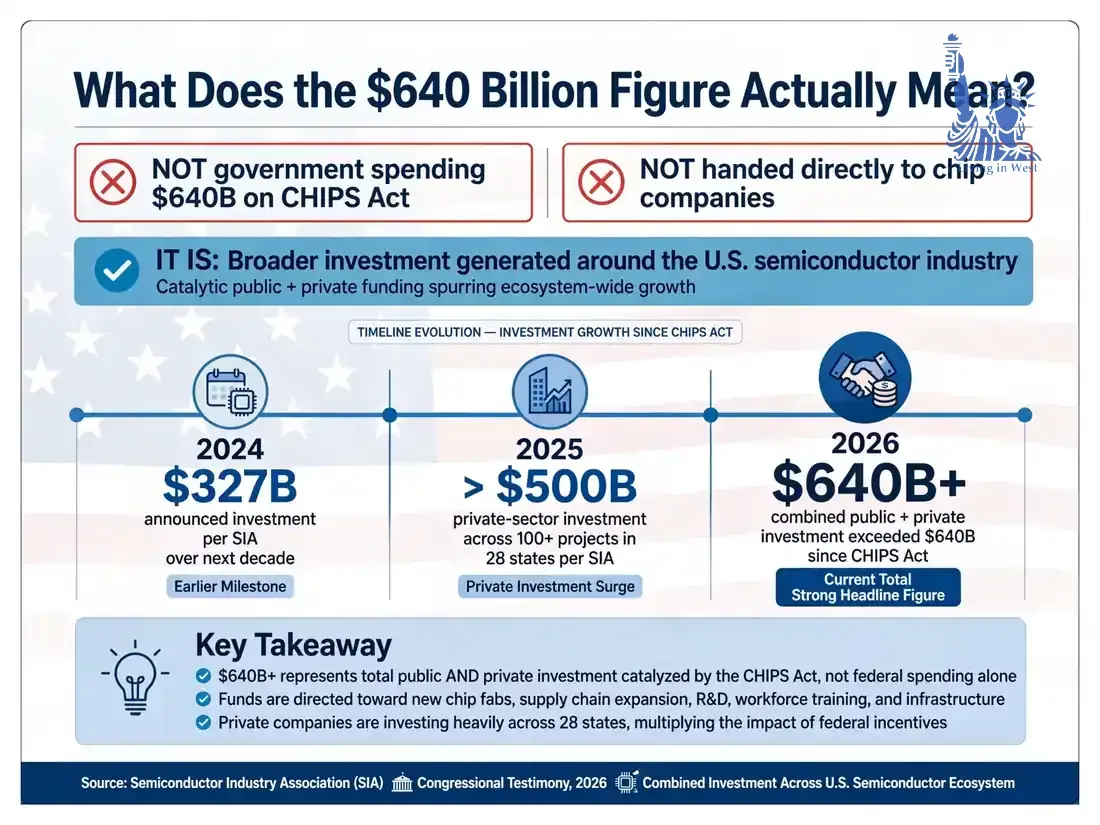
Part 10: What Does the $640 Billion Figure Actually Mean?
This is probably the most important point for readers.
The $640 billion figure does not mean that the U.S. government spent $640 billion on the CHIPS Act.
It also does not mean that $640 billion was handed directly to chip companies.
The number represents the much broader investment generated around the U.S. semiconductor industry.
The measurements have changed over time:
2024:
SIA-related estimates cited about $327 billion in announced semiconductor investment over the following decade.
2025:
SIA reported more than half a trillion dollars in private-sector semiconductor investment across more than 100 projects in 28 states.
2026:
Congressional testimony stated that combined public and private semiconductor investment since the CHIPS Act had exceeded $640 billion.
Therefore, for a current article, $640B+ is the stronger headline figure, while $327B should be explained as an earlier milestone.
What Happens Next?
The semiconductor construction boom is still unfolding.
TSMC is expanding its Arizona campus.
Samsung is moving toward operation of its Taylor, Texas facility.
Micron is accelerating construction in Idaho and New York.
Intel continues developing manufacturing and packaging capacity across multiple states.
At the same time, the U.S. semiconductor industry is facing challenges including high construction costs, long project timelines, workforce shortages and the difficulty of bringing complex semiconductor supply chains back together.
The SIA's 2025 projection was that these projects could help triple U.S. chipmaking capacity by 2032.
That means the full impact of today's investment announcements will not be visible immediately.
Many of the most important factories will continue coming online during the second half of the 2020s and into the early 2030s.
The Bottom Line
America's semiconductor investment boom has grown far beyond the original $327 billion figure that attracted attention in 2024.
Today, the better current picture is:
- $327B: earlier 2024 announced-investment milestone
- $500B+: private semiconductor investment announced by 2025
- $640B+: combined public and private semiconductor investment cited in 2026
- 28 states: locations covered by more than 100 announced semiconductor projects
- 500,000+: projected jobs supported by the announced investment wave
- 2032: SIA's target horizon for roughly tripling U.S. chipmaking capacity
The result is a major rebuilding of America's domestic semiconductor manufacturing base.
It is not one giant factory and it is not simply a $280 billion government spending project.
It is a nationwide network of fabs, research centers, packaging plants, equipment suppliers, construction projects and supporting industries that could reshape where advanced chips are manufactured in the United States over the next decade.
FAQ
What is the $640 billion U.S. semiconductor investment?
It refers to combined public and private semiconductor investment in the United States since the CHIPS and Science Act, with congressional testimony in 2026 putting the total above $640 billion.
Was the original investment figure $327 billion?
Yes. About $327 billion in announced semiconductor-related investment was cited in 2024 based on SIA calculations. The figure has since been surpassed by later announcements.
How much money did the CHIPS Act itself provide?
The semiconductor-related CHIPS program included $39 billion in manufacturing incentives and about $50 billion in total appropriated semiconductor activities, while also providing $75 billion in loan and loan-guarantee authority.
Which companies are making the biggest U.S. semiconductor investments?
Major projects include TSMC's $165 billion U.S. investment plan, Micron's approximately $200 billion expanded U.S. plan, Intel's more than $100 billion broader U.S. expansion plan, and Samsung's more than $37 billion Central Texas investment plan.
When will the projects be completed?
There is no single completion date. Different fabs are scheduled for different years. Several projects are expected to enter production during 2026–2030, while the broader capacity expansion continues toward 2032 and beyond.
Will the United States become completely independent from Asian semiconductor production?
No single official target establishes complete independence. The policy objective is to substantially expand domestic capacity and strengthen supply-chain resilience, particularly in strategically important semiconductor technologies.
Disclaimer
Investment figures in this article refer to announced, planned or projected investments and should not be interpreted as money already spent. Project schedules, investment amounts, production targets and job estimates can change as companies adjust construction and capital plans. Government incentives also depend on applicable agreements and project milestones.

Editorial Team