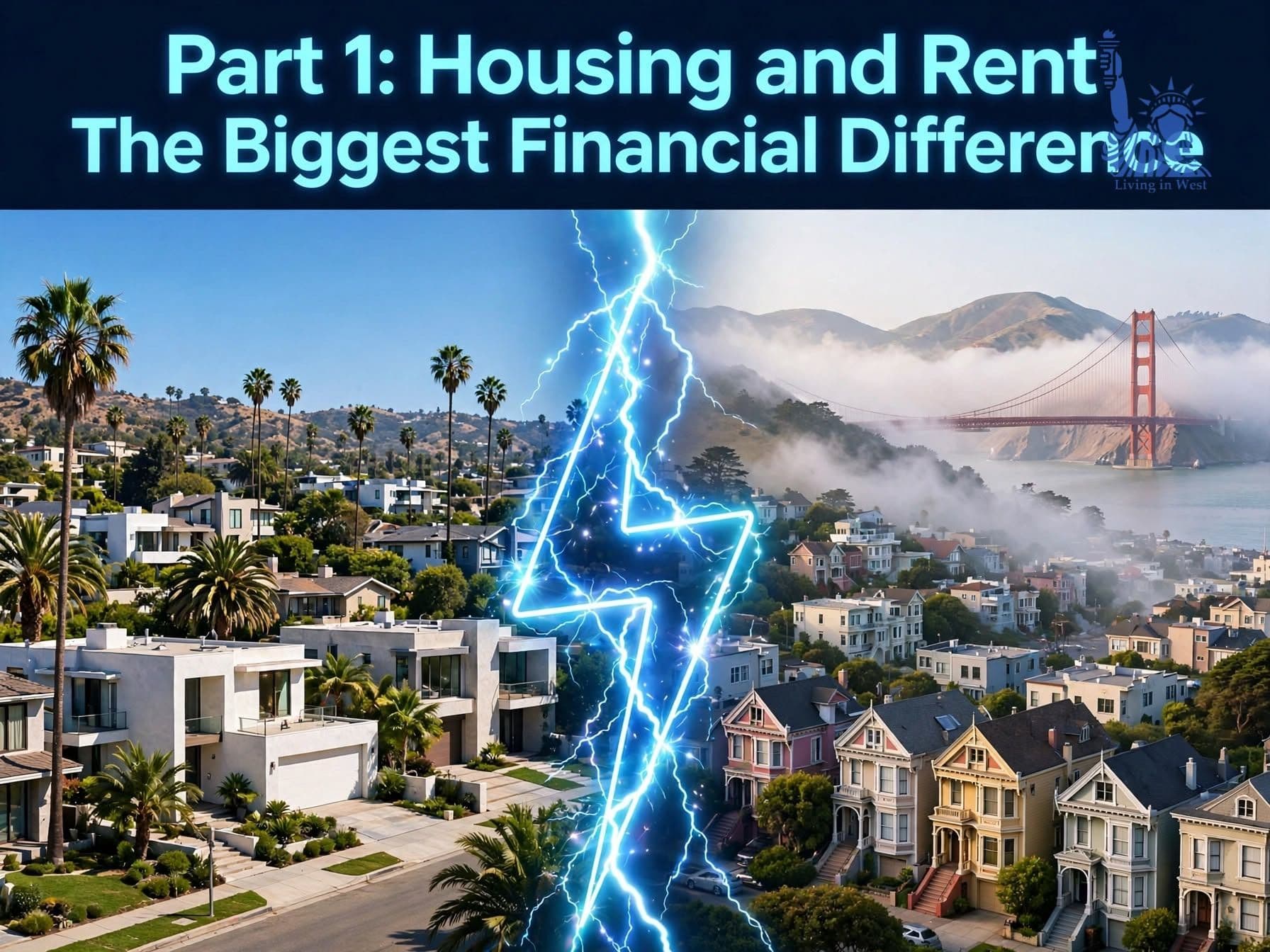
Part 1: Housing and Rent — The Biggest Financial Difference
Housing is one of the clearest differences between Los Angeles and San Francisco.
According to Zillow's August 2026 data, the typical home value in San Francisco was $1,424,767, while Los Angeles was $929,572. That makes the San Francisco figure approximately 53% higher than Los Angeles on this particular Zillow measure.
Zillow also reported a major difference in rents.
| Housing Metric | Los Angeles | San Francisco | Difference |
|---|---|---|---|
| Typical home value, Aug. 2026 | $929,572 | $1,424,767 | SF ~53% higher |
| 1-year home-value change | -0.4% | +13.6% | Very different trend |
| Median sale price, July 2026 | $1,026,250 | $1,595,000 | SF higher |
| Average rent, Aug. 2026 | $2,778 | $4,682 | SF ~69% higher |
| Median days to pending | 30 | 14 | SF homes moved faster |
Zillow's figures show that San Francisco's typical home value rose 13.6% year over year, while Los Angeles was down 0.4% over the same period.
The rent gap is also substantial: Zillow's August 2026 rental figures show approximately $4,682 in San Francisco versus $2,778 in Los Angeles.
However, these are city-level Zillow metrics, not a promise that every apartment or house will follow the same price.
What this means
If housing is the largest part of your monthly budget, the difference between the two cities can be significant.
Los Angeles also covers a much larger geographic area, so residents have more neighborhood and housing-type choices. San Francisco is much more compact, which contributes to its very high housing costs.
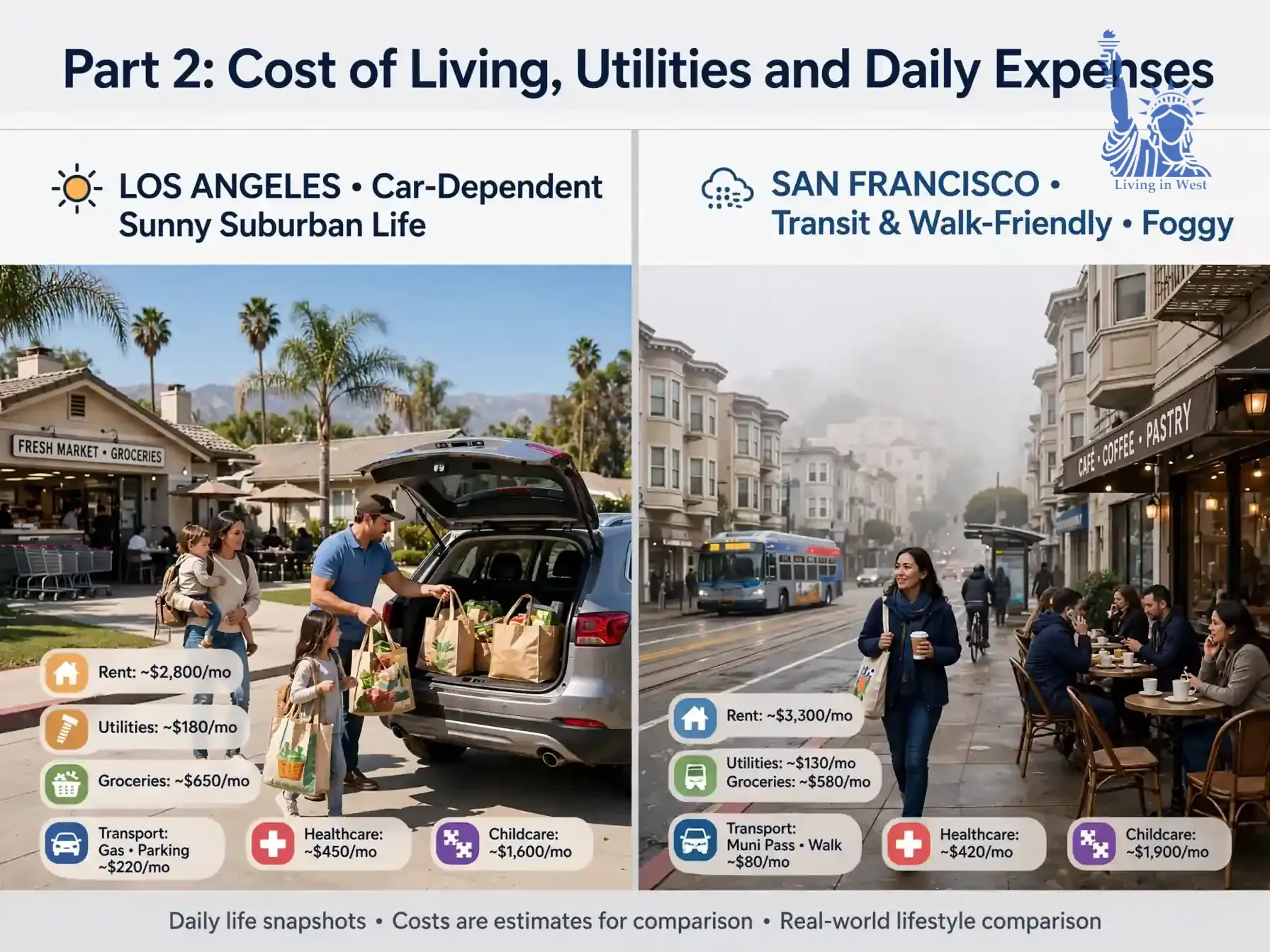
Part 2: Cost of Living, Utilities and Daily Expenses
Housing creates the biggest difference, but everyday spending also matters.
A comparison should include:
- Rent or mortgage
- Utilities
- Groceries
- Transportation
- Healthcare
- Insurance
- Restaurants
- Childcare
- Entertainment
- Property taxes for homeowners
It is difficult to give one universal monthly cost because a single person living in a small apartment will have a completely different budget from a family owning a house.
General comparison
| Expense Area | Los Angeles | San Francisco |
|---|---|---|
| Housing | Very expensive | Extremely expensive |
| Rent | Lower than SF in current Zillow data | Higher |
| Home purchase | Lower typical value | Higher typical value |
| Transportation | More car-dependent | More transit/walk friendly |
| Groceries | Expensive | Expensive |
| Restaurants | Expensive | Expensive |
| Utilities | Varies by home | Varies by home |
| Family budget | Highly neighborhood-dependent | Housing can dominate budget |
One important point is that citywide averages can hide huge neighborhood differences.
A household living in a relatively affordable Los Angeles-area neighborhood can have a very different budget from a household in Beverly Hills or Santa Monica.
Likewise, San Francisco neighborhoods vary, but the citywide housing market remains extremely expensive.
Sales tax is another interesting difference
California sales tax is not identical in every city.
The California Department of Tax and Fee Administration's rates effective July 1, 2026 show that local combined rates vary by city and address. Therefore, a blanket statement such as "San Francisco always has higher sales tax than Los Angeles" is not reliable. The exact rate should be checked for the specific location.
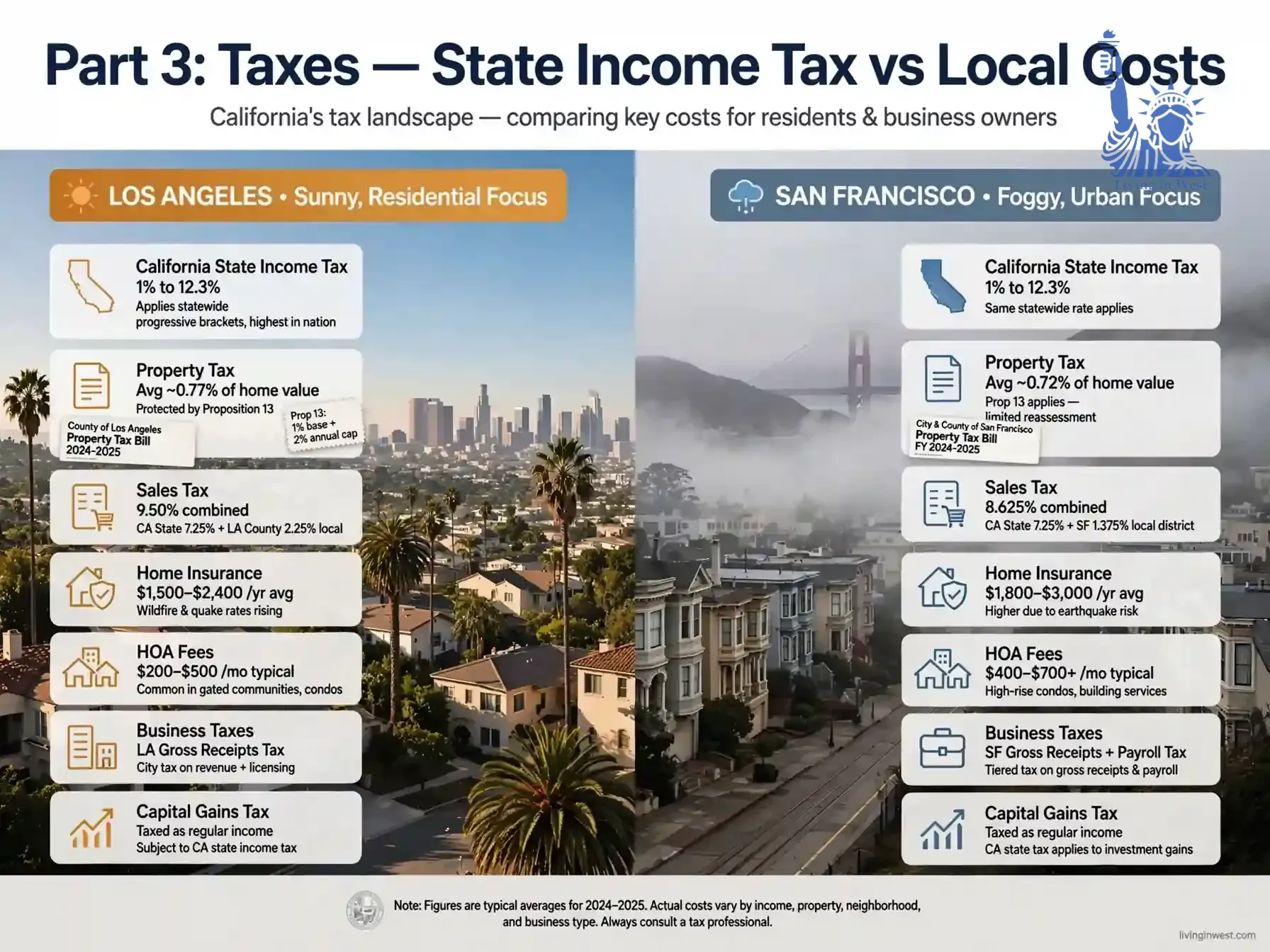
Part 3: Taxes — State Income Tax vs Local Costs
Both Los Angeles and San Francisco are in California, so residents are subject to California's state income-tax system.
For high-income residents, California's state income tax can be a major consideration regardless of which of these two cities they choose.
But taxes are not simply a city-versus-city issue.
A homeowner needs to consider:
- California income tax
- Property tax
- Local sales tax
- Insurance
- HOA fees
- Special assessments
- Capital-gains implications
- Business taxes, where applicable
Property tax
California's Proposition 13 system means property taxation does not work like a simple annual percentage of whatever the current market value happens to be.
For a new buyer, the purchase price generally becomes important to the initial assessed value, while long-time owners can have very different assessed values.
That means comparing two homeowners simply by saying:
"SF house costs more, therefore its property tax is exactly X dollars more"
can be misleading.
Tax comparison
| Tax/Cost | Los Angeles | San Francisco |
|---|---|---|
| California income tax | Same state system | Same state system |
| Property tax | Depends on assessed value | Depends on assessed value |
| Sales tax | Local rate applies | Local rate applies |
| Home insurance | Property-dependent | Property-dependent |
| Business/local taxes | Depends on activity | Depends on activity |
The important point is that San Francisco does not have a separate California state income-tax schedule simply because it is San Francisco.
Part 4: Education and Healthcare
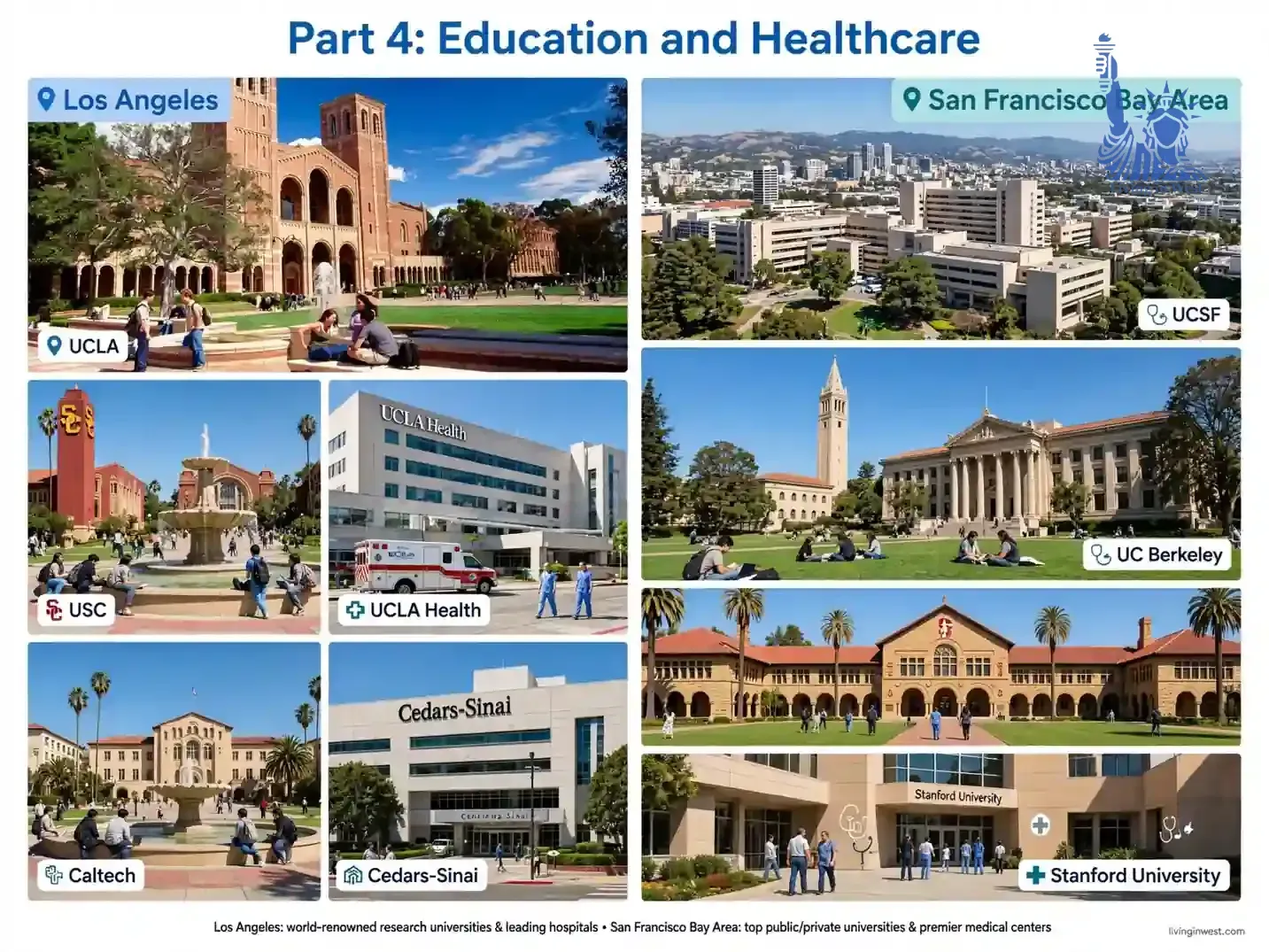
Both regions provide access to major universities and medical institutions.
Education
Los Angeles has major institutions such as:
- UCLA
- USC
- Caltech
- Loyola Marymount University
The wider San Francisco Bay Area includes:
- UC San Francisco
- UC Berkeley
- Stanford University
- San Francisco State University
- University of San Francisco
Stanford and UC Berkeley should technically be described as Bay Area institutions rather than universities located inside the city of San Francisco.
Education comparison
| Category | Los Angeles | San Francisco / Bay Area |
|---|---|---|
| Major universities | UCLA, USC, Caltech | UCSF, Berkeley, Stanford nearby |
| Technology ecosystem | Strong | Extremely concentrated |
| Entertainment/media education | Major ecosystem | Smaller |
| Research | Strong | Strong |
| Student housing | Expensive | Extremely expensive in many areas |
| Transportation | Often car-dependent | More transit-friendly |
Healthcare
Los Angeles has major healthcare systems including UCLA Health and Cedars-Sinai.
San Francisco has UCSF and other major medical institutions.
Rather than claiming that healthcare is universally more expensive in one city, the more accurate approach is to compare:
- Insurance plan
- Employer coverage
- Deductible
- Copay
- Prescription costs
- Hospital
- Treatment
- Family size
A person with excellent employer-sponsored insurance could have a completely different healthcare budget from someone buying an individual plan.
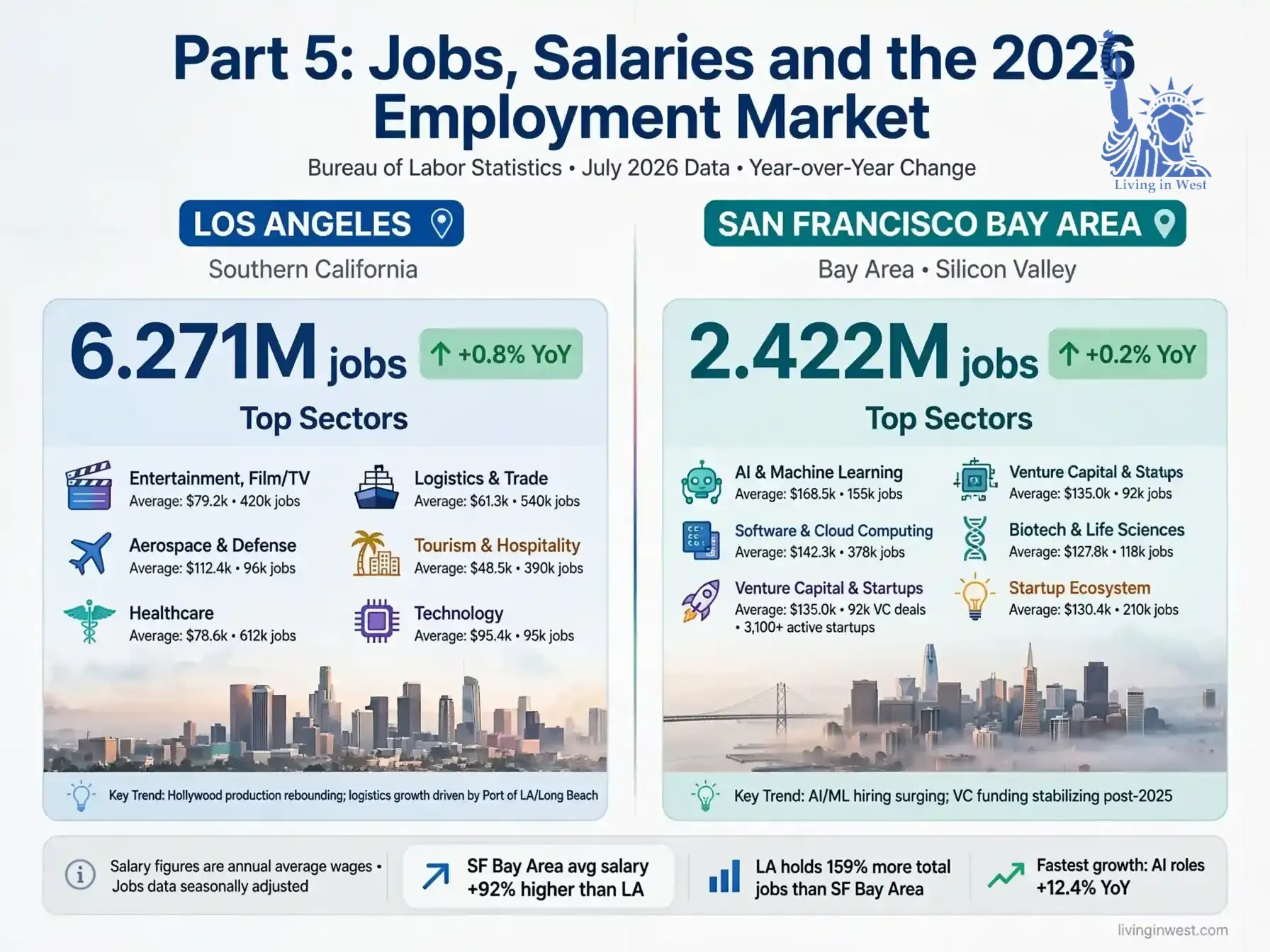
Part 5: Jobs, Salaries and the 2026 Employment Market
This is where the two cities become particularly different.
Los Angeles has a diversified economy involving:
- Entertainment
- Film and television
- Aerospace
- Logistics
- International trade
- Healthcare
- Tourism
- Construction
- Professional services
- Technology
San Francisco and the wider Bay Area are particularly concentrated around:
- Technology
- Artificial intelligence
- Software
- Venture capital
- Startups
- Professional services
- Biotechnology
What does the latest BLS data show?
The July 2026 BLS metropolitan employment release reports 6.271 million nonfarm jobs in the Los Angeles-Long Beach-Anaheim metropolitan area, up 0.8% from July 2025.
For the San Francisco-Oakland-Fremont metropolitan area, BLS reported 2.422 million jobs, up 0.2% year over year.
| July 2026 BLS employment | Los Angeles metro | San Francisco metro |
|---|---|---|
| Nonfarm jobs | 6.271 million | 2.422 million |
| Year-over-year change | +0.8% | +0.2% |
Important BLS naming clarification
There was concern that the name "San Francisco-Oakland-Fremont" was an outdated metro name.
However, the current July 2026 BLS release itself uses "San Francisco-Oakland-Fremont" in its employment table. Therefore, using that name when citing this particular BLS dataset is not evidence that the data was copied from an old source.
The BLS release also separately lists Oakland-Fremont-Berkeley and San Francisco-San Mateo-Redwood City as metropolitan divisions.
This distinction is important because BLS tables can use specific statistical-area definitions that do not always match casual geographic terminology.
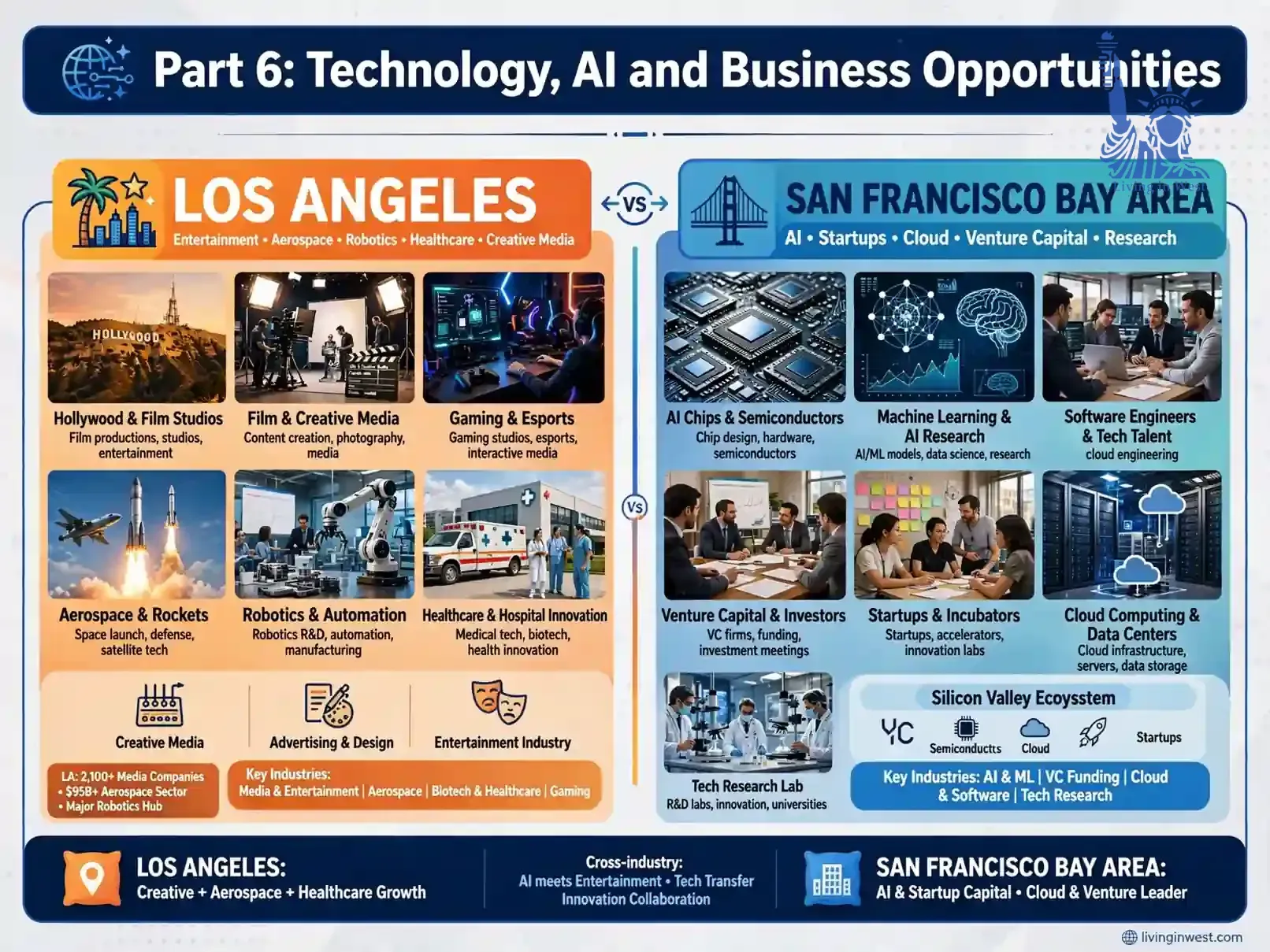
Part 6: Technology, AI and Business Opportunities
San Francisco remains closely associated with America's technology and AI ecosystem.
For someone working in:
- AI
- Software
- Machine learning
- Venture capital
- Startups
- Cloud computing
- Technology research
the Bay Area provides a dense concentration of companies, investors and professionals.
Los Angeles has a different economic mix.
Its technology opportunities overlap with:
- Entertainment
- Film
- Gaming
- Aerospace
- Robotics
- Healthcare
- Creative industries
- Media
This creates an important distinction.
Industry comparison
| Industry | Los Angeles | San Francisco / Bay Area |
|---|---|---|
| AI | Growing | Major ecosystem |
| Software | Strong | Extremely strong |
| Startups | Strong | Very strong |
| Venture capital | Significant | Major concentration |
| Entertainment | Global center | Smaller |
| Film/TV | Global center | Smaller |
| Aerospace | Major | Smaller |
| Logistics/ports | Major | Significant Bay Area activity |
| Gaming | Strong | Strong |
| Healthcare | Major | Major |
Rather than saying one city has "more opportunities" overall, the more accurate question is which industry you work in.
A software engineer focused on AI may interact with a very different job market from an aerospace engineer, filmmaker, logistics professional or healthcare worker.
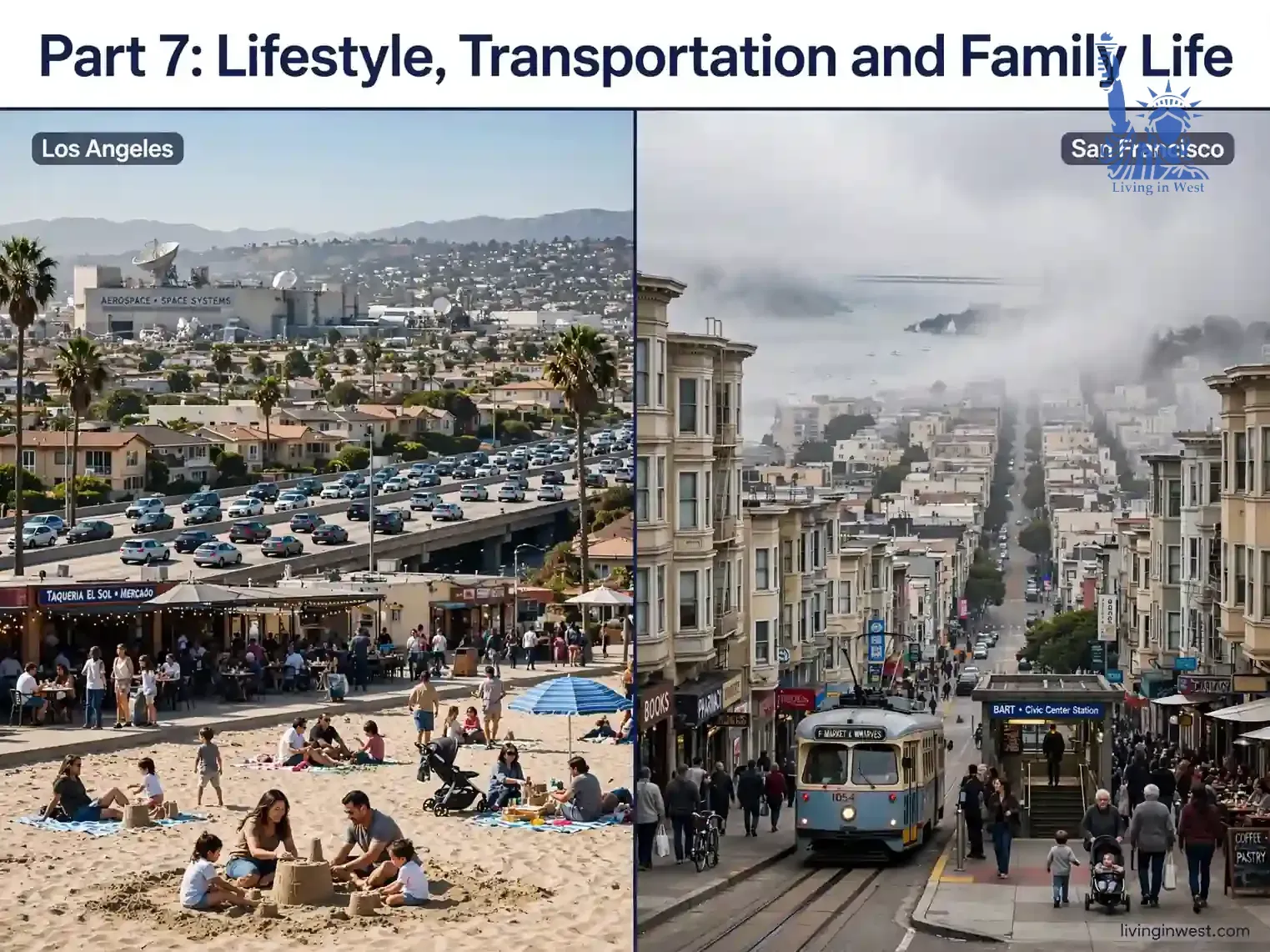
Part 7: Lifestyle, Transportation and Family Life
The everyday experience can be dramatically different.
Los Angeles
Los Angeles is large and spread out.
A car is useful for many residents because homes, workplaces, shopping areas and entertainment venues can be far apart.
The advantages include:
- Warm weather
- Beaches
- Larger suburban choices
- Entertainment
- Restaurants
- Shopping
- Large immigrant communities
- Aerospace
- Outdoor activities
The major challenge is traffic and commuting.
San Francisco
San Francisco is much more compact.
Many neighborhoods are walkable, and public transportation can play a larger role in daily life.
The city offers:
- Dense neighborhoods
- Walkability
- Public transportation
- Restaurants
- Technology jobs
- Urban lifestyle
- Bay views
- Cooler weather
But housing space is generally much more expensive.
Lifestyle comparison
| Lifestyle Factor | Los Angeles | San Francisco |
|---|---|---|
| Weather | Warmer, sunnier | Cooler, foggier |
| City layout | Very spread out | Compact |
| Car dependency | Generally higher | Generally lower |
| Walkability | Neighborhood-dependent | Stronger in many areas |
| Public transit | Available but car often useful | More practical for many residents |
| Beaches | Major advantage | Different coastal environment |
| Family housing choices | Wider across metro | More limited/expensive |
| Urban density | Lower overall | Higher |
For a family, neighborhood selection can matter more than the city label.
A Los Angeles family living close to work and school may have a completely different experience from a family commuting across the metropolitan area every day.
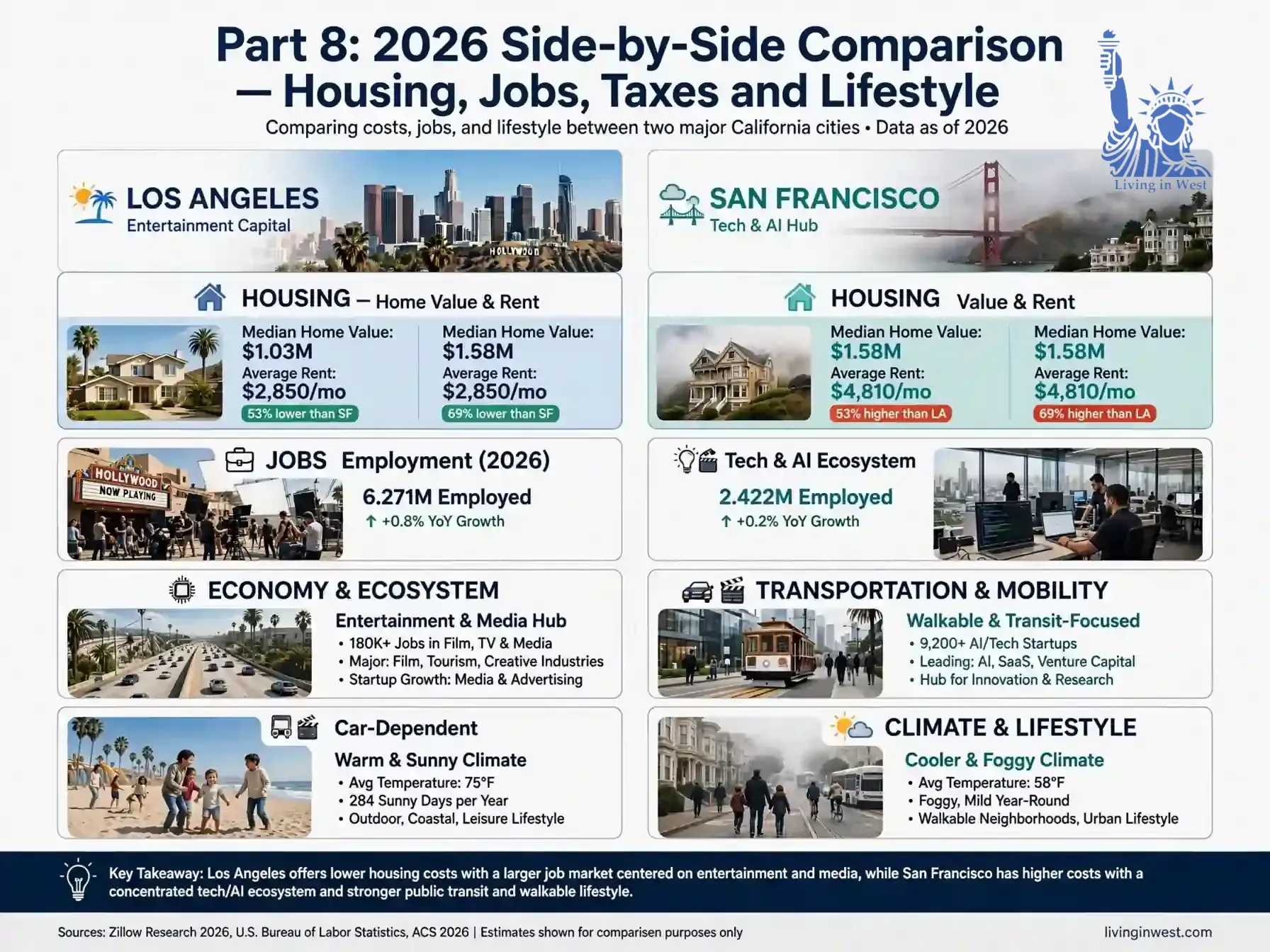
Part 8: 2026 Side-by-Side Comparison — Housing, Jobs, Taxes and Lifestyle
After looking at all seven areas above, the overall comparison becomes clearer.
| Category | Los Angeles | San Francisco |
|---|---|---|
| Typical home value | $929,572 | $1,424,767 |
| Home value YoY | -0.4% | +13.6% |
| Zillow average rent | $2,778 | $4,682 |
| July 2026 median sale price | $1,026,250 | $1,595,000 |
| Metro employment | 6.271M | 2.422M |
| Employment YoY | +0.8% | +0.2% |
| Main economic strengths | Entertainment, aerospace, logistics, healthcare, trade, technology | Technology, AI, startups, venture capital, professional services |
| Transportation | More car-oriented | More transit/walkability |
| Climate | Warmer and sunnier | Cooler and foggier |
| Housing space | More geographic choice | More expensive/limited |
| Tech/AI concentration | Growing | Very high |
| Entertainment | Global industry center | Smaller |
| Family housing choices | Broad across metro | More constrained |
| Urban lifestyle | Spread out | Dense and compact |
At the same time, the employment figures show that both metropolitan areas have large labor markets, with Los Angeles reporting stronger year-over-year nonfarm payroll growth in the July 2026 BLS data.
So what is the real difference?
Los Angeles:
A huge, diversified metropolitan area where housing varies significantly by neighborhood, with major strengths in entertainment, aerospace, healthcare, logistics, tourism and technology.
San Francisco:
A compact and extremely expensive city connected to one of America's strongest technology, startup and AI ecosystems.
The right choice depends on your:
- Income
- Career
- Family size
- Housing budget
- Commute
- Need for a car
- Preferred climate
- Desired lifestyle
- Industry
There is no single answer that applies to everyone.
FAQ: Los Angeles vs San Francisco in 2026
Is San Francisco more expensive than Los Angeles in 2026?
For housing, current Zillow data shows a substantial difference. The typical San Francisco home value was $1,424,767 in August 2026 versus $929,572 in Los Angeles.
Is rent higher in San Francisco?
Yes, according to Zillow's August 2026 rental data. San Francisco's average rent was $4,682 compared with $2,778 in Los Angeles.
Which city has more technology and AI opportunities?
San Francisco and the wider Bay Area have a much more concentrated technology and AI ecosystem. Los Angeles also has technology opportunities, particularly where technology overlaps with entertainment, gaming, aerospace and creative industries.
Is Los Angeles more car-dependent?
Generally, yes. Los Angeles is geographically spread out and many residents rely on cars for commuting and daily activities.
Is San Francisco more walkable?
Many San Francisco neighborhoods are highly walkable and have stronger access to public transportation than many parts of Los Angeles.
Are taxes higher in San Francisco?
California's state income-tax system applies to both cities. Local taxes and fees can differ, so the actual tax burden depends on income, property ownership, spending and the specific address.
Is Los Angeles or San Francisco better for families?
The answer depends on the family's priorities. Los Angeles provides a much larger geographic area with a broad range of neighborhoods and housing types, while San Francisco offers a denser urban environment and stronger walkability in many neighborhoods.
Why does the BLS report call it San Francisco-Oakland-Fremont?
Because that is the metropolitan-area label used in the current BLS July 2026 employment table. The BLS release also separately reports metropolitan divisions such as Oakland-Fremont-Berkeley and San Francisco-San Mateo-Redwood City.
Data & Sources
The main current figures in this comparison come from:
- Zillow — August 2026 housing and rental data
- U.S. Bureau of Labor Statistics — July 2026 metropolitan employment data
- California Department of Tax and Fee Administration — 2026 city and county sales-tax rates
Data can change monthly, and different organizations use different definitions and methodologies. Readers should verify current figures for a specific property, neighborhood, tax situation or employment decision.
Disclaimer
This article is for general informational purposes only. Housing, employment, tax and cost-of-living figures can change over time and can vary substantially by neighborhood, household and individual circumstances. The information should not be treated as financial, tax, real-estate or investment advice.

Editorial Team