PART 1: WHAT IS THE J-1 VISA AND WHO CAN APPLY?
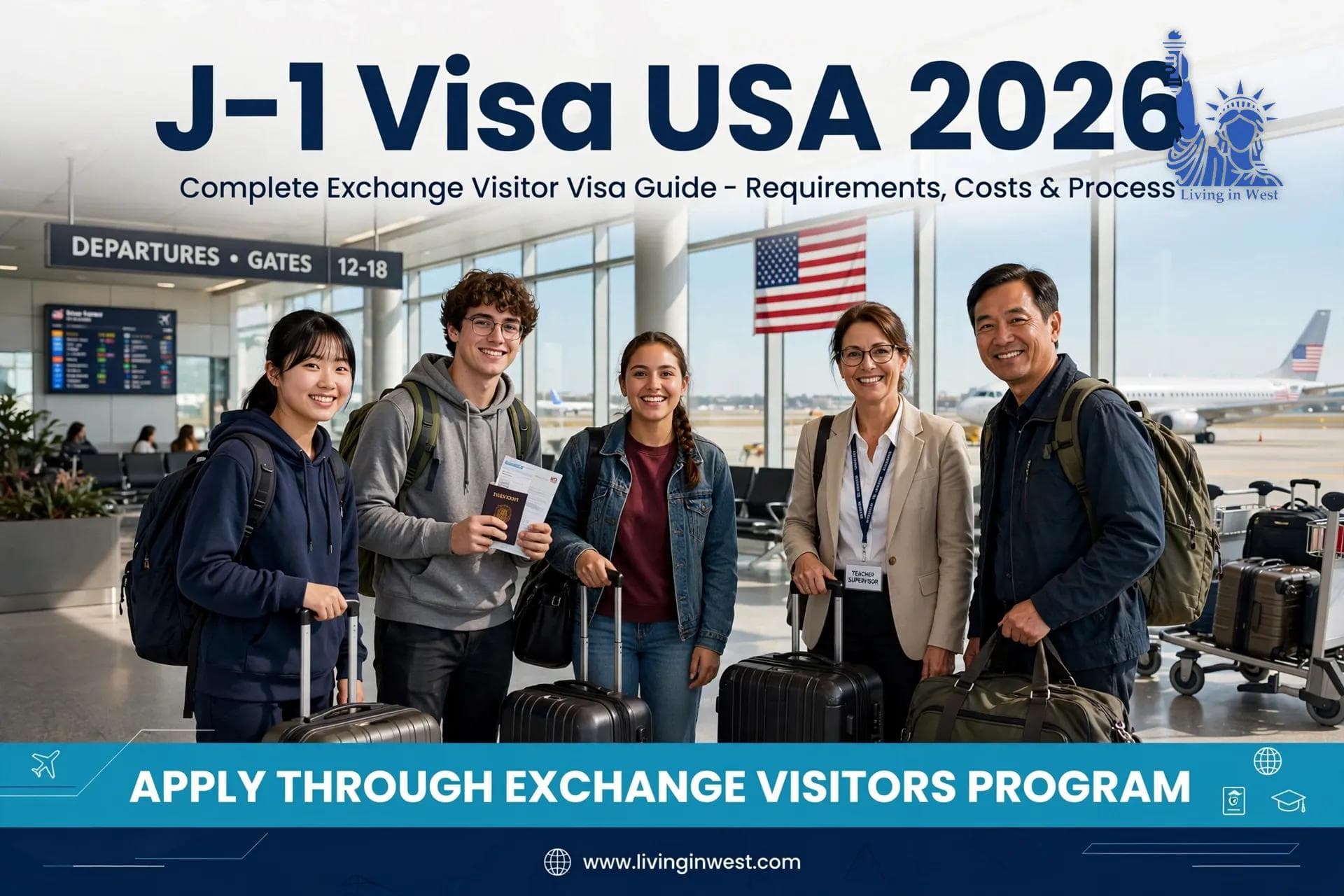
The J-1 is a nonimmigrant exchange visitor visa administered through the U.S. Department of State's Exchange Visitor Program.
It is designed to promote educational and cultural exchange between the United States and other countries.
Unlike some visa categories where you independently apply for a visa first, a J-1 applicant generally needs to be accepted into an approved exchange program and sponsored by a State Department-designated organization.
Only designated sponsors can issue the Form DS-2019, which is the key document needed to apply for J-1 status.
Who Can Use a J-1 Visa?
There are 15 official J-1 exchange categories, including:
- College and university students
- Secondary-school students
- Research scholars
- Professors
- Short-term scholars
- Interns
- Trainees
- Teachers
- Physicians
- Au pairs
- Camp counselors
- Summer Work Travel participants
- Specialists
- Government visitors
- International visitors
So, the J-1 visa is not simply a "student visa."
A university student may use J-1 for an exchange program, while a researcher could come to the U.S. for academic research, a teacher could participate in an approved teaching exchange, and an intern or trainee could receive structured professional experience.
Can Anyone From Any Country Apply?
There is no simple list saying that only certain nationalities can use J-1 visas.
Eligibility depends primarily on the specific exchange category, sponsor and program requirements. Your nationality can also matter for certain requirements, including the 212(e) Skills List rules.
Therefore, applicants should check their specific program rather than assuming that being from a particular country automatically qualifies them.
PART 2: J-1 VISA REQUIREMENTS, DS-2019 & HOW LONG YOU CAN STAY
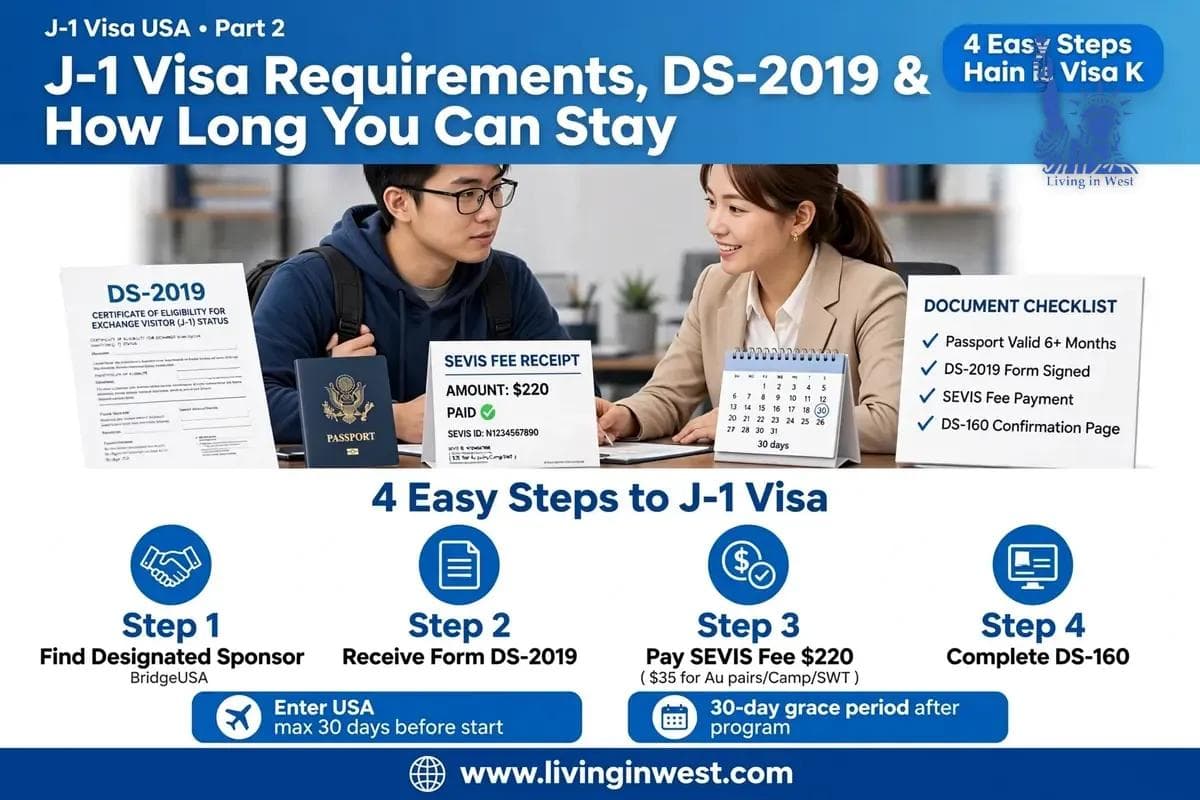
The first major step is finding the correct exchange program.
Step 1: Find a Designated Sponsor
Use the official BridgeUSA sponsor information to find organizations authorized to operate J-1 programs.
The sponsor evaluates your eligibility and selects you for its program.
Step 2: Receive Form DS-2019
Once accepted, the designated sponsor issues your Form DS-2019 — Certificate of Eligibility for Exchange Visitor (J-1) Status.
The DS-2019 contains important information such as:
- Your exchange category
- Program start date
- Program end date
- Sponsor information
- Estimated financial support
- Program details
Receiving a DS-2019 does not automatically guarantee the visa. The final visa decision is made by a U.S. consular officer.
Step 3: Pay the SEVIS Fee
Most J-1 categories currently have a $220 I-901 SEVIS fee.
The fee is $35 for:
- Au pairs
- Camp counselors
- Summer Work Travel participants
Some federally funded exchange programs may have different fee arrangements or exemptions.
Step 4: Complete DS-160
After obtaining the required program documents, applicants complete the DS-160 Online Nonimmigrant Visa Application.
You then follow the instructions of the U.S. embassy or consulate where you will apply.
How Early Can You Enter the USA?
Under current BridgeUSA guidance, J-1 participants generally cannot arrive more than 30 days before the program start date shown on the DS-2019.
What Happens After the Program Ends?
J-1 participants generally receive a 30-day grace period after completing their program.
During this period, the participant may prepare to leave the United States and travel domestically, but cannot continue exchange activities or work under J-1 authorization.
PART 3: J-1 VISA COST, WORK RULES & IMPORTANT 2026 CHANGE
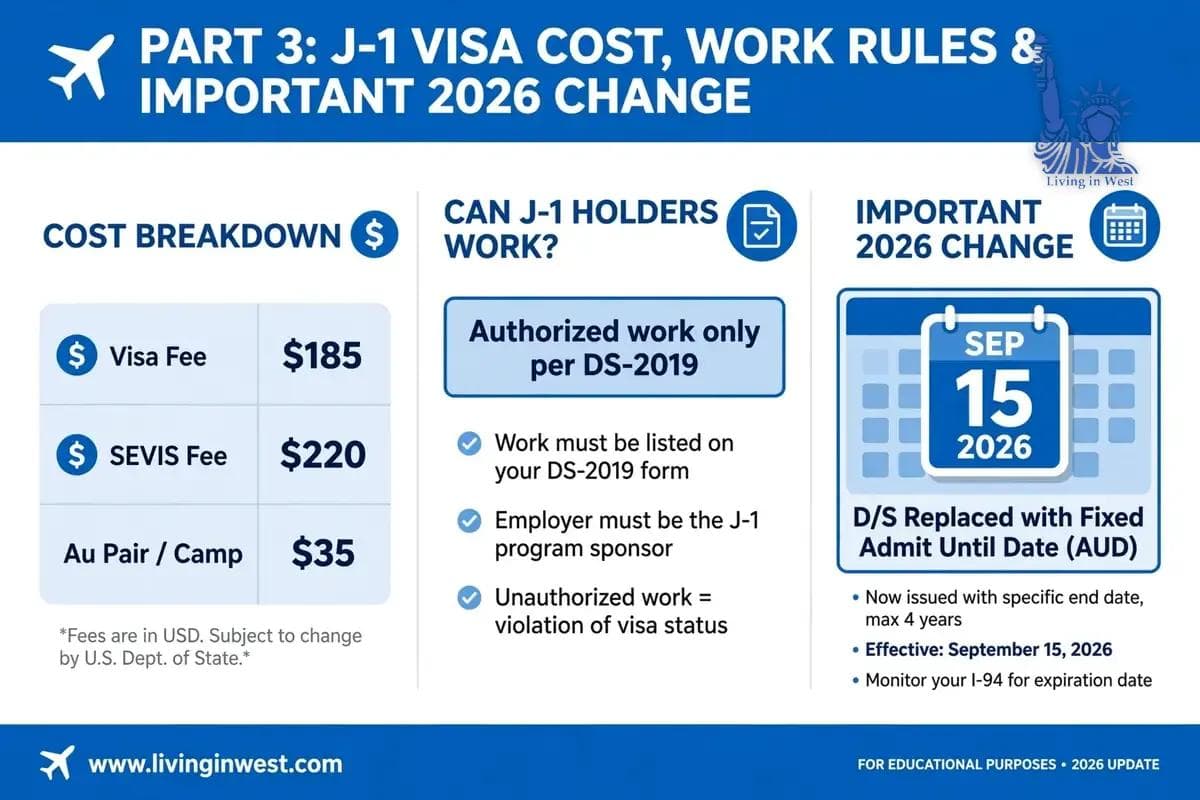
How Much Does a J-1 Visa Cost?
The exact cost depends heavily on your exchange category and sponsor.
Common Government Fees
ExpenseCurrent Amount
J visa application fee
$185
I-901 SEVIS — most J-1 categories
$220
SEVIS — Au Pair/Camp Counselor/SWT
$35
Visa issuance/reciprocity fee
Depends on nationality
Sponsor program fee
Depends on sponsor
J-1 waiver processing fee
$120
The standard nonimmigrant visa application fee for J visas is currently $185, although official U.S.-government-sponsored exchange participants can be exempt under specific conditions.
The J-1 waiver application through Form DS-3035 has a $120 non-refundable processing fee.
What About the Total Program Cost?
There is no universal "$1,500–$4,500 J-1 fee."
Your actual budget may include:
- Visa fee
- SEVIS fee
- Sponsor fee
- Program tuition or participation costs
- Flights
- Housing
- Food
- Health insurance
- Local transportation
- Personal expenses
Some programs are heavily funded, while others can cost thousands of dollars.
Can J-1 Holders Work?
This is an important point.
A J-1 holder cannot simply take any job in America.
Employment or other activities must be authorized and consistent with the participant's J-1 category and Form DS-2019. BridgeUSA specifically states that exchange visitors may perform the activity listed on their DS-2019 and allowed under the applicable regulations.
For example, Summer Work Travel participants have a specific work-and-travel program, while a research scholar has completely different program rules.
Important 2026 Change: D/S Is Being Replaced
This is one of the biggest updates to mention in a 2026 J-1 article.
The Department of Homeland Security published a final rule on July 17, 2026, changing the admission system for F-1 and J-1 students/exchange visitors from the traditional Duration of Status (D/S) system to a fixed admission period. The rule is scheduled to become effective September 15, 2026, subject to the stated regulatory review process.
Under the new system, eligible F-1 and J-1 students/scholars will generally receive a specific Admit Until Date (AUD) rather than simply "D/S" on their admission record.
The initial admission period generally cannot exceed four years, but that does not mean every J-1 participant automatically gets four years. The permitted period depends on the applicable program and rules.
If additional time is needed under the new system, an extension process may be required.
Because this rule is scheduled to take effect on September 15, 2026, applicants planning a long J-1 program should check the latest DHS, USCIS and BridgeUSA guidance before traveling.
PART 4: THE 2-YEAR HOME-COUNTRY RULE — 212(e)
For some J-1 participants, Section 212(e) can be one of the most important immigration rules to understand.
If you are subject to the two-year home-country physical presence requirement, you generally must spend a cumulative two years in your home country before becoming eligible for certain immigration benefits.
The requirement can apply if one or more of these situations exists:
1. Government Funding
Your exchange program was funded in whole or in part by:
- The U.S. government
- Your home-country government
- Certain international organizations receiving government funding
2. Skills List
Your exchange program involved a specialized field included on the applicable Exchange Visitor Skills List.
The current 2024 Skills List applies to J exchange visitors who obtained J status on or after December 9, 2024, where the country and field meet the applicable requirements.
3. Graduate Medical Education or Training
J-1 physicians who participate in qualifying graduate medical education or training are subject to specific 212(e) rules.
What Does 212(e) Actually Prevent?
If you are subject to the requirement and have not fulfilled it or received a waiver, it can prevent you from:
- Changing status in the U.S. to H status
- Changing status to L status
- Adjusting status to permanent residence
- Receiving an immigrant visa
- Receiving certain H, L or K visas
It does not mean that you can never return to America.
It also does not necessarily mean that you must immediately leave America after the program if you otherwise have valid authorization.
Can the Two-Year Requirement Be Waived?
Potentially, yes.
Eligible applicants can request a waiver through the J-1 waiver process.
The Department of State's Waiver Review Division makes a recommendation, while USCIS makes the final waiver decision.
The DS-3035 waiver processing fee is currently $120 and non-refundable.
If you are unsure whether 212(e) applies to you, you can request an official Advisory Opinion from the
PART 5: J-1 VISA APPLICATION PROCESS + FAQ
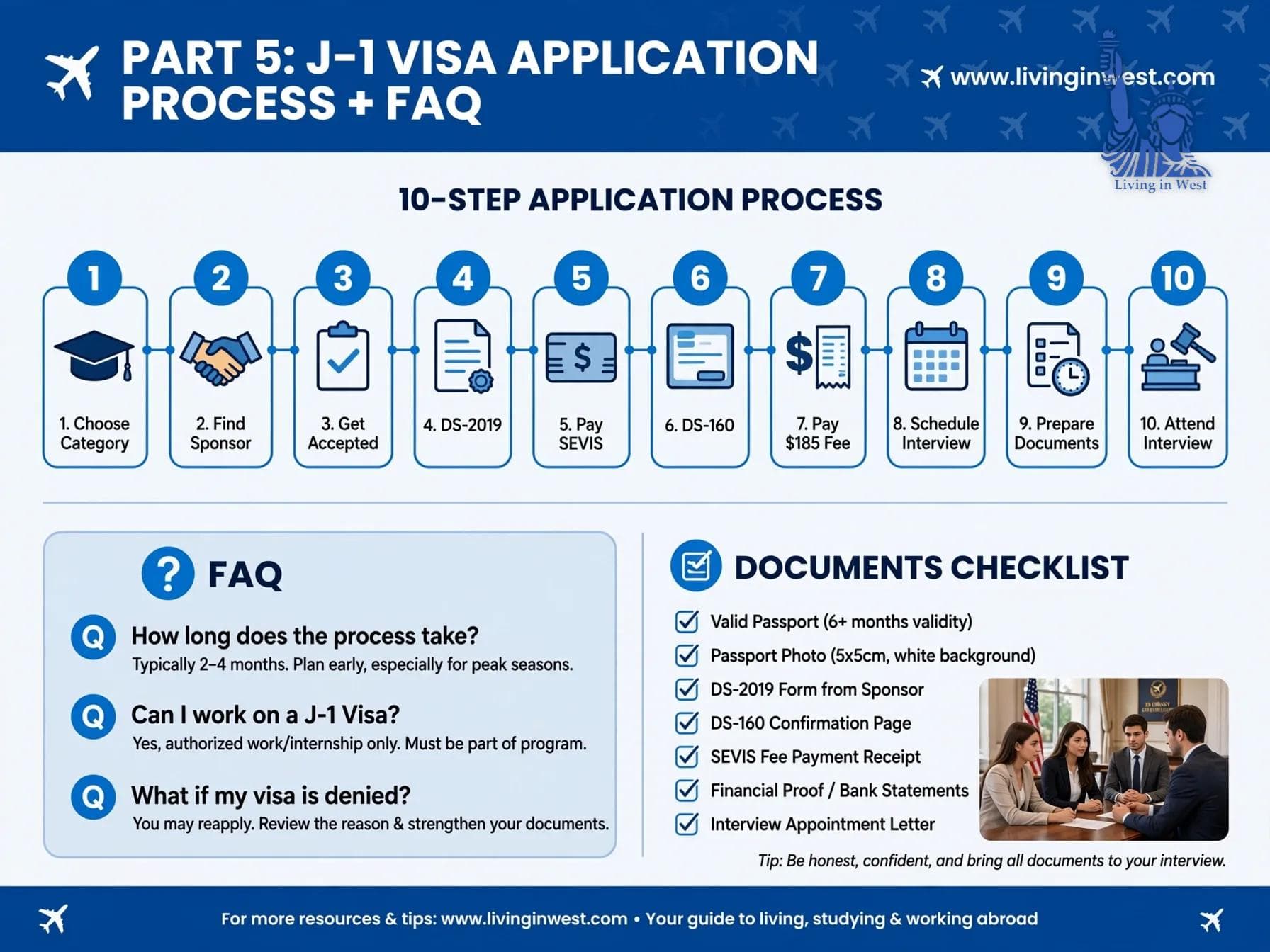
J-1 Visa Application — Step by Step
1. Choose Your J-1 Category
First determine whether you qualify as a student, researcher, intern, trainee, teacher, physician, au pair or another exchange category.
2. Find a Designated Sponsor
Apply through an organization authorized by the U.S. Department of State.
3. Get Accepted
The sponsor reviews your qualifications and program eligibility.
4. Receive DS-2019
After selection, the sponsor issues your Form DS-2019.
5. Pay SEVIS
Pay the applicable I-901 SEVIS fee unless your program is exempt or the sponsor has already paid it on your behalf.
6. Complete DS-160
Submit your online nonimmigrant visa application.
7. Pay the Visa Fee
The standard J visa application fee is currently $185, subject to applicable exemptions.
8. Schedule Your Interview
Follow the instructions of the U.S. embassy or consulate where you will apply.
9. Prepare Your Documents
Common documents can include:
- Valid passport
- DS-160 confirmation
- DS-2019
- SEVIS payment receipt, if applicable
- Program acceptance information
- Financial documents
- Academic/professional documents
- Evidence relevant to your visa application
The embassy may request additional documents.
10. Attend the Interview
The consular officer evaluates whether you qualify for the visa under U.S. immigration law.
Remember:
Being accepted by a J-1 sponsor does not guarantee visa approval.
Editorial Team