U.S. National Debt in 2026: How Did America Reach More Than $39 Trillion?
The United States is facing a growing debt challenge in 2026.
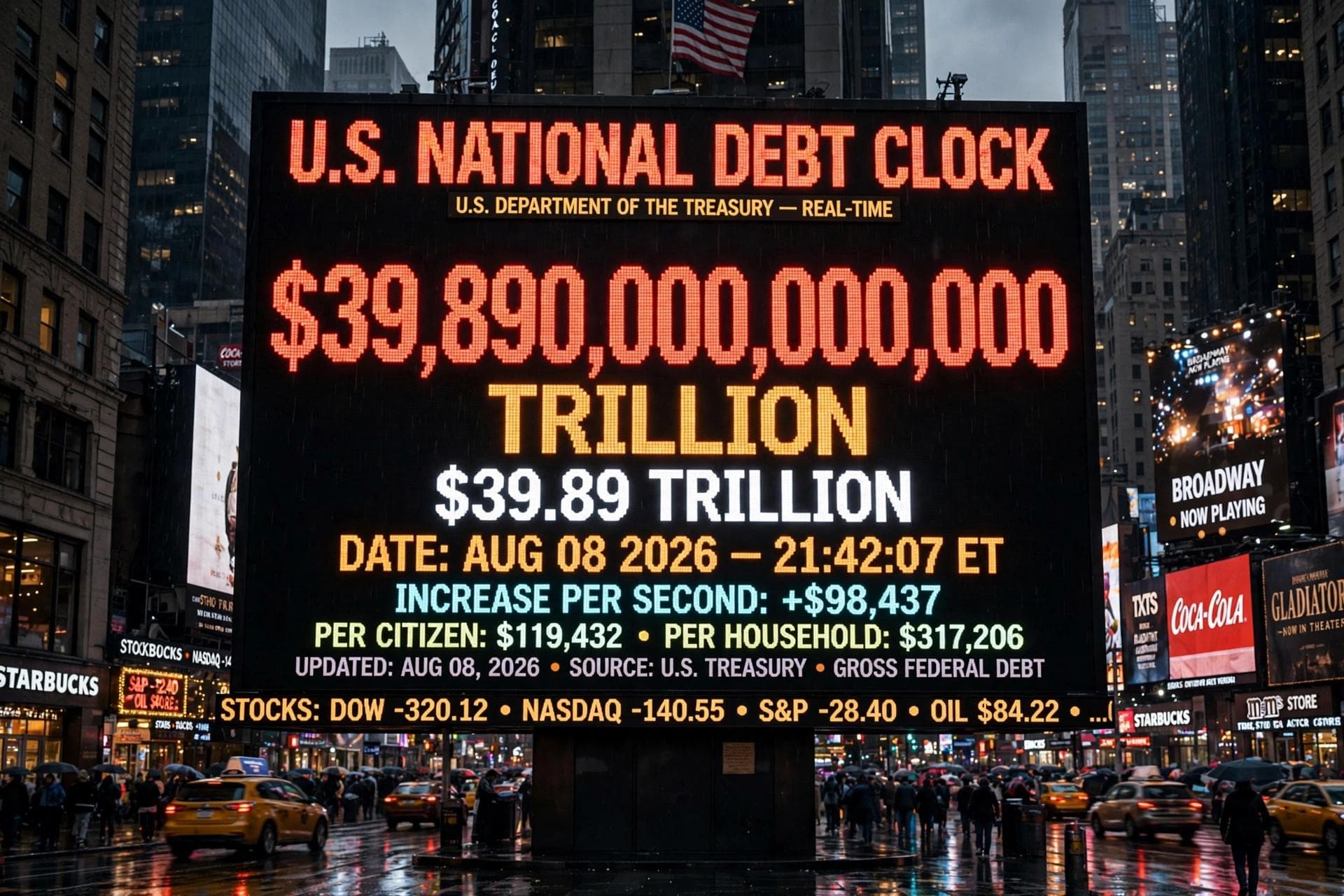
The country's gross federal debt passed the $39 trillion mark earlier this year, highlighting the scale of America's long-term borrowing problem. The Peter G. Peterson Foundation noted in March that U.S. national debt had reached $39 trillion and warned that, at the then-current pace, it could reach $40 trillion before the fall elections.
The bigger question is not simply how large the number has become. It is why the debt continues to rise and what the growing interest bill could mean for America's economy, taxpayers and future government spending.
The Congressional Budget Office (CBO) projects that the federal budget deficit will reach approximately $1.9 trillion in fiscal year 2026. CBO also projects that debt held by the public will rise from about 101% of GDP in 2026 to 120% by 2036 if current laws and policies broadly remain in place.
1. Why Does the U.S. Government Keep Borrowing?
The federal government spends more money than it collects in revenue.
When annual spending exceeds federal revenue, the government runs a budget deficit. Treasury finances those deficits primarily by issuing government debt.
According to the CBO's February 2026 outlook:
- Federal revenues are projected at about $5.6 trillion in fiscal 2026.
- Federal outlays are projected at about $7.4 trillion.
- The resulting deficit is projected at approximately $1.9 trillion.
This gap is one of the main reasons the national debt continues to increase.
Major Sources of Federal Spending
America's budget includes enormous spending commitments such as:
- Social Security
- Medicare
- Medicaid and other health programs
- National defense
- Veterans' programs
- Federal employee benefits
- Infrastructure and other government programs
- Interest on existing federal debt
CBO says that more than 80% of the projected increase in federal outlays in 2026 is attributable to growth in mandatory spending. Rising net interest costs are also adding to the pressure.
2. Interest on the Debt Is Becoming a Major Budget Problem
One of the biggest concerns is not only the amount borrowed, but the cost of servicing that debt.
CBO projects that net federal interest costs will reach approximately $1.0 trillion in fiscal year 2026, an increase of about $69 billion, or 7%, from 2025.
The Peterson Foundation also warned in March that annual interest costs were on track to reach a record $1 trillion.
This means the federal government has to devote a growing amount of money to interest payments rather than programs such as infrastructure, defense, healthcare or other priorities.
CBO projects that net interest costs could rise to $2.1 trillion by 2036 under its baseline assumptions.
3. How Much Debt Do American Households Have?
Government debt is only one part of America's debt story.
American households also carry a huge amount of debt.
According to the Federal Reserve Bank of New York, total U.S. household debt reached approximately $18.794 trillion at the end of the first quarter of 2026.
The largest component was mortgage debt.
Household Debt at the End of Q1 2026
Type of DebtBalance
Mortgage debt
$13.19 trillion
Credit card debt
$1.25 trillion
Auto loans
$1.69 trillion
Student loans
$1.66 trillion
HELOCs
$446 billion
Total household debt
$18.79 trillion
The New York Fed reported that total household debt increased by about $18 billion during Q1 2026, or 0.1%.
Credit-card balances actually declined by $25 billion during the quarter, while mortgage and auto-loan balances increased.

4. Is America's Debt Caused by Mortgages?
No.
This is an important distinction.
Mortgage debt is household debt, not federal government debt.
A homeowner borrowing $300,000 to purchase a house does not add $300,000 to the U.S. government's national debt.
The two systems are separate:
Federal debt:
Money borrowed by the U.S. government.
Household debt:
Money borrowed by consumers through mortgages, credit cards, auto loans, student loans and other forms of credit.
Both are important indicators of financial conditions, but they should not be combined into one debt figure.
5. Why Is the Federal Debt Growing?
There is no single cause.
America's debt has accumulated over decades because federal spending and revenues have repeatedly failed to balance over time.
Some of the major factors include:
Large Mandatory Programs
Social Security and Medicare are among the largest federal spending programs. An aging population increases pressure on these programs.
Healthcare Costs
Healthcare is another major component of federal spending.
However, it would be inaccurate to say healthcare costs are simply “10% more expensive every year.” Medical prices vary considerably by category and year.
For example, the Bureau of Labor Statistics reported that medical care services increased 2.9% over the 12 months through June 2026, while hospital services increased 5.1%.
Defense and Other Government Spending
National defense represents a major federal spending category, while other discretionary and mandatory programs also contribute to total expenditure.
Tax and Spending Decisions
Congress determines taxation and federal spending through legislation. When spending exceeds revenue, the Treasury must borrow to finance the resulting deficit.
6. What About Wars and Military Operations?
Wars and military operations can contribute to federal borrowing, but it would be misleading to attribute a specific increase in America's national debt entirely to one conflict without an official accounting of that conflict's incremental cost.
The original claim that the Iran war alone had increased U.S. debt by $406 billion in three months could not be verified from the official Treasury sources reviewed for this article.
Likewise, the claim that the Iran conflict had already cost the U.S. government more than $12 billion, attributed to the White House, should not be presented as a confirmed national-debt figure without a specific official budget document supporting it.
For a fact-checked article, it is safer to say that military operations can increase federal spending, but the overall debt is driven by a much broader combination of spending, revenue and interest costs.

7. How Much Does the U.S. Treasury Borrow?
Treasury borrowing requirements can change significantly from one quarter to another.
In May 2026, the U.S. Treasury estimated that it would borrow $189 billion in privately held net marketable debt during April–June 2026 and $671 billion during July–September 2026, assuming the cash-balance assumptions used in its forecast.
That means the earlier figure of $739 billion for Q3 2026 should be updated if you want to use the official May Treasury estimate.
Treasury had previously estimated $109 billion for April–June and $574 billion for January–March, but those estimates were subsequently revised.
8. Does Every American Owe the Same Amount?
No.
“Debt per American” is a useful way to understand the scale of federal debt, but it does not mean that every citizen receives a bill for that amount.
Per-person debt calculations simply divide a national debt figure by the population.
The actual financial burden is more complicated because federal debt is financed through Treasury securities held by individuals, financial institutions, pension funds, foreign investors, Federal Reserve-related accounts and government trust funds.
Therefore, a headline such as “Every American owes $116,000” should be presented as a debt-per-capita calculation, not as an individual personal liability.
9. What About Debt by State?
Another common misunderstanding is that every state has its own share of the U.S. national debt.
That is not how federal debt works.
The federal government borrows nationally. States separately issue their own debt and have their own budgets.
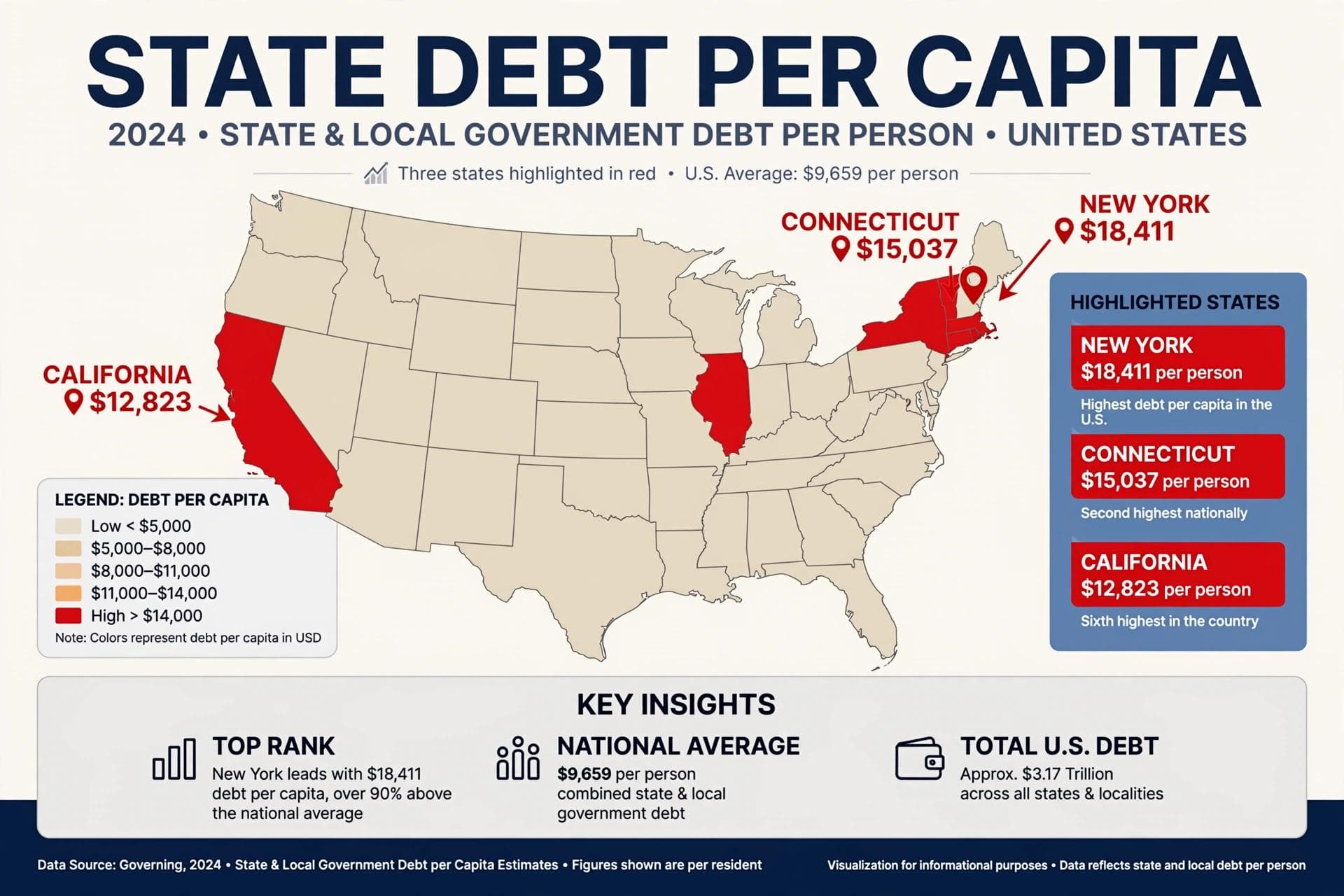
For example, California can have a large amount of state and local government debt because of its enormous population and economy, while New York and Connecticut can have high debt burdens relative to their populations or tax bases.
But these figures should not be presented as shares of the $39 trillion federal debt.
State debt, municipal debt and federal debt are different categories.
10. What Could Happen If the Debt Keeps Rising?
A high debt level does not automatically mean that the U.S. economy will collapse.
The United States issues the world's dominant reserve currency and has deep financial markets, which gives it significant borrowing capacity.
However, persistent deficits can create long-term risks.
Higher Interest Costs
As debt grows, more federal revenue may eventually be required to service it.
Less Budget Flexibility
A larger interest bill can leave policymakers with less money available for other priorities.
Higher Borrowing Costs
If investors demand higher interest rates to hold government debt, borrowing costs can rise for the government and potentially affect businesses and consumers.
Greater Pressure on Future Budgets
CBO projects that debt held by the public will continue rising relative to GDP over the coming decade under its baseline assumptions.
11. Could America Reduce Its Debt?
Yes—but reducing federal debt is politically and economically difficult.
The government has several broad options:
Option 1: Reduce Spending
Congress could reduce or slow spending growth.
However, major spending programs affect millions of Americans, making large cuts politically difficult.
Option 2: Increase Revenue
The government could increase tax revenue through higher tax rates, a broader tax base or other tax changes.
Option 3: Faster Economic Growth
A growing economy can increase tax revenue and make a given level of debt easier to manage relative to GDP.
Option 4: A Combination
In practice, economists often discuss combinations of spending reforms, revenue changes and policies designed to support economic growth.
12. What If the U.S. Reduced Its Debt by 50% in 10 Years?
This is a hypothetical scenario, not a government forecast.
If the United States somehow reduced its debt dramatically over a decade, the long-term benefits could include lower interest costs and greater flexibility in future federal budgets.
But it would not automatically mean:
- Mortgage rates would fall to exactly 4%.
- A $300,000 mortgage payment would automatically fall by $800.
- The dollar would immediately become stronger.
- Fitch would automatically restore the United States to AAA.
- The U.S. would suddenly have hundreds of billions of dollars available for new projects.
Those outcomes depend on many other factors, including Federal Reserve policy, inflation, Treasury yields, economic growth, global demand for dollars and the actions of credit-rating agencies.
13. Could Lower Debt Help American Families?
Potentially, over the long term.
If lower debt resulted in substantially lower interest costs, the federal government could have more room in its budget.
However, there is no simple formula saying that reducing national debt by a certain amount would automatically lower mortgage rates.
Mortgage rates are influenced by Treasury yields, Federal Reserve policy, inflation expectations, mortgage-market conditions and other factors.
Therefore, lower government debt could improve fiscal conditions without guaranteeing a particular mortgage rate.
14. What Could America's Debt Mean for the Rest of the World?
The U.S. economy and Treasury market are deeply connected to the global financial system.
A significant change in U.S. borrowing, interest rates or fiscal policy could affect:
- Global bond markets
- The U.S. dollar
- Emerging-market currencies
- International investment
- Commodity prices
- Trade
- Global interest rates
Countries such as Pakistan and India can be affected indirectly through changes in the dollar, global capital flows, interest rates and demand for goods and services.
However, claims that reducing U.S. debt would automatically generate $500 billion of additional investment in emerging markets or increase global GDP by exactly 2% by 2030 would be speculation without a specific economic model.
15. Is America Heading Toward a Debt Crisis?
The answer is more complicated than a simple yes or no.
The United States does face a serious long-term fiscal challenge, but that is not the same thing as saying the country is currently in a sovereign debt crisis.
The CBO's 2026 outlook shows that deficits remain historically large and that debt held by the public is projected to rise substantially over the next decade.
At the same time, the U.S. remains the world's largest economy and issues debt in its own currency.
The biggest concern is therefore the long-term trajectory: if deficits remain large for many years, interest costs can consume an increasing share of the federal budget.
16. The Historical Perspective
America has faced periods of extremely high debt before.
After World War II, federal debt held by the public reached approximately 106% of GDP in 1946.
CBO projects that debt held by the public will reach 120% of GDP by 2036, exceeding that historical postwar record.
The important lesson from history is that debt can fall relative to GDP when economic growth is strong, fiscal conditions improve, or government spending and revenues change.
But there is no guarantee that the United States will repeat the postwar experience.
Final Conclusion: Can America Escape Its Debt Problem?
America's national debt is a serious long-term challenge, but the situation is more complicated than simply saying that the country is “drowning in debt.”
The United States continues to borrow because federal spending is greater than federal revenue. At the same time, rising interest costs are making the problem more difficult.
The CBO projects a $1.9 trillion federal deficit in fiscal 2026, while net interest costs are expected to reach about $1 trillion.
American households also carry substantial debt, with total household debt reaching $18.79 trillion in Q1 2026, including $13.19 trillion in mortgages.
The United States does not have one simple solution.
Reducing the long-term debt burden would likely require some combination of economic growth, spending reforms, revenue changes and careful management of interest costs.
The real question for Washington is not whether America can borrow more—it clearly can.
The bigger question is how long the country can maintain large structural deficits before rising interest costs begin to significantly limit the government's choices.
For American families, investors and the rest of the world, that is the part of the U.S. debt story worth watching.

Editorial Team