Part 1: Why Do Earthquakes Happen — and Are Humans Making Them Worse?
An earthquake is one of nature's most powerful reminders that the ground beneath us is not actually still.
Deep below Earth's surface, huge tectonic plates are constantly moving. Most of the time, that movement is extremely slow. But where plates meet, rocks can become locked together while stress continues to build.
Eventually, the stress can overcome the strength of the rocks. A fault suddenly slips, releasing stored energy as seismic waves. That sudden release is what we experience as an earthquake.
Earthquakes can happen almost anywhere, but the biggest and most frequent events tend to occur near tectonic plate boundaries.
Are humans causing earthquakes?
This question needs a careful answer.
Most earthquakes are natural. However, scientists have documented earthquakes that are linked to certain human activities.
The U.S. Geological Survey says human-induced earthquakes have been associated with activities including:
- Large reservoirs
- Mining
- Withdrawal of fluids and gas
- Injection of fluids deep underground
- Some oil and gas operations
One important example is wastewater disposal. In parts of the central United States, the increase in seismic activity has been linked to wastewater injection into deep wells.
However, it would be misleading to say that human activity is responsible for the world's earthquake problem.
USGS research shows that most earthquakes remain naturally occurring events, while induced earthquakes are a separate hazard that can occur under particular geological and industrial conditions.
So the bigger picture is simple: humans can trigger some earthquakes, but we are not creating most of the world's earthquakes.
Part 2: Why Is the Pacific Ring of Fire So Dangerous?
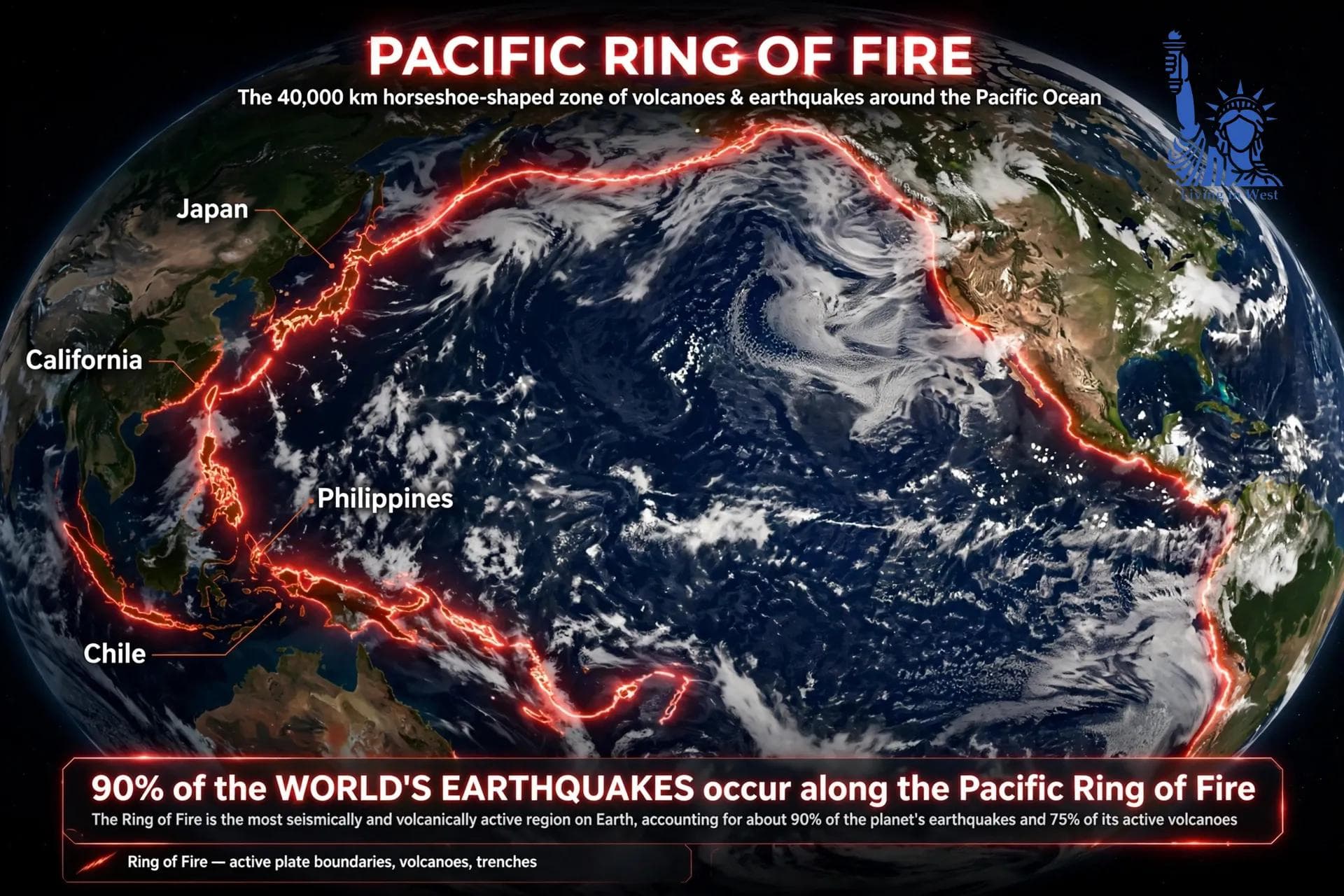
If you look at a world earthquake map, one region immediately stands out: the Pacific Ring of Fire.
The Ring of Fire is a horseshoe-shaped zone surrounding much of the Pacific Ocean. It contains numerous tectonic plate boundaries and subduction zones, where one tectonic plate can move beneath another.
According to the USGS, about 90% of the world's earthquakes occur in the Ring of Fire, making it the planet's most seismically active region.
Countries and regions around this zone include areas of:
- Japan
- Indonesia
- The Philippines
- New Zealand
- Alaska
- The western United States
- Mexico
- Central America
- Chile
- Peru
But the Ring of Fire is not the only earthquake zone.
Another important seismic region is the Alpide belt, which stretches from the Mediterranean region through Turkey, Iran and toward northern India. USGS estimates that this belt accounts for roughly 5–6% of earthquakes.
This is particularly important for South Asia because countries such as Pakistan, India and Afghanistan are located near active tectonic regions.
Does an increase in earthquakes mean a huge earthquake is coming?
Not necessarily.
This is one of the biggest misconceptions surrounding earthquakes.
USGS says temporary increases or decreases in earthquake activity are part of normal fluctuations and do not provide a reliable indication that a major earthquake is about to happen.
The world records many earthquakes that are too small for people to feel.
USGS estimates that its National Earthquake Information Center locates around 20,000 earthquakes worldwide each year, or approximately 55 per day.
That does not mean the planet has suddenly become more dangerous.
Better instruments and improved monitoring also mean that scientists can detect earthquakes that older systems would have missed.

Part 3: Can Animals Really Predict Earthquakes?
This is one of the most fascinating earthquake questions.
There have been reports for centuries of animals behaving strangely before earthquakes.
Dogs may become restless. Birds may suddenly move away. Snakes, fish and other animals have also appeared in historical reports.
But does that mean animals can predict earthquakes?
Science has not established a reliable animal-based earthquake prediction system.
The USGS says unusual animal behavior has been documented before some earthquakes, but researchers have not found a consistent and reproducible relationship that could be used to predict when an earthquake will occur.
There is, however, an interesting scientific explanation for some behavior that occurs seconds before humans feel shaking.
Earthquakes produce different seismic waves.
The faster P-waves arrive before the slower and generally more damaging S-waves and surface waves. Some animals may be sensitive enough to notice the first waves before humans do.
That is very different from predicting an earthquake hours or days in advance.
So if a dog suddenly becomes restless, it should not be treated as an earthquake alarm.
Part 4: Can Scientists Predict a Major Earthquake in 2026 or 2027?
This is where online rumors often become misleading.
You may see social media posts claiming that a particular country will experience a huge earthquake on a specific date.
There is currently no scientific method capable of making that kind of reliable prediction.
According to the USGS, a true earthquake prediction would need to specify three things:
- The exact date and time
- The location
- The magnitude
Scientists cannot currently provide all three accurately for a future major earthquake.
That means headlines such as “A magnitude 8 earthquake is guaranteed in 2026” should be treated very carefully unless supported by a recognized scientific authority.
Prediction is different from forecasting
This distinction is important.
Scientists can estimate the probability of earthquakes in particular regions over longer periods. They can also identify faults and areas where earthquake hazards are higher.
But probability is not the same as knowing exactly when an earthquake will strike.
USGS long-term records indicate that, since around 1900, the world has averaged roughly 16 major earthquakes of magnitude 7 or greater per year. But the number varies significantly from year to year. For example, 2010 had 23 magnitude 7+ earthquakes, while 1989 had only six.
So 2026 and 2027 cannot be given a reliable “major earthquake date” simply by looking at historical averages.
Part 5: What Happens When an Underwater Earthquake Creates a Tsunami?
Earthquakes are not only a land hazard.
Some of the world's most destructive earthquakes occur beneath the ocean.
But an underwater earthquake does not automatically create a tsunami.
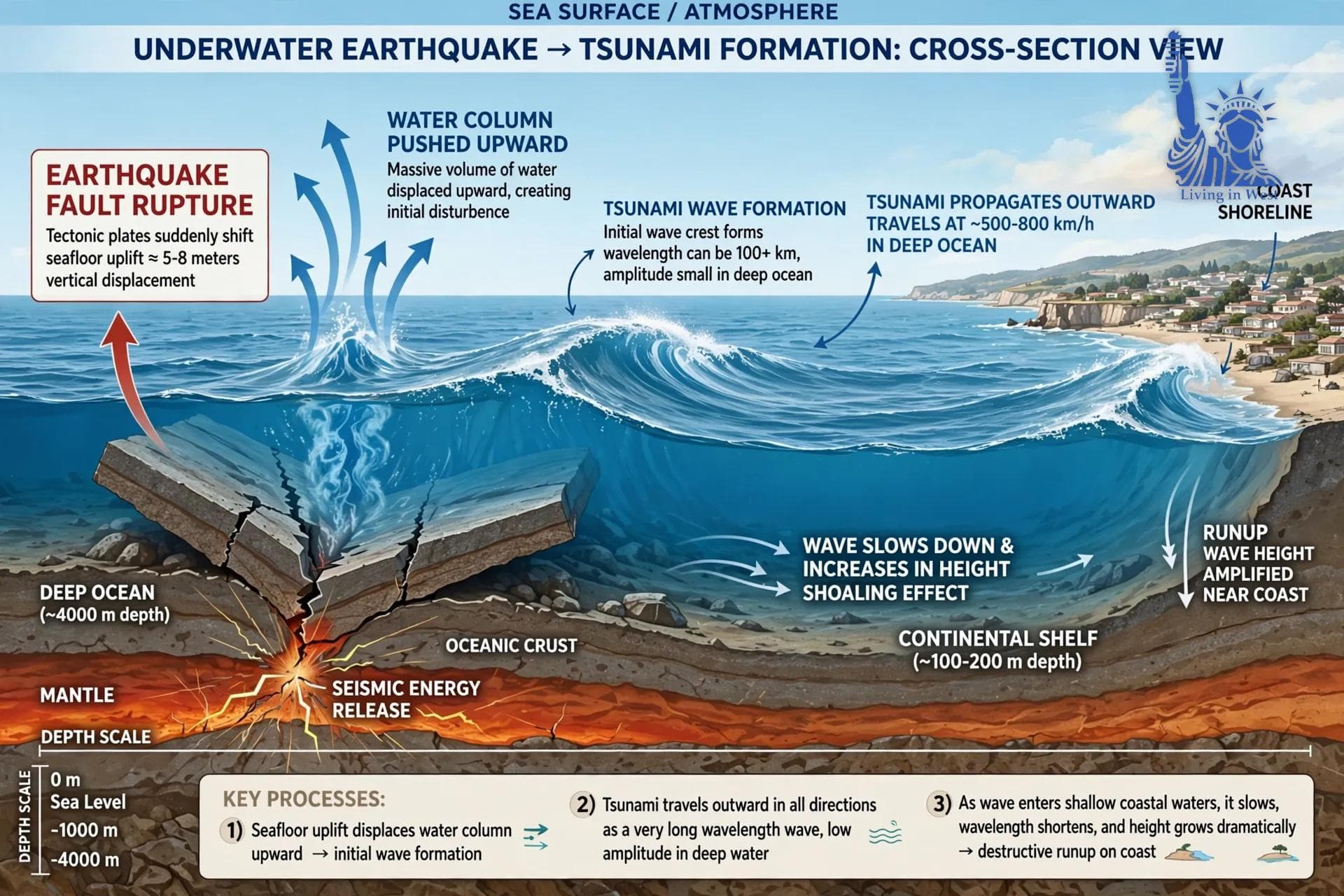
A tsunami is most likely when an earthquake or another disturbance causes a large and sudden displacement of the seafloor and the water above it.
According to NOAA, tsunamis can be generated by earthquakes, underwater landslides, volcanic eruptions and other large disturbances. Earthquakes are the most common cause.
The key factor is movement of the ocean floor.
If the seafloor suddenly moves vertically, it can push a huge column of water upward or downward. That energy then travels outward through the ocean.
In deep water, tsunami waves may be relatively low and difficult to notice. As they approach shallow coastal areas, their speed decreases and their height can increase dramatically.
This is why coastal communities near active earthquake zones need tsunami warning systems and evacuation plans.
A person near the coast should never wait for a dramatic “wall of water” to appear before reacting to an official tsunami warning.
Part 6: Can Technology Reduce Earthquake Damage?
Scientists cannot currently stop an earthquake.
They also cannot reliably tell us that a major earthquake will happen at a specific place and time next week or next year.
But technology can still save lives.
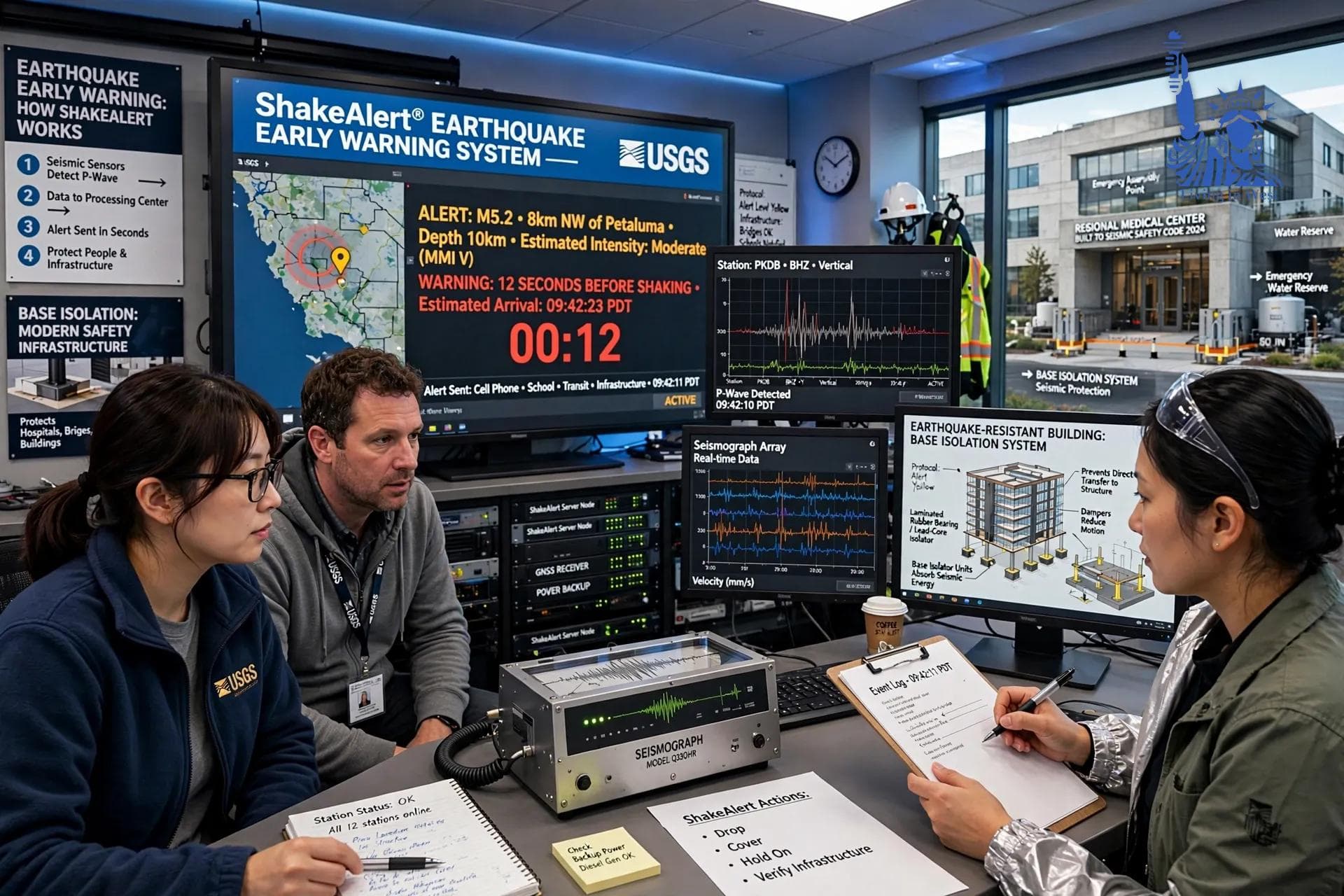
One of the most important developments is Earthquake Early Warning.
Systems such as the U.S. ShakeAlert network detect an earthquake after it has already started.
This sounds confusing, but the idea is simple.
An earthquake produces P-waves first. These waves travel faster than the more damaging S-waves and surface waves.
Sensors detect the early waves and rapidly send information to processing centers. If the earthquake meets the required criteria, an alert can be delivered before stronger shaking reaches some locations.
Depending on the distance from the earthquake, people may receive seconds to tens of seconds of warning.
That may not sound like much.
But a few seconds can be enough to:
- Drop, Cover and Hold On
- Stop a train
- Shut down industrial equipment
- Open firehouse doors
- Protect sensitive systems
- Move away from dangerous machinery
There is also an important limitation: areas very close to the earthquake's epicenter may have little or no warning because the strongest shaking can arrive before the alert has time to travel.
Buildings are just as important as technology
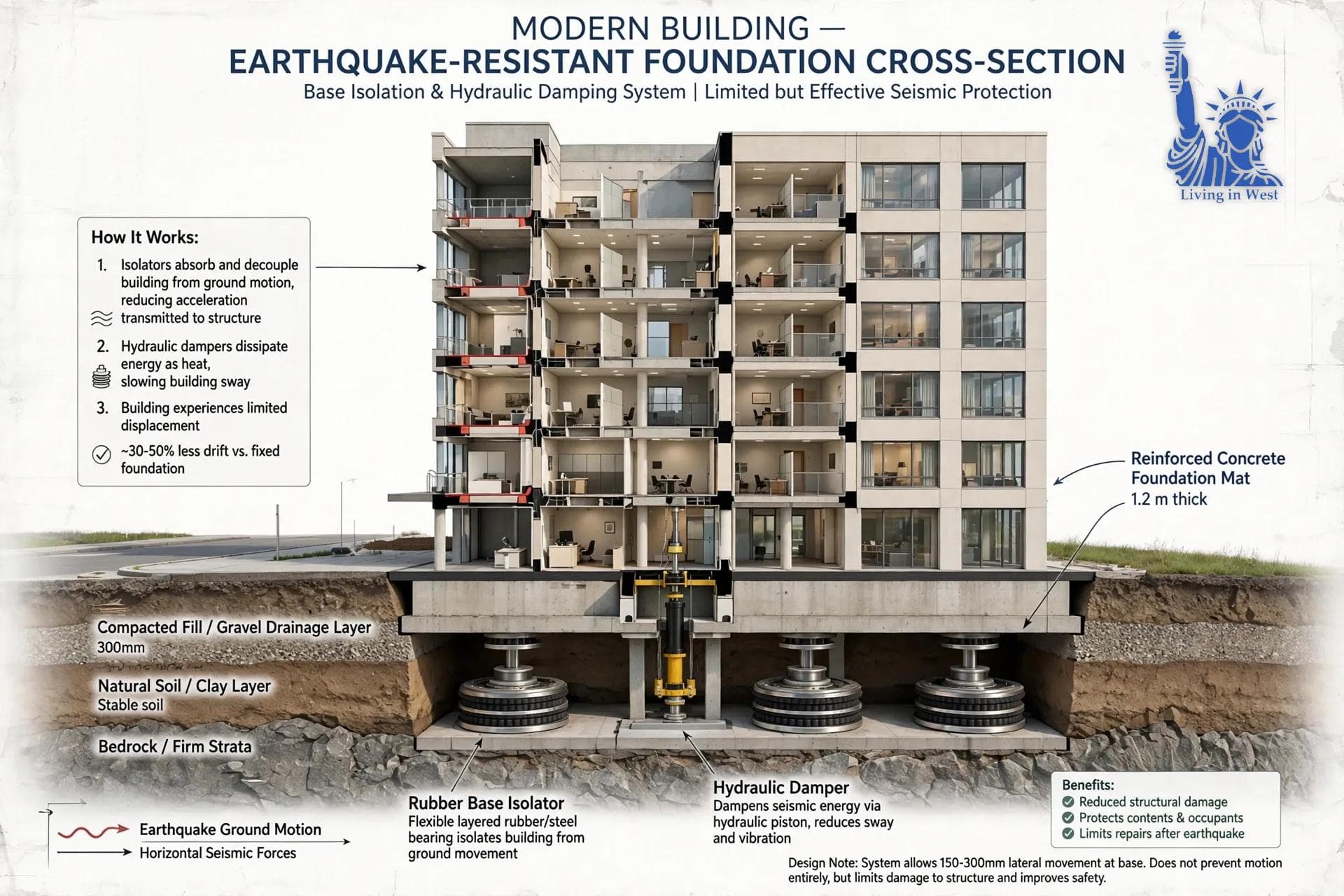
Early warning cannot prevent a building from collapsing.
That's why earthquake-resistant construction, stronger building codes, retrofitting older structures and public preparedness remain critical.
USGS emphasizes that while natural earthquakes cannot be prevented, their effects can be reduced through hazard identification, safer structures and earthquake education.
So, Will a Devastating Earthquake Happen in 2026–27?
The honest scientific answer is:
Nobody knows.
There is no verified scientific evidence that allows researchers to say a specific devastating earthquake will happen in 2026 or 2027.
At the same time, it would also be wrong to say there is no earthquake risk.
Earthquakes happen every day. Some regions have much higher long-term risk than others, particularly areas near active plate boundaries.
The sensible approach is therefore neither panic nor false reassurance.
Instead, people should understand their local earthquake risk, follow official warnings, know basic earthquake safety and make sure homes and workplaces are as safe as possible.
Nature cannot be controlled, but preparation can make a huge difference.
FAQ
Can scientists predict a major earthquake in 2026?
No. Scientists cannot currently predict the exact date, location and magnitude of a future major earthquake.
Are earthquakes increasing around the world?
Not necessarily. USGS says temporary increases and decreases are normal, and the growing number of recorded earthquakes is partly due to better instruments and monitoring.
Which region has the most earthquakes?
The Pacific Ring of Fire is the world's most seismically active region and accounts for about 90% of the world's earthquakes.
Can animals predict earthquakes?
There are many reports of unusual animal behavior, but there is no scientifically reliable animal-based earthquake prediction method.
Can humans cause earthquakes?
Some human activities can induce earthquakes, particularly certain forms of underground fluid injection, reservoir filling and mining. Most earthquakes, however, are natural.
Does every underwater earthquake cause a tsunami?
No. A tsunami generally requires a sufficiently large and sudden displacement of water, often caused by vertical movement of the seafloor.
Can earthquake early-warning systems predict earthquakes?
No. Early-warning systems detect an earthquake after it has started and may provide seconds of warning before stronger shaking arrives at some locations.
What should I do during an earthquake?
The basic advice is Drop, Cover and Hold On. Move away from windows and objects that could fall, and follow local emergency guidance.
Final Takeaway
Earthquakes are not becoming predictable simply because scientists have better technology.
What has changed is our ability to detect earthquakes, understand faults, estimate long-term risk, issue early warnings and build safer structures.
The idea of a guaranteed “megaquake in 2026–27” may attract attention online, but current science does not support such a prediction.
The better question is not “When will the next earthquake happen?”
It is:
“If a major earthquake happens, how prepared are we?”
That is a question science can actually help us answer.

Editorial Team