1. How Big Is Colorado and How Many People Live There?
Colorado covers about 103,637 square miles of land, making it the 8th-largest state in the United States by land area.
According to the U.S. Census Bureau, Colorado's estimated population reached 6,012,561 on July 1, 2025, taking the state above the six-million mark for the first time in the Census Bureau's estimate series. The state's 2020 Census population was 5,773,714.
Quick Colorado Facts
- State: Colorado
- Nickname: The Centennial State
- Capital: Denver
- 2025 population estimate: 6,012,561
- Land area: 103,637 square miles
- Statehood: August 1, 1876
- State number: 38th
- Highest point: Mount Elbert, 14,433 feet
- Fourteeners: 58
- Time zone: Mountain Time
Colorado's population growth has been significant over the long term. Between the 2010 and 2020 censuses, the state's population increased from about 5.03 million to 5.77 million.
2. Denver: Colorado's Capital and the "Mile High City"
Denver is Colorado's capital and largest city.
It is widely known as the “Mile High City” because a reference point at the Colorado State Capitol is exactly 5,280 feet above sea level—one mile high.
Denver sits on the High Plains just east of the Rocky Mountain foothills rather than directly inside the mountains. From the city, visitors can see the Front Range and reach major mountain destinations by car.
Denver is also Colorado's main transportation and business hub, making it a common starting point for visitors exploring the state.
3. Which States Border Colorado?
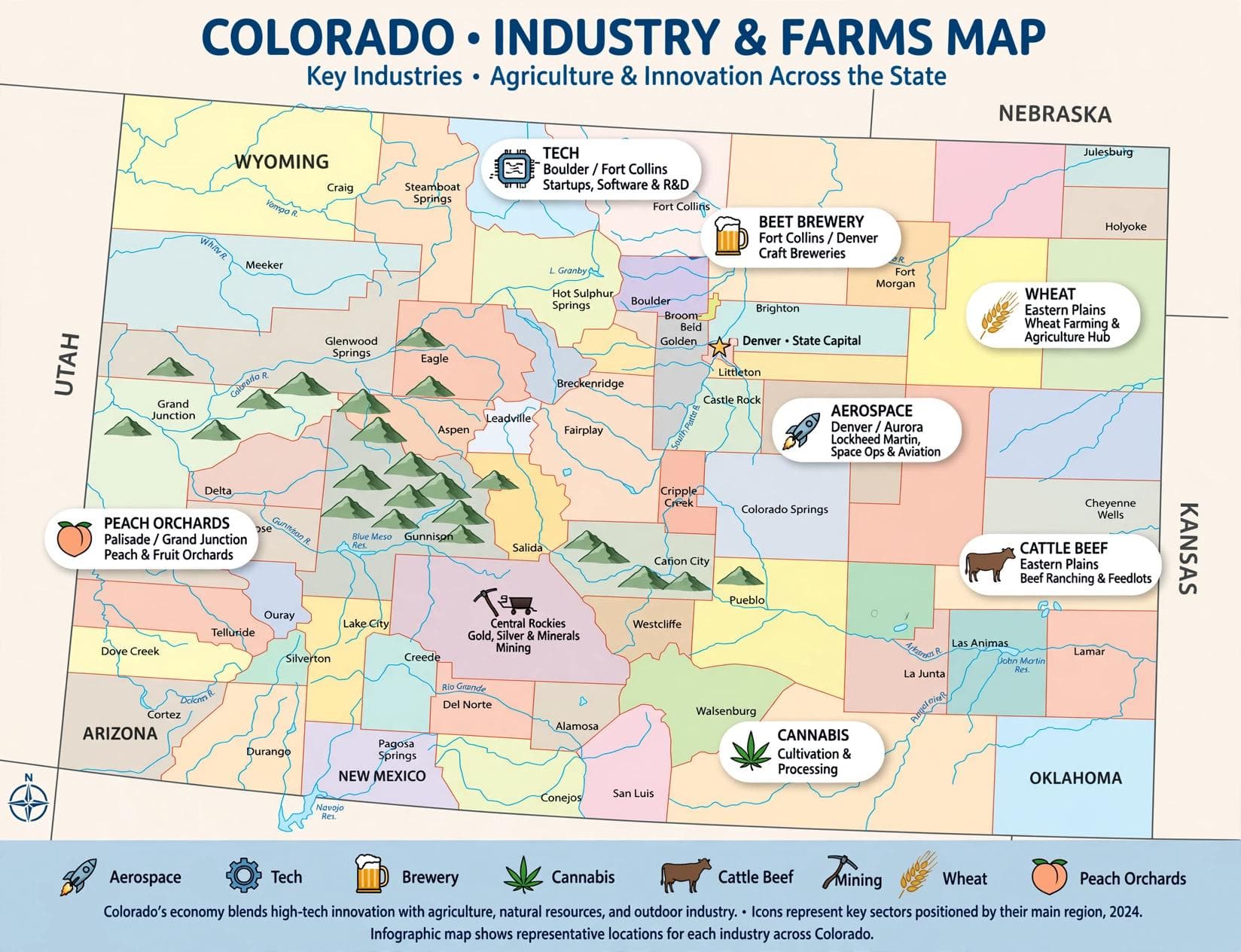
Colorado shares borders with seven states, giving it one of the most distinctive locations in the American West.
Its neighbors are:
- Wyoming — north
- Nebraska — northeast
- Kansas — east
- Oklahoma — southeast
- New Mexico — south
- Utah — west
- Arizona — southwest
Colorado, Arizona, New Mexico and Utah meet at the famous Four Corners, the only place in the United States where four state boundaries meet at a single point. The surrounding Four Corners region is part of the broader Colorado Plateau.
4. Colorado's Economy and Major Industries
Colorado's economy is much more than tourism and skiing.
The state has major industries in technology, aerospace, defense, healthcare, energy, agriculture, manufacturing, outdoor recreation and professional services.
Colorado's nominal GDP reached approximately $584.3 billion in 2025, according to data sourced from the U.S. Bureau of Economic Analysis. Its real GDP was approximately $458.1 billion, adjusted for inflation.
Aerospace and Space Technology
Aerospace and defense are among Colorado's most important high-tech industries.
The state has more than 2,000 aerospace companies, according to Colorado economic-development officials, and Colorado Springs is a major center for military and space-related activity. The state also hosts a large share of the U.S. Space Force presence.
Major companies and organizations with significant operations in the state include companies such as Lockheed Martin and Boeing, along with military and space installations.
Rather than saying NASA has a major headquarters in Denver, it is more accurate to describe Colorado as a major aerospace, defense and space-technology hub.
Agriculture
Colorado has a major agricultural sector.
Important products include:
- Cattle and beef
- Hay
- Wheat
- Corn
- Dairy products
- Fruits and vegetables
The western part of the state is particularly known for fruit production, including Palisade peaches.
Energy and Mining
Colorado has a long history of mining.
Gold and silver played a major role in the state's early development, particularly during the Colorado Gold Rush.
Today, Colorado continues to produce energy and minerals, including oil, natural gas and molybdenum.
Cannabis Industry
Colorado was one of the first U.S. states to establish a legal recreational marijuana market.
The industry remains economically significant, although it is no longer accurate to describe it simply as a continuously growing “billion-dollar boom.”
Colorado's Department of Revenue reported $1.2069 billion in regulated marijuana sales in 2025, with $236.4 million in state tax and fee revenue. The state has collected more than $3.1 billion in marijuana tax revenue since 2014.
5. Colorado's Most Famous Natural Attractions
Colorado's biggest attraction is its landscape.
The state has the Rocky Mountains, alpine lakes, forests, canyons, deserts and high-elevation plains.
Colorado's 58 Fourteeners
Colorado has 58 mountain peaks above 14,000 feet, more than any other U.S. state. These mountains are commonly called “Fourteeners.”
Some of the best known include:
- Mount Elbert
- Pikes Peak
- Longs Peak
- Mount Blue Sky
- Mount Bierstadt
Mount Elbert is Colorado's highest point at 14,433 feet.
Mount Blue Sky Scenic Byway
One of Colorado's most spectacular drives is the Mount Blue Sky Scenic Byway, formerly known as the Mount Evans Scenic Byway.
It reaches approximately 14,130 feet and is recognized by the U.S. Forest Service as the highest paved road in North America.
Because the road is at extreme elevation and operates seasonally, visitors should check current road conditions and opening dates before planning a trip.
Rocky Mountain National Park
Rocky Mountain National Park is one of America's most famous national parks.
Established on January 26, 1915, the park covers more than 265,000 acres and contains mountain peaks, alpine tundra, forests, lakes and wildlife.
The park's Longs Peak rises to approximately 14,259 feet, and the Continental Divide runs through the park.
Garden of the Gods
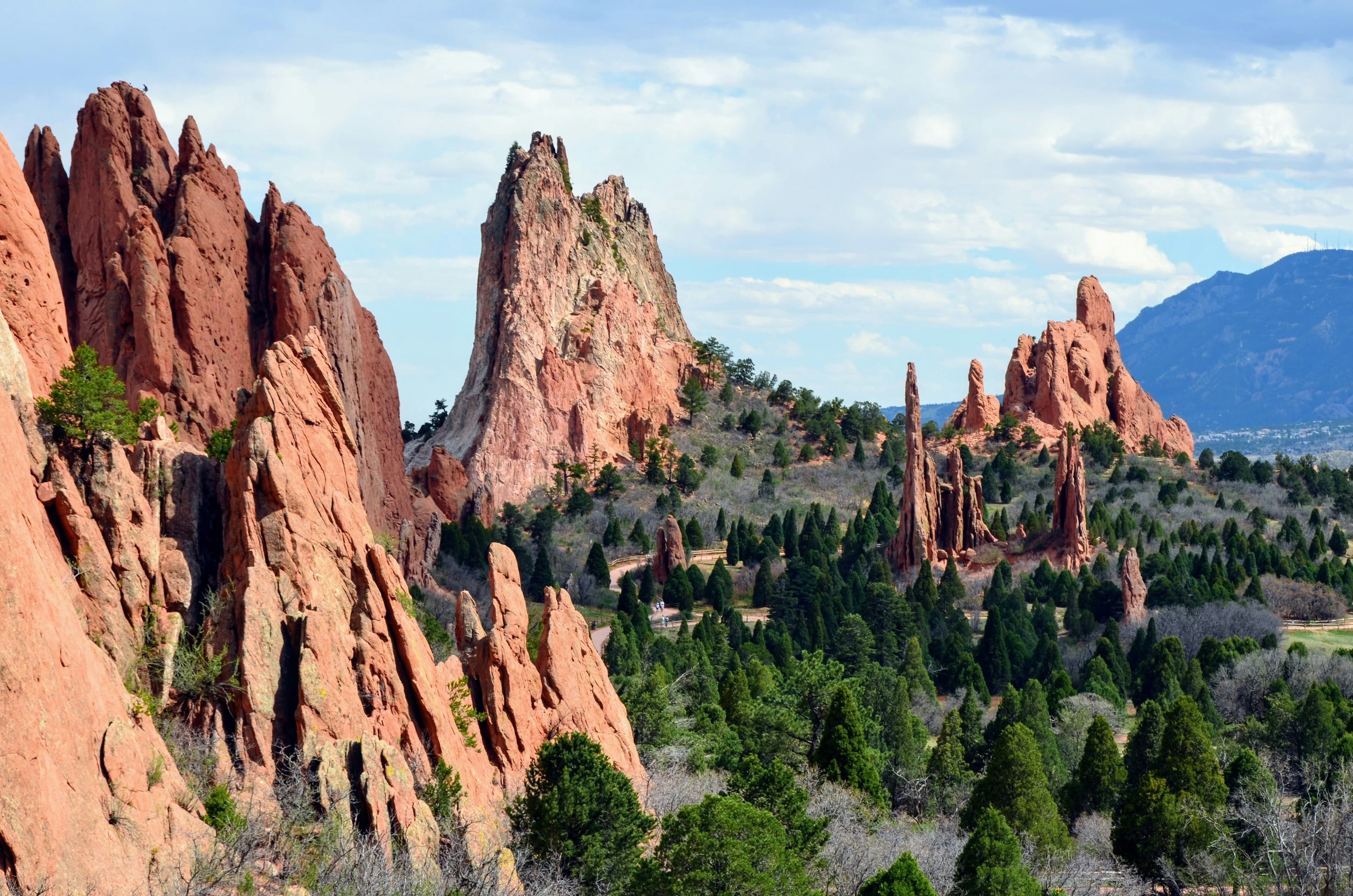
Located in Colorado Springs, Garden of the Gods is famous for its dramatic red-rock formations and views of Pikes Peak.
One of its biggest attractions for travelers is that admission to the park is free.
Aspen and Vail
Aspen and Vail are among Colorado's best-known mountain resort destinations.
They are particularly popular for:
- Skiing
- Snowboarding
- Luxury hotels
- Fine dining
- Summer hiking
- Mountain biking
These destinations can be significantly more expensive than many other parts of Colorado.
6. Colorado's History
Colorado's history goes back thousands of years before European-American settlement.
Indigenous peoples, including the Ute, Cheyenne and Arapaho, have deep historical and cultural connections to the region.
1858–1859: Gold Rush
The discovery of gold near present-day Denver helped trigger the Pikes Peak Gold Rush.
Thousands of people traveled west in search of gold, accelerating settlement and economic development.
1861: Colorado Territory
Colorado Territory was established in 1861, with boundaries that largely correspond to the state's modern borders.
1876: Statehood
Colorado became the 38th state on August 1, 1876.
Because statehood came 100 years after the Declaration of Independence, Colorado became known as the Centennial State.
1915: Rocky Mountain National Park
Rocky Mountain National Park was established in 1915, becoming an important part of Colorado's tourism and conservation identity
7. Taxes in Colorado
Colorado has a relatively straightforward state tax structure, but the actual amount residents pay can vary depending on location.
State Income Tax
Colorado's individual income tax rate is currently 4.40%.
Sales Tax
Colorado's state sales tax rate is 2.9%.
However, consumers can also pay local city, county and special-district taxes. As a result, the final sales-tax rate at the checkout can be considerably higher than the 2.9% state rate.
This is why it would be misleading to describe Colorado simply as a “2.9% sales-tax state” when discussing what consumers actually pay.
8. Cost of Living in Colorado
Colorado is generally considered a relatively expensive state, particularly in popular mountain communities and parts of the Denver metropolitan area.
Housing is one of the biggest factors behind the state's high living costs.
Denver
Denver has a much higher housing cost than many smaller Colorado communities.
Boulder
Boulder is also among the state's expensive housing markets and is known for its strong technology, university and outdoor-recreation economy.
Colorado Springs
Colorado Springs can offer lower housing costs than Denver in many circumstances, although prices vary considerably by neighborhood and market conditions.
Pueblo
Pueblo is generally considered one of the more affordable larger cities in Colorado compared with Denver and Boulder.
Instead of claiming that Colorado is exactly “12–15% more expensive” or that Pueblo is exactly “12% cheaper,” it is better to compare specific housing, transportation and utility data because cost-of-living measurements vary by source and change over time.
9. Visiting Colorado: Best Time to Go
The best time to visit depends on what you want to do.
December to March: Ski Season
Winter is ideal for skiing and snowboarding.
Popular destinations include:
- Aspen
- Vail
- Breckenridge
- Keystone
- Steamboat Springs
- Winter Park
Mountain roads can be snowy and icy, so travelers should check weather and road conditions before driving.
June to October: Hiking and Road Trips
Summer and early fall are excellent for hiking, sightseeing, camping and mountain road trips.
However, some high-elevation roads and trails can remain affected by snow well into the summer.
10. What Are the Best Places to Visit?
Denver
- Downtown Denver
- Denver Art Museum
- Union Station
- Red Rocks Park and Amphitheatre
- Denver Botanic Gardens
Colorado Springs
- Garden of the Gods
- Pikes Peak
- U.S. Olympic & Paralympic Museum
- Cheyenne Mountain
Rocky Mountain National Park
Ideal for:
- Hiking
- Wildlife viewing
- Scenic drives
- Photography
- Alpine landscapes
Aspen
Best known for:
- Ski resorts
- Luxury travel
- Mountain scenery
- Summer hiking
Vail
A major resort destination known for skiing, mountain villages and upscale tourism.
Maroon Bells
Located near Aspen, Maroon Bells is one of Colorado's most photographed mountain landscapes.
Because of its popularity, access can be subject to seasonal transportation and reservation rules, so visitors should check the latest official information before going.
11. How Much Does a One-Week Colorado Trip Cost?
The actual cost depends heavily on the season, city and type of accommodation.
A rough planning budget for one person might look like this:
Travel StyleApproximate 7-Day Budget
Budget
$1,200–$1,600
Mid-range
$2,200–$3,200
Luxury
$5,000+
These figures are planning estimates rather than fixed prices.
A trip based in Denver with public transportation and free outdoor attractions can cost much less than a ski vacation in Aspen or Vail.
Car rental is useful for many mountain destinations, but it is not always necessary if you are staying mainly in Denver or another major city.
13. Colorado's Importance to the American West
Colorado plays an important role beyond tourism.
Water
Colorado contains the headwaters of the Colorado River, one of the most important water systems in the American Southwest.
The Colorado River Basin serves roughly 40 million people, supports agriculture and provides water to communities far beyond Colorado.
The river's water is shared and managed through a complex system involving multiple states, federal agencies, interstate agreements and other legal arrangements.
Aerospace and Defense
Colorado has a major role in America's aerospace and defense industries.
Colorado Springs is particularly important because of its military and space-related installations. State economic officials say Colorado has more than 2,000 aerospace companies.
Tourism
Tourism is another major economic engine.
Colorado recorded a record 96.8 million travelers in 2025, generating approximately $29.2 billion in visitor spending, according to the Colorado Tourism Office's latest figures.
The tourism economy supports hotels, restaurants, transportation, ski resorts, outdoor businesses and communities across both urban and rural Colorado.
14. What Makes Colorado Different?
Colorado stands out because several very different environments exist within one state.
You can experience:
- A major city in Denver
- Red-rock landscapes around Colorado Springs
- Alpine mountains in the Rockies
- High-end ski resorts in Aspen and Vail
- Desert-like landscapes in southwestern Colorado
- National parks and forests
- Historic mining towns
- Agricultural communities
- Major aerospace and defense operations
That combination makes Colorado attractive to both travelers and people considering a move to the American West.
Final Thoughts
Colorado is much more than a destination for skiing.
It is a state with a population of more than 6 million people, a $584 billion-plus nominal economy, a major aerospace and defense sector, a nationally important water system, a large tourism industry and some of the most recognizable mountain landscapes in the United States.
For visitors, the state offers an unusual combination of city life, outdoor adventure, wildlife, history and luxury resorts.
For people considering moving to Colorado, the biggest factors to research are housing costs, taxes, employment opportunities, transportation and the large differences between communities.
Whether you are looking for a mountain vacation, a new place to live or simply want to explore the American West, Colorado deserves a place near the top of the list.

Editorial Team