PART 1: Premium Lifestyle in Wisconsin — Lakes, Resorts, Culture & Outdoor Living
Wisconsin's premium lifestyle is closely connected to its lakes, waterfront communities, resorts, golf courses, restaurants and four-season outdoor recreation.
Unlike states where luxury living is concentrated in one major metropolitan area, Wisconsin offers several different types of higher-end lifestyle destinations.
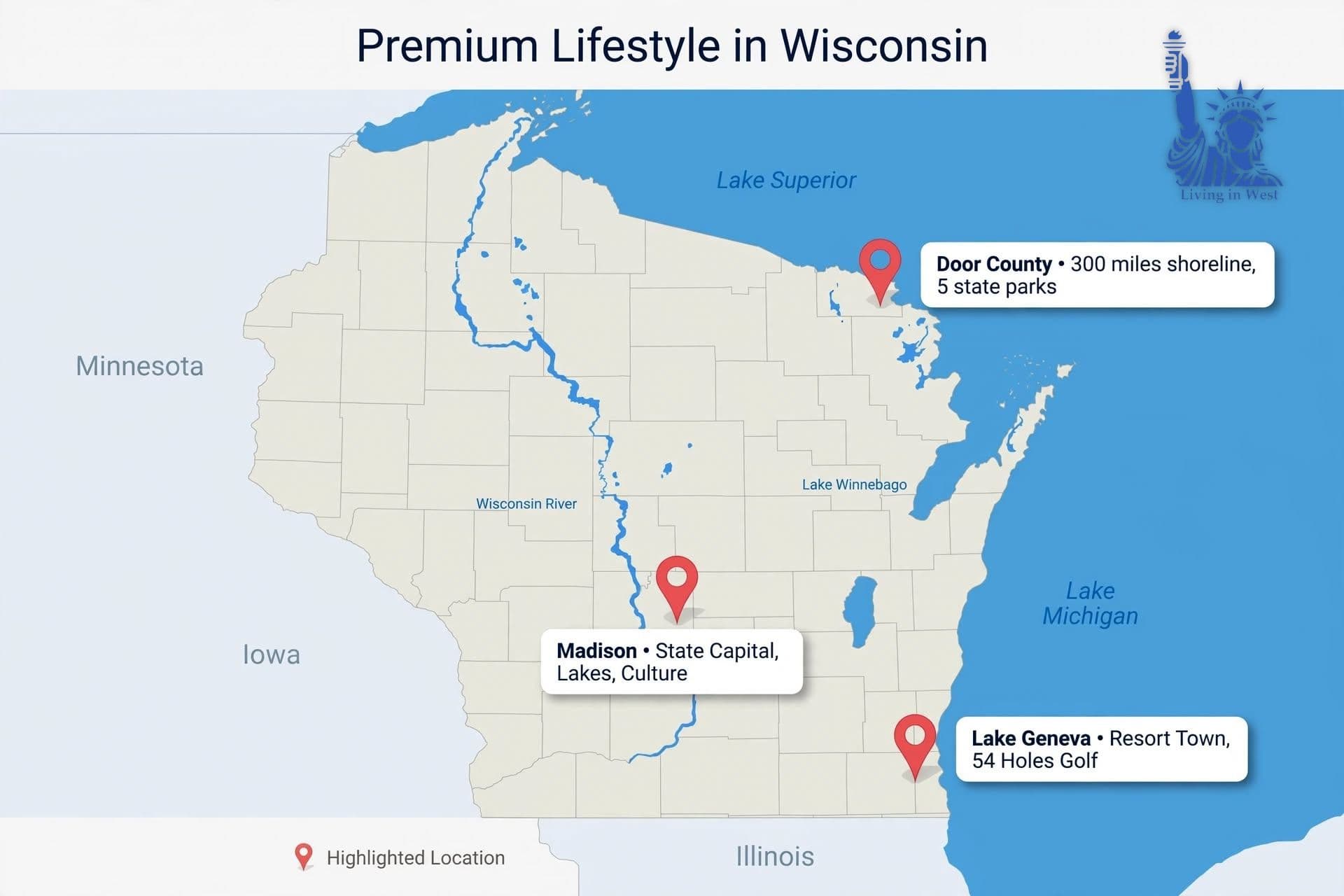
Door County
Door County is one of Wisconsin's best-known destinations for waterfront recreation and leisure.
The county has approximately 300 miles of shoreline and five state parks, including Peninsula State Park, Newport State Park, Potawatomi State Park, Rock Island State Park and Whitefish Dunes State Park. Destination Door County's current parks information lists 19 county parks as well.
The region combines waterfront communities with hiking, boating, beaches, galleries, restaurants, wineries and seasonal activities.
For someone looking for a second-home or vacation-oriented lifestyle, Door County provides a very different environment from Madison or Milwaukee.
Lake Geneva
Lake Geneva is another well-known upscale leisure destination in southern Wisconsin.
The area has resorts, golf, spas, restaurants and lake activities. Geneva National, for example, has 54 holes of golf associated with Arnold Palmer, Gary Player and Lee Trevino.
This makes the Lake Geneva area particularly relevant for people interested in resort-style living, recreation and weekend or second-home use.
Madison
Madison offers a more urban and professional version of Wisconsin's premium lifestyle.
The city combines lakes, restaurants, cultural attractions, university life, professional employment and outdoor recreation.
For people who want access to education, healthcare, technology, research and government while still having lakes and recreational areas nearby, Madison provides a different lifestyle from resort communities such as Door County or Lake Geneva.
PART 2: Wisconsin Housing in 2026 — Home Prices, Rentals & Taxes
Housing affordability is one of the biggest reasons people consider Wisconsin, but prices vary substantially by city.
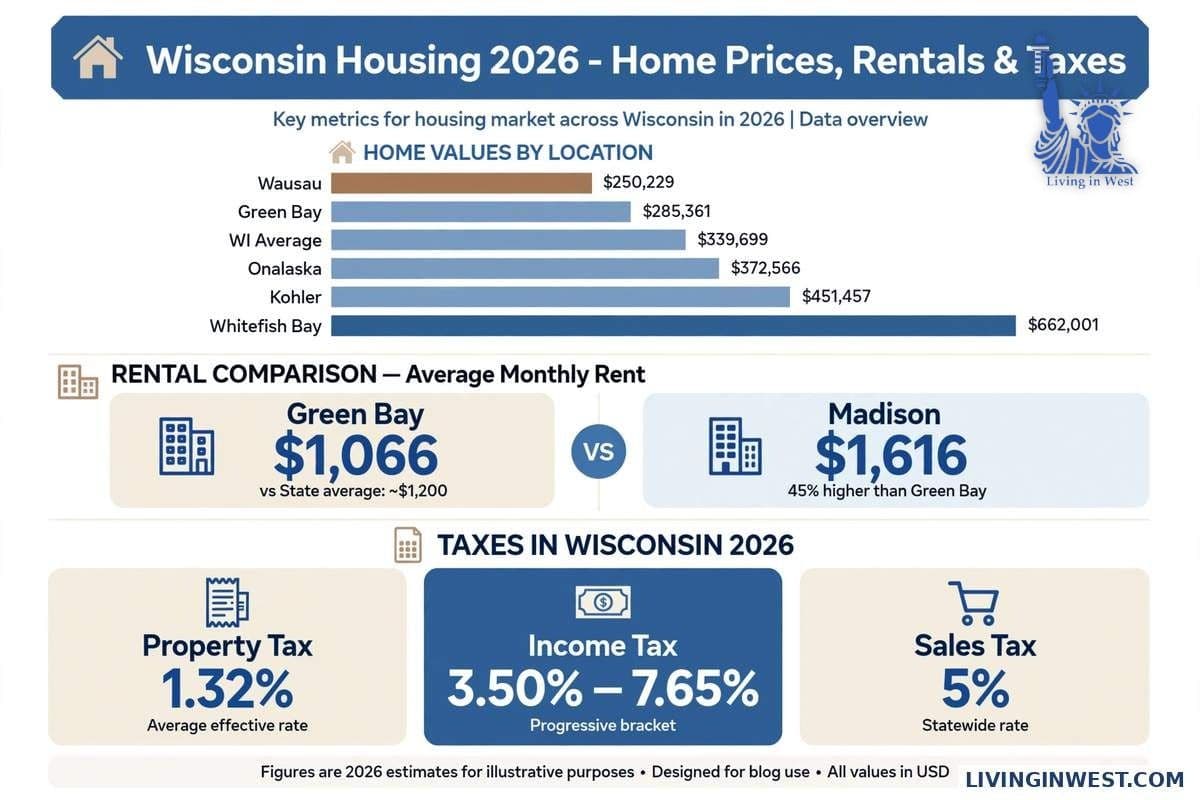
According to Zillow, the typical Wisconsin home value was approximately $339,699 as of August 31, 2026, up 5.1% over the previous year. Zillow's statewide data also showed a median sale price of approximately $330,000 for July 2026.
The important point is that the statewide number does not represent every Wisconsin community.
Green Bay
Green Bay's typical home value was approximately $285,361 as of August 31, 2026, up 5.4% year over year.
Zillow reported a median sale price of about $275,400 for July 2026. Average rent was approximately $1,066 in August.
This makes Green Bay considerably less expensive than some of Wisconsin's higher-value communities.
Madison
Madison's typical home value was approximately $426,336 as of August 31, 2026, up 2.5% year over year.
The median sale price was about $428,550 in July, while Zillow reported average rent of approximately $1,616 in August 2026.
Madison therefore has a higher housing cost than Green Bay, although the city also has a large university, professional workforce and employment base.
Whitefish Bay
Whitefish Bay represents the higher end of Wisconsin's residential housing market.
Zillow reported a typical home value of approximately $662,001 as of August 31, 2026, up 6% over the previous year.
Kohler
Kohler is another higher-value community with a strong connection to hospitality, design and resort-oriented living.
Its Zillow typical home value was approximately $451,457 based on July 2026 data.
Onalaska
Onalaska's typical home value was approximately $372,566 based on July 2026 Zillow data.
Because Zillow's latest available month differs by community, these figures should be treated as the latest available 2026 data rather than as a single identical monthly snapshot.
Wausau
Wausau remains one of the lower-cost markets among the Wisconsin communities discussed in this guide.
Its typical home value was approximately $250,229 as of August 2026.
The area also offers access to outdoor recreation and Granite Peak.
Property Taxes
Home buyers should look beyond the purchase price.
Wisconsin has relatively high property taxes compared with many other states. Tax Foundation's latest state comparison puts Wisconsin's effective property tax rate for owner-occupied housing at approximately 1.32%, based on 2024 property-tax data.
Property taxes can vary considerably between municipalities, so buyers should check the actual tax bill for a property before purchasing.
Wisconsin Income & Sales Taxes
Wisconsin's individual income tax rates range from 3.50% to 7.65%, depending on taxable income and filing status.
The state sales tax rate is 5%, with additional local taxes applying in some circumstances.
For someone planning a permanent move, these taxes should be included in the household budget alongside mortgage or rent, insurance, utilities and property taxes.
PART 3: Business & Jobs — Wisconsin's Economic Base
Wisconsin has a diversified economy built around manufacturing, healthcare, agriculture, food production, logistics, education, technology and research.
The state's major economic centers serve different industries.
Madison
Madison has strong connections to government, higher education, healthcare, research, technology and biotechnology.
The University of Wisconsin–Madison is also an important part of the city's research and employment ecosystem.
Milwaukee
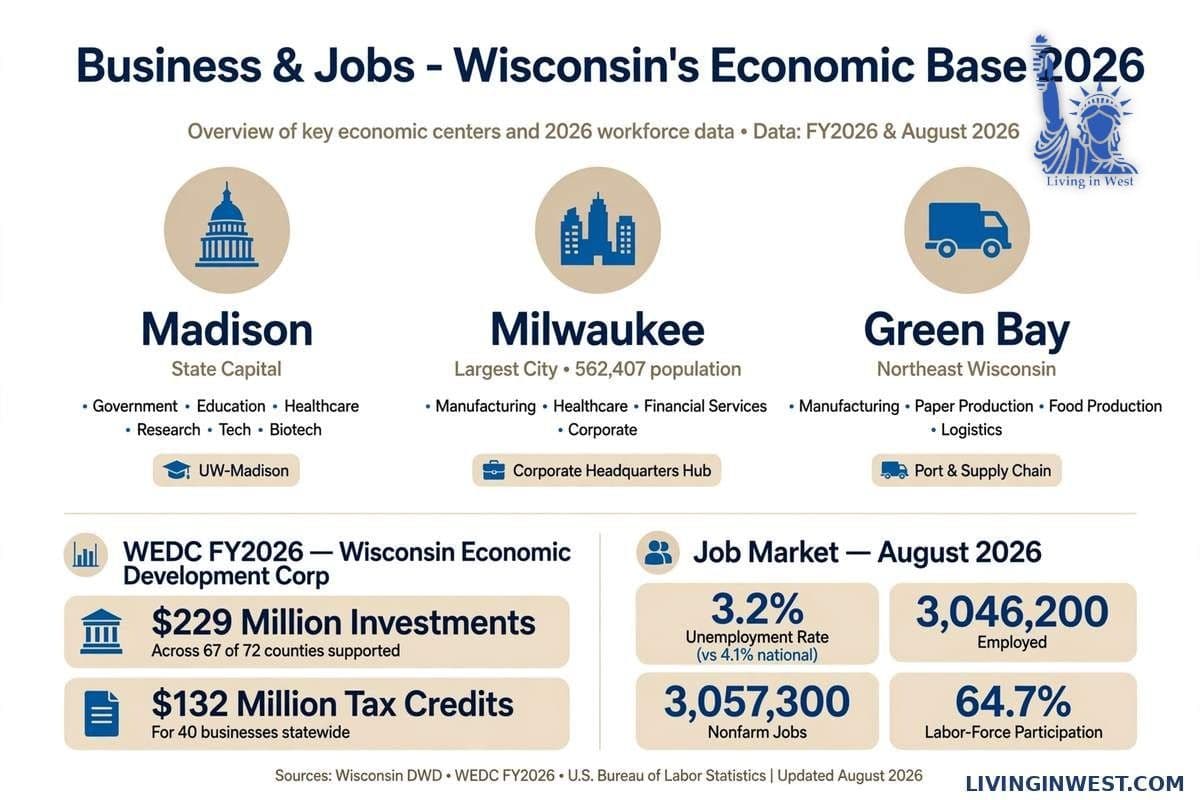
Milwaukee is Wisconsin's largest city, with an estimated population of 562,407 on July 1, 2025, according to the U.S. Census Bureau.
The city has a much larger urban environment than Green Bay or Wausau and includes manufacturing, healthcare, financial services, professional services, corporate activity and entrepreneurship.
Green Bay
Green Bay has a strong regional economy connected to manufacturing, paper production, food production, logistics and business services.
Its smaller-city environment also makes it different from Milwaukee.
WEDC Business Support
The Wisconsin Economic Development Corporation provides programs designed to support business startups, expansions and relocations.
One of its programs, the Business Development Tax Credit, can provide refundable tax credits to qualifying businesses for eligible expansion or relocation projects.
FY2026 WEDC Investment
WEDC's preliminary FY2026 figures, covering the fiscal year that ended June 30, 2026, reported approximately $229 million in investments across 67 of Wisconsin's 72 counties.
WEDC also reported assisting 40 businesses moving to or expanding in Wisconsin through more than $132 million in authorized performance-based Enterprise Zone and Business Development Tax Credits.
This is important because these figures are explicitly identified by WEDC as preliminary FY2026 results, rather than being presented as a final annual report figure.
Wisconsin Job Market in 2026
Wisconsin's latest available August 2026 preliminary labor-market data showed:
- 3.2% seasonally adjusted unemployment
- 3,046,200 employed people
- 3,057,300 nonfarm jobs
- 64.7% labor-force participation
The unemployment rate was 0.9 percentage points below the national rate of 4.1% at the time of the release.
The August data were released by Wisconsin's Department of Workforce Development on September 17, 2026 and are preliminary estimates subject to later revision.
PART 4: Best Wisconsin Cities for Different Lifestyles
Wisconsin does not have one city that fits every household.
The better approach is to compare communities based on housing, employment, education, recreation and the type of lifestyle a person wants.
Green Bay — Smaller-City Environment
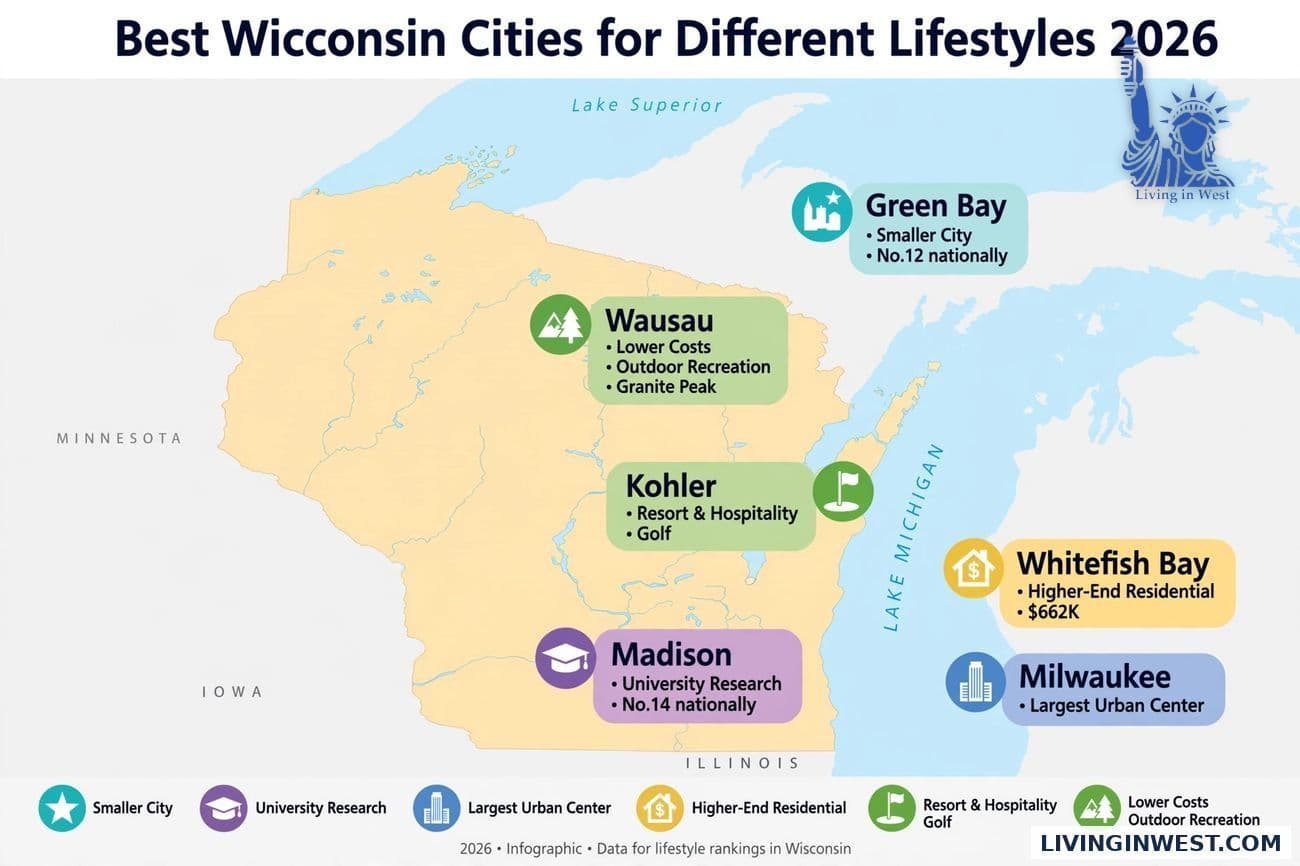
Green Bay ranked No. 12 nationally in the 2025–2026 U.S. News Best Places to Live ranking and was the highest-ranked Wisconsin city in that list.
U.S. News considered quality of life, value, job market and desirability among its factors.
Housing is also relatively lower than in Madison and Whitefish Bay. Zillow's August 2026 typical home value was about $285,361.
Madison — University, Research & Professional Careers
Madison ranked No. 14 nationally in the same U.S. News ranking.
It is Wisconsin's capital and home to the University of Wisconsin–Madison.
The city is particularly relevant for people working in government, education, healthcare, research, technology and professional services.
The trade-off is housing cost: Zillow's August 2026 typical home value was approximately $426,336.
Milwaukee — Largest Urban Center
Milwaukee is Wisconsin's largest city, with a 2025 population estimate of 562,407.
It offers the state's largest urban environment, with a broader range of businesses, healthcare institutions, cultural attractions, restaurants, entertainment and professional opportunities than smaller Wisconsin cities.
For someone who wants a city environment rather than a smaller community, Milwaukee deserves consideration alongside Madison and Green Bay.
Whitefish Bay — Higher-End Residential Market
Whitefish Bay is a Milwaukee-area community where housing values are substantially above the Wisconsin statewide figure.
Its August 2026 typical home value was approximately $662,001.
Kohler — Resort & Hospitality Lifestyle
Kohler is associated with hospitality, golf, design and resort-oriented experiences.
Its July 2026 typical home value was approximately $451,457.
Wausau — Lower Housing Costs & Outdoor Recreation
Wausau offers a lower housing price point than Madison, Kohler or Whitefish Bay.
Its August 2026 typical home value was approximately $250,229.
The area also provides access to outdoor recreation and Granite Peak.
PART 5: Education — Graduation, UW–Madison & Medical Education
Education is another important reason families consider Wisconsin.
However, education statistics should always include the school year or ranking year because national datasets are not updated simultaneously.
Wisconsin High-School Graduation
Wisconsin has historically reported strong high-school graduation outcomes.
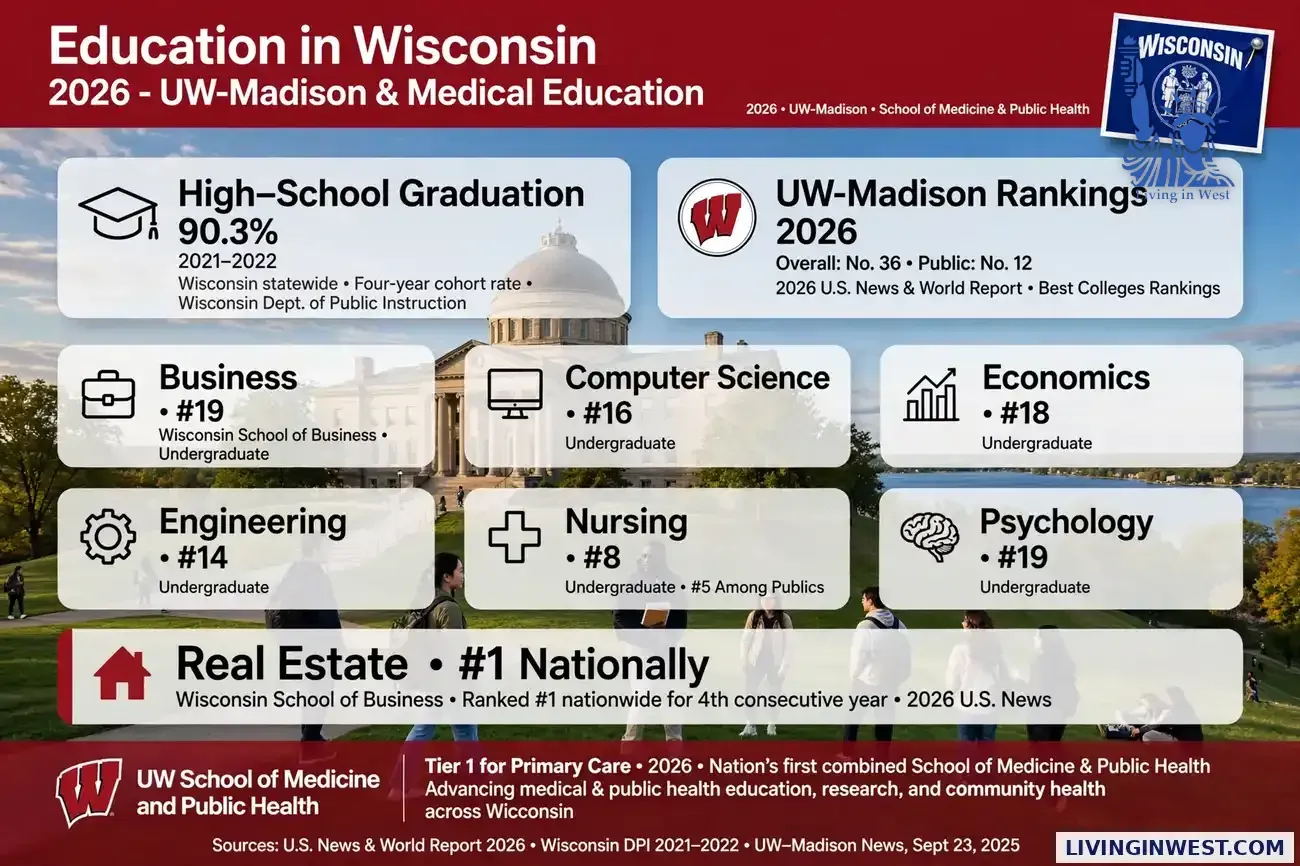
The 90.3% four-year graduation figure used in earlier versions of this article comes from federal data for the 2021–2022 school year, so it should not be presented as a current 2026 graduation rate.
For a 2026 guide, readers should pay attention to the specific school year and methodology attached to any graduation statistic.
This distinction matters because different federal datasets can use different measures, such as Average Freshman Graduation Rate and Adjusted Cohort Graduation Rate.
University of Wisconsin–Madison
The University of Wisconsin–Madison was ranked No. 36 overall and No. 12 among public universities in the 2026 U.S. News Best Colleges rankings.
Its 2026 undergraduate specialty rankings included:
Business: No. 19
Computer Science: No. 16
Economics: No. 18
Engineering: No. 14
Nursing: No. 8
Psychology: No. 19
UW–Madison's undergraduate real estate program ranked No. 1 nationally in the U.S. News specialty rankings.
Medical Education
The UW School of Medicine and Public Health is another important part of Wisconsin's education and healthcare infrastructure.
For anyone considering Wisconsin for education, medicine or research, Madison's combination of a major public university and medical school is particularly relevant.
PART 6: Healthcare — Strong Hospital Quality Performance
Wisconsin's healthcare system should be evaluated using specific measures rather than a single claim that the state has the "best healthcare."
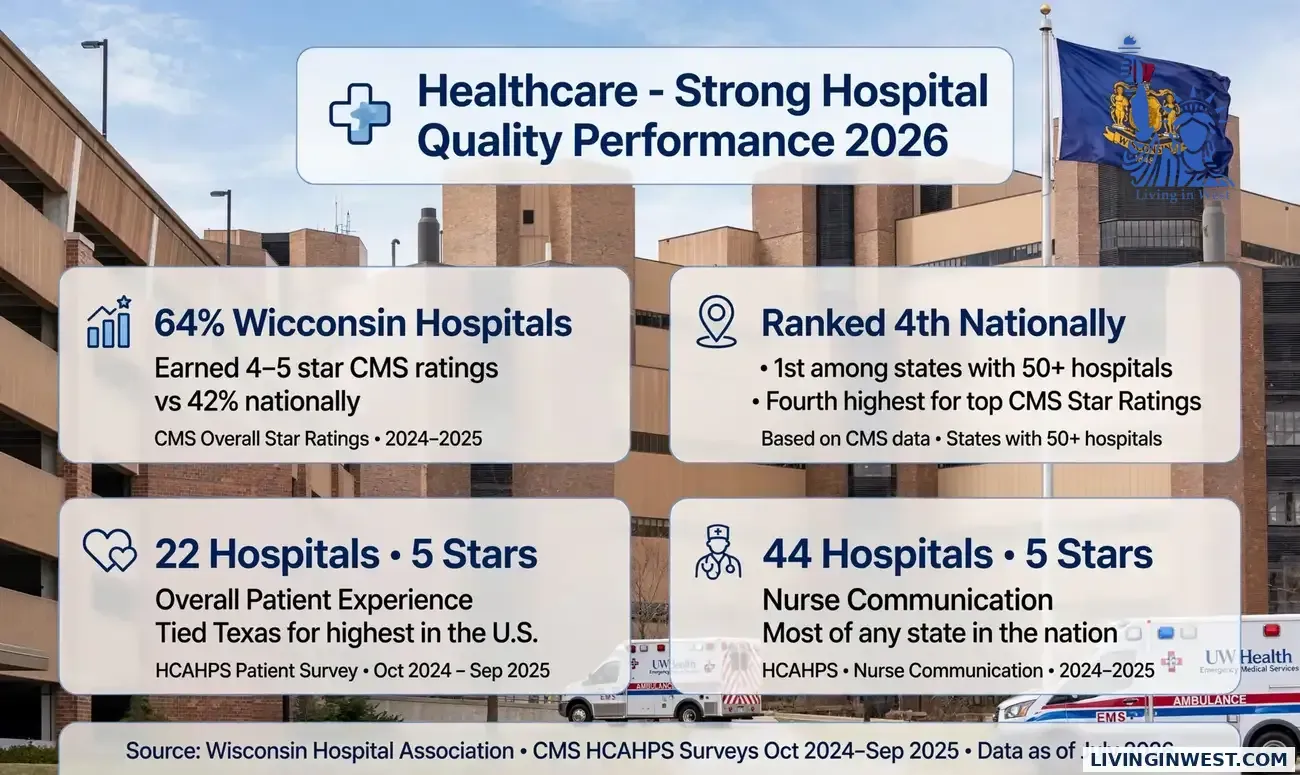
The latest 2026 Wisconsin Hospitals Quality Snapshot reported strong performance in CMS hospital ratings.
According to the Wisconsin Hospital Association, 64% of Wisconsin hospitals earned four- or five-star CMS Overall Hospital Star Ratings, compared with approximately 42% nationally.
Wisconsin ranked fourth nationally overall and first among states with more than 50 hospitals in that comparison.
The CMS Overall Hospital Star Ratings incorporate measures covering mortality, safety of care, readmissions, patient experience and timely/effective care.
Patient Experience
Newer 2026 CMS patient-experience data provide another notable measure.
Wisconsin tied Texas for the highest number of hospitals receiving five stars for overall patient experience, with 22 Wisconsin hospitals receiving five-star ratings in the cited data.
The ratings are based on HCAHPS patient surveys and reflect surveys collected from October 2024 through September 2025.
Wisconsin also had 44 hospitals receiving five stars for nurse communication, the most of any state in the cited CMS-based comparison.
These figures describe hospital quality and patient-experience measurements; they do not mean that every Wisconsin resident has identical access to healthcare.
Healthcare costs, insurance coverage, specialist availability and distance to hospitals can still vary depending on where a person lives.
PART 7: Safety, Family Life & Retirement
Safety is an important part of any relocation decision, but statewide rankings should not be treated as a substitute for checking an individual city or neighborhood.
Wisconsin has received positive rankings in several national quality-of-life studies.
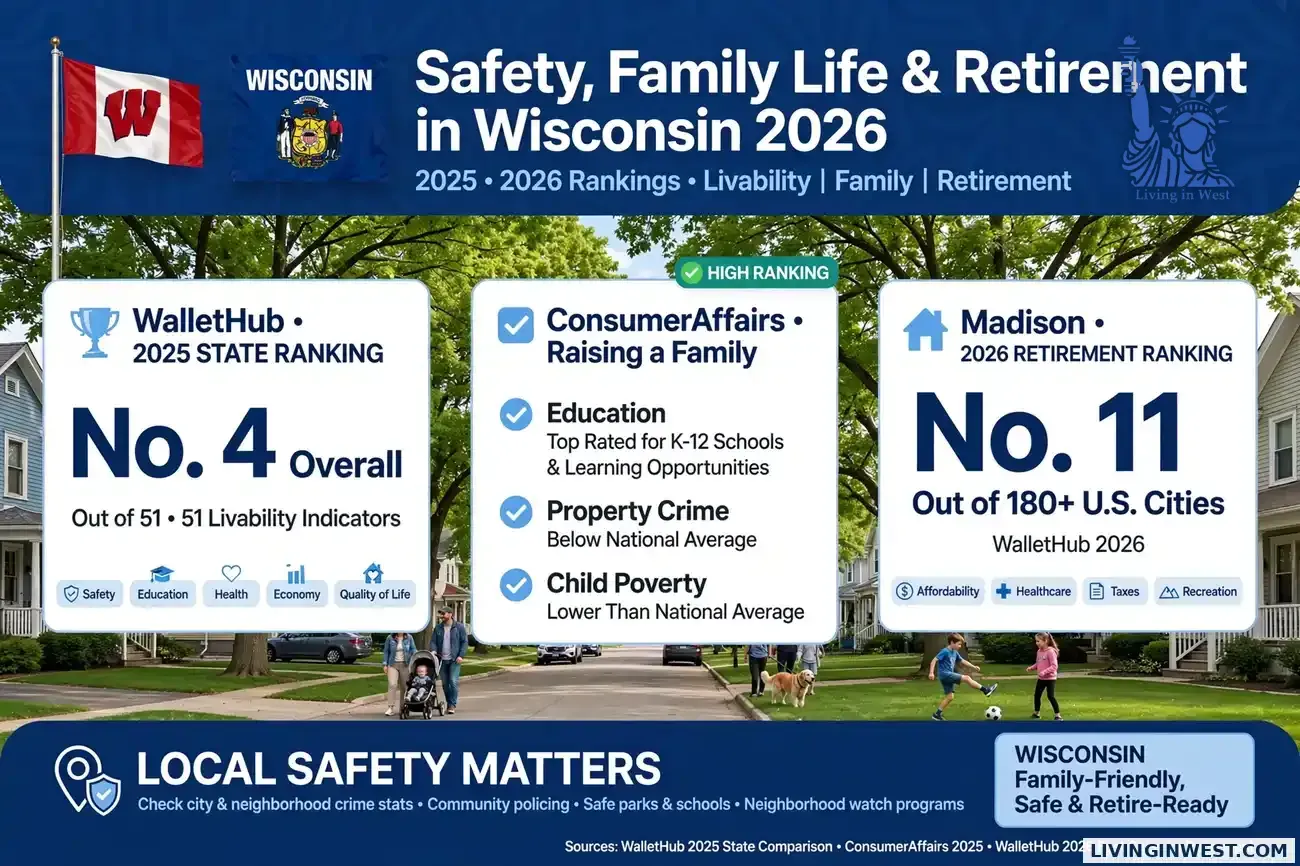
A WalletHub analysis examining 51 livability indicators placed Wisconsin No. 4 overall in its 2025 state comparison. The study also provided separate category rankings for safety, education and health, economy and quality of life.
ConsumerAffairs also placed Wisconsin highly in its comparison of states for raising a family, considering factors such as education, property crime and child poverty.
These are third-party rankings rather than government safety measurements, so their methodology and publication year should always be considered.
Local Safety Matters
Crime conditions can vary substantially between cities and neighborhoods.
Someone considering Green Bay, Madison, Milwaukee, Wausau, Whitefish Bay or another Wisconsin community should check current local crime statistics and neighborhood-level information before choosing a home.
A statewide ranking cannot tell a prospective resident whether one specific street or neighborhood is appropriate for their needs.
Retirement
Madison has also appeared in national retirement-city comparisons.
WalletHub's 2026 comparison of more than 180 U.S. cities placed Madison at No. 11 in its retirement ranking, using factors such as affordability, healthcare, taxes and recreational opportunities.
For retirees, however, actual housing costs, property taxes, healthcare access, climate preferences and proximity to family may matter more than a national ranking.
PART 8: Cost of Living, Taxes, Rentals & Who Wisconsin May Suit
Wisconsin's biggest feature for prospective residents may be the range of choices available within one state.
A person with a higher housing budget can consider communities such as Whitefish Bay or Kohler.
Someone focused on university education, research, government or professional employment may look toward Madison.
A person seeking a smaller-city environment with lower home values can consider Green Bay.
Someone prioritizing lower purchase prices may find Wausau worth investigating.
Buying vs. Renting
The latest Zillow data illustrate the difference between Wisconsin communities.
Green Bay's August 2026 typical home value was approximately $285,361, with average rent around $1,066.
Madison's August 2026 typical home value was approximately $426,336, with average rent around $1,616.
This means renters and buyers should compare the specific city rather than relying on the statewide average.
Taxes Matter
Wisconsin's statewide home-value figure can look moderate compared with expensive U.S. markets, but buyers should account for property taxes.
The latest Tax Foundation comparison places Wisconsin's effective property tax rate on owner-occupied housing at approximately 1.32%.
Wisconsin's individual income-tax rates range from 3.50% to 7.65%, while the state sales-tax rate is 5%.
For a family deciding between buying and renting, the full monthly budget should therefore include housing, property taxes if buying, insurance, utilities, transportation and local taxes.
Winter Weather
Wisconsin also has an important lifestyle trade-off: winter.
Cold temperatures, snow and winter driving are part of normal life across the state.
Someone moving from a warmer climate should consider heating costs, snow removal, winter clothing and commuting conditions when calculating the real cost of living.
Healthcare Access
Wisconsin's hospital quality statistics are strong, but access still depends on location.
Living near Madison or Milwaukee can provide access to larger medical and specialist networks, while residents of smaller or rural communities may have to travel farther for certain services.
Final Takeaway: What Makes Wisconsin Interesting in 2026?
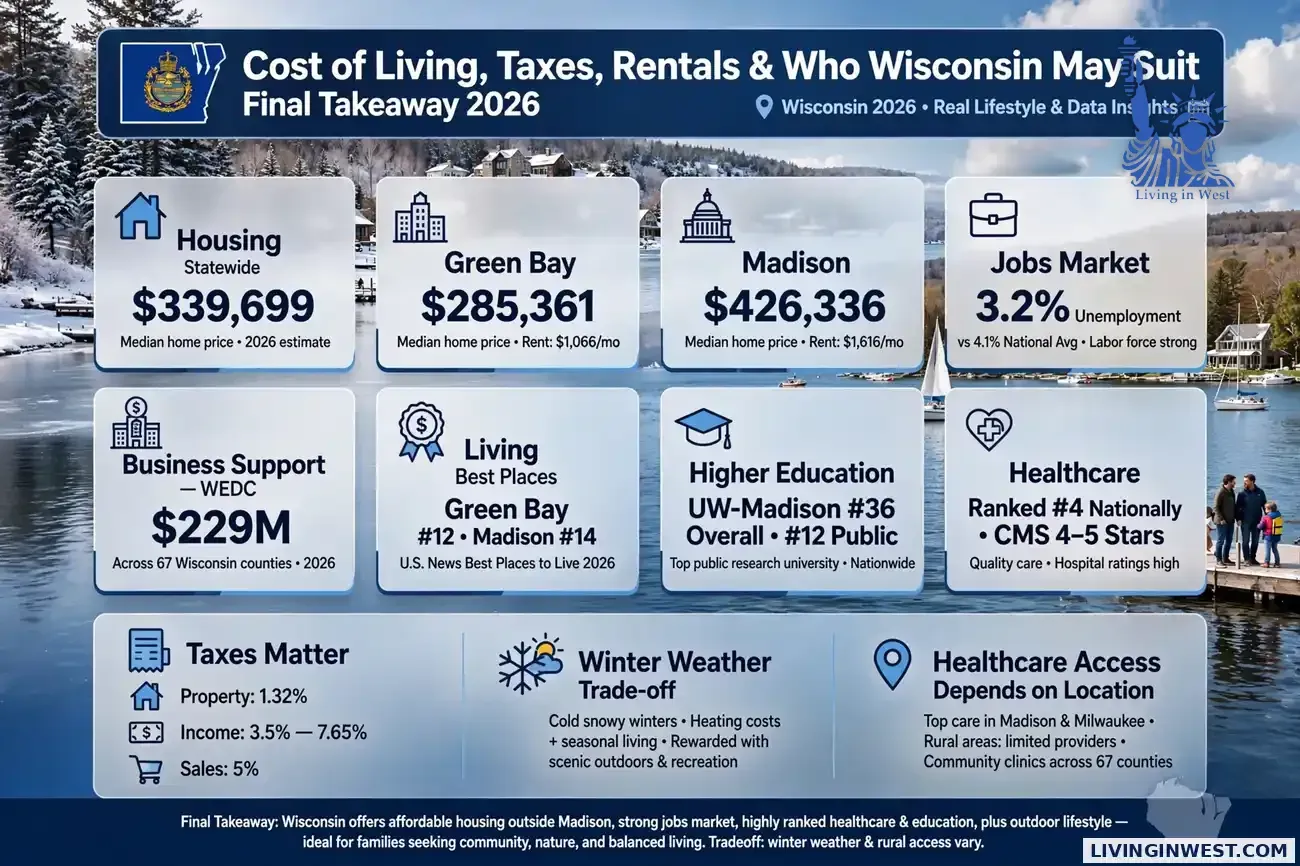
Wisconsin in 2026 offers a broad combination of housing choices, employment opportunities, education, healthcare infrastructure and outdoor recreation.
Housing: Zillow's typical Wisconsin home value was approximately $339,699 as of August 31, 2026.
Green Bay: Typical home value around $285,361 in August 2026, with average rent around $1,066.
Madison: Typical home value around $426,336 in August 2026, with average rent around $1,616.
Jobs: Wisconsin's preliminary August 2026 unemployment rate was 3.2%, below the national 4.1% at the time of release.
Business: WEDC's preliminary FY2026 figures showed $229 million invested across 67 Wisconsin counties, with FY2026 ending June 30, 2026.
Living: Green Bay ranked No. 12 and Madison No. 14 in U.S. News' 2025–2026 Best Places to Live ranking.
Higher Education: UW–Madison ranked No. 36 overall and No. 12 among public universities in the 2026 U.S. News rankings.
Healthcare: Wisconsin ranked fourth nationally for the percentage of hospitals receiving four- or five-star CMS Overall Hospital Star Ratings in the 2026 Wisconsin Hospitals Quality Snapshot.
Lifestyle: Door County, Lake Geneva, Madison and Wisconsin's many lake communities offer combinations of recreation, dining, golf, boating, culture and outdoor activities.
Wisconsin is therefore not simply a "cheap" state or a "luxury" state. Its housing markets range from relatively lower-cost cities such as Wausau and Green Bay to higher-value communities such as Kohler and Whitefish Bay.
For someone considering a move, the most useful approach is to compare the specific city, housing cost, taxes, employment opportunities, schools, healthcare access and lifestyle rather than relying on one statewide ranking.

Editorial Team